






While the winter chill has not yet fully released its grip on the soil and you imagine your prized succulents are resting peacefully in winter dormancy, you may suddenly notice petite, bright purple-flowered weeds emerging across your planters. Known in botanical taxonomy as Lamium amplexicaule (commonly referred to as Henbit or Henbit Deadnettle), this winter annual conceals one of the most aggressive nutrient and moisture thieves of succulent beds behind an innocent, delicate facade. A longstanding native of the Mediterranean basin and Eurasia, its extraordinary cellular machinery enables active photosynthesis even at near-freezing temperatures, easily outcompeting and overshadowing your slow-growing xerophytic specimens.
The most deceptive attribute of this deadnettle is that, despite carrying the moniker 'nettle', it completely lacks stinging trichomes (urticating hairs); it will not sting your skin when handled, yet its dense root network absorbs scarce ambient moisture and free nitrogen like an aggressive subterranean sponge. Furthermore, it functions as an ideal winter reservoir for destructive pests that frequently haunt succulent collections, such as spider mites (Tetranychidae) and mealybugs. In this definitive guide, we will explore the precise botanical keys to identifying and permanently eradicating this weed, which compromises substrate aeration and rapidly colonizes your arid rockeries.
1. Early Diagnostic Signs and Microscopic / Visual Botanical Keys
Distinguishing Lamium amplexicaule from closely related wild labiates—such as Lamium purpureum (Red Deadnettle)—is critical for timely and effective horticultural intervention. The genus Lamium exhibits diagnostic morphological hallmarks characteristic of the mint family (Lamiaceae):
- Quadrangular Stem Architecture: The stem is distinctly square in cross-section rather than cylindrical. Rolling the stem gently between your fingertips reveals four sharp, structural ridges.
- Stem-Clasping (Amplexicaule) Foliage: Here lies the primary morphological characteristic lending the species its specific epithet; the upper leaves lack distinct petioles (leaf stalks). Instead, rounded to kidney-shaped (reniform) leaves with deeply crenate margins directly clasp the stem, forming a collar. In contrast, the basal lower leaves possess elongated petioles.
- Floral Morphology and Cleistogamy: Tubular, two-lipped (bilabiate) corollas measure roughly 1.5 to 2 cm in length, displaying vibrant pinkish-purple hues. In early spring or persistent cold snaps, the plant can produce self-pollinating, unopened 'cleistogamous' flowers, setting viable seed reserves without ever unfolding visible petals.
- Root System Architecture: It develops a shallow yet remarkably dense fibrous root system. These fine web-like roots quickly entangle and strangle the delicate, slow-growing feeder roots of your xerophytic plants.
2. Root Causes and Environmental Triggers of Infestation
The appearance of Henbit within your succulent displays is never accidental. Its seed bank breaks dormancy when soil temperatures decline to roughly 10–15°C (50–59°F) in tandem with late autumn and winter rains. In dry and semi-arid container gardening, Henbit outbreaks are commonly driven by specific cultural oversights:
- Unsterilized Garden Soil and Compost: Incorporating raw, unpasteurized topsoil or open outdoor compost into your succulent mix introduces thousands of viable weed seeds. A single Henbit specimen can disperse up to 2,000 seeds per season, which can remain dormant and fully viable in substrates for 5 to 25 years.
- Excessive Winter Surface Moisture: Top-watering dormant succulents throughout winter or leaving outdoor planters unprotected against persistent winter rain leaves the top layer of substrate continually damp, triggering rapid Lamium seed germination.
- Absence of Coarse Mineral Top-Dressing: Exposing bare peat, coco coir, or organic compost invites windblown seeds to lodge and anchor firmly. Pots that lack a heavy, sharp inorganic mulch layer—such as pumice, crushed lava rock, or zeolite—provide an open nursery for opportunistic annual weeds.

3. Natural and Organic Control Protocols
Given the sensitivity of succulent foliage, CAM metabolism, and shallow root structures to harsh chemicals, natural and manual control methods should always serve as your primary line of defense:
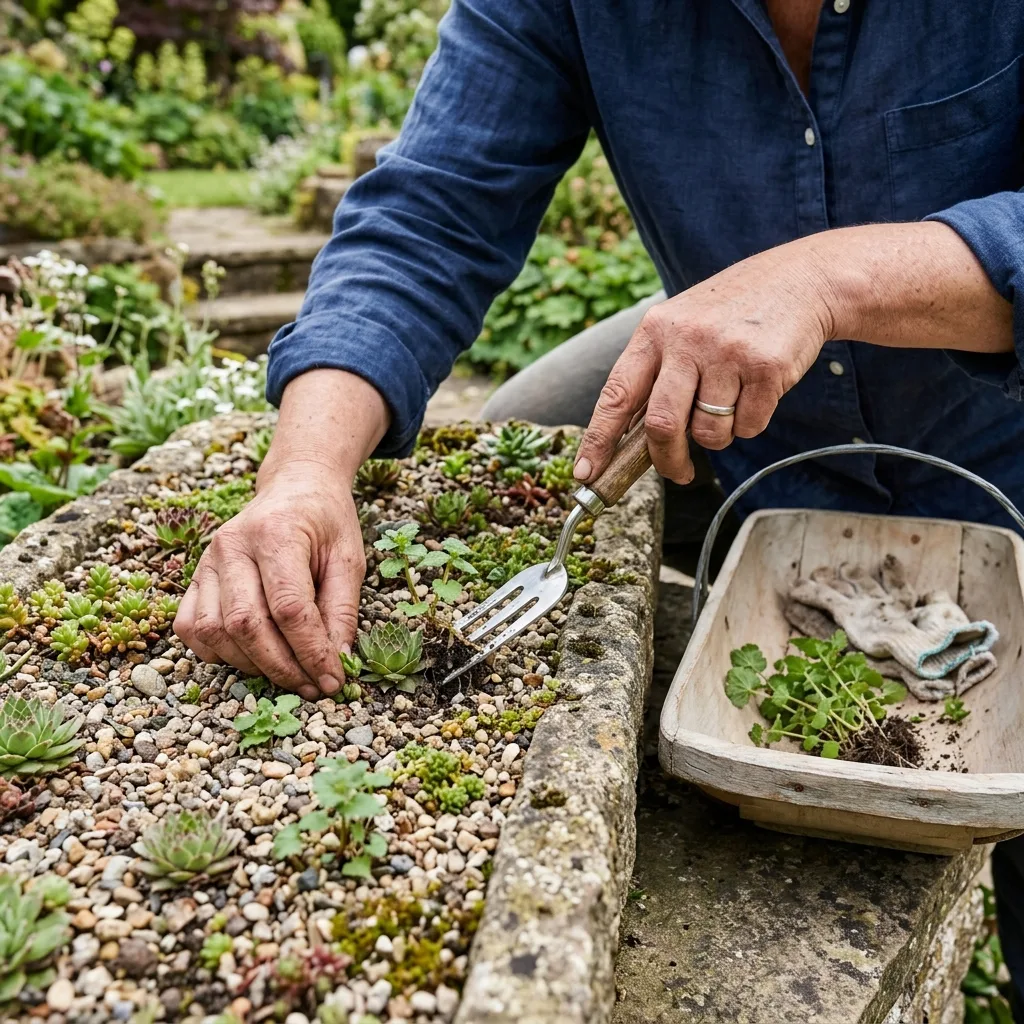
- Early-Stage Manual Extraction: The most dependable organic technique is methodical hand-pulling before the plant opens its purple bilabiate corollas or forms hidden cleistogamous seed pods. When the substrate is slightly damp, slide a narrow root weeding fork or curved precision tweezers down to the lowest crown node and pull steadily upward with even tension. Snapping the stem at soil level will only spur regrowth from the basal meristems.
- Inorganic Mineral Mulch Barrier: Top-dress your cactus and succulent pots with a 2 to 3 cm (approx. 1 inch) deep layer of 3–5 mm angular pumice, zeolite, or porous lava grit. This fast-drying, coarse inorganic mantle cuts off seed contact with moist organic particles, suppressing seedling emergence by over 80%.
- Corn Gluten Meal (Organic Pre-Emergent): For open rockery beds or gravel pathways populated by succulents, application of Corn Gluten Meal acts as a safe organic pre-emergent that inhibits seed radicle formation during germination. Caution: Ensure the powder is applied strictly to the bare mineral surface and does not cake upon succulent rosettes.
4. Chemical and Systemic Herbicide Protocols
In extensive xeriscape displays or severe container infestations where manual extraction is physically impractical, selective active ingredients or ultra-targeted micro-applications may become necessary. Remember that broadleaf herbicides can easily deform or kill fleshy succulent tissues; avoid blanket spray applications entirely and rely strictly on micro-brush spot treatments.
| Active Ingredient | Intended Horticultural Use | Dilution Rate (Per Liter of Water) | Application Frequency |
|---|---|---|---|
| Iron Chelate (Fe-HEDTA) | Selective Organic Contact Herbicide | Follow label specs (approx. 1.5–2% solution) | Every 10–14 days (Direct foliar micro-brushing only) |
| Pelargonic Acid (Saturated Fatty Acid) | Natural Cell-Membrane Disruptor | 20 – 30 ml / L | Single application on a sunny day (Use physical spray shield) |
| Glyphosate (Isopropylamine salt) | Non-Selective Systemic Herbicide (Ultra-targeted) | 10 ml / L (Direct dab on cut weed stem) | Single precise application (Prevents crown resprouting) |
| Prodiamine or Oryzalin | Synthetic Pre-Emergent Barrier | Strictly per manufacturer label (Microgram range) | Apply once in early autumn before seed germination |
When applying any chemical herbicide near succulents, never allow drift to contact the delicate farina (epicuticular wax coating) of your plants. Breaching this waxy bloom causes permanent cellular scarring, tissue collapse, and extreme susceptibility to secondary fungal infections.
5. Quarantine and Sanitation Protocols
Weeds removed from infested pots must never be added to standard garden compost or left near staging benches. Mature Lamium amplexicaule stems can continue to allocate residual vascular sugars to mature and shed viable seeds even after being completely uprooted (post-abscission seed ripening).
- Substrate Sterilization: If you plan to reclaim and reuse contaminated potting media, pasteurize the damp mix in an oven at 80–85°C (175–185°F) for 30 minutes, or seal it inside heavy black plastic bags exposed to intense summer sun for 4 to 6 weeks to exhaust the seed bank.
- Tool Sanitation: Sanitize all tweezers, weeding hooks, and pruners with 70% isopropyl alcohol between working on different pots. This practice eliminates microscopic fungal spores (such as Rhizoctonia) and root-knot nematode cysts from hitchhiking into sterile specimens.
6. Plant Rehabilitation and Post-Removal Care
Once freed from the suffocating competition of Henbit, your succulents may temporarily suffer root disturbance or localized nutrient deficits. Implement the following steps to ensure uninterrupted, vigorous growth:
- Backfilling Root Voids: If extracting the weed's fibrous roots dislodged soil around your succulent's primary root core, immediately backfill the cavity with a bone-dry, free-draining blend containing 50% pumice, 20% lava grit, 15% zeolite, and 15% sifted peat or coarse bark.
- Temporary Moisture Suspension: Manual weed removal invariably causes micro-fissures along delicate succulent feeder roots. To eliminate the risk of opportunistic water molds and vascular wilt (Pythium or Fusarium), withhold irrigation entirely for 5 to 7 days post-weeding, allowing wounded root cells to suberize and develop a protective callus.
- Restorative Nutrient Infusion: When resuming irrigation, apply a gentle, low-nitrogen, high-potassium succulent fertilizer (such as an NPK 5-10-10 formulation) at one-quarter strength. This supports osmotic cellular regulation, restores turgor pressure, and encourages healthy new lateral root growth.


Reader Reviews & Comments 3 Reviews
Marcus Sterling
Chloe Davenport
Eleanor Vance
Leave a Review & Rating
Share your plant care tips, experiences, or questions with our succulent community.