






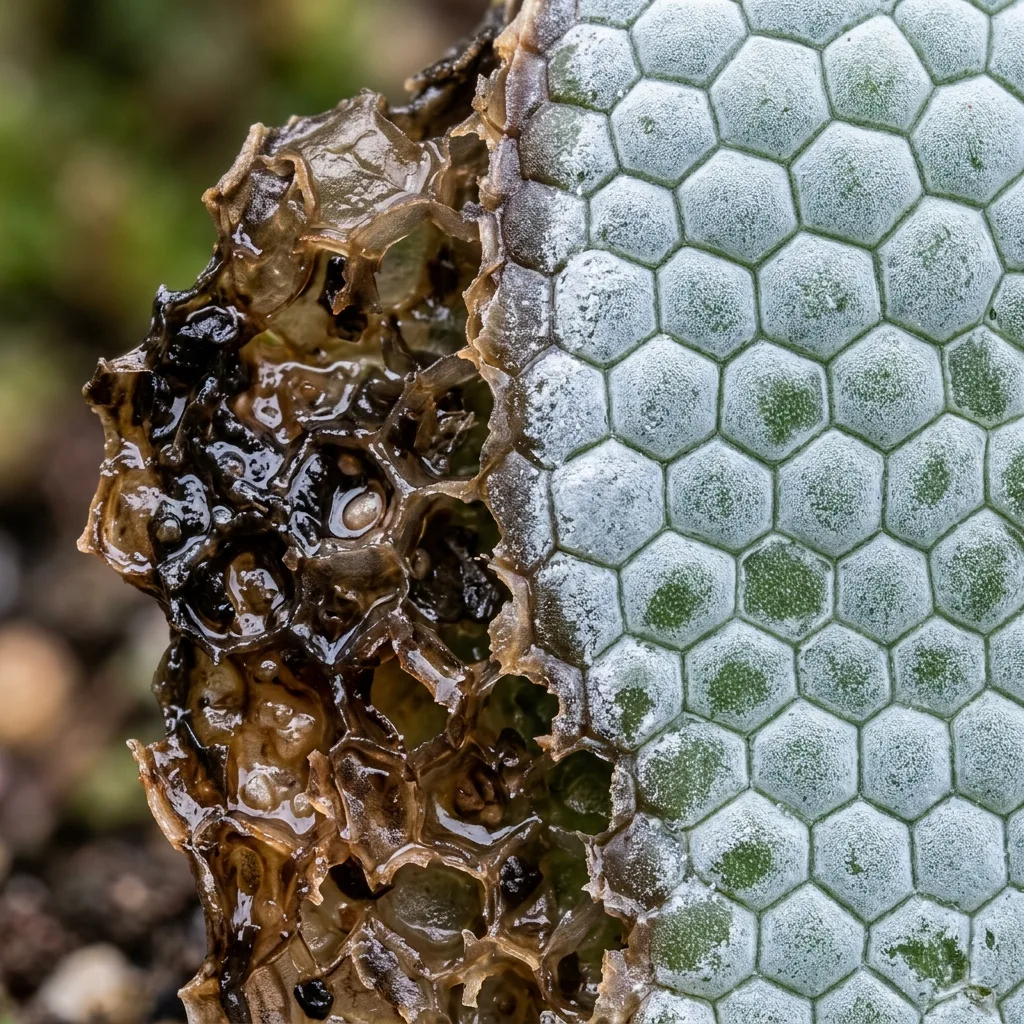
Root and stem rot is arguably the most common and panic-inducing catastrophe succulent enthusiasts encounter. Crisp, vibrant foliage suddenly turning yellow and translucent, leaves dropping at the slightest touch, and a dark discoloration climbing upward from the base of the stem are unmistakable indicators that your succulent is facing a profound biological crisis. While members of the Crassulaceae family evolved miraculous cellular mechanisms to endure prolonged droughts in arid habitats, they remain acutely vulnerable to stagnant moisture within enclosed containers.
Rot is never merely a matter of 'too much water'; it occurs when an anoxic (anaerobic) root environment enables opportunistic fungal pathogens such as Phytophthora, Fusarium, and Pythium species to invade the plant's vascular bundles (xylem and phloem). Fortunately, with early diagnosis and precise surgical intervention, even seemingly doomed specimens can be successfully re-rooted and restored to full vigor.
1. Botanical Identity and Morphological Characteristics
Succulent plants (including genera such as Echeveria, Sedum, Crassula, and Graptopetalum) possess specialized parenchyma storage tissue in their leaves and stems to endure harsh droughts. Cells within this tissue swell with water stored inside large central vacuoles, generating elevated turgor pressure. Furthermore, foliar surfaces are protected by farina (epicuticular wax)—a hydrophobic layer that minimizes water loss via transpiration.
Succulent metabolism relies heavily on Crassulacean Acid Metabolism (CAM) photosynthesis, a process where stomata open at night to capture carbon dioxide and remain sealed during the day to conserve hydration. When rot sets in, intracellular turgor pressure escalates uncontrollably until oversaturated parenchyma cell membranes rupture. Cellular fluids leak into intercellular spaces, giving leaves their telltale 'jelly-like' translucency while fibrous vascular bundles in the stem darken. The earliest anatomical sign of decay is the necrosis of fragile root hairs, quickly followed by the collapse of xylem and phloem vessels, halting internal fluid transport entirely.
2. Light Requirements and Indoor Placement
Light is a paramount restorative tool for a recovering succulent, yet its intensity must be calibrated with surgical care. While an established, healthy succulent thrives under at least 5 to 6 hours of unfiltered direct sunlight, an operated specimen devoid of functional roots will dehydrate rapidly under intense solar radiation.
During the initial two weeks post-surgery, position the plant in bright, indirect filtered light. An east-facing window behind sheer curtains or an unobstructed northeast exposure is ideal. Substandard lighting induces etiolation and weakens defenses, encouraging latent fungal spores, whereas harsh midday sunlight overburdens the stressed CAM photosynthetic machinery and scorches sensitive healing tissues.
3. Watering Discipline: The 'Soak and Dry' Protocol
The single most prevalent cultural mistake leading to succulent mortality is frequent, superficial watering. Succulent root architecture is naturally calibrated to absorb sudden downpours in arid soils followed by extended stretches of complete desiccation. Consequently, indoor cultivation demands strict adherence to the universal 'Soak and Dry' protocol.
Drench the potting substrate thoroughly until excess moisture streams freely through the bottom drainage holes, and empty any accumulation from the drainage tray immediately. Crucially, do not apply water again until the substrate has reached a 0% moisture level throughout its entire depth, not just on the surface layer. Verify complete dryness using a calibrated soil moisture meter or a wooden skewer inserted deep into the root ball. For any specimen undergoing rot rehabilitation, watering must be suspended entirely until new adventitious roots have developed!
4. Ideal Soil Substrate and Pot Selection
Preventing secondary decay in a rehabilitated succulent relies almost entirely on subterranean gas exchange and aeration. Standard peat-based potting mixes or heavy garden loam absorb excessive moisture like a sponge, suffocating root structures. An ideal substrate for succulents must consist predominantly of porous, inorganic aggregates.
| Component | Ratio (%) | Horticultural Function |
|---|---|---|
| Pumice (3-5 mm) | 40% | High internal porosity, provides permanent aeration voids and drainage |
| Lava Rock / Zeolite | 25% | Structural anchorage, trace mineral release, pathogen buffer |
| Coarse Horticultural Perlite | 15% | Lightweight drainage amendment, rapid moisture dissipation |
| Sterile Cactus Peat / Coir | 20% | Minimal organic matrix for baseline moisture and micronutrient buffering |
Regarding containers, unglazed terracotta is unquestionably the gold standard. The porous ceramic walls enable ambient evaporation through the pot itself, dramatically lowering dry-out times. Glazed ceramic and plastic pots seal moisture inward, increasing vulnerability to rot. Generously sized drainage ports at the base are strictly non-negotiable.
5. Step-by-Step Propagation and Surgical Rescue Techniques
Do not hesitate to perform surgical intervention on a decaying succulent; every hour of delay allows fungal hyphae to migrate further up the vascular stem. Here is our step-by-step clinical intervention protocol:
- Unpot the Plant: Carefully extract the succulent from its container. Gently rinse residual soil from the root network under lukewarm running water to inspect the pathological extent clearly.
- Examine Damaged Tissues: Roots that appear black, mushy, and slough off like wet threads denote advanced root rot. A dark, soft, or collapsing stem confirms systemic stem rot.
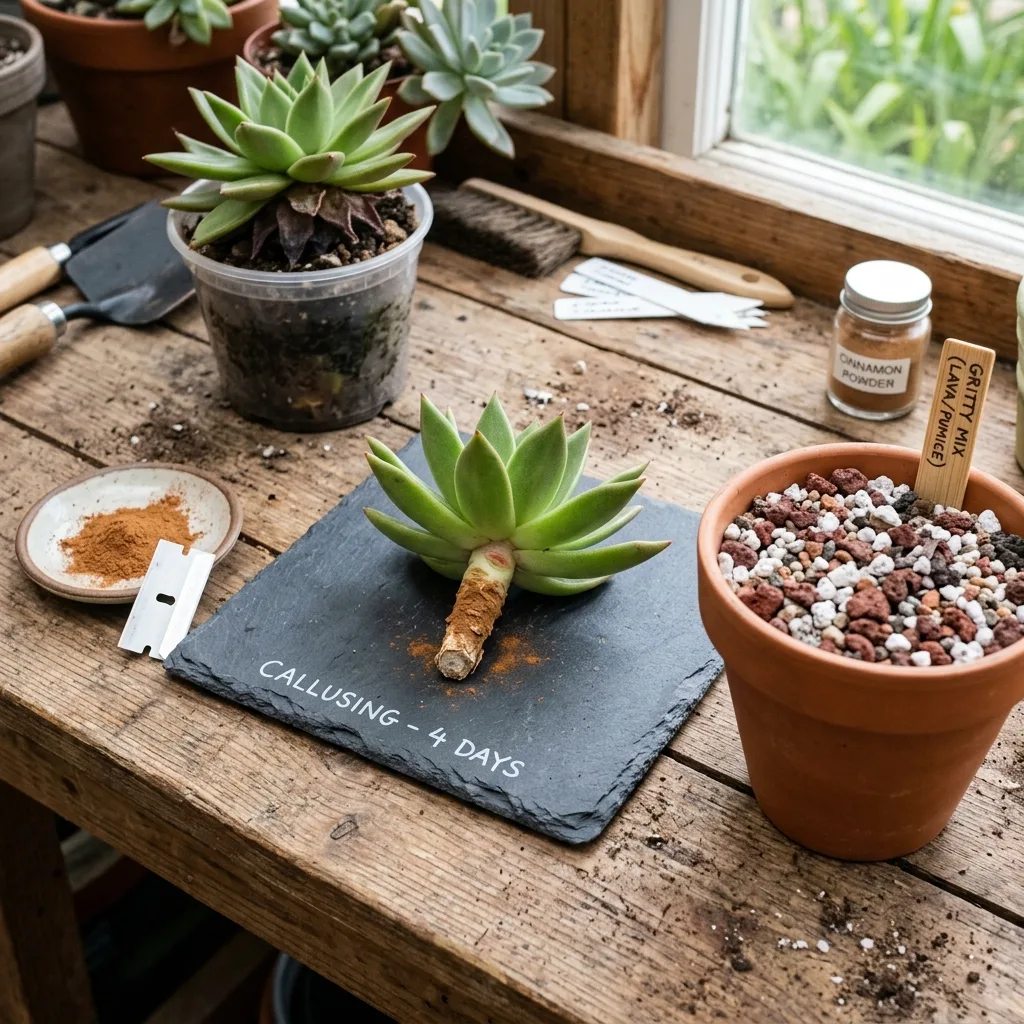
- Perform Surgical Excision: Using an alcohol-sterilized razor blade or surgical scalpel, sever the stem at least 1 to 2 cm above the highest visible margin of discoloration.
- Vascular Inspection: Scrutinize the cut cross-section. If brown or black necrotic specks or rings are visible in the vascular ring, the pathogen remains present. Continue taking progressive 5 mm cross-sectional slices upward until you reach entirely pristine, uniform pale-green or white tissue.
- Wound Dressing and Callus Induction: Dust the exposed cross-section with an antifungal agent, such as organic ground cinnamon or horticultural sulfur powder. Place the cutting in a dry, well-ventilated, shaded environment for 4 to 7 days. This allows the wounded parenchymatous tissue to synthesize a protective, suberized barrier known as a callus.
- Re-rooting the Cutting: Once a firm callus has developed, place the terminal cutting atop completely dry, mineral-based substrate. Do not water it! After 2 to 3 weeks, delicate pink root primordia will emerge from the nodes, at which point you may introduce minimal bottom-watering or light misting around the perimeter.
6. Common Pathogens, Pests, and Treatments
Succulents weakened by rot are prime targets for opportunistic pests. Notably, root mealybugs (Rhizoecus spp.) feed aggressively on subterranean roots, producing mechanical lesions that welcome fungal pathogens. If white, cottony wax deposits are discovered among the roots, it is advisable to excise the compromised root ball entirely or sanitize it thoroughly using a 70% isopropyl alcohol rinse.
Should gray mold (Botrytis cinerea) manifest on fresh cuts, immediately increase air circulation with an oscillating fan. Never mist water directly over foliage that is undergoing rot rehabilitation, as surface moisture spreads fungal spores between vulnerable leaf axils.
7. Seasonal Care Calendar and Expert Protocols
Approximately 80% of rot incidents take place during late autumn and winter, when many succulents enter physiological dormancy. During this phase, CAM photosynthetic rates plummet and the plant's transpiration and water uptake become negligible.
Spring and Summer: Active vegetative growth period. Root generation post-surgery is remarkably rapid (10 to 14 days). Apply the soak-and-dry regimen consistently, allowing full dry-down between waterings.
Autumn: As ambient temperatures decline, extend watering intervals to every 2 to 3 weeks.
Winter: House succulents in a cool (10-15°C / 50-59°F), brightly illuminated location. Water sparingly once a month, or withhold water entirely until the lower leaves exhibit minor wrinkling. Cold, wet soil is an absolute guarantee of fungal infection.


Reader Reviews & Comments 3 Reviews
Eleanor Vance
Marcus Sterling
Clara Higgins
Leave a Review & Rating
Share your plant care tips, experiences, or questions with our succulent community.