






Hailing from the basaltic volcanic cliffs of the Canary Islands and widely admired for its pinwheel-like rosette arrangement, Aeonium haworthii (commonly known as the Pinwheel Succulent) is one of the most distinctive shrub-forming species in the succulent kingdom. Its architectural rosettes feature a mesmerizing spiral symmetry, cartilaginous micro-cilia along the margins, and striking red borders brought out by sunlight. However, maintaining this sculptural beauty depends entirely on what transpires beneath the surface: the intricate balance of gas exchange and hydraulic conductivity within the root rhizosphere.
Contrary to widespread belief, succulent roots are not passive straws designed solely for water absorption; they are living, respiring tissues requiring direct gaseous oxygen (O₂). Cellular respiration, which enables root cells to synthesize ATP (cellular energy), swiftly shifts toward anaerobic fermentation in the absence of oxygen. Compacted, undrained, or fine-textured clay soils create a continuous liquid film after irrigation, completely choking off atmospheric airflow. Deprived of oxygen (hypoxia), root meristems accumulate toxic levels of lactic acid and ethanol within minutes. This cellular acidosis triggers the lysosomal breakdown of root epidermal cells, creating an open gateway for insidious opportunistic pathogens such as Fusarium, Phytophthora, and Pythium.
Operating under Crassulacean Acid Metabolism (CAM), Aeonium haworthii opens its stomata at night to capture carbon dioxide. Yet, if oxygenation within the root zone is compromised, the plant loses its ability to replenish the protective cuticle and epicuticular farina on its foliage, vascular turgor collapses, and the lower leaves of its pinwheel rosettes rapidly discolour and slough off. Ensuring root aeration is the first and most critical biological imperative when cultivating this species.
1. Comparative Analysis of Inorganic Mineral Substrates
The natural habitats of Aeonium species are basaltic lava flows, volcanic tuff outcrops, and wind-scoured rock crevices. Consequently, standard peat-heavy potting soil serves as a virtual death sentence. Substrate engineering must prioritize macro-porosity and strict particle size grading. In an optimal succulent substrate, aggregate size must remain uniformly calibrated between 2 mm and 5 mm.
Pumice: The cornerstone of professional succulent horticulture. This volcanic silicate retains up to 30% of its weight in water within an intricate network of microscopic open and closed pores, yet it never decomposes, contracts, or compacts. Pumice guarantees permanent macropore aeration channels in the root zone. Operating within a neutral pH range (6.5–7.2), it acts as a chemically stable physical buffer.
Lava Rock (Scoria): Characterized by sharp, angular edges and high concentrations of iron and magnesium, this dense volcanic rock provides necessary ballast. Its substantial weight anchors the woody, top-heavy branching stems of mature Aeonium haworthii specimens, preventing pot tipping while offering micro-fissured surfaces for fine root hairs to grip securely.
Zeolite (Clinoptilolite): A microporous aluminosilicate lattice mineral offering exceptional Cation Exchange Capacity (CEC). Zeolite traps surplus potassium, calcium, and ammonium ions, shielding tender roots from fertilizer burn before releasing these nutrients systematically as needed by the plant. Additionally, its molecular sieve structure adsorbs toxic metabolic gases within the rhizosphere.
Calcined Clay vs. Perlite: Calcined clay (such as hard-fired Akadama or montmorillonite) retains moisture while preserving structural integrity over prolonged cycles, providing visual feedback on subterranean hydration. Conversely, perlite is ultralight, sterile, and economical, but it suffers from severe flotation during bottom or top watering and crumbles into fine, air-blocking dust over time. For structural, semi-woody species like Aeonium haworthii, pumice and zeolite are far superior choices.
2. Organic Matter Balance: Peat Moss, Coco Peat, and Compost Hazards
While inorganic aggregates establish the necessary void space for oxygen, a controlled organic fraction is necessary to supply moisture retention and nutrient exchange. However, the origin and decomposition stage of the organic matter must be strictly regulated:
Sphagnum Peat Moss: Fibrous, sterile, and naturally acidic (pH 3.5–4.5), peat moss must be stabilized with agricultural lime to a target pH of 6.0–6.5 prior to succulent integration. Its primary liability is extreme hydrophobicity: once thoroughly dry, it repels water aggressively, causing irrigation to channel around the root ball and out through the drainage holes without rehydrating the root core.
Coco Peat (Coconut Coir): Sourced from processed coconut husks, coir resists hydrophobicity far better than peat and rehydrates effortlessly after dry periods. Nevertheless, lower-grade coir often harbors high concentrations of sodium chloride; hence, only washed, buffered, low-EC (electrical conductivity) grades should ever be introduced into your mix.
The Perils of Garden Compost and Worm Castings: Unsterilized compost introduces pathogenic fungal spores, root nematodes, and fungus gnat larvae (Bradysia spp.). Furthermore, unrefined organic compost rapidly breaks down into fine silt that clogs aggregate pores. Sifted, pure worm castings should be restricted to a maximum of 5% of total substrate volume, functioning purely as an organic mycorrhizal inoculant.

3. Customized Substrate Formulations Across Species and Climates
Transpiration rates, cuticle thickness, and root architecture vary significantly across succulent genera. For instance, while Aeonium haworthii follows a winter-active, summer-dormant growth cycle, genera like Echeveria thrive during summer warmth. The following matrix illustrates field-tested mineral-to-organic ratios across diverse environmental conditions:
| Plant Group / Species | Inorganic Aggregate (% Vol) | Organic Fraction (% Vol) | Recommended Granular Components | Target Substrate Dry-Out Time |
|---|---|---|---|---|
| Aeonium haworthii (Pinwheel) | 70% | 30% | 40% Pumice, 20% Scoria/Lava, 10% Zeolite + 25% Coarse Peat, 5% Worm Castings | 3 - 4 Days |
| Haworthia fasciata / cooperi | 80% | 20% | 50% Pumice, 20% Hard Akadama, 10% Calcined Clay + 20% Coarse Coco Coir | 2 - 3 Days |
| Echeveria & Graptopetalum | 65% | 35% | 45% Pumice, 10% Lava, 10% Perlite + 35% Neutralized Sphagnum Peat | 3 - 5 Days |
| Desert Cacti (Echinocactus, etc.) | 85% | 15% | 40% Pumice, 30% Lava, 15% Quartz Grit (2-4mm) + 15% Sifted Peat | 1 - 2 Days |
| Lithops & Mesembs (Extreme Succulents) | 90% - 95% | 5% - 10% | 50% Pumice (1-3mm), 30% Lava, 15% Zeolite + 5% Aged Leaf Mold | 24 - 48 Hours |
4. Pot Dynamics: Terracotta, Glazed Ceramics, and Plastic
Even the most meticulously engineered substrate will fail if the container does not facilitate proper hydraulic equilibrium. Container walls play an active role in root-zone gas diffusion and thermal regulation:
Terracotta (Unglazed Earthenware): Fired clay is inherently porous and filled with micro-capillary voids. The walls absorb water from the substrate and transpire it outwards through evaporative cooling. This mechanism lowers root temperatures under intense sun and supplies continuous oxygen directly to the root perimeter. Terracotta is undeniably the gold standard for Aeonium haworthii, though it requires slightly more frequent irrigation during peak growth.
Unglazed Ceramic and Heavy Stoneware: Similar to terracotta in breathability, these thick-walled pots offer exceptional thermal insulation against sudden ambient temperature swings. Their physical mass is invaluable for anchoring taller, mature branching rosettes that would otherwise capsize in lightweight vessels.
Plastic and Glazed Containers: These materials are completely non-porous. Water loss can occur solely through surface evaporation and bottom drainage holes. If utilizing plastic or glazed pots, raise the inorganic mineral fraction to at least 80% and extend your watering intervals. Clear glass containers or vessels without drainage holes will inevitably cause hypoxic root collapse.
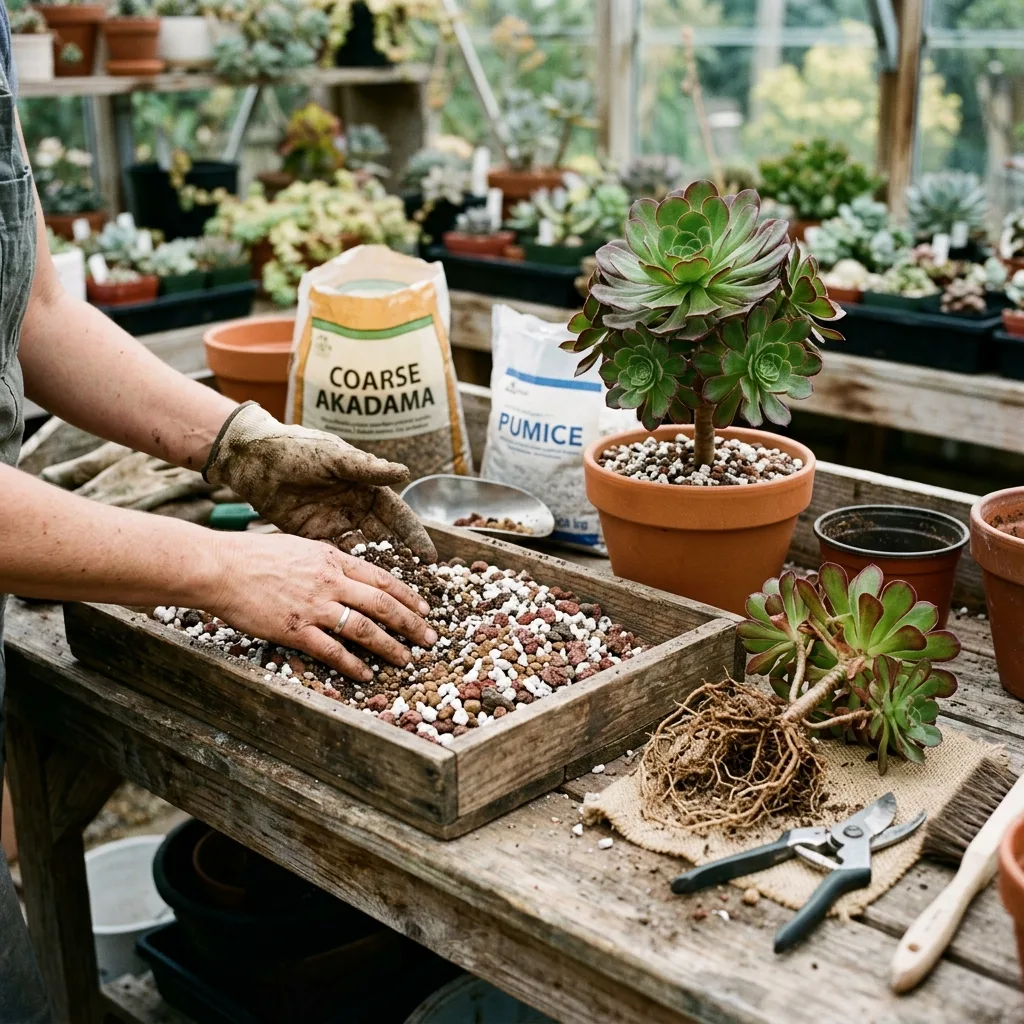
5. Step-by-Step Repotting and Root Pruning Protocol
The optimal window for repotting Aeonium haworthii occurs when the plant breaks summer dormancy and actively pushes fresh central growth—typically early autumn (September–October) or late winter (February–March). Never disturb or repot this species during the height of its summer dormancy.
- Withhold Moisture: Stop all irrigation 5 to 7 days prior to repotting. A thoroughly dry substrate allows root fibers to separate cleanly without tearing from the container walls.
- Substrate Depletion & Root Unraveling: Gently squeeze the pot edges and extract the plant while supporting the base of the main woody trunk. Using a smooth wooden chopstick, carefully tease away the depleted, compacted nursery mix until the central root flare is exposed to fresh air.
- Surgical Root Pruning: Using razor-sharp, sterilized shears, prune away hollow, dry, brown, or girdling root fibers. Trimming back roughly one-third of the fibrous root system while leaving primary anchor roots intact triggers the formation of new, highly efficient capillary feeder roots.
- Positioning in the New Container: Choose a container that measures no more than 2–3 cm wider than the loosened root mass. Cover the drainage hole with mesh, lay down a 2 cm base layer of coarse pumice, and seat the plant so the rosette collar rests roughly 1 cm below the pot rim. Fill around the root system with your granular blend. Avoid compressing the mix with your fingers; simply tap the sides of the pot lightly against your work surface to settle the particles naturally.
6. Post-Repotting Management: The 'Keep Dry' Principle
Unlike standard tropical foliage plants, succulents must NEVER be watered immediately following a repot. Root manipulation and pruning unavoidably inflict microscopic tears across root tissues. Submerging these open cellular wounds into wet substrate provides an open invitation for opportunistic soil pathogens.
Position the newly repotted specimen in bright, indirect light with excellent ambient airflow. Withhold all water for a strict minimum of 5 to 7 days. During this critical recovery window, open root tips undergo suberization—depositing a protective cork-like layer of suberin that seals wounds against pathogen penetration. Initiate the first irrigation lightly from below, reserving a full, deep drench for the subsequent watering cycle once active growth is visually confirmed.


Reader Reviews & Comments 3 Reviews
Julian Vance
Marcus Finch
Clara Sterling
Leave a Review & Rating
Share your plant care tips, experiences, or questions with our succulent community.