






Clinging to the sheer rocky escarpments and granite outcrops of Kenya and Tanzania under the blazing East African sun, Kleinia petraea (historically classified as Senecio jacobsenii) graces modern indoor collections with cascading tapestries of fleshy, emerald-green foliage. Popularly known among plant lovers as 'Trailing Jade' or 'Weeping Jade' due to its flattened, coin-like succulent leaves, this fascinating species shares no direct genetic lineage with Crassula ovata, yet it has evolved an astonishingly convergent cellular water-storage architecture. However, when deprived of the whistling winds, rapid evaporation, and razor-sharp drainage characteristic of native African cliffs, internal cellular vacuoles rupture and suffocating fungal colonies inevitably invade the root zone.
Treasured by succulent collectors under colloquial names like trailing jade succulent or weeping senecio, this striking plant conceals an acute vulnerability beneath its robust exterior: an extreme intolerance to root hypoxia. The agonizing sight of foliage turning dull and wrinkled, nodal stems collapsing into mushy brown lesions, and subterranean fungal pathogens such as Fusarium or Pythium creeping upward is all too frequently met with a fatal caretaker error: the assumption that the plant 'just needs a sip of water.' Repeated watering is never an act of affection; in compacted soil, it is an accidental drowning of the root system.
If your Trailing Jade's luminous leaves are turning translucent and jelly-like, or its trailing stems detach at the slightest brush, do not lose heart. By re-establishing xylem flow, neutralizing aggressive fungal spores, and applying sterile horticultural surgery to rescue viable tissue, this clinical master protocol will guide you through resuscitating your prized Kleinia petraea.
1. Early Diagnostic Symptoms and Microscopic / Visual Markers
Under healthy conditions, the leaves of Kleinia petraea are plump, turgid, overlapping, and protected by a smooth, protective epidermal cuticle. When systemic stress or cellular decay takes root, the plant exhibits specific morphological indicators:
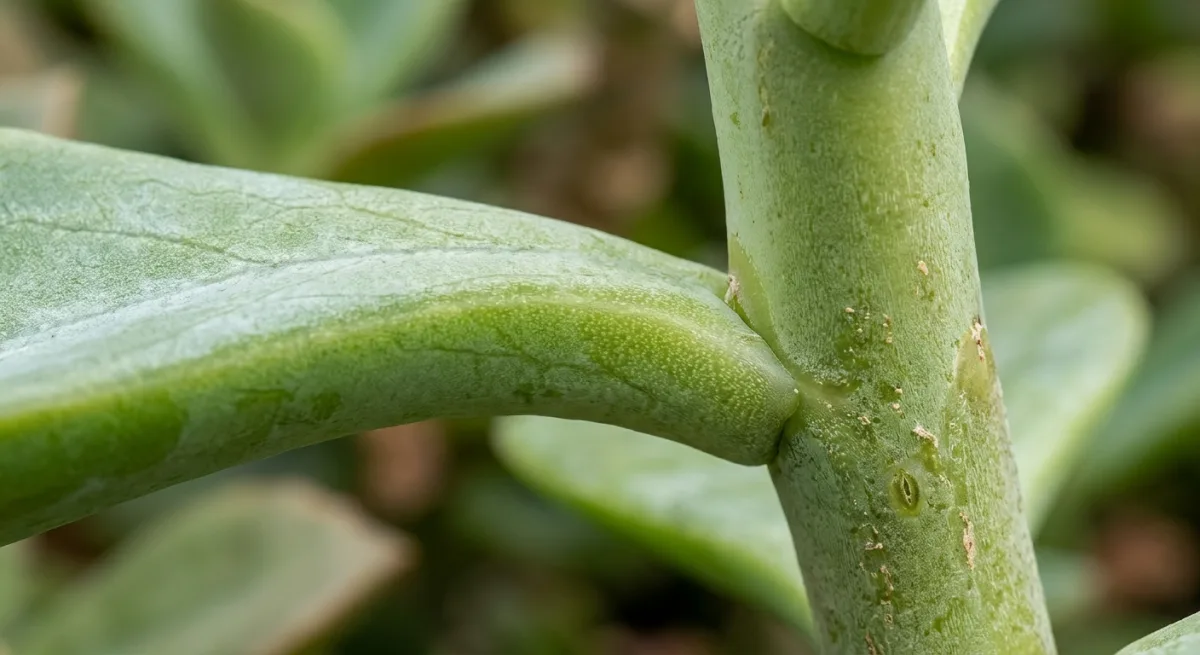
- Vacuolar Degeneration and Vitrification (Oedema): When roots continuously force water into intercellular spaces under hydraulic pressure, leaf cells stretch past their elastic limit and burst. The foliage shifts from a vibrant, opaque emerald into a glassy, yellowish, translucent gel that collapses under minimal finger pressure.
- Basal Stem Necrosis (Collar Rot): The main trailing stems right at the soil line develop dark brown to charcoal-black lesions. Because the vascular bundles (xylem and phloem) become occluded with necrotic tissue, moisture can no longer ascend, causing the upper stems to paradoxically shrivel as if severely dehydrated.
- Spontaneous Foliar Abscission: When untouched or gently shifted, fully green, intact leaves pop off the stem at the petiole attachment point. This sudden drop is driven by the internal synthesis of ethylene gas—an emergency hormonal response to root asphyxiation.
- Root Epidermal Breakdown: Instead of resilient, cream-white feeder roots, unpotting reveals foul-smelling, black, thread-like fibers that slough off effortlessly when squeezed in wet substrate.
2. Root Causes and Environmental Triggers
The microbial culprits orchestrating root destruction in Kleinia petraea are primarily oomycetes and fungal pathogens including Pythium ultimum, Phytophthora cactorum, and Fusarium oxysporum. While these organisms remain dormant as resting spores even in retail potting soils, specific microclimatic mistakes wake them from their slumber:
- Substrate Asphyxiation: Standard, peat-heavy houseplant potting mixes behave like dense sponges indoors. Lacking coarse aggregates like coarse pumice or perlite, the pore spaces remain saturated with water; deprived of gas exchange, the roots turn anaerobic, cellular respiration halts, and opportunistic fungi invade the necrotic tissue.
- Suboptimal Light and Stalled CAM Photosynthesis: Operating via Crassulacean Acid Metabolism (CAM), Kleinia petraea opens its stomata at night to sequester carbon dioxide, processing it through photosynthetic energy pathways during high-intensity daytime light. In dim indoor corners, cellular metabolism stalls, transpirational pull drops to near zero, and standing soil moisture rapidly rots the dormant root zone.
- Cachepots and Hanging Baskets Without Drainage: Displaying trailing specimens in sealed ceramic hanging planters or leaving run-off water pooling in drip trays turns the bottom root layer into a stagnant, oxygen-starved swamp.
- Thermal Drops with Saturated Substrate: When ambient temperatures fall below 54°F (12°C) while the root ball is damp, the plant's metabolic defenses plummet, rendering the cellular membranes vulnerable to cold-induced chilling injury combined with rapid fungal colonization.
3. Natural and Organic Mitigation Methods
If the infection is caught during its initial phases before vascular discoloration climbs up the primary trailing vines, organic and biological interventions can successfully rehabilitate the tissue:
- Substrate Aeration and Ceylon Cinnamon Antiseptic: After thoroughly trimming away discolored, limp root strings, dust all exposed cuts with fresh, finely ground pure Ceylon cinnamon (Cinnamomum verum). Cinnamon naturally contains cinnamaldehyde, a potent organic antifungal compound that suppresses spore germination and encourages rapid suberization (protective callus formation).
- Horticultural Activated Charcoal: Incorporating 5% granular activated horticultural charcoal into the potting substrate actively adsorbs phytotoxic organic residues, anaerobic fermentation byproducts, and foul-smelling fungal volatile compounds.
- Hydrogen Peroxide Root Cleansing Bath: Prepare an oxygenating drench by diluting two tablespoons (30 ml) of standard 3% pharmaceutical hydrogen peroxide into one quart (approx. 1 liter) of distilled water. Swishing the cleaned root mass in this solution releases free oxygen radicals that oxidize anaerobic fungal cell walls on contact while infusing suffocated root tissues with vital oxygen.
4. Chemical and Systemic Fungicide Protocol
Once fungal hyphae penetrate the inner vascular bundles of the trailing stems, natural remedies cannot halt the systemic march of decay. Halting systemic collapse requires targeted, curative fungicides. Adhere to the following clinical protocol:
| Active Ingredient | Target Pathogen | Dosage (Per 1 Liter Water) | Frequency | Application Method |
|---|---|---|---|---|
| Propamocarb Hydrochloride | Pythium & Phytophthora (Root & Collar Rot) | 2.5 ml | Twice, spaced 10–12 days apart | Substrate drench & root submersion |
| Fosetyl-Aluminium | Vascular Blight & Systemic Dieback | 2.0 g | Twice, spaced 14 days apart | Systemic foliar and vine spray |
| Azoxystrobin + Difenoconazole | Fusarium, Stem Lesions, Anthracnose | 0.75 ml | Single or double dose, 15 days apart | Fine atomized mist over green tissue |
Always execute chemical treatments outdoors or in an isolated, well-ventilated space away from direct, scorching sunlight (preferably in the early evening to prevent phototoxic foliar burn).
5. Quarantine and Disinfection Protocol
Upon confirming fungal infection in your Kleinia petraea, immediate biocontainment measures must be initiated to protect the rest of your succulent collection:
- Physical Spatial Isolation: Move the plant at least six feet away from any neighboring plants into a bright, warm room with steady, gentle air movement. Avoid positioning fans to blast directly against the foliage, as high-velocity drafts can disperse microscopic fungal conidia across the room.
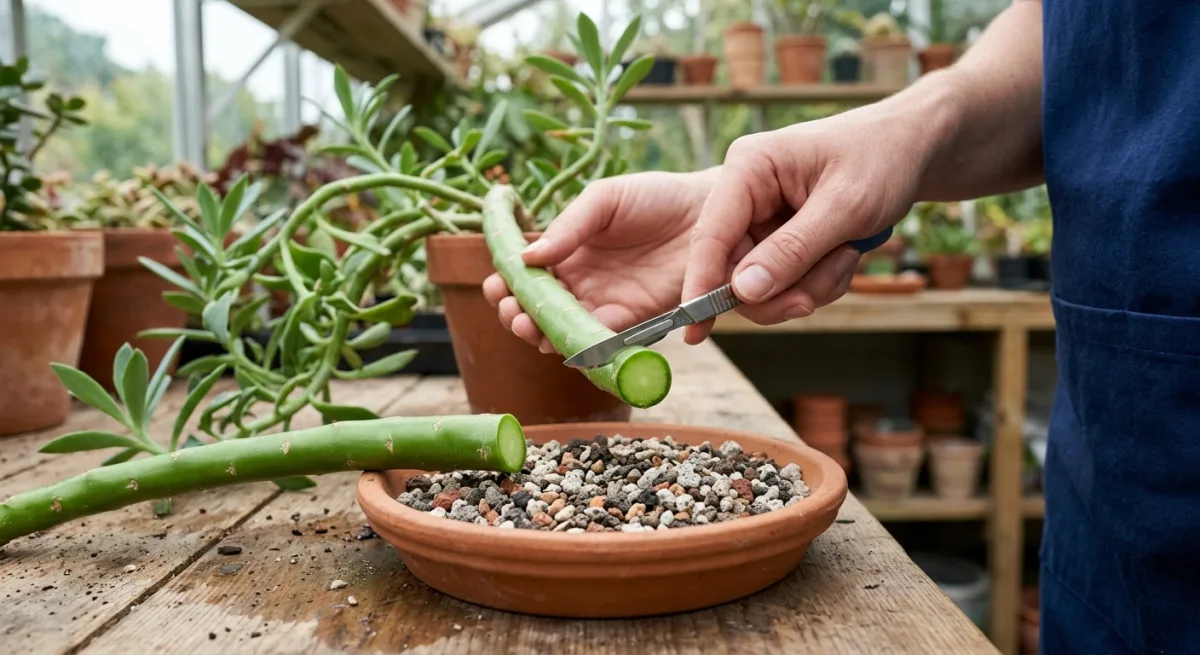
- Surgical Implement Sterilization: Between every single cut, dip or wipe pruning shears, craft knives, or razor blades with 70% isopropyl alcohol, or run the blade through an open flame. Never slice from diseased, darkened tissue into healthy tissue with an unsterilized blade.
- Substrate Disposal & Pot Sanitization: Discard all contaminated growing media into household trash; never add diseased succulent soil to outdoor compost piles. If salvaging the decorative container, soak it in a 1:9 household bleach-to-water solution for a full 24 hours, followed by vigorous scrub rinsing.
6. Plant Rehabilitation and Post-Surgical Recovery
When the original root system has suffered comprehensive necrosis, stem propagation via salvage surgery remains the most dependable technique for resurrecting Kleinia petraea. Follow this precise step-by-step restoration routine:
- Surgical Resection: Sever the trailing stems at least one inch (2.5 cm) above the highest visible point of discoloration. Inspect the cross-section carefully: if any brown, black, or discolored rings appear inside the vascular ring, make another cut higher up until the internal tissue is completely uniform, pale green, and crisp.
- Callus Formation: Never insert freshly severed cuttings directly into potting mix. Lay the cuttings horizontally on dry paper towels in a shaded, warm, well-ventilated space for 4 to 7 days. Allow the cut ends to form a tough, silvery, corky callous that completely seals off entry pathways for soil pathogens.
- Pure Mineral Substrate Formulation: Eliminate peat-heavy soils during recovery. Prepare a high-porosity mineral substrate consisting of: 40% coarse horticultural pumice (3–5 mm), 20% zeolite, 20% crushed volcanic lava rock, and no more than 20% well-screened organic compost or fine coconut coir.
- Dry Planting & Light Adaptation: Insert the callused stem ends approximately 1 inch into the bone-dry mineral mix. Do not provide a single drop of water for the first 10 days. Position the container where it receives abundant, bright indirect daylight (filtered through a sheer curtain) at temperatures between 68°F and 75°F (20°C–24°C).
- Root Primordia Hydration: After 10 days, lightly mist the surface of the gravel around the base of the stem (not directly on the stem or leaves) once a week. Within 3 to 4 weeks, adventitious root primordia will push down into the gritty substrate, anchoring your Trailing Jade firmly for a complete revival.


Reader Reviews & Comments 4 Reviews
Eleanor Vance
Marcus Holloway
Clara Higgins
Julian Miller
Leave a Review & Rating
Share your plant care tips, experiences, or questions with our succulent community.