






Look upward at the sheer, dizzying gypsum cliffs of the Sierra Madre Oriental canyons in Nuevo León, Mexico, and you will witness living sculptures anchored tenaciously to hairline fissures in bare rock. Introduced to the botanical community in the early 1990s by field botanist George S. Hinton, the rare Gypsum Geophyte Cactus (Aztekium hintonii) stands as a crown jewel among succulent and cactus collectors worldwide. Renowned for its glacial growth rate and breathtakingly intricate rib morphology, this species is simultaneously an endurance trial for the patient grower and a masterwork of natural bioengineering.
Prized across the rare succulent community, this singular species captures admiration with deeply furrowed stems reminiscent of ancient Mesoamerican stepped pyramids. In its harsh native ecosystem, it dwells exclusively on vertical gypsum karst formations, surviving in mineral crevices devoid of typical organic matter. This extreme evolutionary adaptation makes it exquisitely specialized—and unforgiving of common indoor cultivation errors when introduced to our living rooms, windowsills, or greenhouse collections.
Nurturing this gem successfully over decades requires a deep appreciation of its natural physiological rhythm. Frequent watering is never an expression of plant affection; rather, it starves the root zone of oxygen and invites fatal fungal colonization. For Aztekium hintonii, this principle is the golden rule. In this comprehensive guide, we translate the howling winds, blinding light, and pure mineral ecology of Mexico’s canyons into actionable indoor cultivation secrets.
1. Botanical Profile and Morphological Adaptations
Aztekium hintonii belongs to one of the most geographically restricted and fascinating genera within the Cactaceae family. It is notably larger than its solitary counterpart, Aztekium ritteri. At full maturity, individual solitary stems can attain diameters of 10 to 15 cm and heights of 15 to 20 cm. However, attaining such proportions in natural or indoor settings can take several decades—frequently spanning half a century or more.
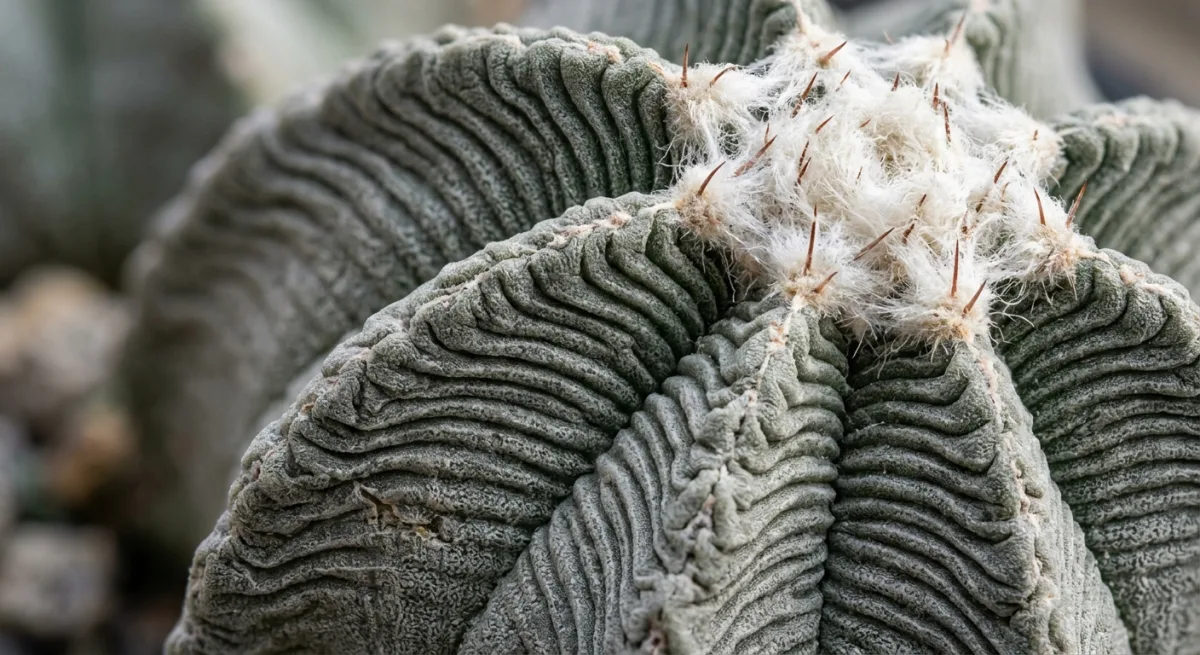
The epidermis displays an elegant palette shifting from grayish-green to glaucous matte blue-green. Its most mesmerizing structural attribute consists of 10 to 15 primary vertical ribs divided by acute sinuses, overlaid with countless fine, horizontal ripples or secondary transverse folds across the lateral rib walls. This accordion-like pleating allows the plant to expand safely when moisture arrives and shrink tightly into its subterranean taproot during extreme drought. Areoles along the rib margins are adorned with thick grayish-white lanose felt, bearing fragile, recurved spines on juvenile tissue that frequently shed as the stem matures.
Upon reaching maturity, vibrant magenta to bright pink blooms measuring 1.5 to 3 cm across emerge from the woolly apical center. These delicate diurnal blossoms unfold primarily during the brightest, warmest days of midsummer, lasting a brief few days to attract desert pollinators.
2. Sunlight Requirements and Indoor Placement
In the canyons of Nuevo León, Aztekium hintonii predominantly clings to vertical north- and east-facing cliff crevices. This unique niche shields the plant from the fiercest midday desert thermal peaks while bathing it in uninterrupted, high-intensity ambient alpine illumination.
For indoor growing, position your specimen where it receives copious filtered morning sunlight, such as an unobstructed eastern window, or behind sheer curtains on a bright southern exposure. Direct, stagnant midsummer sun behind unventilated window glass can cause irreversible bronze-brown dermal scorching on the epidermis. Conversely, insufficient light triggers etiolation, forcing this naturally depressed-globose marvel into an unsightly, stretched, and weakened columnar form.
3. Precision Watering: The 'Soak and Dry' Protocol
Aztekium hintonii possesses a massive, swollen subterranean taproot (napiform root system) designed for geophytic drought survival. While exceptionally efficient at storing cellular water reserves, this root architecture quickly succumbs to opportunistic fungal pathogens whenever moisture lingers without rapid drainage. Traditional houseplant watering schedules must never be used.
Adopt a strict 'Soak and Completely Dry' protocol. During the active vegetative window from mid-spring through early autumn, drench the substrate thoroughly only after confirming that the potting medium has dried completely to the very bottom of the container. Avoid splashing moisture into the woolly apical crown or rib recesses; instead, apply water at the soil line or allow the pot to draw moisture up through bottom-wicking.
4. Substrate Engineering and Ideal Planter Selection
Because this species is an obligate gypsophile—thriving naturally on nearly pure calcium sulfate formations—conventional peat-rich cactus mixes are fatal. High organic content holds water too long and promotes acidic pH levels that destroy its delicate root hairs. At least 85% to 90% of the potting medium must consist of coarse, porous mineral fractions.
The following mineral mix replicates the wild gypsum habitat while optimizing air exchange and mineral nutrition:
| Substrate Component | Ratio (%) | Botanical Function |
|---|---|---|
| Pumice (2–4 mm) | 35% | Creates porous aeration, prevents compaction, and facilitates swift drainage. |
| Crushed Lava Rock (Scoria) | 25% | Supplies structural grit and valuable trace volcanic minerals. |
| Coarse Zeolite | 20% | Regulates nutrient release and balances residual moisture molecules. |
| Crushed Gypsum or Limestone Grit | 10% | Buffers the pH toward slight alkalinity and supplies native calcium and sulfur. |
| Sifted Leaf Mold or Horticultural Peat | 10% | Provides minimal organic binding sites for feeder root anchoring. |
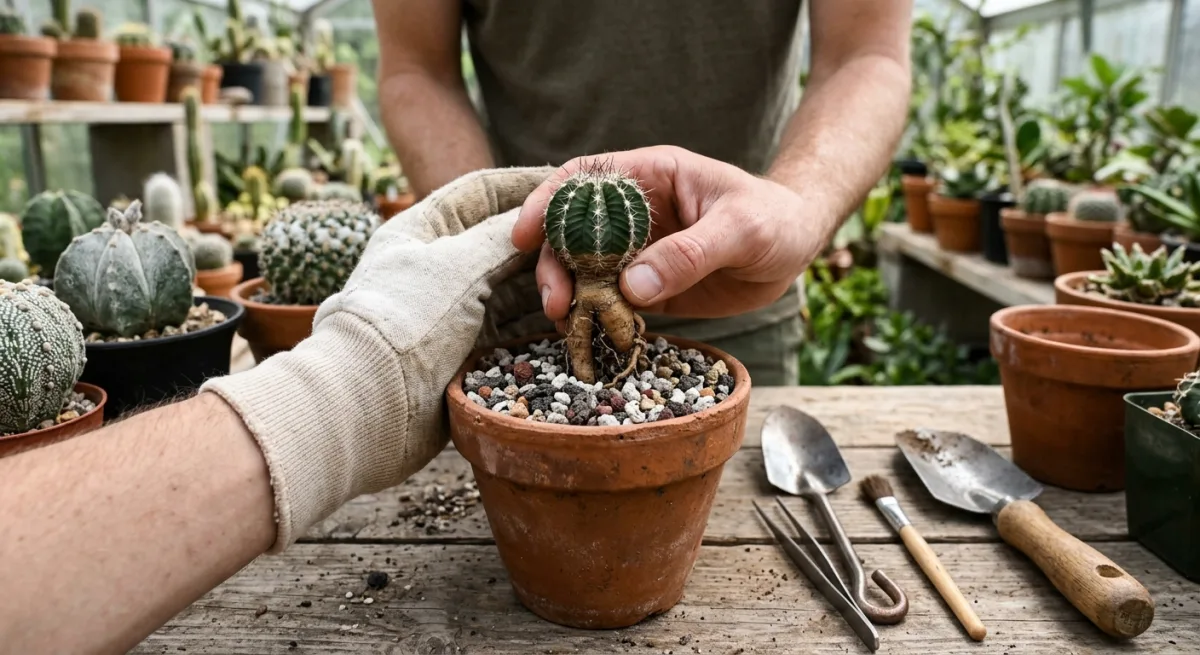
Always house your plant in unglazed, breathable terracotta pots with generous drainage holes. Plastic and glazed ceramic planters trap moisture against the subterranean taproot, drastically elevating infection risks. Choose a relatively narrow, deep pot that accommodates the taproot with 2–3 cm of clearance on the bottom rather than an oversized container that holds excess stagnant wet mix.
5. Propagation Methods: Seed vs. Grafting
Propagating Aztekium hintonii demands exceptional horticultural patience. It cannot be multiplied via leaf or stem cuttings; propagation is achieved exclusively through two specialized techniques:
- Growing from Seed: The seeds are virtually microscopic dust particles. Scatter them over a sterile, finely sifted mineral bed without burying them. Enclose the container to maintain roughly 80% relative humidity at 24–28°C under bright, diffused light. Germination occurs within 2 to 4 weeks, but seedlings may take 2 to 3 full years simply to reach a diameter of 1 cm.
- Grafting: To bypass this painfully slow development, experienced growers graft tiny seedlings onto vigorous, fast-growing rootstocks (such as Trichocereus, Myrtillocactus geometrizans, or Echinopsis). Grafted specimens develop five to ten times faster than their own-root siblings, reaching flowering maturity within just a few seasons.
6. Common Pests, Pathogens, and Remediation
The primary threat to this desert geophyte is well-intentioned over-attention—predominantly excessive watering. Key diagnostic symptoms and treatments include:
- Basal Stem and Root Rot (Phytophthora & Fusarium spp.): Manifests as softening, dark discoloration, and tissue collapse near the soil line. If caught immediately, unpot the specimen, surgically excise all diseased tissue with a sterile scalpel, dust the exposed area with micronized sulfur powder, let it callus in a warm, dry area for 10 days, and either re-root in pure dry pumice or graft the healthy crown.
- Red Spider Mites (Tetranychidae): These microscopic pests congregate within the woolly apex and deep rib valleys, leaving rusty, calloused epidermal scars. They proliferate in hot, stagnant air. Maintain active cross-ventilation and treat infestations with targeted miticides or horticultural sulfur sprays.
- Mealybugs (Pseudococcidae): Cottony white masses often hide under apical wool and deep around the taproot collar. Remove visible colonies using a fine brush dipped in 70% isopropyl alcohol and drench with a systemic imidacloprid-free insecticide if root mealybugs persist.
7. Seasonal Horticultural Calendar
Aligning your cultural practices with the natural seasonal rhythms of northern Mexico ensures long-term success:
- Spring (March – May): Waking phase. Once overnight ambient temperatures settle reliably above 12–15°C, administer the season's first modest watering from below to reactivate root hairs and stimulate cellular turgor.
- Summer (June – August): Active growth and flowering. Irrigate deeply whenever the mineral mix completely dries out. You may apply a diluted, low-nitrogen, high-potassium cactus fertilizer once a month.
- Autumn (September – November): Preparation for dormancy. Gradually taper watering intervals. Withhold all water by late October to allow cellular fluids to concentrate, which naturally protects tissues against chilling injury.
- Winter (December – February): Full dormancy. Maintain a cool, crisp, dry environment between 8°C and 12°C. Keep the plant in bright ambient light and keep the substrate completely dry until spring arrives.


Reader Reviews & Comments 3 Reviews
Julian Vance
Eleanor Brooks
Marcus Sterling
Leave a Review & Rating
Share your plant care tips, experiences, or questions with our succulent community.