






Wandering through the rugged crags of Oaxaca, Mexico, or traversing the rocky crevices of the European Alps, you quickly realize that nature's hardiest succulents do not seek subterranean depths to anchor themselves. Instead, they thrive within shallow, mineral-rich stone depressions merely a few centimeters deep. Birdbaths, with their expansive, low-profile bowl geometry, mimic these primordial microhabitats almost flawlessly. Converting an idle concrete, stone, or ceramic birdbath into a living propagation oasis—where hundreds of tender leaf cuttings and stem offsets take root—is botanically the most elegant way to harness a succulent's innate rooting instinct.
Every stem cutting and detached leaf severed from a parent plant carries an astonishing evolutionary miracle within its tissues. Auxin phytohormones pooling at the cut surface and dormant meristematic cells awakening in response to light and oxygen orchestrate the formation of an entirely new root system. Thanks to their generous surface area and rapid gas exchange, birdbath planters provide exceptional oxygenation to the nascent root zone, naturally suppressing the suffocating fungal pathogens so often encountered in deep, stagnant nursery pots.
1. Botanical Foundations of Shallow-Basin Propagation
Multiplying succulents in shallow vessels through stem cuttings and single leaves relies fundamentally on adventitious organogenesis. Under normal physiological conditions, the cortical and mesophyll parenchyma cells within stems and leaves dedicate their energy to photosynthesis and water storage. However, once excised from the parent vascular system, polar auxin transport redistributes these growth regulators directly toward the severed wound. This hormonal concentration stimulates undifferentiated cells to divide exponentially, organizing rapidly into a new root apical meristem.
Birdbath planters present a hydro-dynamic environment drastically superior to deep nursery pots. In deep containers, gravity creates a saturated perched water table at the base, suffocating delicate developing callus tissue and causing anoxia. In contrast, an expansive birdbath with a substrate depth of only 4 to 8 centimeters offers an enormous surface-to-volume ratio. Evaporation is uniform, capillary action is uninterrupted, and gas diffusion through the granular pore network remains at peak levels. This buoyant oxygen concentration allows secondary xylem vessels to form swiftly and anchor firmly into mineral aggregates.
2. Essential Equipment and Mother Plant Preparation
The foundation of any high-yield birdbath propagation bed lies in strict pathogen control. Because reclaimed birdbaths originally held stagnant water, their micro-pores often harbor fungal spores, cyanobacteria, and alkaline mineral crunches that must be neutralized prior to planting.
- Birdbath Basin with Functional Drainage: Concrete, natural cast stone, terra cotta, or unglazed ceramic. If the bowl lacks an exit path, you must drill at least one or two 1/2-inch holes through the center using a diamond-tipped masonry or ceramic drill bit.
- Sterilized Cutting Tools: An ultra-sharp horticultural scalpel, single-edge razor, or fine bypass pruners (thoroughly sanitized with 70% isopropyl alcohol).
- Mother Plant Preparation: The donor mother plants (such as Echeveria, Sedum, Ghost Plant / Graptopetalum, or Hens and Chicks / Sempervivum) should be given a light watering roughly 48 hours prior to taking cuttings. Cells infused with optimal turgor pressure supply the severed cutting with the essential internal water reserves needed to survive the callus and rooting phase.
- Drainage Mesh & Geotextile Barrier: A piece of fine fiberglass or synthetic mesh placed across the drainage aperture to prevent fine gravel and volcanic scoria from washing out.
- Inorganic Propagation Substrate: Horticultural pumice, porous zeolites, crushed volcanic lava rock, and a minimal fraction of sifted, low-salt coco coir.

3. Step-by-Step Harvesting and Callus Formation Protocol
Eighty percent of propagation failures stem from premature planting. An open cut on a succulent stem is an unhealed vascular wound; burying it directly into damp growing medium creates a direct pathway for soil-borne pathogens to invade the xylem channels.
- Harvesting Healthy Vegetative Tissue: When taking apical stem cuttings, select vigorous, non-flowering shoots boasting at least 3 to 5 compact nodes. For single-leaf propagation, gently hold the leaf between your thumb and forefinger, wiggling it laterally until it snaps cleanly away from the stem axis with an audible 'click'. If the crescent-shaped basal meristem tissue remains attached to the stem, that leaf cannot regenerate adventitious plantlets.
- Stripping Lower Foliage: Gently strip the leaves along the lowest 2 to 3 centimeters of the stem cutting, exposing the clean nodal rings. These dormant nodal scars are the primary hormonal hotbeds from which adventitious root initials emerge.
- The Critical Callus Period: Never insert freshly cut plant tissue directly into soil. Lay your harvested stems and leaves horizontally onto a dry, shaded, well-ventilated nursery tray away from scorching direct midday sun. Over 3 to 6 days, the exposed parenchymal cells undergo suberization, forming a protective, corky, desiccation-resistant scar tissue. Once this protective callus turns a dry, silvery-white or pale buff color, the material is ready for the birdbath.
4. Formulating the Ideal Birdbath Substrate Matrix
Standard peat-heavy commercial potting soils are fundamentally incompatible with shallow birdbath planters. Peat shrinks, becomes hydrophobic when dried, and holds water far too long when compressed in a broad dish, choking young root hairs. A successful rooting matrix must prioritize physical pore stability, structural non-compaction, and balanced air porosity.
| Substrate Component Profile | Water Retention | Air Porosity | Root Initiation Speed | Fungal / Rot Vulnerability |
|---|---|---|---|---|
| Dry Horticultural Pumice + Zeolite (2-4 mm) | Low - Moderate | Very High (45%+) | Exceptional, Thick Anchor Roots | Minimal (Safest Choice) |
| 100% Pure Perlite | Low | High | Rapid, but Structurally Brittle | Low |
| Commercial Peat-Based Potting Soil | Excessive | Poor (<15%) | Sluggish / High Root Hypoxia | Extremely High (Fatal) |
| Engineered Birdbath Propagation Mix* | Optimal | High (35-40%) | Rapid, Resilient, Fibrous Roots | Very Low |
*The Master Birdbath Propagation Formula: 40% Fine Horticultural Pumice (2-4 mm), 20% Crushed Red Lava Rock (1-3 mm), 15% Clinoptilolite Zeolite, 15% Coarse Washed River Grit, and 10% Triple-Rinsed Sifted Coco Coir.
Line the bottom of the birdbath bowl with a thin, 1-centimeter foundation of coarse volcanic scoria, then fill the vessel with your propagation mix, leveling the surface gently without compacting it. Insert callused stem cuttings at a gentle 45-degree angle to anchor them against the wind, and lay leaf cuttings flat atop the gritty top-dressing with their callused meristem tips resting barely against the mineral particles.
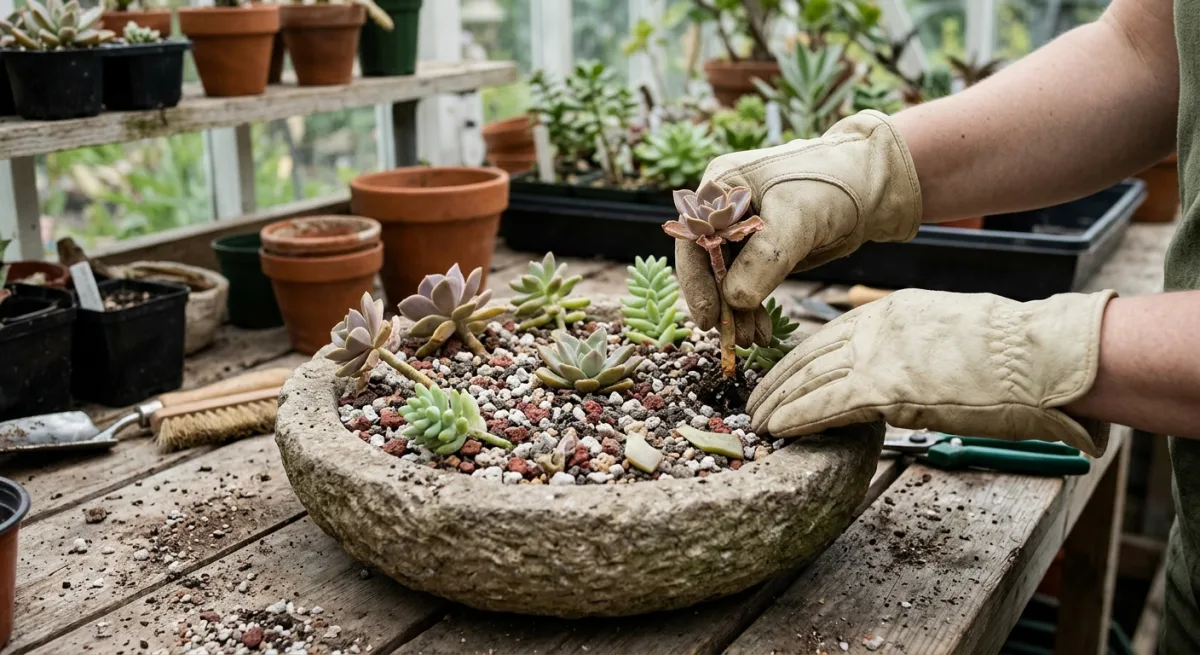
5. Microclimate Dynamics: Balancing Light, Heat, and Moisture
When placed in a garden, courtyard, or patio, an elevated birdbath occupies a distinct thermal microclimate. Because a rootless cutting relies entirely on its internal succulent water reservoirs, harsh direct sunlight will vaporize these reserves before a vascular root network can ever develop.
- Targeted Photoperiod & Light Intensity: Keep your birdbath nursery in bright, filtered daylight (under 30-40% horticultural shade cloth, beneath an open arbor, or where it receives gentle, early-morning rays for 1 to 2 hours followed by bright, indirect ambient light). Direct, blistering midday sun degrades auxin phytohormones and scorches the fragile epicuticular wax (farina) coating of unrooted leaves.
- Temperature Parameters: Cellular division and lateral root emergence peak within an ambient temperature bracket of 66°F to 75°F (19°C to 24°C). Temperatures plummeting below 59°F (15°C) stall meristematic cell division, while ambient heat exceeding 86°F (30°C) triggers heat dormancy, prompting unrooted cuttings to abort lower leaves rather than generate roots.
- Strategic Hydration: You cannot water an unrooted succulent cutting in the traditional manner—without root systems, water intake is zero, and soggy media simply rots the base. Maintain the substrate completely bone-dry for the first 7 to 10 days post-insertion. Afterward, using a fine-mist pressure sprayer during the cool twilight hours, mist the surface gravel lightly every few days. The evaporating moisture creates a localized humidity pocket beneath the leaves, stimulating positive hydrotropism—encouraging root tips to stretch downwards toward the moisture.
6. Root Establishment, Compositional Design, and Hardening Off
Between 2 to 4 weeks after resting your cuttings on the mineral bed, perform the gentle 'tug test'. A subtle upward pull on a stem will meet gentle resistance; this tactile feedback confirms that pink and silver adventitious roots have successfully penetrated the pores of the pumice and volcanic rock.
Now your birdbath shifts from an unassuming nursery tray into an ornamental garden focal point. You can begin bottom-layer hydration or directional root-zone watering using a gooseneck watering can, deliberately keeping moisture out of the center of developing rosettes to avoid fungal heart rot.
If the birdbath is situated in an exposed outdoor environment, harden off your young succulents incrementally. Expose them to an additional 30 to 45 minutes of gentle morning sun each week. As their photoprotective mechanisms adapt, their protective farina wax layer will thicken noticeably into a soft powdery frost, and protective anthocyanin pigments will blush the leaf tips in brilliant pink, crimson, amethyst, and copper hues.
7. Common Propagation Setbacks and Botanical Diagnostics
If your birdbath propagation bed shows signs of distress, utilize this diagnostic botanical framework to troubleshoot and recover your specimens:
- Translucent, Glassy, or Mushy Leaves: The internal cell walls have ruptured due to excessive moisture, osmotic shock, or soft rot bacteria (Erwinia carotovora). Remove the affected cutting immediately, suspend all watering, and increase surrounding air movement.
- Blackened, Shriveled Stem Bases: The cutting was planted prior to completing full suberization (callus formation), or non-sterile tools introduced pathogen spores into the wound. Recut the stem with an alcohol-wiped blade several millimeters into healthy, firm green vascular tissue. Dust the clean wound with sulfur or activated charcoal powder, and allow it to dry in a shaded, well-ventilated space for 5 to 6 full days before reintroducing it to dry grit.
- Etiolation (Pale, Stretched, Weak Growth): The newly sprouted rosettes are stretching unnaturally toward a directional light source, indicating insufficient photosynthetically active radiation (PAR). Gradually relocate your birdbath to a brighter position that enjoys higher ambient indirect illumination.


Reader Reviews & Comments 3 Reviews
Claire Holloway
Eleanor Vance
Marcus Thornton
Leave a Review & Rating
Share your plant care tips, experiences, or questions with our succulent community.