






Concealed within the rocky, mineral-rich soils of the miombo woodlands spanning Zambia and Zimbabwe, Euphorbia decidua—often affectionately known among collectors as the Deciduous Spurge—stands as one of evolution's most brilliant masterclasses in drought survival. At first glance, its native habitat might reveal nothing more than a sunbaked rock fissure or a seemingly lifeless patch of dry soil. Yet, suspended directly beneath the surface lies a massive, turnip-shaped subterranean water reservoir. When the scorching African dry season arrives, this botanical marvel sacrifices and completely sheds its upper cylindrical branches (true to its Latin name decidua), locking all vital moisture and metabolic energy safely inside its buried caudex. Cultivating this rare geophytic treasure on our windowsills requires not only admiration, but a profound respect for nature's seasonal rhythms.
Prized as the holy grail among caudiciform collectors, Euphorbia decidua defies conventional succulent care rules. Uninitiated growers often panic at the onset of seasonal dormancy, misinterpreting the natural yellowing and dropping of branches as a sign of dehydration. Reaching hurriedly for the watering can during this resting phase invariably spells disaster, rotting the ancient tuber from within. In truth, this annual leaf-and-branch shed is a masterfully choreographed defense strategy. Let us delve into the biological adaptations, microclimate preferences, and precise cultivation secrets required to keep this living relic of the African savanna flourishing in your collection.
1. Botanical Identity and Morphological Characteristics
Euphorbia decidua (formerly classified under the botanical synonym Euphorbia mennellii) belongs to the Euphorbiaceae (Spurge) family. It represents a specialized group of geophytes—succulents that develop primary storage organs beneath the soil level. The species epithet derives directly from the Latin deciduus ('falling off' or 'temporary'), accurately describing its hallmark physiological behavior: its photosynthetic aerial organs are ephemeral by design.
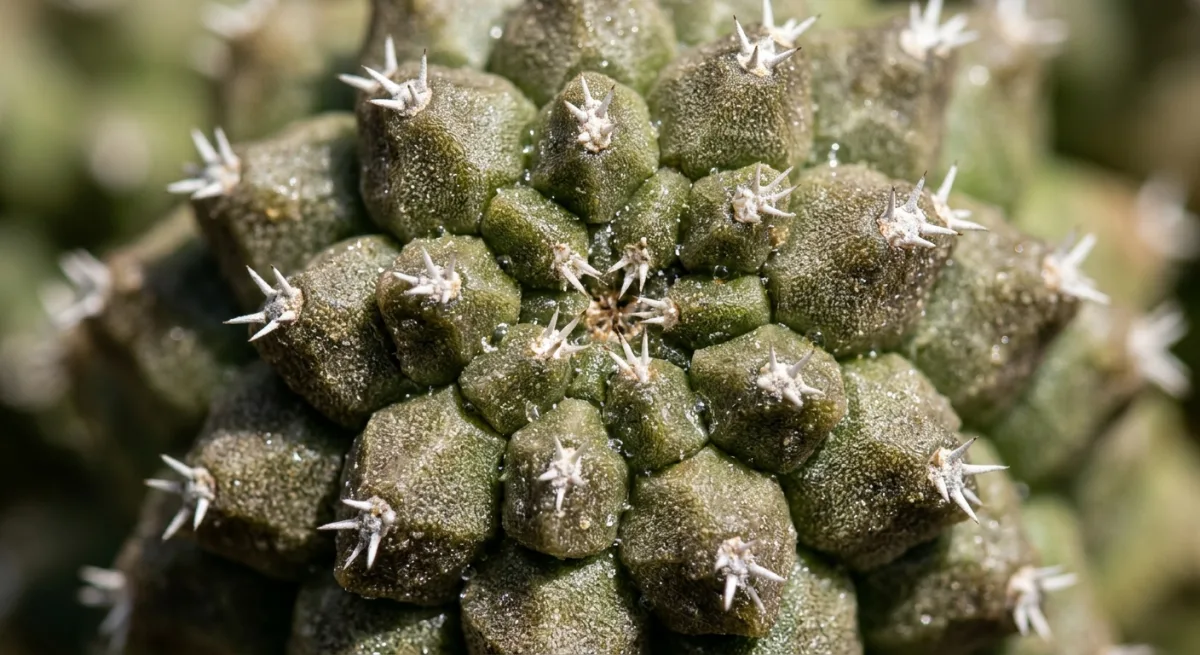
Morphologically, the plant operates as a two-part organism: an immense, succulent, conical-to-subglobose underground tuberous caudex, and an apical growing crown from which dozens of slender, cylindrical, toothed, blue-green stems erupt in a radial rosette. In habitat, this massive caudex remains fully subterranean, shielded from savanna brushfires and intense solar radiation. The slender branches bear tiny, triangular tubercles tipped with minute, chalky-white stipular spines. With the arrival of early spring, diminutive, sessile, chartreuse-to-yellowish flowers termed 'cyathia' cluster at the stem tips and central meristem. Like all members of the genus, mechanical damage causes the plant to exude a viscous, milky white latex rich in diterpene esters—a potent chemical deterrent that is highly irritant to skin and mucous membranes.
2. Light Requirements and Indoor Placement
Euphorbia decidua evolved under the unsparing, high-lux skies of southeastern Africa. Having adapted to unshaded, stony slopes, this species demands intense, unfiltered sunlight inside the home environment. Providing at least 5 to 6 hours of direct solar exposure daily is paramount; this maintains the compact, dense, and distinctly toothed architecture of the aerial branch crown.
Insufficient light quickly triggers etiolation. When deprived of adequate photons, the plant produces weak, stringy, pale lime-green stems that quickly drain the subterranean caudex's stored carbohydrate reserves. The premier indoor vantage is an unobstructed south- or west-facing window ledge with exceptional ambient air movement. During the peak of midsummer, if window glass amplifies temperatures excessively, ensure active ventilation rather than retreating the plant into darkness, though a sheer curtain during the single hottest midday hour can temper extreme focal heat. Even during winter dormancy when the branches have dropped, keeping the resting caudex in bright, indirect light is essential to stimulate waking hormones—predominantly cytokinins—come spring.
3. Watering Discipline: The 'Soak and Dry' Cadence
Watering a geophyte like Euphorbia decidua is a masterclass in calculated restraint. The specialized parenchymal cells within the underground caudex can retain vast reserves of moisture; consequently, the plant rarely perishes from thirst, but will swiftly succumb to root asphyxiation and fungal decay in stagnant, waterlogged substrate. The golden horticultural rule is strictly 'drench thoroughly, then allow the root zone to dry bone-dry.'
- Spring and Summer (Active Vegetative Phase): As fresh shoots unfurl and ambient daytime temperatures hover between 22°C and 30°C (72°F–86°F), water deeply until runoff drains freely from the pot. Always empty drip trays within 10 minutes to prevent capillary back-saturation.
- Autumn (Dormancy Preparation): As photoperiods shorten and temperatures dip, taper watering intervals dramatically. When the blue-green branch tips begin to fade, yellow, and naturally abscise, scale moisture down to an absolute minimum.
- Winter (Absolute Rest): Once the branches dry up and drop, the plant enters deep physiological dormancy. Maintained in a cool room around 12°C to 15°C (54°F–59°F), the specimen can safely go weeks without a single drop of water. To prevent excessive shriveling of the finer feeder roots, a modest sip applied along the inside rim of the pot once a month is more than sufficient.
4. Ideal Substrate Mix and Pot Selection
The fibrous feeder roots and fleshy caudex of Euphorbia decidua have zero tolerance for water retention. Standard, peat-heavy commercial potting soils act as an immediate death sentence for this species. Instead, cultivate it exclusively in an inorganic, mineral-dominant substrate engineered for rapid drainage, structural longevity, and maximum macroporosity.
| Substrate Component | Ratio (%) | Botanical Function & Horticultural Benefit |
|---|---|---|
| Coarse Horticultural Pumice (3–6 mm) | 40% | Guarantees permanent aeration, preventing root xylem hypoxia and compaction. |
| Crushed Lava Rock / Scoria | 25% | Provides vesicular micro-pores for mycorrhizal grip and steady trace mineral release. |
| Clinoptilolite Zeolite | 15% | Improves cation-exchange capacity (CEC) while buffering against harmful fertilizer salts. |
| Sterile Low-Peat Cactus Mix or Coco Coir | 20% | Supplies a baseline organic matrix that preserves minimal, controlled root-zone hydration. |
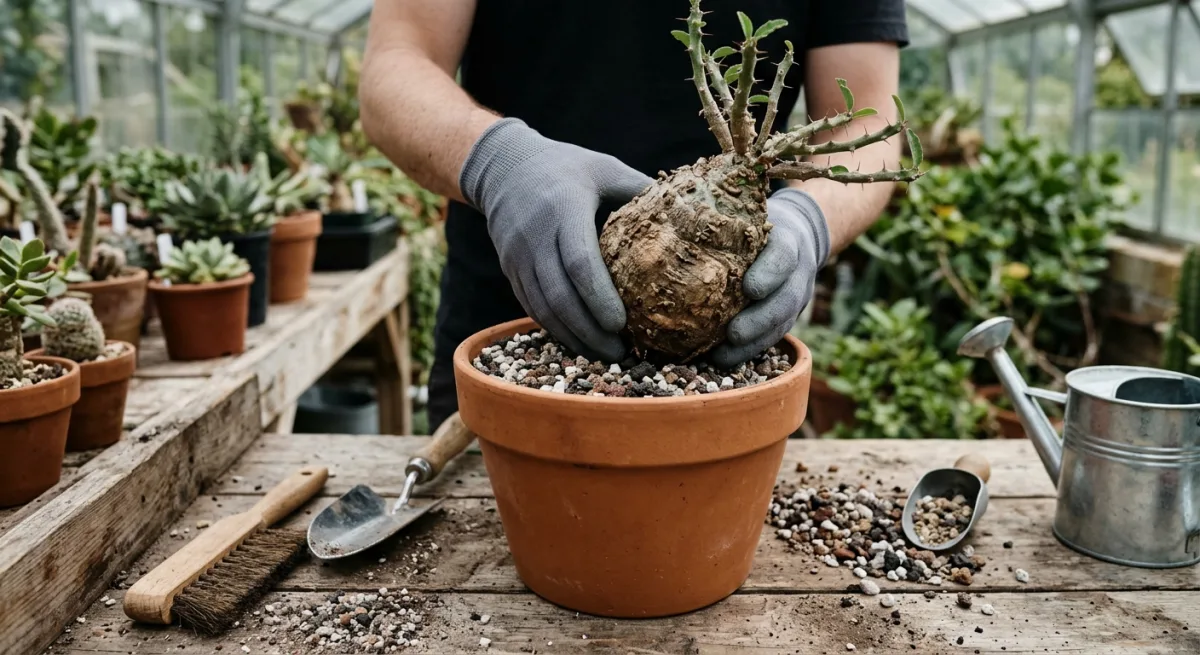
Pot depth is equally fundamental. Unlike shallow-rooted desert succulents, Euphorbia decidua anchors itself with a stout, downward-tapering conical taproot system. Avoid wide, shallow bonsai trays and opt instead for deep, unglazed terracotta containers. Unglazed clay features porous walls that breathe, expediting moisture evaporation from all angles and eliminating dangerous cool-moisture pockets around the base of the subterranean caudex.
5. Step-by-Step Propagation Techniques
In the propagation of Euphorbia decidua, growers encounter an unyielding morphological reality well-documented in academic botany: vegetative cuttings taken from aerial branches will root, but they will never develop a true, swollen tuberous caudex. Seed propagation remains the only pathway to securing the prized, sculpted underground caudex.
Propagation from Seed (Essential for Caudex Development)
- Seed Sourcing and Fresh Sowing: In habitat, mature seed capsules dehisce explosively. Fresh seeds possess the highest metabolic vigor. Sow during the rising warmth of mid-to-late spring.
- Substrate Preparation: Blend 70% fine pumice with 30% sifted peat or coir, and steam-sterilize to eliminate fungal spores. Press seeds gently onto the leveled surface and cover with a nominal 1–2 mm layer of mineral grit.
- Temperature and Humidity: Bottom-water the tray with distilled water, seal with a transparent propagator dome, and maintain constant temperatures between 24°C and 28°C (75°F–82°F) under bright, indirect light. Germination typically initiates within 10 to 25 days.
- Ventilation Acclimatization: The moment the green embryonic hypocotyls emerge, prop the humidity cover open to promote gas exchange and suppress damping-off pathogens. Noticeable globular swelling of the embryonic caudex is observable within the first 6 months.
Propagation via Stem Cuttings (Columnar Shrub Form)
During the height of summer growth, sever a mature lateral branch using a sterilized scalpel. Plunge the severed base briefly into cold water to coagulate the latex stream. Place the cutting in a dry, shaded, well-ventilated location for 7 to 10 days to produce a firm, callused wound. Insert the callused cutting into pure dry pumice and maintain gentle bottom warmth with sparse ambient moisture. While this cutting will root and produce cyathia, it will forever retain a branching, shrub-like habit without ever swelling into a basal tuber.
6. Common Diseases, Pests, and Treatments
Despite its resilient, drought-tempered anatomy, this specialized geophyte faces distinct threats from opportunistic pathogens and covert sap-sucking pests:
- Caudex and Root Rot (Fusarium / Pythium): Almost always triggered by unseasonal winter hydration or poorly drained, heavy substrates. Symptoms manifest as a sudden softening, water-soaking, and blackening at the base of the tuber. If caught in the early stages, unpot the specimen immediately, excise all necrotic tissue with a sterile blade until only pristine white flesh remains, dust the margins liberally with sulfur powder, dry-cure in open air for two weeks, and reset into pure pumice.
- Mealybugs (Pseudococcidae): These persistent pests nestle within the tight recesses of the toothed branch tubercles and around the subterranean root crown, presenting as white cottony masses. Treat localized colonies directly with a cotton swab dipped in 70% isopropyl alcohol; systemic drenching with an appropriate insecticide may be required for severe subterranean infestations during active growth.
- Spider Mites (Tetranychidae): Hot, stagnant indoor conditions invite spider mites, which rasp the tender growing tips, leaving a dusty, silvery-bronze stippling. Elevate ambient cross-ventilation immediately and apply insecticidal soap or a dedicated horticultural miticide.
7. Seasonal Care Calendar and Expert Insights
Synchronizing your cultivation routine with Euphorbia decidua's internal circannual clock ensures pristine health and vigor throughout the year:
- Spring (March – May): The awakening phase. Watch for emerald green growth points and petite cyathia emerging from the apex of the caudex. Reintroduce watering gradually. Apply a balanced, low-nitrogen, high-potassium succulent fertilizer diluted to quarter-strength once per month. If repotting is due, execute it immediately as the root tips activate.
- Summer (June – August): Maximum metabolic activity. Provide abundant sunlight, warm days, and steady soak-and-dry watering intervals. Maintain exceptional fresh air movement to facilitate transpirational cooling.
- Autumn (September – November): Dormancy transition. The branches will naturally cease elongation, lose their vibrant luster, and turn greyish-brown before dropping. This is biological perfection, not a crisis—withhold all fertilizers and systematically stretch watering intervals until the potting mix remains dry.
- Winter (December – February): Deep dormancy. Keep the pot on a bright, cool shelf where temperatures remain reliably between 10°C and 15°C (50°F–59°F). Never permit ambient conditions to drop below 8°C (46°F), and keep the substrate completely arid.


Reader Reviews & Comments 4 Reviews
Dr. Alistair Vance
Claire Montgomery
Julian Brooks
Sarah Jenkins
Leave a Review & Rating
Share your plant care tips, experiences, or questions with our succulent community.