






Tucked within the limestone crevices of the Kouga Dam and gorge valleys in South Africa’s Eastern Cape, an extraordinary architectural masterpiece defies harsh, desiccating winds: Crassula perforata subsp. kougaensis. Threading its geometric, triangular leaves along a central stem like beads on a natural necklace, this distinct subspecies enjoys well-earned fame among succulent aficionados as the 'String of Buttons.' As it gently drapes along your windowsill, it brings the ancient survival ingenuity of the untamed Karoo wilderness directly into your living space.
While many succulents in the plant kingdom adopt a standard rosette blueprint, the kougaensis subspecies opts for a vertical and cascading axis. Pairs of leaves lock together at 90-degree alternating angles, constructing what looks like a living botanical pagoda. Yet, this striking aesthetic can quickly unravel indoors if environmental parameters miss the mark. Suffocated roots from overwatering or etiolated, leggy stems caused by deficient light are the greatest sorrows this South African survivor can face.
So, pull up a chair as if we were sharing a cup of coffee over our nursery propagating benches, and let us dive deep into the botanical heart of this captivating species. From its epicuticular farina wax to root xylem water transport, we will demystify its care with rigorous science and practical, hands-on horticultural expertise.
1. Botanical Identity and Morphological Characteristics
This remarkable subspecies within the Crassula perforata complex (subsp. kougaensis) stands out from the nominate type through pronounced morphological adaptations. Its leaves are connate-perfoliate, fusing at the base to clasp the stem entirely—making it appear as though an artisan’s needle has pierced through the center of stacked geometric disks. In the kougaensis subspecies, the leaves are considerably more succulent, compact, shorter, and sharply triangular compared to the standard species.
One of the plant's most crucial evolutionary shields is the powdery, silvery-blue epicuticular wax (farina) coating its epidermis. This farina layer serves as a built-in sunscreen; never rub or wipe it off with your fingers, as doing so permanently strips away its primary defense against scorching UV rays and opportunistic fungal pathogens. Under favorable environmental sun stress, anthocyanin pigments gather along microscopic hydathodes (specialized water-secreting pores) on the leaf margins, painting the foliage with breathtaking coral-pink, crimson, and wine-red contours.
Metabolically, kougaensis utilizes Crassulacean Acid Metabolism (CAM) photosynthesis, sealing its stomata during scorching daylight hours and opening them exclusively at night to capture carbon dioxide. This elegant strategy enables carbon fixation with virtually zero water loss. As the stems age, they lignify (develop woody tissue) from the base upward—a vital mechanical adaptation engineered to support the weight of mature, trailing shoots.
2. Lighting Requirements and Optimal Indoor Placement
Hailing from exposed, sun-drenched rocky terraces in habitat, the String of Buttons is an unapologetic photophile. To maintain tight internodal spacing and keep the cellular structure dense, it requires at least 5 to 6 hours of direct, unfiltered sunlight each day. Indoors, an unobstructed south- or southwest-facing windowsill provides the ideal exposure.
Deprived of adequate light, the plant rapidly displays textbook etiolation: stems stretch erratically, internodes widen, foliage fades to an anemic pale green, and those brilliant pink margins vanish. If your home lacks sufficient natural southern exposure, position the plant 20–25 cm (8–10 inches) beneath a high-efficiency full-spectrum LED grow light, running for 12 to 14 hours daily to preserve its tight architectural form.

3. Watering Discipline: The 'Soak and Dry' Protocol
Dousing succulents on a rigid calendar schedule is not a gesture of affection; it systematically suffocates root hair cells and invites root rot. Crassula perforata subsp. kougaensis houses remarkable moisture reserves within its vascular cylinder and thick parenchyma storage tissue. Watering frequency must always be dictated by the physiological state of the plant and substrate, never by a predetermined day of the week.
The foundational rule is the 'Soak and Dry' protocol. Only after the potting substrate has dried out completely down to the very base of the container (verify by inserting a wooden skewer to the bottom), saturate the soil thoroughly until water drains freely from the drainage holes. Never allow stagnant runoff to sit in the saucer; empty it completely within 10 to 15 minutes.
During winter, when ambient temperatures dip to 10–15°C (50–59°F), the plant enters a semi-dormant state and transpiration rates plummet. At this stage, stretch watering intervals to once a month or even every 5 to 6 weeks, depending on ambient indoor humidity. A subtle loss of luster and slight longitudinal wrinkling on the lower leaves is the safest cellular signal that the plant is genuinely ready for a drink.
4. Ideal Mineral Soil Blend and Pot Selection
The Achilles' heel of the kougaensis subspecies is inadequate oxygen levels around the root zone. Standard peat- or coir-based potting mixes act like dense sponges, depriving root hairs of air and triggering anaerobic bacterial decay within days. An optimal substrate must flush water through instantaneously while offering an open, granular framework that keeps root xylem channels continuously supplied with fresh atmospheric oxygen.
| Ingredient | Ratio (%) | Botanical Function and Dynamics |
|---|---|---|
| Pumice (3–5 mm) | 40% | Superior internal porosity, provides enduring macropores, prevents root suffocation. |
| Crushed Lava Rock (Scoria) | 25% | Releases trace minerals, adds ballast, and maintains permanent drainage channels. |
| Coarse Quartz / Sharp River Sand | 15% | Breaks capillary water surface tension, facilitating rapid gravity drainage. |
| Sterile Organic Succulent Base | 20% | Supplies minimal organic nutrients and root anchoring surface with low water retention. |
When selecting containers, unglazed terracotta is unquestionably the gold standard. The micro-porous clay walls allow moisture to evaporate not just from the soil surface, but through the pot walls themselves, cutting the risk of root rot by up to 70%. Ensure the pot has generous, unobstructed drainage holes at the base.
5. Step-by-Step Propagation Techniques
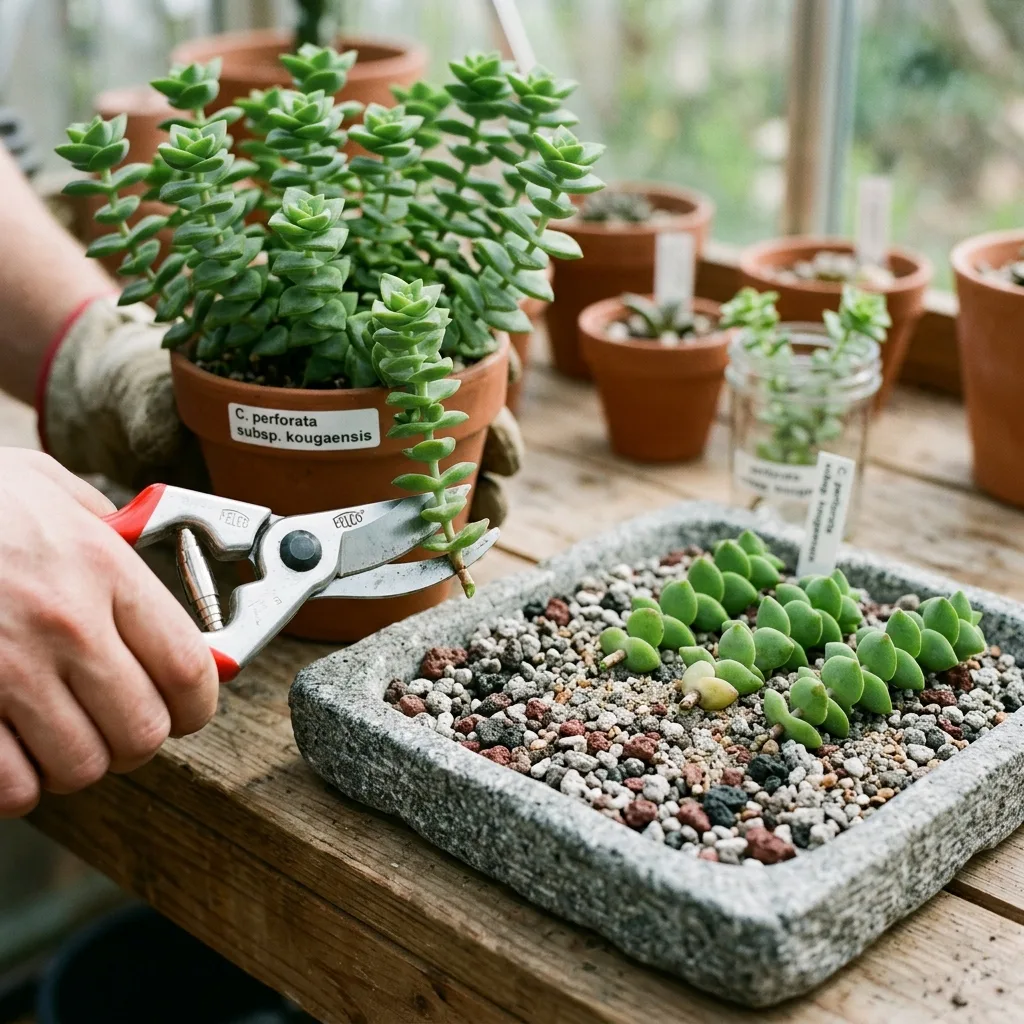
Stem cuttings represent the most reliable, rapid, and foolproof method for propagating Crassula perforata subsp. kougaensis. Single-leaf propagation in the Crassula genus yields notoriously sluggish results with high failure rates; healthy stem cuttings remain the undisputed horticultural benchmark.
- Timing and Selection: In spring or early summer, select a robust, non-blooming stem featuring at least 6 to 8 healthy leaf pairs (nodes). Using a razor-sharp pruning shear sterilized with 70% isopropyl alcohol, make a clean cut immediately beneath a leaf node.
- Callus Formation (Crucial Step): Carefully twist or slice off the lowest 1 to 2 leaf pairs to expose clean stem tissue for adventitious root initiation. Do not insert the fresh cutting into soil right away! Place it in a dry, warm, shaded, well-ventilated spot for 3 to 5 days, allowing the wounded vascular bundle to form a firm suberized callus. This step creates an impenetrable barrier against soil-borne pathogens.
- Dry Potting and Patience: Insert the callused cutting 2 to 3 cm deep into the dry mineral mix detailed above. Do not apply any water for the first 5 days following planting.
- Root Establishment: After day 5, lightly moisten the top substrate layer (refrain from deep drenching). Within 2 to 3 weeks, fine adventitious roots will emerge. Once you feel gentle resistance when lightly tugging upward on the stem, root establishment is complete!
6. Common Pests, Diseases, and Targeted Remedies
While the String of Buttons is an exceptionally hardy perennial, indoor cultivation can expose it to two primary horticultural adversaries: Mealybugs (Pseudococcidae) and Fungal Root Rot (Phytophthora or Pythium species).
Mealybugs: The sheltered connate hollows where perfoliate leaves hug the stem create an ideal microhabitat for cottony mealybugs. For early infestations, dip a fine cotton swab in 70% isopropyl alcohol and contact-treat the pests directly to dissolve their protective wax. For extensive colonies, treat with horticultural neem oil emulsions or apply a systemic insecticidal drench.
Root and Stem Rot: If basal leaves turn translucent, squishy, and yellow while the stem base darkens or collapses, root rot is underway. Unpot the plant immediately, amputate all compromised, soft root tissues with a sterile blade, take a cutting from healthy green stem tissue well above the infection line, let it callus thoroughly, and reroot in fresh, sterile mineral grit.
7. Seasonal Care Calendar and Professional Tips
Cultivating a flourishing String of Buttons means aligning your care routine with its natural seasonal rhythm:
- Spring (Awakening): Active vegetative growth resumes. Feed once a month with a balanced, low-nitrogen liquid succulent fertilizer (such as NPK 5-10-10) diluted to one-quarter strength.
- Summer (Growth and Form): Maintain maximum bright light and active air circulation. If ambient indoor temperatures climb above 35°C (95°F), the plant may enter brief aestivation; reduce watering volume slightly during extreme heat spells.
- Autumn (Budding and Pigment): Cooler nocturnal temperatures trigger vivid anthocyanin flushes along the leaf margins. Terminal, thyrse-like inflorescences bearing clusters of tiny, star-shaped, fragrant cream-white flowers emerge at stem tips.
- Winter (Dormancy): Water minimally and maximize light exposure. Keep the plant away from cold window drafts and heat radiators; maintain ambient temperatures reliably above 8°C (46°F).


Reader Reviews & Comments 3 Reviews
Eleanor Vance
Marcus Sterling
Clara Higgins
Leave a Review & Rating
Share your plant care tips, experiences, or questions with our succulent community.