






High in the arid, sun-bleached canyons of Nuevo León and Coahuila in northeastern Mexico, an architectural wonder emerges from narrow limestone crevices like a living monolithic jewel: Mammillaria melanocentra, affectionately known among enthusiasts as the Black-Spined Pincushion Cactus. Sculpted by thousands of years of evolutionary adaptation, this striking desert succulent commands immense respect throughout the botanical community, brandishing jet-black central spines that thrust upward like miniature obsidian daggers from its sharply angled pyramidal tubercles. Whether you are an experienced cactophile or a budding houseplant parent drawn to the serene geometry of arid flora, the stately, commanding presence of this desert monarch will transform the character of your living space.
Known in vernacular circles as the Black-Spined Pincushion Cactus, Mammillaria melanocentra represents one of the hardiest yet most uncompromising species a grower can cultivate. Its vascular system evolved to rapidly imbibe torrential desert downpours and ration that moisture over months of merciless drought. The true art of keeping this noble wanderer thriving indoors lies in meticulously replicating the austere, stone-dominated balance of its native habitat within the confines of a container.
Join us as we explore the cellular water-retention mechanisms, morphological intricacies, and evidence-based cultivation protocols required to nurture this desert treasure from its deep winter rest to its vibrant spring coronation.
1. Botanical Identity and Morphological Characteristics
Belonging to the vast and diverse Mammillaria genus within the Cactaceae family, Mammillaria melanocentra exhibits a primarily solitary growth habit with a depressed-globose (flattened sphere) stem architecture. While ancient specimens may gently elongate into a short, stout cylinder, the plant typically remains wider than it is tall, commanding an impressive visual footprint. In its native limestone outcrops, mature specimens reach diameters of 15 to 20 centimeters (6–8 inches) and heights of 10 to 15 centimeters (4–6 inches).
The defining anatomical fingerprint of this species lies in its geometric tubercles—the conical, nipple-like projections characteristic of the genus. The body does not form continuous vertical ribs; instead, it is composed of neatly arranged, four- to six-sided, sharply angled tubercles. These multifaceted terraces function as a sophisticated microclimatic shading system, allowing the cactus to cast self-shading canopies over its lower epiderm when solar radiation peaks at noon.
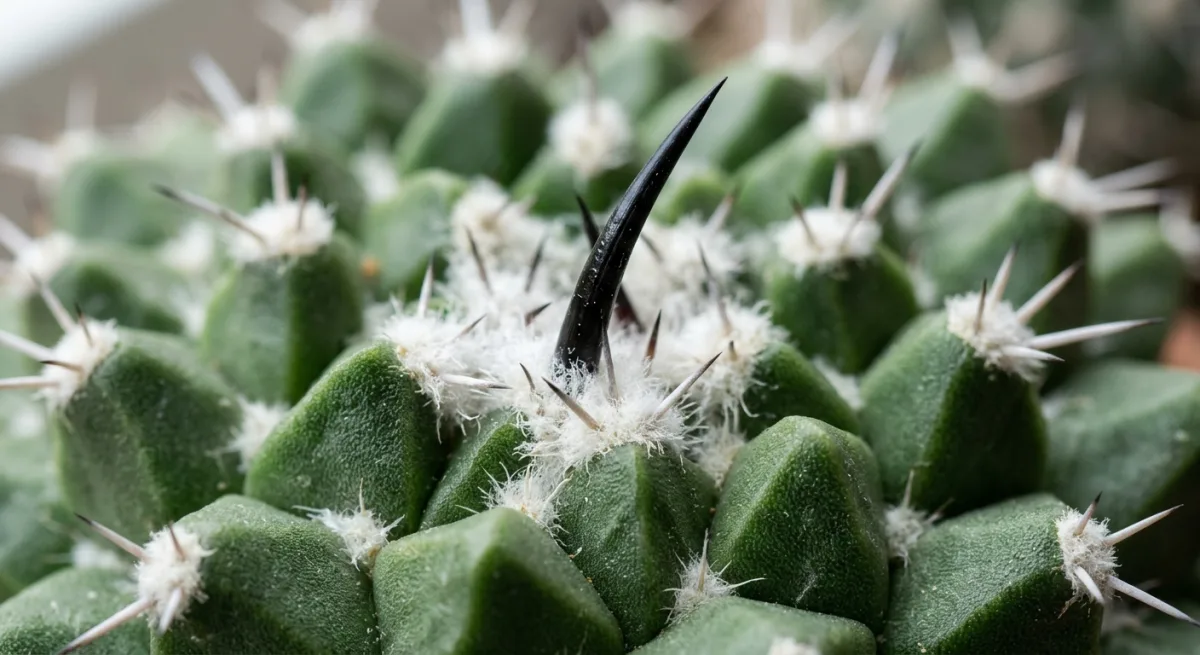
Perched atop each tubercle sits an areole bearing an outer cluster of slender, straw-yellow to pale brown radial spines. Dominating the center is a formidable, solitary spine (occasionally accompanied by 1 to 3 secondary central spines) of gleaming, jet-black coloration that guards the vascular core of each tubercle. The specific epithet melanocentra (derived from the ancient Greek melas meaning 'black' and kentron meaning 'center') honors this unmistakable anatomical crown. Nestled between the tubercles, particularly circling the apical growth center, lies a dense layer of white, woolly trichomes that shield the tender meristem from intense ultraviolet rays. In late spring, this woolly corona erupts with a wreath of funnelform, 2 to 3 cm wide blossoms displaying radiant shades of deep magenta, carmine, and soft lilac.
2. Sunlight Requirements and Indoor Positioning
Mammillaria melanocentra is phototropically demanding. In its native habitats at elevations between 1,000 and 1,800 meters, it bathes in unfiltered, high-intensity sunlight rich in natural ultraviolet spectrums. When cultivated in dim indoor settings, its compressed, geometric crown deteriorates rapidly: the cactus initiates etiolation (a weak, stretched, pale columnar elongation), the spines grow soft and sparse, and those celebrated obsidian central spines fade into brittle, brownish threads.
For indoor culture, your primary real estate must be an unobstructed south- or southwest-facing windowsill receiving at least 6 to 8 hours of direct to lightly dappled sunlight every day. Direct morning and late-afternoon sun thickens the outer cuticle, enhances farina wax development, and encourages robust, dark spine pigmentation. However, keep in mind that closed windowpanes can produce a magnifying greenhouse effect during midsummer; if ventilation is poor, positioning a sheer curtain during scorching midday hours prevents thermal epidermal scald.
3. Watering Discipline: The 'Soak and Dry' Method
The single greatest hazard in succulent horticulture is confusing infrequent watering with superficial watering. Offering a teaspoon of water every few days dehydrates the subterranean root system, while frequent, shallow dousing depletes oxygen from the root cortex, triggering anaerobic cellular rot. Watering succulents too frequently is not an act of devotion; it is accidental suffocation.
The gold standard for the Black-Spined Pincushion Cactus is the rigorous 'Soak and Dry' protocol. When you water, saturate the entire substrate volume thoroughly until water streams freely from the drainage holes, ensuring that moisture penetrates deep into the root core. Once the water drains completely, immediately empty the catchment saucer—never allow the pot base to linger in standing water.
Between waterings, the potting medium must dry out completely from the top dressing down to the very base of the container. Verify this by inserting a wooden skewer deep into the drainage hole or by lifting the pot to gauge its weight. During the active growth window of spring and summer, watering once every 10 to 15 days is generally sufficient depending on ambient temperature and air movement. In autumn, widen the intervals, and as winter dormancy arrives (with temperatures hovering around 10–15°C / 50–59°F), withhold water almost entirely.
4. Substrate Composition and Pot Selection
The root system of Mammillaria melanocentra will swiftly collapse in peat-heavy, moisture-retentive commercial potting soils. In nature, its delicate fibrous roots anchor within gritty rock crevices where air circulation is perpetual. To thrive indoors, the substrate must possess superior macroporosity, allowing surplus water to flush through within 3 to 5 seconds while holding only trace moisture along mineral surfaces.
The following botanical substrate recipe recreates its natural limestone canyon bed with exceptional fidelity:
| Substrate Component | Ratio (%) | Horticultural Function & Benefit |
|---|---|---|
| Pumice (3–6 mm grain) | 40% | Maximizes macroporosity, prevents compaction, and guarantees root zone oxygenation. |
| Crushed Lava Rock (Scoria) | 25% | Provides an abrasive surface for root anchorage and supplies iron and trace minerals. |
| Zeolite or Calcined Clay | 15% | High cation-exchange capacity (CEC); stores and releases nutrients gently to roots. |
| Sifted Cactus Peat / Leaf Mold | 15% | Provides the baseline organic matter and beneficial humic acids needed for root health. |
| Coarse River Sand / Quartz Grit | 5% | Improves water percolation and structural stability around the root collar. |
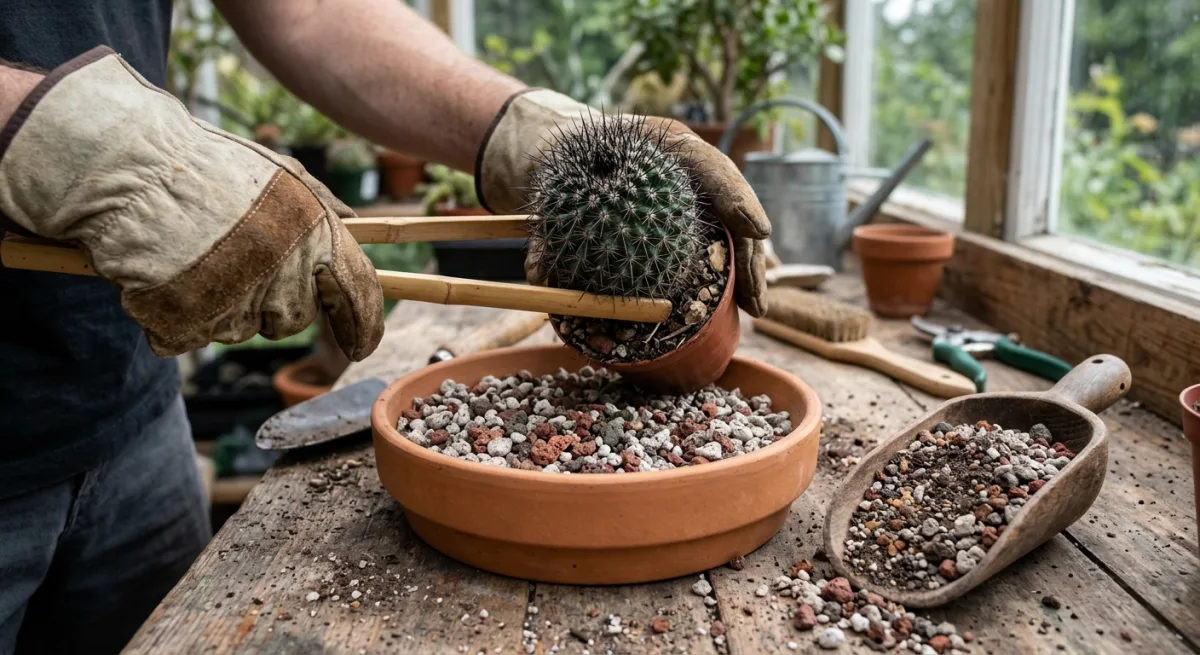
When selecting a container, always prioritize unglazed terracotta. The porous earthen walls allow moisture to evaporate laterally from the soil column, preventing stagnant moisture pockets and keeping roots cool and aerated. The pot's depth should not drastically exceed the cactus's height; shallow, wide bowl-shaped pots that allow a 2–3 cm clearance around the perimeter are optimal for lateral root expansion.
5. Step-by-Step Propagation Protocols
Because Mammillaria melanocentra displays an almost strictly solitary growth habit, it rarely produces the basal offsets ('pups') typical of clumping Mammillarias like M. prolifera. While ancient specimens may occasionally produce a basal pup in response to apical damage, the definitive, most rewarding propagation method is through seed germination.
Botanical Seed Propagation Protocol:
- Seedbed Preparation: Fill a shallow seed tray with an inorganic mix composed of 70% fine pumice/sifted zeolite and 30% sterile, fine peat. Moisten the medium with distilled water and sterilize it in a microwave or oven to eliminate latent fungal spores.
- Sowing: Scatter the minute black seeds evenly across the surface. Mammillaria seeds are photoblastic (requiring light cues to terminate dormancy); do not bury them under soil. Lightly press them into the surface with a sterile spatula to ensure substrate contact.
- Humidity Dome: Cover the container with a transparent plastic sheet or seal it in a clear zip-top bag to create a 90%+ micro-greenhouse humidity level. Position the tray in bright, indirect light at temperatures maintained between 22°C and 26°C (72–79°F).
- Ventilation and Care: Germination typically occurs within 7 to 21 days. As soon as emerald spheres appear, crack open the covering daily to introduce fresh air, reducing stagnant humidity and preventing damping-off fungus. Gradually acclimate the seedlings to ambient room conditions over several months.
6. Common Diseases, Pests, and Therapeutic Solutions
While anatomically rugged, Mammillaria melanocentra remains vulnerable when environmental conditions deviate from its evolutionary requirements. Keep an eye out for the following potential issues:
- Root and Stem Collar Rot (Phytophthora & Fusarium): Triggered by waterlogged soil, cold drafts, or poorly drained containers. Manifests as a soft, yellowing, or browning base accompanied by an unstable, wobbling stem. As emergency therapy, unpot the plant, excise every trace of discolored tissue with a sterile scalpel back to clean green/white flesh, dust the wound liberally with sulfur powder, dry the cutting in warm shade for 7 to 10 days, and re-root in completely dry pumice.
- Mealybugs (Pseudococcidae): These pervasive pests adore hiding within the dense white apical wool and deep tubercle crevices. They appear as tiny cottony tufts. Treat localized infestations by dabbing individuals with a cotton swab soaked in 70% isopropyl alcohol. For extensive infestations, apply a systemic insecticide such as an imidacloprid- or spirotetramat-based drench during the active growth phase.
- Red Spider Mites (Tetranychidae): Thriving in hot, dry, stagnant air, these microscopic arachnids attack the delicate epidermal tissue near the apex, leaving behind rusty, cork-like scabs and dull epidermal bronzing. Mitigate this by boosting ambient air circulation and applying a targeted horticultural miticide or sulfur spray.
7. Seasonal Care Calendar & Expert Horticultural Rhythms
True success with the Black-Spined Pincushion Cactus requires tuning your care habits to the plant's internal biological clock:
- Spring (March – May): The plant awakens from winter dormancy. Gradually resume watering as ambient temperatures rise. In mid-spring, flower buds will pierce the apical wool. Supplement once a month with a low-nitrogen, high-potassium liquid cactus fertilizer diluted to half strength.
- Summer (June – August): Crassulacean Acid Metabolism (CAM) operates at peak efficiency, opening stomata at night to absorb carbon dioxide while conserving daytime water reserves. During extreme heatwaves (exceeding 35°C / 95°F), the cactus may enter summer semi-dormancy; slightly scale back watering and maintain brisk ventilation.
- Autumn (September – November): As day lengths contract and evening temperatures drop, taper your watering frequency. By late November, the substrate must be allowed to dry completely to toughen the epidermal tissue and prepare cell sap for winter cold tolerance.
- Winter (December – February): Full dormancy. Move the cactus to a cool (8–12°C / 46–54°F), bright, bone-dry location. Cease all watering. This prolonged period of cold, dry rest (vernalization) is biologically mandatory to trigger the hormonal cascades required for bud initiation in spring.


Reader Reviews & Comments 4 Reviews
Clara Montgomery
Marcus Sterling
Julian Vance
Fiona Gallagher
Leave a Review & Rating
Share your plant care tips, experiences, or questions with our succulent community.