






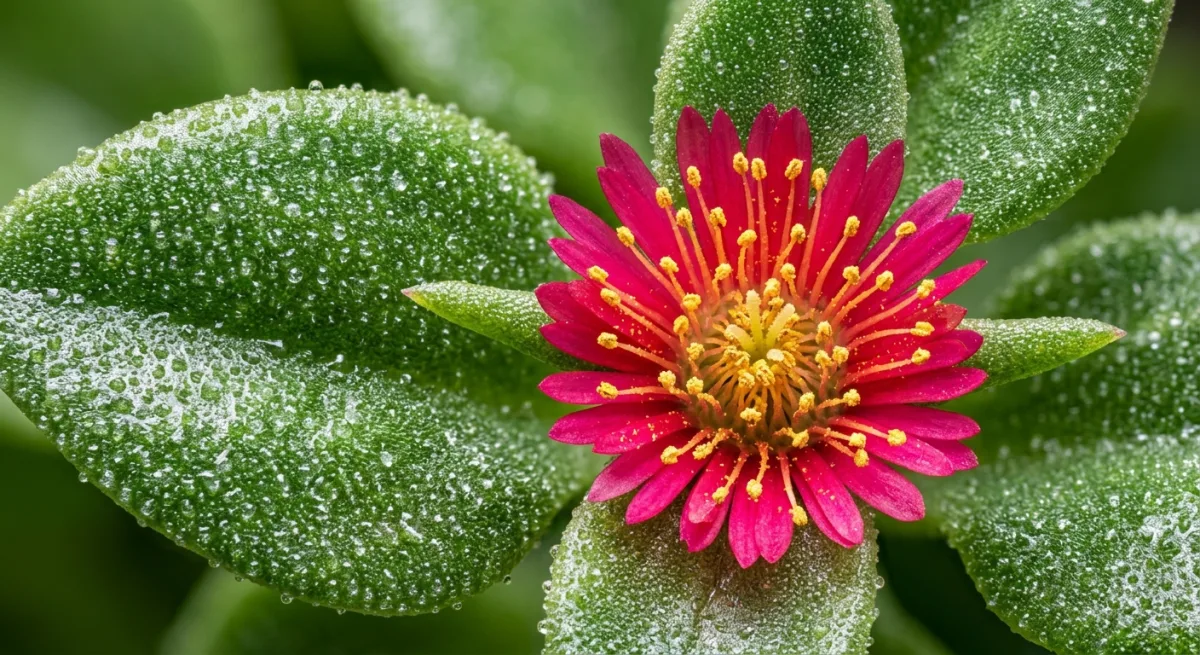
Picture a succulent draping like a lush emerald carpet over rocky cliffs along the Eastern Cape of South Africa, kissed by ocean breezes, salt spray, and radiant sunlight. Aptenia cordifolia—recently reclassified botanically as Mesembryanthemum cordifolium and affectionately known across the globe as 'Baby Sun Rose'—delivers one of nature's most cheerful wake-up calls with its daisy-like, fuchsia-ruby flowers that unfurl at the first touch of morning light. Glistening across the surface of its heart-shaped leaves are microscopic water-storing bladder cells that sparkle like diamonds in the sun, elevating this vigorous plant from a humble groundcover to an enchanting horticultural spectacle.
Many plant enthusiasts first encounter Baby Sun Rose cascading from hanging baskets or trailing gracefully over dry-stone garden walls. Yet the true wonder of this plant lies in its remarkable adaptability, rapid rooting vigor, and resilient succulent constitution. Whether cascading down an apartment balcony railing or forming a dense, verdant canopy in a shallow terracotta bowl, Aptenia is a remarkably generous companion that rewards proper botanical care with an almost non-stop tapestry of blooms throughout the growing season.
1. Botanical Identity and Morphological Characteristics
Aptenia cordifolia is an esteemed member of the vast Aizoaceae family (the ice plant or fig-marigold family). While modern molecular phylogenetic research has formally placed it within the genus Mesembryanthemum as Mesembryanthemum cordifolium, commercial nurseries and everyday gardeners still fondly celebrate it under its classic botanical moniker, Aptenia cordifolia. Most robust, large-flowered red cultivars commonly encountered in cultivation belong to 'Red Apple', a vigorous hybrid between M. cordifolium and M. haeckelianum.
Morphologically, Baby Sun Rose exhibits a prostrate, sprawling, and pendulous growth habit. Its fleshy, four-angled cylindrical stems creep along substrates and spill effortlessly over container edges, readily putting down adventitious roots from every stem node that contacts the ground. The leaves are distinctly cordate (heart-shaped) to broadly ovate, tender yet succulent. The most captivating feature of this foliage is the presence of specialized epidermal papillae known as idioblasts or 'water bladders'. When direct sunlight strikes these crystalline cells, the leaves shimmer as if adorned with morning dew or finely crushed quartz.
The blossoms display fascinating heliotropic and nyctinastic behaviors. They open fully only under the direct stimulation of bright, warm sunlight; during overcast days or as twilight descends, the petaloid staminodes (modified sterile stamens) contract snugly around the pistil and fertile stamens. This protective morphological reflex shields the delicate reproductive pollen grains from ambient night moisture, fog, and chilling temperatures.
2. Light Requirements and Indoor Placement
Baby Sun Rose is an unapologetic sun worshipper. Having evolved along open coastal cliffs and dry coastal scrubland with zero canopy shade, it demands a minimum of 5 to 6 hours of direct, unfiltered sunlight each day to maintain dense leaf nodes and produce an abundance of flower buds.
When grown in low-light indoor environments, Aptenia cordifolia quickly succumbs to etiolation. Stem internodes stretch out thinly, the plump cordate leaves become frail, narrow, and dull, and the plant ceases flowering altogether as energy is diverted solely toward hunting for light.
For indoor culture, position your pot directly on an unshaded south- or southwest-facing windowsill. However, this species thrives with unmatched vitality when kept outdoors during spring and summer—basking on sunny balconies, patios, or in open hanging baskets. It exhibits supreme heat tolerance, effortlessly shrugging off sweltering summer afternoons even in Mediterranean climates, provided the root zone remains sufficiently aerated and does not bake excessively in black, heat-trapping plastic pots.
3. Watering Discipline: The 'Soak and Dry' Method
As with the vast majority of succulents, the single greatest threat to Baby Sun Rose is overzealous care—specifically, chronic overwatering. Dousing your succulent on a rigid weekly calendar is not an act of love; it deprives the root system of vital oxygen and suffocates the plant from below. While Aptenia grows faster and consumes somewhat more moisture than extreme xeric Aizoaceae relatives (such as Lithops or Conophytum), its root architecture remains inherently intolerant of stagnant moisture.
Your watering regimen must adhere strictly to the botanical 'Soak and Dry' principle:
- Substrate Verification: Insert a clean wooden skewer or your finger deep into the root zone. If you detect any coolness or damp substrate clinging to the probe, withhold water. Wait until the container has dried out completely.
- Turgor Pressure Assessment: When leaf cells are fully turgid, the foliage feels firm and plump. When the lower leaves begin to soften slightly, lose their diamond-like luster, and show subtle micro-wrinkles along the stem base, cellular turgor is depleted, signaling that it is time to water thoroughly.
- Deep Saturation: When watering, saturate the entire root ball evenly until water pours freely from the drainage holes. Allow the pot to drain fully, and empty the drip saucer within 15 minutes to prevent perched water tables.
4. Ideal Substrate Formulation and Pot Selection
Baby Sun Rose relies on rapid gas exchange and superior root aeration rather than prolonged water retention in the soil matrix. Dense garden loam, heavy compost, or pure peat moss will quickly compact, choke delicate root hairs, and foster anaerobic root-rotting pathogens. The ideal growing medium must possess high mineral porosity, allowing surplus water to drain through in mere seconds.
The following custom formulation provides exceptional drainage, aeration, and longevity for both hanging baskets and mixed succulent planters:
| Substrate Component | Ratio by Volume (%) | Morphological & Physical Function |
|---|---|---|
| Pumice (3–5 mm) | 35% | Creates porous aeration pockets and guarantees rapid gravitational drainage |
| Crushed Lava Rock (Scoria) | 20% | Provides micro-porous root anchorage and essential trace minerals |
| Zeolite (Clinoptilolite) | 15% | Offers exceptional cation exchange capacity (CEC) to buffer nutrients |
| Sterile Peat Moss or Coir | 25% | Supplies a lightweight organic buffer for balanced moisture retention |
| Coarse Perlite | 5% | Lightens the overall mix density and keeps the upper root plane aerated |
Regarding container choices, unglazed terracotta pots or well-perforated hanging baskets are superior. The breathable, microporous walls of terracotta allow excess moisture to evaporate laterally, serving as a forgiving safety buffer against overwatering. Because of its spreading, trailing habit, wide shallow planters (succulent bowls) or elevated hanging baskets give the root system room to breathe while letting the stems cascade in their natural form.
5. Step-by-Step Propagation Techniques
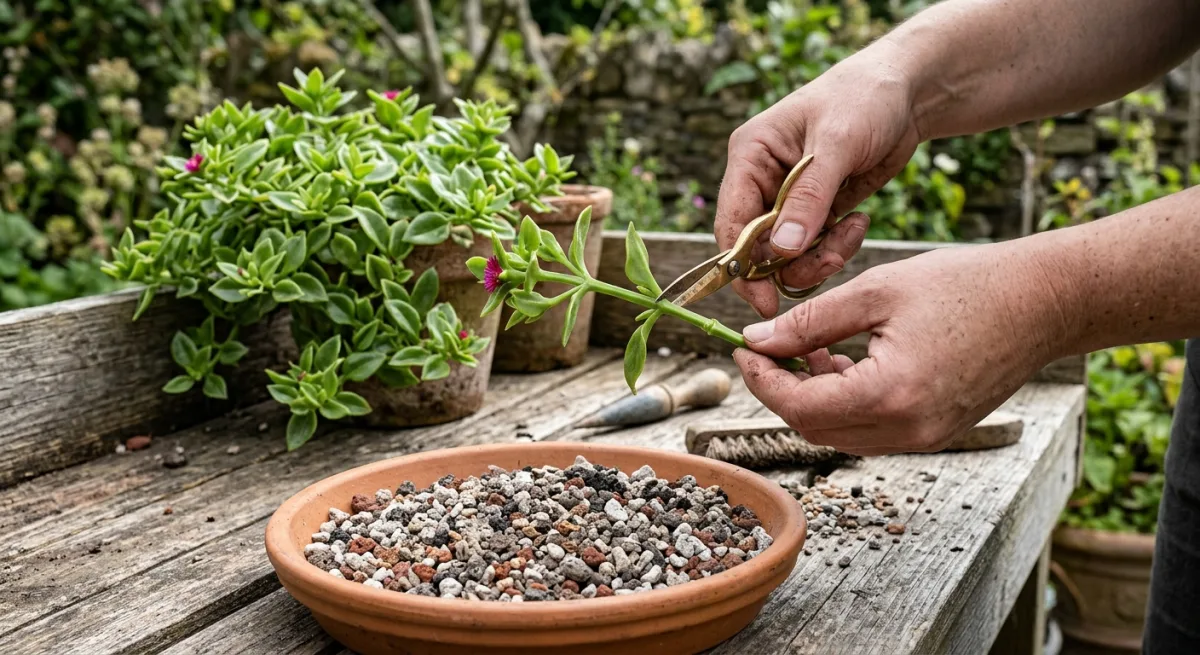
Aptenia cordifolia is celebrated as one of the easiest succulents to propagate, boasting nearly a 100% success rate. The meristematic cells concentrated at every stem node stand ready to initiate adventitious root primordia the moment they encounter a suitable, slightly moist substrate.
- Harvesting Healthy Cuttings: Using an alcohol-sterilized razor blade or sharp bypass pruners, snip a robust, non-flowering stem cutting roughly 8 to 12 cm (3 to 5 inches) long, ensuring it contains at least 3 to 4 healthy leaf nodes.
- Stripping Lower Foliage: Gently pinch away the leaves from the bottom 1 or 2 nodes. This exposes the nodal meristems from which vigorous root clusters will swiftly emerge once planted.
- Callus Formation: Resist the urge to plunge fresh, moist cuttings directly into damp soil. Place the cuttings in a warm, dry, shaded spot with good airflow for 24 to 48 hours. Allowing the cut wound to form a dry, suberized callus layer creates an impenetrable barrier against bacterial and fungal infections.
- Planting: Insert the callused end into a dry, gritty succulent soil blend, burying the stripped nodes firmly beneath the surface. Do not water for the first 3 to 4 days.
- Rooting Phase: Starting on day 4 or 5, lightly mist the surface of the substrate or apply a modest drizzle of water around the cutting's perimeter. Keep the cutting in bright, indirect light. Within 10 to 14 days, sturdy white roots will establish. As soon as vibrant new growth emerges at the stem tip, transition the plant to direct morning sunlight and normal watering practices.
6. Common Pests, Diseases, and Treatments
Despite its innate hardiness and thick cuticle layer, environmental imbalances can invite physiological stress and opportunistic pests:
- Root and Crown Rot (Phytophthora & Pythium): The direct byproduct of compacted, soggy soil and inadequate drainage. Stems turn translucent, black, and mushy near the soil level. Treatment: Immediately unpot the plant, excise all necrotic tissue back to healthy, firm green stem with a sterile blade, dust the cut with sulfur powder or ground cinnamon, let it callus, and reroot in fresh, sterilized, highly mineral substrate.
- Mealybugs (Pseudococcidae): These sap-sucking pests congregate in leaf axils and beneath dense new shoots, disguising themselves as white, cottony tufts. They drain phloem sap, leading to chlorosis and leaf drop. Treatment: Dab individuals directly with a cotton swab dipped in 70% isopropyl alcohol. For extensive infestations, spray thoroughly with a cold-pressed horticultural neem oil solution in the evening hours out of direct sun.
- Red Spider Mites: Under hot, bone-dry, dusty conditions, these micro-arachnids spin fine webbing on leaf undersides, leaving behind stippled, yellow necrotic speckles. Treatment: Rinse the foliage thoroughly with a gentle stream of lukewarm water, boost room ventilation, and apply an organic insecticidal soap or miticide if populations persist.
7. Seasonal Care Calendar and Expert Tips
To keep your Baby Sun Rose overflowing with color, vigor, and structural balance, synchronize your horticultural care with the changing seasons:
- Spring (Reawakening & Pruning): Once all threat of winter frost has passed, prune the plant hard. Cutting back leggy, overwintered shoots triggers a burst of lateral branching, yielding a bushier crown and hundreds of new flowering tips. Feed once a month with a balanced, low-nitrogen liquid succulent fertilizer (such as an NPK 5-10-10) diluted to half strength.
- Summer (Peak Flowering & Sunlight): This is the golden apex of bloom production. Water thoroughly whenever the soil dries completely. Deadheading spent flower heads prevents the plant from expending vital metabolic energy on seed capsule formation, redirecting its resources into non-stop bud initiation.
- Autumn (Transition & Slowdown): As temperatures dip and photoperiods shorten, halt all fertilization. Lengthen intervals between waterings to allow the plant tissues to harden off naturally. If your plant lives outdoors, relocate it under sheltered eaves to protect it from heavy autumn downpours.
- Winter (Dormancy & Frost Protection): Aptenia cordifolia can briefly tolerate light frost down to -2°C or -3°C (28°F to 26°F), but prolonged freezes will turn its succulent tissues to mush. In cold-winter regions, move outdoor containers indoors before the first hard frost, stationing them in a bright, cool room (8°C to 12°C / 46°F to 54°F) while keeping the soil dry.


Reader Reviews & Comments 3 Reviews
Eleanor Vance
Clara Higgins
Marcus Sterling
Leave a Review & Rating
Share your plant care tips, experiences, or questions with our succulent community.