






Journeying from the rugged, semi-arid slopes of South Africa’s Eastern Cape to the sun-drenched corners of our living rooms, the jade plant (Crassula ovata) has captured the hearts of botanists and interior plant enthusiasts alike for centuries. In its natural habitat, under a blazing sun, this timeless succulent matures into a sturdy, woody shrub, defying prolonged droughts with the clear water reservoirs sealed within its leaves. Indoors, its glossy emerald sheen brings a serene, grounding elegance and vital natural energy to any space.
Known colloquially as the money tree, friendship succulent, or lucky plant, this iconic species can, with mindful care, become a living family heirloom passed down through generations. However, merely keeping a jade plant alive differs profoundly from helping it flourish into a magnificent miniature specimen. From ensuring root cells have uninterrupted access to atmospheric oxygen to stimulating anthocyanin pigmentation along leaf margins under intense sunlight, let us explore the biological inner workings of this extraordinary succulent.
1. Botanical Identity and Morphological Adaptations
Crassula ovata is one of the most characteristic members of the family Crassulaceae. Its defining morphological hallmarks include a thick, fleshy central stem that gradually acquires a smooth, segmented, woody bark as it matures, paired with opposite, obovoid (reverse-egg-shaped) leaves. These leaves are coated with a resilient, waxy cuticle layer that serves as a protective shield against transpirational water stress.
Metabolically, the plant utilizes Crassulacean Acid Metabolism (CAM photosynthesis). To survive extreme daytime heat, it keeps its microscopic pores (stomata) tightly sealed during daylight hours, eliminating water loss through transpiration. At night, as temperatures drop, it opens these pores to capture and chemically sequester carbon dioxide. This specialized cellular adaptation makes the jade plant remarkably forgiving of occasional neglect. Furthermore, when mature specimens receive an optimal autumn chilling period, they reward their growers in late winter with delicate clusters of star-shaped, white-to-pale-pink blossoms.
2. Light Requirements and Strategic Indoor Placement
The jade plant is an unapologetic sun worshipper. Adapted to thrive beneath open African skies, it requires a minimum of 4 to 6 hours of bright, direct sunlight or intense unfiltered light each day in home environments. When light levels are inadequate, the stems rapidly stretch and weaken, internodes elongate unnaturally (etiolation), and the branches eventually droop under their own fleshy weight.
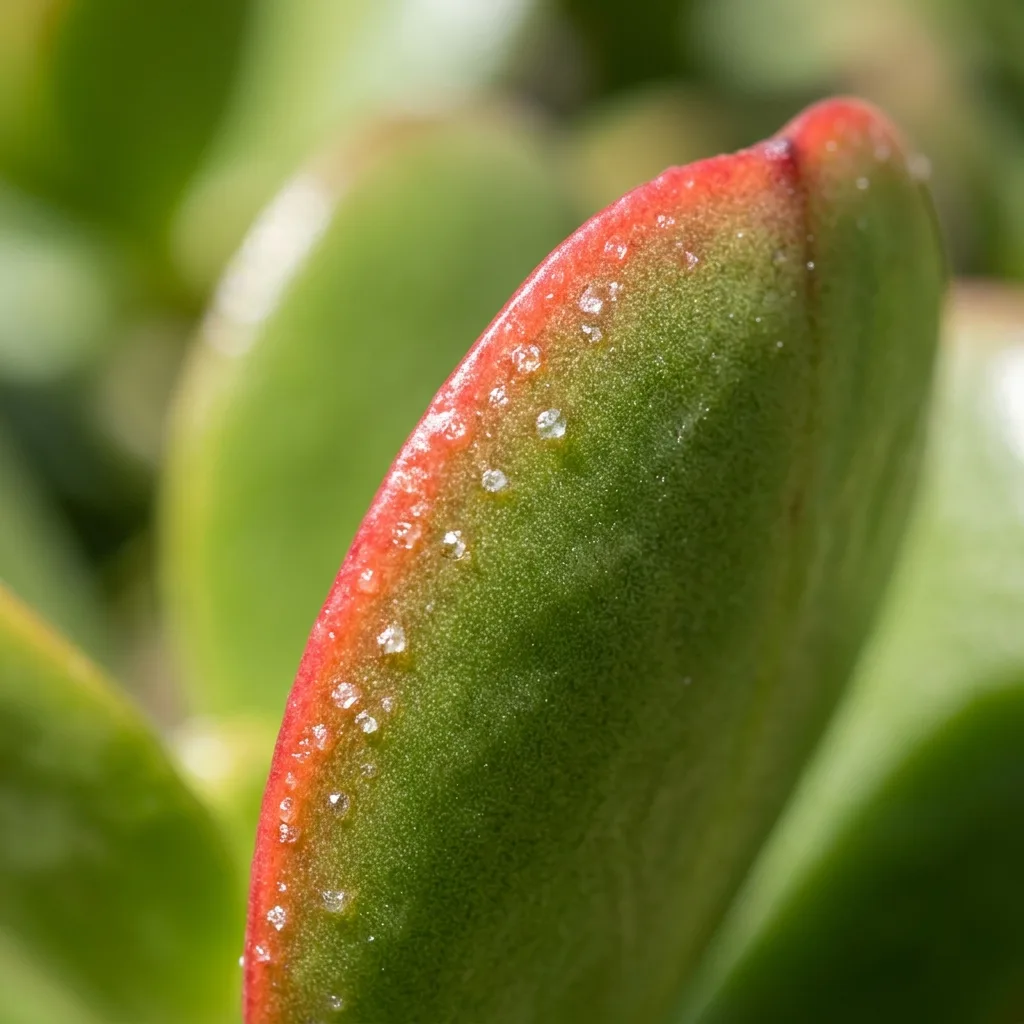
A south- or west-facing windowsill provides an optimal microclimate. When exposed to sufficient ultraviolet radiation, the margins of the emerald leaves produce 'anthocyanins'—protective red pigments that act as a natural sunscreen. This ruby-red halo is a dependable visual indicator that your plant is thriving under ideal light intensity. During peak midsummer heat, however, if glass magnification produces intense greenhouse heat, provide sheer curtain filtration during midday hours to prevent thermal leaf scorching.
3. Watering Discipline: The 'Soak and Dry' Protocol
The swiftest route to losing a jade plant is watering on a rigid calendar with small, frequent sips out of fear that it might get thirsty. Dousing succulents constantly is not an act of devotion; it suffocates delicate root hairs by depriving them of oxygen. The expansive parenchyma cells within jade leaves store massive reserves of water; thus, prolonged soil moisture—never temporary dryness—is the fatal threat.
The golden rule is the Soak and Dry method. Before introducing water, insert a wooden moisture meter probe or your finger at least 4 to 5 centimeters deep into the root zone. Only if the probe emerges bone dry and the lower leaves feel slightly yielding rather than turgid and firm should you irrigate. Saturate the root ball thoroughly until water drains freely from the drainage holes, and always empty the drip tray after 15 minutes to prevent perched water tables.
4. Substrate Composition and Pot Selection
The fine root system of Crassula ovata demands excellent air circulation. Standard peat-heavy indoor potting soils behave like a saturated sponge, suffocating roots and triggering decay. Therefore, your potting substrate should consist of at least 60% inorganic, porous aggregates.
| Substrate Component | Ratio (%) | Botanical Function & Soil Benefit |
|---|---|---|
| Coarse Pumice (3-6 mm) | 35% | Creates durable aeration pathways and provides continuous oxygen to the root zone. |
| Crushed Lava Rock / Zeolite | 25% | Suppresses root rot pathogens, provides structural weight, and accelerates drainage. |
| Premium Succulent Peat / Coco Coir | 30% | Delivers base organic matter and moisture buffering for root anchors. |
| Perlite or Coarse River Sand | 10% | Preserves overall soil porosity and prevents compaction at the base of the container. |
Regarding containers, unglazed terracotta pots remain unsurpassed. The natural micropores within unglazed clay allow moisture to evaporate outward through the container walls, accelerating drying cycles. In addition, because jade plants develop heavy, top-heavy canopies, the physical ballast of thick clay prevents accidental toppling.

5. Step-by-Step Propagation Techniques
Crassula ovata is renowned for its remarkable regenerative capacity. Propagating a new specimen from stem cuttings or even a single healthy leaf is a straightforward and rewarding horticultural endeavor.
- Stem Cuttings: In spring or early summer, select a robust branch 8-10 cm long with at least 2-3 leaf nodes. Make a clean cut using a sterilized, razor-sharp pruning knife. Gently strip the bottom leaves. Place the cutting in a shaded, well-ventilated area for 3 to 5 days until a protective calloused tissue seals the cut surface. Insert the calloused stem into dry, pumice-rich succulent substrate, and wait 5 days before offering light moisture. Strong structural roots typically establish within three weeks.
- Single Leaf Propagation: Select a plump, undamaged leaf and gently twist it side-to-side until it detaches cleanly from the main stem with its basal meristem intact. Rest the leaf on a dry surface for two days to callous. Place it horizontally on top of a shallow tray of porous potting mix—do not bury the leaf base. Keep the tray in bright, indirect light and mist the surface sparingly. Within several weeks, tiny pink feeder roots and a miniature leaf rosette will emerge from the leaf base.
6. Common Pests, Pathogens, and Physiological Disorders
While jade plants boast robust constitutions, environmental missteps can manifest as specific physiological or pest challenges:
- Mealybugs (Pseudococcidae): These sap-sucking insects appear as white, cotton-like masses clustered along leaf axils and stem crevices. Dip a cotton swab in 70% isopropyl alcohol and touch each insect directly to dissolve their protective wax coating; follow with an application of organic cold-pressed neem oil solution for extensive infestations.
- Translucent, Yellowing Dropping Leaves: This is the classic hallmark of overwatering and root asphyxiation. When root hairs die from moisture saturation, cellular membranes collapse, causing leaves to turn watery, yellow, and shed at the slightest touch. Unpot the plant immediately, prune blackened or mushy roots, allow the root system to air-dry, and repot in fresh, bone-dry inorganic substrate.
- Shriveled, Puckered Foliage: A sign of water deprivation or root loss. If the soil is completely dry, a deep bottom-watering soak will re-hydrate the parenchyma reserves, plumping the leaves back up within 24 to 48 hours.
7. Seasonal Care Calendar and Bonsai Styling
Spring (Regrowth and Pruning): March and April mark the start of active growth. This is the optimal window for structural pruning. Pinching or pruning back elongated branch tips forces back-budding along bare wood, thickening the primary trunk and crafting a dense, majestic bonsai silhouette. Feed monthly with a balanced, low-nitrogen succulent fertilizer diluted to half strength.
Summer (Sun Exposure and Airflow): Once night temperatures remain reliably above 15°C (59°F), transition your jade plant to an outdoor patio or balcony. Outdoor air movement strengthens trunk wood and virtually eliminates stagnant humidity-related fungal risks.
Autumn (Preparation): As night temperatures drop toward 10°C (50°F), bring the plant back indoors. Discontinue all fertilizer applications and widen intervals between waterings.
Winter (Rest and Floral Induction): Position the plant in a bright, cool room maintained around 10-15°C (50-59°F). This gentle temperature drop paired with natural short-day lighting cycles stimulates latent floral meristems to develop blooms by late winter.


Reader Reviews & Comments 3 Reviews
Marcus Sterling
Eleanor Vance
Claire Redfield
Leave a Review & Rating
Share your plant care tips, experiences, or questions with our succulent community.