






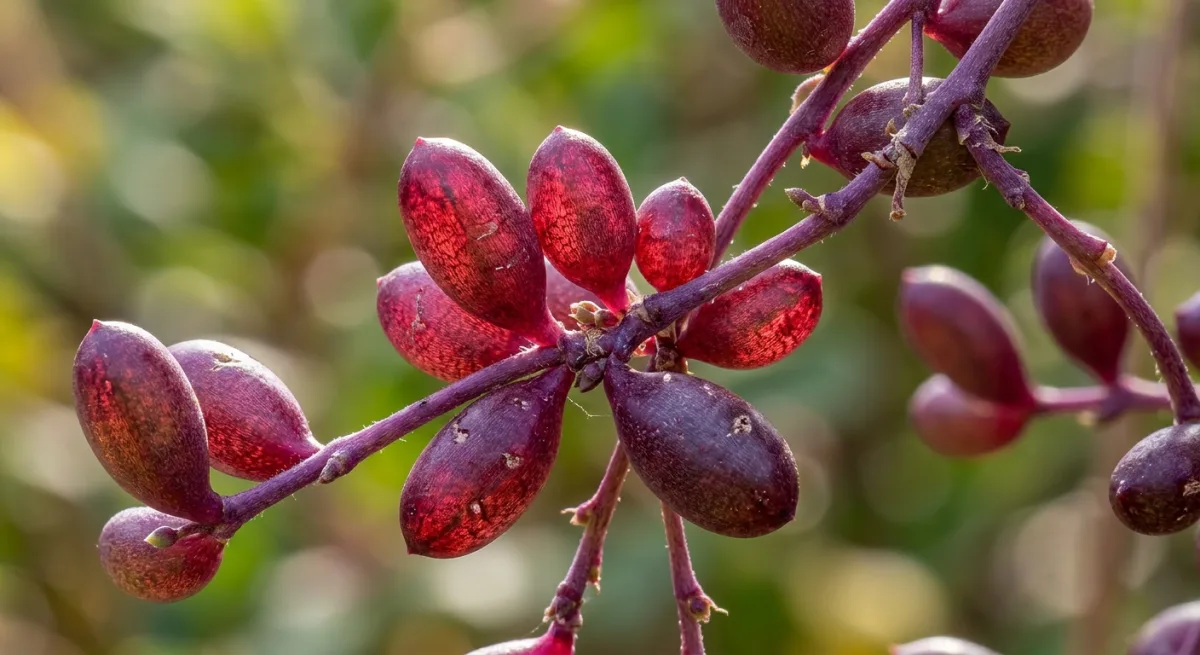
Draping gracefully from the rocky limestone fissures of South Africa's arid Little Karoo basin, Othonna capensis is one of the plant kingdom's most astonishing color alchemists. Universally celebrated by enthusiasts as 'Ruby Necklace' or 'String of Rubies', this extraordinary succulent transforms its emerald-green, bean-shaped cylindrical leaves into a breathtaking tapestry of magenta, violet, and deep ruby-red when bathed in radiant sunshine. Paired with slender purple stems, delicate yellow daisy-like blossoms, and bead-like foliage, it is not merely a hanging houseplant—it is living botanical jewelry.
While many plant parents enthusiastically bring this charmer home, few realize that it belongs to the dry-adapted lineage of Asteraceae (the daisy family). The way its plump leaves swell like miniature water reservoirs—or subtly deflate and turn violet during moisture deficits—serves as a direct cellular barometer of its physiological needs. When provided with an appropriate microclimate and fast-draining substrate, its cascading curtain of rubies will flourish for years. Let us delve into the cellular rhythms, light dynamics, and comprehensive care protocols required to cultivate this delicate desert gem in your living space.
1. Botanical Identity and Morphological Characteristics
Taxonomically nested within the Asteraceae family—and recently reclassified in contemporary botanical literature as Crassothonna capensis—Othonna capensis is a perennial, succulent-leaved trailing and creeping groundcover. Its stems are thin, pliable, and exhibit a pronounced purplish-red tint due to high concentrations of anthocyanin pigments. The leaves are sub-cylindrical, tapering gently toward their tips, forming fleshy, spindle-shaped water-storage structures.
At the cellular level, the leaf epidermis is protected by a thin waxy cuticle that drastically curtails transpiration against arid winds. The plant utilizes Crassulacean Acid Metabolism (CAM) photosynthesis, holding its stomata firmly closed during hot daylight hours to prevent moisture loss, only opening them at night to capture carbon dioxide. During spring and autumn, slender, wire-like pedicels arise from the leaf axils, bearing miniature yellow composite flowerheads (capitula) that unmistakably declare its kinship with daisies. The mesmerizing transition from emerald green to vivid amethyst is driven by photoprotective anthocyanins, which surge to shield photosynthetic chloroplasts from UV-induced oxidative stress.
2. Sunlight Requirements and Indoor Placement
The hallmark ruby-purple blush that defines this species depends entirely on light quality and intensity. In low-light environments, internodal spacing elongates dramatically (etiolation), the foliage thins, and the entire plant reverts to a monochromatic, dull green. To maintain vibrant pigmentation and compact nodes, provide a minimum of 4 to 6 hours of bright, direct or gently filtered sunlight daily via south- or west-facing windowsills.
If you transition your trailing basket outdoors during midsummer, introduce it gradually to gentle morning or late-afternoon sun rather than brutal midday rays. In its native habitat, Ruby Necklace often tucks its roots beneath the partial shade of rock overhangs; abrupt exposure to scorching temperatures exceeding 40°C (104°F) can trigger irreversible solar scorch patches on its turgid leaves. During winter months, suspend the basket in the brightest window available, supplementing with a full-spectrum LED grow light if natural light levels drop significantly.
3. Watering Discipline: The 'Soak and Dry' Protocol
Ruby Necklace possesses a remarkably shallow, fine capillary root architecture. Overwatering suffocates these delicate rootlets, sparking rapid hypoxia and fungal decay within days. The cardinal rule of watering this succulent is the classic 'soak and dry' method: never reapply water until the substrate has dried out completely from the top crust all the way down to the base of the pot.
The most reliable indicator of thirst is leaf turgor pressure. When the cylindrical foliage feels firm, plump, and smooth, withhold water. Once the leaves soften slightly, yield to a gentle squeeze, and develop subtle longitudinal wrinkles, it is time for a thorough drenching. Water evenly until moisture runs freely from the drainage holes, and be sure to empty any runoff collected in the saucer after 15 to 20 minutes.
4. Substrate Optimization and Container Selection
Othonna capensis cannot tolerate standing moisture around its root zone. Standard peat-heavy indoor potting soils act as a death sentence, holding moisture for weeks and suffocating fragile roots. What this plant requires is a gritty, highly porous substrate characterized by rapid drainage, low moisture retention, and high gas exchange.
Always choose pots equipped with generous drainage holes. Unglazed terra cotta containers are exceptional because their porous clay walls facilitate evaporative moisture loss from all sides, keeping the root environment oxygenated. For hanging displays, coco-coir lined wire baskets or well-aerated nursery pots provide superb air circulation.
| Component | Proportion (%) | Agronomic & Botanical Function |
|---|---|---|
| Fine Horticultural Pumice (3–5 mm) | 35% | Creates stable macro-pores, promotes aeration, and prevents soil compaction. |
| Red Lava Rock (Scoria) / Zeolite | 25% | Maintains cool root temperatures, releases micro-minerals, and ensures rapid drainage. |
| Sifted Low-Dust Peat or Coir Fiber | 30% | Supplies organic anchor medium with a slightly acidic pH (6.0–6.5) for root uptake. |
| Coarse Horticultural Perlite or Gritty Sand | 10% | Enhances structural porosity and allows delicate capillary roots to spread effortlessly. |
5. Step-by-Step Stem Cutting Propagation
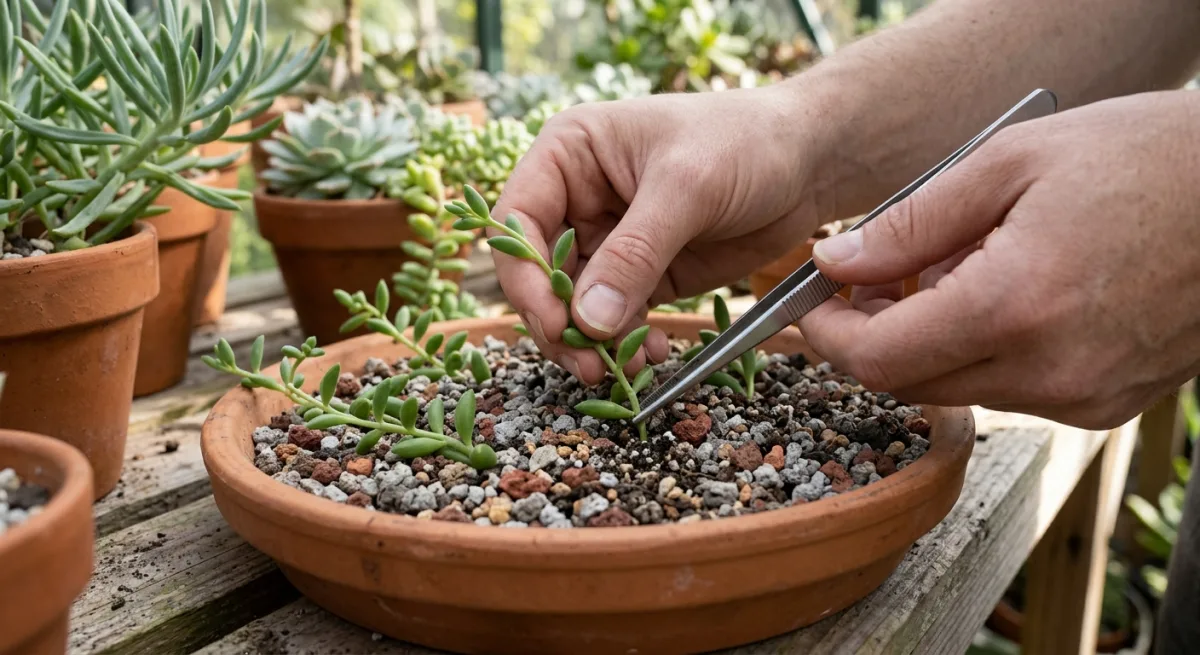
Among all trailing succulents, Ruby Necklace is arguably the fastest and most forgiving to root. While leaf propagation is notoriously unreliable in this species, stem cuttings offer an astonishingly high success rate because every stem node contains latent adventitious root primordia.
- Harvest Healthy Stem Cuttings: Using clean, sterilized pruning shears, snip an 8–12 cm (3–5 inch) robust trailing stem that has at least 4 to 6 healthy leaf nodes.
- Callus Formation: Gently pinch off the bottom 2 or 3 leaves to expose bare nodes. Do not plant the cutting immediately; place it in a shaded, warm, well-ventilated spot for 24 to 48 hours so the cut end can form a firm, protective suberized callus, preventing pathogen entry.
- Substrate Planting or Pinning: Insert the bare nodal section directly into pre-moistened, gritty succulent mix, or lay the stem horizontally across the soil surface, pinning the nodes down with a bent wire or hairpin to encourage multiple rooting points.
- Rooting Phase: Keep the cutting dry for the first 4 to 5 days. Thereafter, lightly mist the soil surface around the nodes every few days. Within 2 to 3 weeks, vigorous white roots will anchor into the mix, followed shortly by fresh, vibrant new shoots.
6. Common Pests, Diseases, and Therapeutic Solutions
The primary threats to Othonna capensis are mealybugs (Pseudococcidae) and root rot pathogens—chiefly water-mold oomycetes such as Phytophthora and fungi like Fusarium—stemming from poorly aerated, waterlogged soil. Mealybugs congregate within the dense leaf axils and along tender new terminal growth, appearing as cottony white deposits.
At the first sign of mealybugs, dab them individually using a cotton swab dipped in 70% isopropyl alcohol. For widespread infestations, apply a thorough evening spray of organic cold-pressed neem oil emulsified with mild horticultural soap. If lower leaves become translucent, mushy, and the base of the stem turns black, root rot has progressed. Immediately salvage healthy upper growth by taking clean stem cuttings above the infection zone, discard the contaminated soil, and propagate anew.
7. Seasonal Growth Cycle and Cultural Calendar
The developmental rhythm of Ruby Necklace follows seasonal temperature and photoperiod shifts:
- Spring (March – May): Active vegetative waking period. Daisy-like yellow blossoms appear as daylight lengthens. Water as soon as the potting mix dries out. Apply a balanced succulent fertilizer diluted to quarter-strength once a month.
- Summer (June – August): Under sustained extreme heat (above 32°C / 90°F), growth slows as the plant enters partial dormancy (estivation). Extend watering intervals, maintain excellent ventilation, and shield from harsh midday sun.
- Autumn (September – November): A secondary burst of active growth and peak color intensification. Cooler nighttime temperatures combined with sunny days trigger the most breathtaking ruby-purple foliage display.
- Winter (December – February): Cold-sensitive; keep temperatures safely above 7–10°C (45–50°F). Protect from frosty window drafts. Reduce watering strictly to maintenance levels—water only when the leaves show visible signs of dehydration and wrinkling.


Reader Reviews & Comments 3 Reviews
Clara Higgins
Eleanor Vance
Marcus Thorne
Leave a Review & Rating
Share your plant care tips, experiences, or questions with our succulent community.