






Clinging to weathered tree bark and moss-draped limestone crevices across the mist-shrouded montane slopes of South America, the Orange Epiphytic Cactus, scientifically known as Pfeiffera monacantha (formerly Lepismium monacanthum), defies every conventional stereotype of desert cacti. Far from sun-scorched dunes and punishing aridity, this forest epiphytic succulent thrives on dappled canopy light, active atmospheric circulation, and the refreshing kiss of morning dew. Producing luminous salmon-orange to apricot blossoms along the margins of flattened, notched stems, it gracefully combines the structural resilience of a succulent with the airborne elegance of a tropical orchid.
Cultivated in hanging baskets or placed upon pedestals indoors, it immediately imparts the lush atmosphere of a tropical greenhouse. However, treating this cloud-forest native like a standard desert cactus—either subjecting it to bone-dry neglect or suffocating it in heavy, dense potting soil—is one of the most common pitfalls indoor gardeners encounter. Unlocking its full vitality requires honoring its epiphytic heritage by providing a highly porous, well-oxygenated microenvironment where its root system can truly breathe.
1. Botanical Profile and Morphological Adaptations
Belonging to the Cactaceae family within the genus Pfeiffera, Pfeiffera monacantha was long classified under Lepismium and Rhipsalis before granular morphological and molecular revisions solidified its distinct status. Its wild native range spans the montane Yungas forests of Bolivia and northwestern Argentina at elevations ranging between 1,000 and 2,000 meters above sea level.
The plant produces pendulous, flattened, ribbon-like stem segments known botanically as cladodes. These stems feature gently undulating, scalloped, or bluntly serrated margins. The specific epithet monacantha translates from Greek as 'single-spined', referencing the solitary (occasionally paired) tiny, bristly spine nestled within each marginal areole. These are not vicious, puncture-prone spines; rather, they serve as an evolutionary adaptation designed to provide tactile friction and mechanical anchoring as the stems trail over mossy host limbs.
Blooming in late spring to early summer, its flowers display an intense, warm tangerine, apricot, or rich pumpkin hue—a rare color palette within the epiphytic cactus tribe. Following pollination, these blossoms transition into spherical, glossy orange-red berries that remain ornamental on the stems for several months. The root architecture is entirely fibrous and superficial; instead of developing a thick anchor taproot, it produces an extensive network of fine, absorbent feeder roots engineered for rapid gas and moisture exchange.
2. Light Requirements and Optimal Indoor Placement
Pfeiffera monacantha is inherently vulnerable to the searing ultraviolet radiation of intense midday sunlight. If exposed to the blazing eight-hour sun typical of arid desert environments, its cladodes suffer rapid chlorophyll degradation, taking on a bleached, pale-yellow pallor, followed by permanent, corky sunburn scars along the areoles.
The ideal lighting regime consists of gentle, early-morning direct sun or bright, dappled, filtered light sustained throughout the day. An unobstructed east-facing windowsill provides ideal natural illumination. If positioned near south- or west-facing windows, shielding the plant behind a sheer curtain to diffuse peak afternoon rays is mandatory. Conversely, insufficient ambient light results in thin, etiolated growth, loss of structural rigidity, and a complete failure to initiate reproductive flower buds.

3. Watering Discipline: The 'Soak and Partially Dry' Protocol
Epiphytic cacti cannot tolerate standing water around their root crowns, yet they equally detest the bone-dry desiccation endured by desert species. Thanks to cellular water storage within their fleshy cladodes, they can withstand short dry spells; however, sustained vigorous growth throughout spring and summer demands regular, consistent hydration.
The golden rule of watering this epiphyte is straightforward: wait until roughly 60% to 70% of the potting medium has dried down from the surface, then saturate thoroughly until water runs freely from the drainage holes. Crucially, empty the drainage saucer within 15 minutes. Allowing the pot to sit in stagnant runoff triggers anaerobic conditions, suffocating root hairs and inviting rapid root cortex decay.
During the cooler winter rest phase, the plant's metabolic tempo slows considerably. Watering intervals must be extended, offering just enough moisture every two to three weeks (contingent on ambient room temperatures) to prevent the stems from shriveling or losing turgor pressure.
4. Ideal Substrate Formulation and Potting Dynamics
Pfeiffera monacantha cannot survive in standard, dense garden soil or purely peat-based commercial mixes. In habitat, its roots nestle into pockets of decomposing leaf litter, bark mosses, and airborne debris lodged in tree forks. Consequently, it requires an open, airy, mildly acidic substrate (pH 5.5 to 6.5) with exceptional porosity and rapid drainage capacity.
For container choice, hanging baskets with ample drainage holes or unglazed terracotta pots are ideal. The porous clay walls of terracotta facilitate lateral evaporation, helping to regulate core moisture levels and shielding vulnerable roots from fungal pathogen outbreaks.
| Substrate Component | Ratio (%) | Horticultural Function |
|---|---|---|
| Pine Bark (Fine/Orchid Grade) | 35% | Replicates natural epiphytic debris; creates indispensable structural oxygen pockets. |
| Pumice (3–5 mm) | 25% | Provides permanent drainage and structural stability without compacting over time. |
| Coconut Coir (Coco-peat) | 20% | Retains light, accessible moisture while preserving balanced acidic aeration. |
| Lava Rock or Zeolite | 15% | Micro-porous minerals that buffer nutrients and boost gas exchange. |
| Worm Castings / Mature Leaf Compost | 5% | Supplies gentle, slow-release biological nutrients and beneficial mycorrhizal flora. |
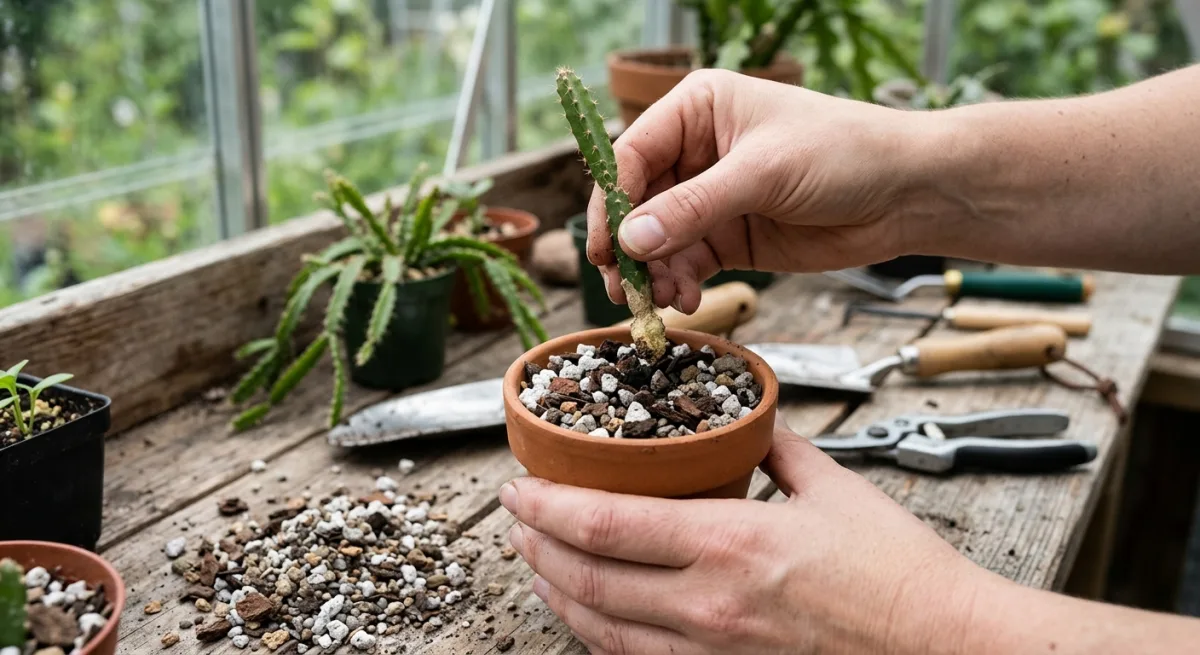
5. Step-by-Step Propagation Guide
Propagating the Orange Epiphytic Cactus is reliable and rewarding when utilizing stem segment cuttings. The optimal window for this procedure is mid-to-late spring, as the specimen emerges from its winter rest and surges into active vegetative growth.
- Select a Vigorous Stem: Choose a firm, mature, disease-free cladode segment measuring approximately 10 to 15 cm in length.
- Make a Clean, Sterile Cut: Disinfect a sharp scalpel or pruning shears with 70% isopropyl alcohol. Sever the segment cleanly at the joint node to minimize tissue bruising.
- Callus Formation: Never insert a freshly severed cutting directly into moist substrate. Place it in a shaded, well-ventilated, dry area for 3 to 5 days, allowing the wound to form a firm, whitish, protective callus. This step virtually eliminates the hazard of fungal invasion.
- Potting the Cutting: Insert the callused base approximately 2 to 3 cm deep into a lightly moistened blend of equal parts fine pumice and coco coir. Secure it with a small support stick if needed.
- Rooting Phase: Position the cutting in bright, indirect light at warm temperatures (20–24°C / 68–75°F). Keep the potting medium barely humid by misting the surface periodically. Avoid saturating the medium until roots establish, which typically takes 3 to 4 weeks. The emergence of fresh, bright green growth nodes confirms successful rooting.
6. Common Pests, Diseases, and Preventative Measures
While naturally robust under proper cultural care, environmental stressors can leave Pfeiffera monacantha vulnerable to several opportunistic pests and pathological disorders:
Mealybugs (Pseudococcidae): These sap-sucking pests appear as small, cottony white tufts tucked inside stem notches and areoles. They sap cellular fluids, causing stem deformities. Spot-treat minor colonies immediately using a cotton swab dipped in 70% isopropyl alcohol or apply cold-pressed neem oil. For advanced infestations, use a systemic horticultural insecticide.
Root Rot (Phytophthora & Fusarium): The direct consequence of poorly draining soil and overwatering. Basal cladodes turn translucent, yellowish, and mushy to the touch. Immediate remediation is crucial: unpot the specimen, prune away all black, necrotic roots with sterilized shears, cut back clean to healthy green tissue, let the cut callus, and re-root in a sterile, porous mix.
Spider Mites (Tetranychidae): Thriving in hot, dry, low-humidity indoor environments, these microscopic arachnids produce faint webbing and rust-colored stippling across the stems. Increasing ambient room humidity and periodically rinsing the plant with lukewarm water helps curb populations.
7. Seasonal Maintenance Calendar and Expert Tips
Aligning your care routine with the seasonal rhythm of Pfeiffera monacantha is the secret to dependable annual blooming:
Spring (Awakening & Budding): Gradually increase watering frequency starting in March. Apply a balanced, water-soluble epiphyte or cactus fertilizer diluted to quarter-strength once a month. Once floral buds form on the areoles, do not rotate, move, or relocate the pot, as sudden shifts in light orientation often trigger bud drop.
Summer (Active Growth & Berry Development): As flowers fade, small decorative berries develop. Water thoroughly whenever the top medium dries out. Moving the plant to a sheltered, breezy, partially shaded porch or balcony promotes thicker, more resilient cladodes.
Autumn (Hardening Off): As night temperatures drop toward 12–15°C (54–59°F), bring outdoor plants inside. Cease all fertilizer applications completely and widen the intervals between waterings.
Winter (Cool Rest Period): The physiological trigger for heavy spring flowering is a cool, bright winter dormancy. Maintain the plant in a cool, well-lit room between 10°C and 14°C (50–57°F). This temperature drop, paired with reduced watering, triggers floral bud differentiation along the cladode margins.


Reader Reviews & Comments 3 Reviews
Clara Evans
Julian Vance
Marcus Bennett
Leave a Review & Rating
Share your plant care tips, experiences, or questions with our succulent community.