






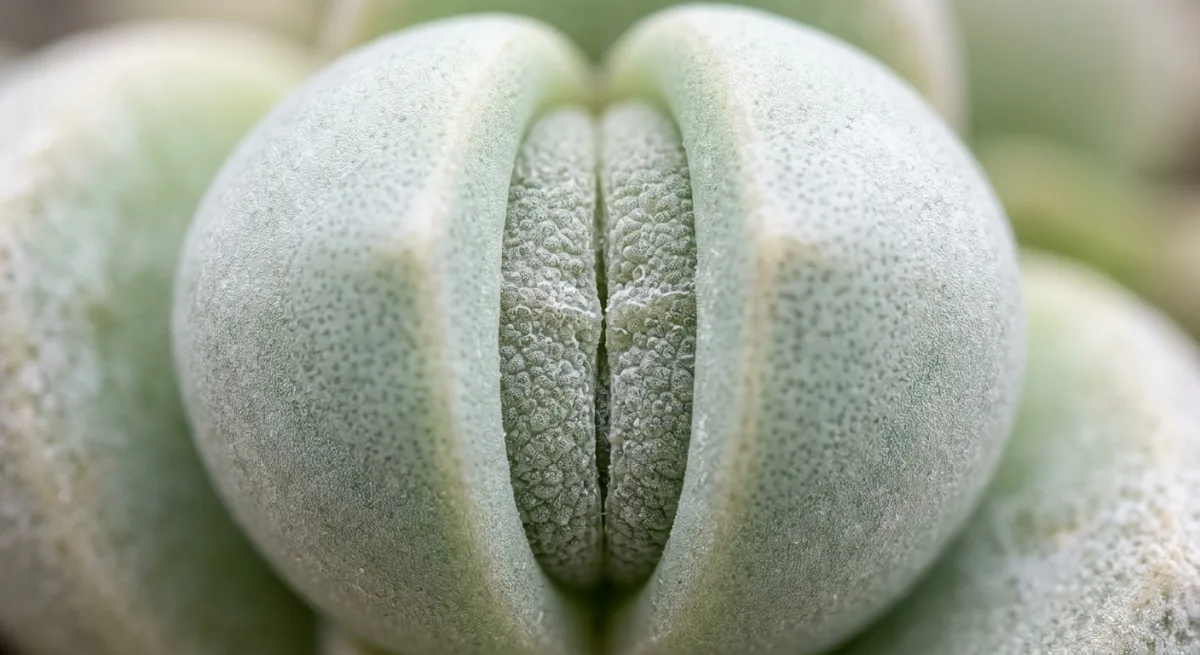
Deep within the sun-scorched plains of South Africa's Little Karoo basin, nestled among stark white quartz pebbles, lives a succulent so masterfully camouflaged that telling it apart from wind-weathered stones is nearly impossible. Commonly known to plant enthusiasts as the Baby's Bum succulent or Hedgehog mimic, Gibbaeum heathii stands as one of Mother Nature's supreme evolutionary masterworks against searing heat and bone-dry drought. Its nearly spherical, plump leaf pairs cradle scarce cellular water like liquid treasure, exuding an aura of serene patience on our sunniest windowsills.
For dedicated succulent lovers, this captivating member of the Aizoaceae family represents far more than a rare curiosity—it is a living connection to the ancient, untamed rhythms of southern African deserts. Yet do not let its silent, pebble-like guise deceive you: beneath that pale epidermis lies an intricately tuned biological engine, balancing cellular turgor pressure and an exquisite seasonal leaf-absorption cycle. In this master horticultural guide, we unpack every detail required to keep this Karoo gem flourishing under your care for decades to come.
1. Botanical Profile and Morphological Adaptations
Gibbaeum heathii is a dwarf perennial succulent belonging to the ice plant family, Aizoaceae, and the sub-family Mesembryanthema. In its indigenous habitat, it colonizes chalky shale ridges and open quartz gravel plains known locally as kwartslande. These brilliant white quartz stones reflect punishing solar radiation to keep underground root systems remarkably cool during blistering midday hours, while radiating stored warmth and condensing precious nighttime dew straight toward the plant's basal crown.
The most arresting feature of Gibbaeum heathii is its compact, sub-globose body, formed by two tightly fused, fleshy opposite leaves separated only by a narrow apical slit or fissure. Its velvety-smooth epidermis ranges in color from chalky silver-green to pale glaucous-blue, frequently blushing soft lavender-pink under intense, direct sunlight. Like many extreme arid succulents, it utilizes Crassulacean Acid Metabolism (CAM), locking its stomata tightly during scorching daylight hours and opening them exclusively under cool night skies to exchange carbon dioxide while minimizing water loss. In early to mid-spring, charming, daisy-like blossoms unfurl from the central fissure—sporting silky petals of porcelain-white, cream, or soft blush-pink that strike a breathtaking contrast against the stony foliage.
2. Sunlight Demands and Ideal Indoor Placement
Accustomed to unfiltered desert skies, Gibbaeum heathii is completely uncompromising when it comes to photon density. Skimping on light is the swiftest way to ruin its iconic shape; inadequate exposure triggers etiolation, causing the spherical form to stretch, the central fissure to gaping ruinously, and the tissue to soften into a vulnerable state.
Indoors, position your plant on an unobstructed south- or west-facing windowsill that delivers a minimum of 5 to 6 hours of direct, radiant sunlight daily. During peak summer heatwaves, intense sunlight magnified through double-paned window glass can occasionally scorch the epidermis; ensuring active airflow around the plant will prevent heat build-up. In regions where natural daylight falls short during dark winter months, high-output, full-spectrum LED horticultural lights set to a 12- to 14-hour daily photoperiod are an indispensable ally.
3. Watering Discipline: The 'Soak and Dry' Science
The single most catastrophic mistake in cultivating Gibbaeum heathii is treating it like a standard, leafy house succulent. Frequent, routine watering is not an act of affection—it is an accidental death sentence that suffocates fragile root hairs. This xerophytic marvel stores extensive moisture within its succulent cells and possesses root systems exceptionally vulnerable to anaerobic rot caused by stagnant water.
Adhere strictly to the 'soak and dry' philosophy, only wetting the substrate when it has dried out completely down to the bottom of the container. During active transitional seasons (autumn and mid-spring), supply a generous soak until water flows freely from drainage holes, emptying any pooled runoff immediately. During the height of summer heat and the cold depths of winter, the plant enters semi-dormancy; curtail hydration drastically to near-zero, offering only a gentle trickle once a month if the central globe shows excessive dehydration wrinkling.
4. Substrate Composition and Pot Selection
The soils of the Little Karoo are notoriously lean, largely stripped of humic organic content and packed with weathered minerals, crystalline quartz, and fractured rock. Consequently, standard commercial peat-based potting soils act as a lethal sponge for Gibbaeum roots. Your potting blend must consist of at least 80% to 85% coarse, inorganic, rapid-draining mineral aggregates.
Container choice is equally vital: select unglazed terracotta pots over plastic or glazed ceramics. The porous clay walls breathe, allowing excess moisture to evaporate laterally from the root core. Furthermore, because Gibbaeum heathii establishes a surprisingly long, anchoring taproot, bypass shallow saucer dishes in favor of standard-depth pots measuring at least 8 to 10 cm (3 to 4 inches) deep.
| Substrate Component | Ratio (%) | Botanical Function & Benefit |
|---|---|---|
| Horticultural Pumice (2-4 mm) | 40% | Provides supreme macroporosity, aerating roots and preventing compaction. |
| Crushed Lava Rock / Scoria | 25% | Heavy porous mineral aggregate that speeds drainage and anchors taproots. |
| Zeolite or Coarse Quartz Grit | 20% | Optimizes cation exchange while faithfully replicating wild quartz scree. |
| Sterile Low-Peat Cactus Soil | 15% | Supplies structural cohesion and trace organic micro-nutrients. |

5. Step-by-Step Propagation Methods
Propagating Gibbaeum heathii requires a measured blend of horticultural patience and surgical hygiene. The plant can be reliably multiplied through two distinct approaches: germinating botanical seed or dividing mature clumping mounds.
- Propagation from Seed: The most rewarding method for collectors. Sow fresh seeds in early autumn or early spring onto the surface of a sterilized, finely screened mineral substrate. Do not bury them—seeds require ambient light cues to break dormancy. Mist the surface gently with distilled water, cover with a clear humidity dome maintaining roughly 80% relative humidity, and hold at 18-22°C (64-72°F). Sprouting typically commences within 2 to 4 weeks; introduce gentle ventilation as soon as cotyledons emerge.
- Division of Clumps (Offsets): Over several seasons, an individual specimen naturally branches out from its subterranean stem to create multi-headed colonies. In early spring prior to active growth, gently dislodge the cluster and sever offset pairs—ensuring each division retains its own portion of the rootstock—using a sterile razor. Dust the wounded tissues with sulfur powder or ground cinnamon, allow the cuttings to callus in a warm, dry, shaded spot for 4 to 5 days, and pot them into dry mineral mix. Delay the initial watering for roughly 10 days.
6. Common Cultivation Pitfalls, Pests, and Remedies
While evolutionarily built to endure grueling environmental extremes, this desert jewel can struggle quickly when indoor culture diverges from its physiological needs:
- Root and Stem Rot (Fusarium / Pythium): Driven by dense substrates, glazed pots, or wet winter conditions. Symptoms present as base softening, translucence, and dark decay. To rescue the specimen, unpot it immediately, excise all blackened tissue with an ethanol-sterilized scalpel, dry the cut surface completely, and reset in 100% dry pumice.
- Epidermal Splitting (Edema): Occurs when a chronically desiccated specimen suddenly absorbs an overwhelming volume of water, forcing cells to expand faster than the thick outer cuticle can yield. While permanent, these physical fissures are non-lethal scars. Keep the plant well-ventilated and dry; the split pair will eventually be absorbed and replaced during the subsequent leaf-renewal phase.
- Mealybugs (Pseudococcidae): These stealthy pests congregate in the sheltered junction where leaf pairs meet or down around the root crown, sheltering beneath white cottony filaments. Dab them away individually using a cotton swab saturated in 70% isopropyl alcohol. For subterranean root mealybug outbreaks, bare-root the plant and rinse with an appropriate horticultural drench.
7. Seasonal Rhythm Calendar for Healthy Growth
Nurturing Gibbaeum heathii boils down to syncing your watering can with the plant's internal seasonal calendar:
- Spring (Awakening & Flowering): As ambient temperatures stabilize around 18-24°C (65-75°F), winter dormancy lifts. Blooms develop from the fissure. Resume deep, spaced waterings as the soil dries out entirely. A single application of a low-nitrogen, high-potassium liquid succulent fertilizer diluted to quarter-strength is beneficial.
- Summer (Semi-Dormancy): Temperatures soaring past 30°C (86°F) prompt the plant to idle its metabolism to conserve moisture. Cease scheduled watering, keep the root zone mostly dry, provide maximum fresh airflow, and buffer against focused greenhouse glass heat.
- Autumn (Peak Vegetative Growth): Mirrors the brief rainy cycles of the southern African desert. This is when new internal leaf bodies swell. Water thoroughly every time the substrate completely dries out down to the drainage holes.
- Winter (Rest & Leaf Translocation): Maintain cool, dry conditions between 8-12°C (46-54°F), protecting strictly against sub-zero freezes. As the outer leaves slowly wrinkle and yield their nutrient reserves to the new emerging core, suspend watering entirely.


Reader Reviews & Comments 3 Reviews
Eleanor Vance
Marcus Sterling
Clara Higgins
Leave a Review & Rating
Share your plant care tips, experiences, or questions with our succulent community.