






Picture yourself standing on the cool, mist-kissed slopes of the Serra dos Órgãos mountains in the state of Rio de Janeiro, Brazil, where emerald peaks kiss low-drifting cloud banks. Perched 1,500 meters above sea level, clinging to the moss-carpeted boughs of ancient canopy trees, hang delicate, segmented stems: this refined forest beauty is Schlumbergera russelliana, one of the most breathtaking epiphytic succulents known to botanical science. Widely celebrated as the elusive botanical ancestor of the ubiquitous holiday hybrids, this heirloom species—often honored as the genuine, wild True Christmas Cactus—remains the quintessential holy grail for discerning botanical collectors and indoor jungle curators alike.
For those accustomed to the sun-baked sands and relentless, parched droughts favored by classic desert cacti, Schlumbergera russelliana represents a complete paradigm shift. Rather than sinking anchor taproots into deep, mineral-heavy ground, this species functions as an obligate forest epiphyte, subsisting on leaf litter humus and moss pockets wedged in tree bark crevices. It actively recoils from blistering midday sun and craves elevated ambient humidity. When you mirror this ancient highland rhythm within the home, it responds during the bleakest, grayest weeks of late winter by transforming your living space into a tropical conservatory, producing pendulous, radially symmetrical, fuchsia-pink lanterns from the tips of its arching cascades.
How do we sustain this delicate jungle epiphyte on an indoor windowsill, shield its photosynthetic stem segments (cladodes) from desiccating wrinkles, and ensure an annual abundance of saturated winter buds? Grab a warm cup of coffee as we fuse practical greenhouse wisdom with peer-reviewed botanical principles to walk through every nuance of cultivating Schlumbergera russelliana.
1. Botanical Identity and Morphological Characteristics
Schlumbergera russelliana is an epiphytic and occasionally lithophytic (rock-dwelling) succulent belonging to the tribe Rhipsalideae within the family Cactaceae. In striking contrast to terrestrial desert cacti, it possesses neither cylindrical ribbing nor menacing spines. Instead, photosynthesis and vital CAM (Crassulacean Acid Metabolism) water storage are orchestrated exclusively by flattened, fleshy stem segments known scientifically as cladodes or phylloclades.
- Segment Morphology: The cladodes of true russelliana are noticeably diminutive compared to modern cultivars, measuring only 1.5 to 3.5 cm in length. Their margins are softly crenate—displaying rounded, toothless, or faintly scalloped edges. This immediately distinguishes them from the sharply toothed, claw-like serrations seen in its Thanksgiving-blooming relative, Schlumbergera truncata.
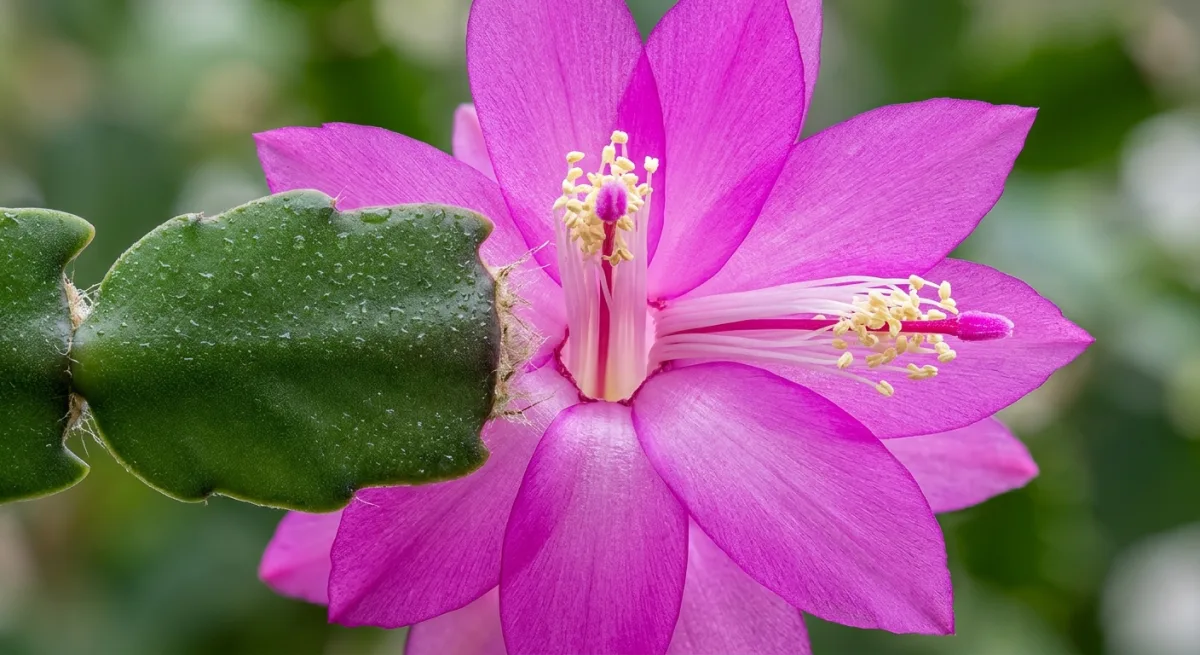
- Floral Architecture: The taxonomic calling card of this species lies in its blossoms. The flowers are radially symmetrical (actinomorphic) and hang perfectly downward in a vertical orientation from the terminal areoles. The perianth petals boast luminous tones of rich fuchsia-pink, converging around a conspicuous, elongate floral tube with a greenish-pink ovary.
- Growth Habit: While juvenile stems initially stand semi-erect, their cascading cladodes gracefully weep under their own mass as segments multiply, generating an exquisite pendulous waterfall silhouette. This growth architecture makes the plant a peerless candidate for hanging macramé planters and elevated pedestals.
2. Light Requirements and Indoor Positioning
Treating Schlumbergera russelliana like a Sonoran desert cactus by placing it in an unshaded south-facing window will rapidly degrade its photosynthetic machinery. Excessive, harsh ultraviolet radiation bleaches out chlorophyll and stimulates protective anthocyanin pigments, causing the cladodes to turn a stressed crimson-purple hue, quickly followed by irreversible cellular scorching.
In its indigenous cloud forest canopy, this epiphyte lives on dappled sun filtering through dense overhead foliage. Within the home, the golden standard is an east-facing exposure that provides brilliant indirect illumination complemented by mild, cool early morning sun. Morning rays kickstart active photosynthesis without generating lethal radiant heat. Unfiltered west-facing windows should always be moderated using a sheer linen curtain, whereas low-light north exposures frequently result in etiolated, paper-thin, and structurally weak segment development.
3. Watering Discipline: The Epiphytic Soak-and-Dry Cycle
The single greatest cause of mortality among potted jungle epiphytes is chronic overwatering. Seasoned growers recognize that dousing succulents daily is not an expression of horticultural care; it is an act of subterranean suffocation that displaces root-zone oxygen. Schlumbergera russelliana relies on aerial-adapted roots that require free gas exchange. When stranded in saturated, stagnant muck, these fragile root hairs fall victim to waterborne pathogenic oomycetes like Phytophthora and Pythium within days.
Instead, follow a disciplined epiphytic soak-and-dry regimen. Allow the top 3 to 4 centimeters of the potting substrate to dry out entirely between waterings. When applying moisture, use room-temperature, dechlorinated or rainwater, soaking the root zone thoroughly until water drains unimpeded from the base holes. Empty the drip saucer within 15 minutes; never permit the container to sit in stagnant effluent. During active bud development in autumn and winter, maintain a steady, gentle substrate moisture, but taper watering substantially once flowering ceases to honor the plant's natural post-bloom dormancy.
4. Ideal Epiphytic Substrate and Potting Selection
Standard mineral-dense garden soil or silt-heavy mixes represent a guaranteed death sentence for Schlumbergera russelliana. In alignment with its evolutionary niche, its root system requires high oxygen diffusion rates, rapid hydraulic conductivity, and an acidic to mildly acidic pH range (5.5 – 6.2). The potting medium should blend moisture-retentive fibrous organic textures with coarse, porous drainage aggregates.
For container selection, unglazed terracotta pots provide an ideal transpiration vessel, permitting excess moisture to evaporate evenly through porous clay walls while preventing thermal heat buildup around the root collar. If using plastic hanging baskets, ensure they feature extensive, unobstructed drainage perforations.
| Component | Ratio (%) | Botanical Function & Benefit |
|---|---|---|
| Fine-to-Medium Horticultural Pine Bark | 35% | Replicates natural tree bark fissures, sustains gentle acidity, and creates stable aeration voids. |
| Horticultural Pumice (3–5 mm) | 25% | Prevents compaction, promotes rapid drainage, and delivers structural air pockets to root hairs. |
| Coco Coir or Premium Blonde Sphagnum Peat | 20% | Retains balanced baseline moisture without suffocating the vascular system. |
| Crushed Lava Rock or Horticultural Zeolite | 10% | Porous volcanic aggregate that stores micro-nutrients while anchoring dangling root stems. |
| Coarse Perlite | 10% | Lightens overall potting density and enhances capillary gas exchange across the root profile. |
5. Step-by-Step Propagation Techniques
Propagating Schlumbergera russelliana is both uncomplicated and immensely rewarding. The highest success rates are achieved in mid-to-late spring (April to May), just as the plant emerges from its post-flowering dormancy and enters its active vegetative push.
- Select Healthy Cladodes: Identify mature, plump stem tips composed of 2 to 3 fully developed, turgid segments that show no discoloration or pest damage.
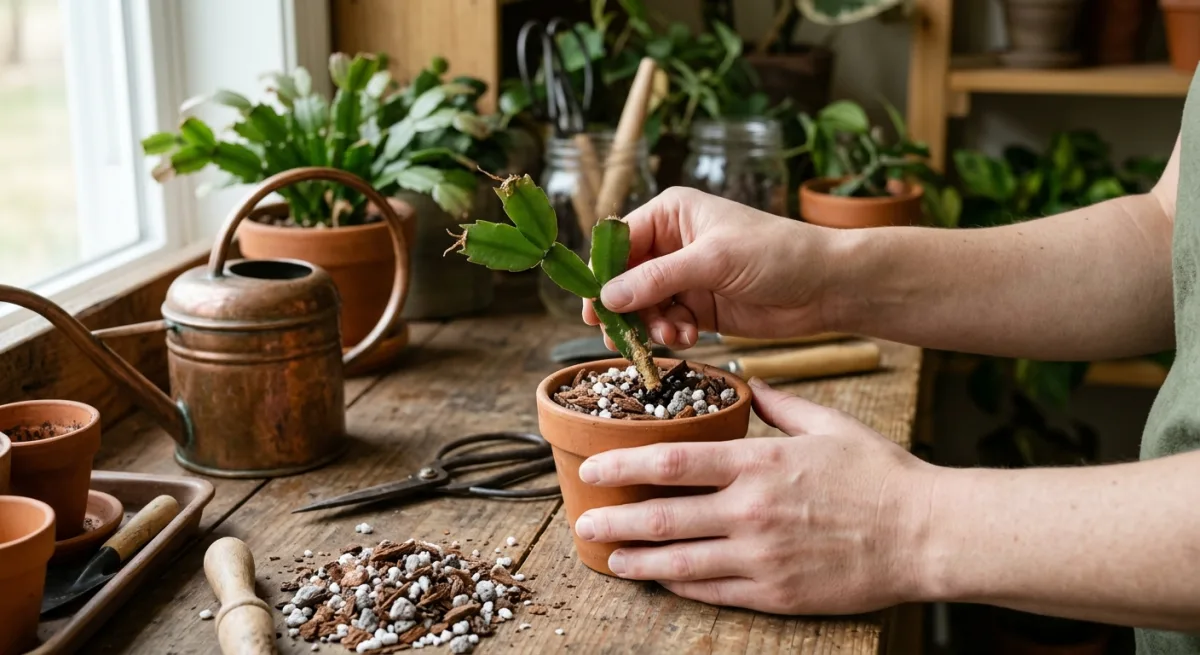
- The Torsion Harvest Technique: Instead of slicing with blades—which can introduce viral vectors—grasp the base of the cutting where it joins the parent segment and gently twist clockwise. The segment will snap cleanly along the natural abscission zone, creating a minimal cellular wound that seals rapidly.
- Callus Formation: Never place fresh, raw cuttings directly into wet substrate. Lay them on clean paper in a warm, dry, shaded room for 24 to 48 hours to allow the nodal wound to form a dry, protective suberized callus. This step virtually eliminates the threat of basal fungal damping-off.
- Rooting Medium: Insert the basal segment approximately one-third deep into slightly damp, highly porous propagation medium (such as equal parts perlite and fine coco peat).
- Establishment Phase: Keep the cuttings in a warm space (20–22°C / 68–72°F) bathed in bright, filtered light. Do not drench the potting mix; mist the surface substrate periodically to maintain ambient humidity. Robust adventitious roots will develop within 3 to 4 weeks, swiftly followed by the emergence of fresh apical cladodes.
6. Common Pests, Pathologies, and Physiological Disorders
While remarkably resilient when supported by adequate ventilation and balanced watering, minor cultural mistakes can leave Schlumbergera russelliana vulnerable to common greenhouse pests and environmental shocks:
- Mealybugs (Pseudococcidae): Appearing as discrete, white cottony masses tucked deeply into segment junctures and terminal nodes, these sap-sucking insects pierce tissue to feed on plant juices, stunting growth. Early infestations should be manually dabbed with a cotton swab dipped in 70% isopropyl alcohol; severe outbreaks require systematic treatment with organic cold-pressed neem oil or horticultural insecticidal soap sprays.
- Fusarium & Phytophthora Root/Stem Rot: The direct fallout of cold, waterlogged potting mix. Stems turn dull gray-green, blacken at the soil line, and emit a distinctly sour odor. In advanced cases, salvation lies in harvesting unaffected upper cladodes to start clean, uninfected cuttings.
- Premature Bud Drop (Abscission): If your plant sets dozens of floral buds only to drop them unceremoniously onto the tabletop, look for sudden changes in environmental parameters: shifting the pot’s light angle, placing it in cold drafts, dry radiator convection currents, or irregular moisture swings during early bud development.
7. Seasonal Care Calendar: The Science of Inducing Blooms
Triggering an abundant, synchronous bloom on Schlumbergera russelliana is not a matter of luck—it is the biological manipulation of two environmental cues: photoperiodism and thermoperiodism.
- Spring (Vegetative Awakening): As daylight lengthens, resume consistent soak-and-dry watering. Feed monthly with a balanced, urea-free liquid fertilizer diluted to quarter-strength to support fresh cladode growth.
- Summer (Canopy Maturation): Maintain high ambient humidity and bright indirect light. If summer temperatures surge above 30°C (86°F), the plant enters defensive semi-dormancy; ensure superior air movement and pull back on fertilizer to prevent root burn.
- Autumn (The Critical Bud-Induction Window): In late September through October, bud formation must be triggered by delivering short days and cool nights. The plant requires 12 to 14 hours of uninterrupted, pitch-black darkness each night alongside ambient evening temperatures lowered to 12–15°C (53–59°F). Reduce watering and withhold fertilizers completely during this pre-bloom period.
- Winter (The Floral Display): Once flower buds swell to pea size, stabilize the plant's environment. Never relocate, rotate, or repot the container. Maintain comfortable indoor temperatures and moderate substrate moisture, and enjoy the glorious downward cascade of authentic magenta blooms.


Reader Reviews & Comments 4 Reviews
Marcus Sterling
Eleanor Vance
Julian Thorne
Clara Higgins
Leave a Review & Rating
Share your plant care tips, experiences, or questions with our succulent community.