






Few species within the cactus family showcase a morphology as spellbinding and distinctive as Austrocylindropuntia vestita, an evolutionary masterpiece forged in the cold, windswept, high-altitude terrain of the Bolivian and Argentine Andes. Commonly known as the 'Woolly Old Man Opuntia' or 'Cotton Pole Cactus,' this taxon takes its name from the dense, silky layer of trichomes (hair-like epidermal cells) enveloping its cylindrical stems like a tailored winter coat. Appearing in botanical collections as a living textile marvel, beneath its extraordinary visual display lies a flawless biological defense mechanism evolved to withstand extreme desert and alpine conditions.
In its native habitat, which exceeds elevations of 3,000 meters across Andean plateaus, intense ultraviolet radiation, sub-zero nocturnal freezes, and relentless winds prevail. Austrocylindropuntia vestita has adapted to these severe challenges by weaving a cottony wool covering around its cylindrical stems. Seamlessly blending the segmented structural habit of the Opuntioid lineage with the water-storing capabilities of high-altitude succulents, this remarkable species brings both ancient resilience and sculptural refinement to any specialized collection.
1. Botanical Identity and Morphological Characteristics
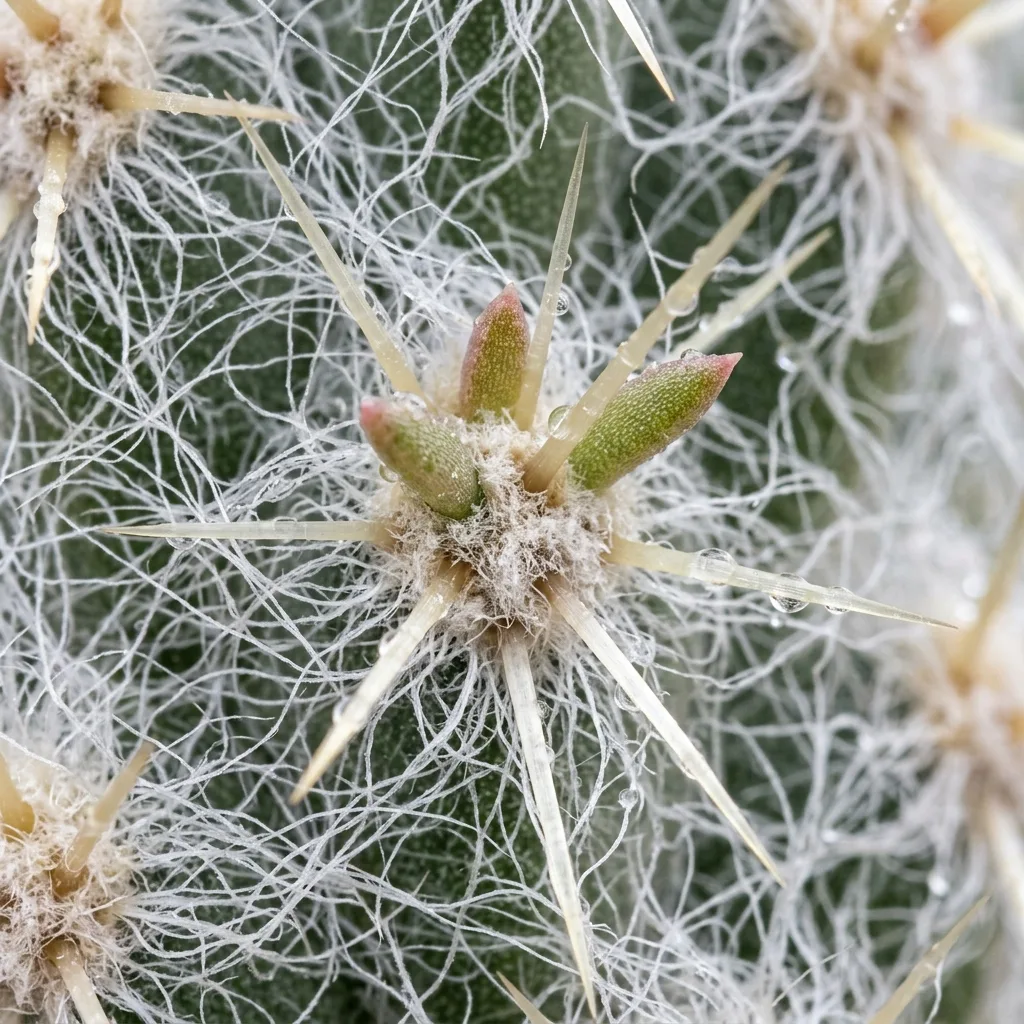
Taxonomically placed within the family Cactaceae, Austrocylindropuntia vestita (formerly classified under Opuntia vestita) is a shrubby cactus that produces slender, segmented, cylindrical stems. The specific epithet 'vestita' derives from Latin, translating directly to 'clothed' or 'robed.' The long, white, silky filaments erupting from the areoles are far more than ornamental features; they are specialized cellular outgrowths (trichomes) designed to preserve cellular viability.
This protective trichome layer scatters lethal high-elevation UV rays, preventing photoinhibition within the photosynthetic green tissue. Simultaneously, it traps a stagnant micro-air buffer around the epidermis, providing thermal insulation against overnight frost while minimizing moisture loss via diurnal transpiration. Young stems frequently bear small, cylindrical, succulent green projections known as rudimentary leaves; these support initial photosynthesis before naturally drying and falling away, revealing sharp, slender, yellowish central spines embedded beneath the woolly mantle.
2. Light Requirements and Indoor Positioning
The density and brilliance of this plant's renowned 'white vestment' depend entirely on the intensity and duration of the light it receives. Under suboptimal illumination, the specimen will thin its woolly shield, exposing pale green tissue, and develop weak, elongated, and distorted growth (etiolation). To encourage a dense, brilliant white, and robust wool covering, provide at least 5 to 6 hours of unfiltered direct sunlight every day.
Indoors, an unobstructed south- or west-facing windowsill provides the ideal microclimate. During midsummer, stagnant heat trapped behind window panes can cause moisture to pool within the trichomes, making regular air circulation around the plant paramount. Semi-shaded spots or dim living spaces are entirely unsuitable for this sun-loving alpine specialist.
3. Watering Discipline: The 'Soak and Dry' Protocol
The most devastating mistake in caring for Austrocylindropuntia vestita is drenching the woolly exterior. Droplets trapped within the dense trichomes cannot evaporate rapidly in enclosed rooms, creating an ideal breeding ground for pathogenic fungal spores (notably Botrytis and Fusarium) that swiftly trigger stem rot at the areoles.
The mandatory gold standard is the 'Soak and Dry' protocol. Deliver water exclusively using a narrow-spout watering can directed at the substrate level, keeping moisture entirely off the stems. Saturate the root ball thoroughly until water drains freely from the base of the container. Never allow the pot to sit in residual drainage water. Before irrigating again, verify that the substrate has dried out 100% all the way to the bottom of the pot, testing depth with a clean wooden skewer. In the active spring and summer months, watering every 10 to 15 days is typically sufficient, whereas winter calls for near-total drought (a very light splash every 6 to 8 weeks simply to keep root hairs intact).
4. Ideal Substrate Formulation and Pot Selection
Having evolved in mineral-dominant, nutrient-poor Andean soils among steep scree and fractured rock, this species rapidly suffers root loss when planted in peat-heavy, moisture-retentive commercial mixes. The optimal substrate must maintain continuous oxygen delivery to the root zone via highly porous volcanic minerals.
For potting, choose unglazed terracotta containers or ceramic pots equipped with ample drainage holes; porous clay enables substrate transpiration and helps excess moisture evaporate rapidly. Select a pot that exceeds the root ball diameter by merely 2 to 3 cm, as oversized containers hold lingering pockets of moisture that can suffocate sensitive root systems.
| Substrate Component | Ratio (%) | Botanical Function |
|---|---|---|
| Pumice (3-6 mm grade) | 40% | Optimal root zone aeration and cellular moisture buffering |
| Lava Rock (Scoria) | 25% | Root anchorage, pot stability, and vital micronutrient release |
| Coarse Perlite or Quartz Grit | 15% | Rapid water displacement and substrate compaction prevention |
| Screened Cactus Peat / Leaf Mold | 20% | Minimal organic baseline for nutrient exchange and water delivery |

5. Step-by-Step Propagation Techniques
Austrocylindropuntia vestita can be propagated efficiently and reliably via vegetative offsets (stem segments):
- Timing and Tools: Undertake propagation in early spring or early summer during the plant's active metabolic cycle. Sterilize a scalpel or heavy-duty pruning shears using 70% isopropyl alcohol.
- Harvesting the Cutting: Wearing thick, puncture-resistant leather gardening gloves, carefully sever a mature joint where it attaches to the central stem. Exercise caution to avoid contact with hidden central spines and microscopic glochids.
- Callus Formation: Never pot fresh cuttings directly into soil! Place the cutting in a warm, dry, well-ventilated location away from direct sunlight for 5 to 7 days. Allow the cut surface to form a firm, dry, and clean protective callus layer.
- Potting the Cutting: Insert the callused end 2 to 3 cm deep into the dry mineral substrate formulated above. Stabilize the cutting vertically by placing several larger lava rocks around its base.
- Initial Moisture: Keep the substrate completely dry for the first 7 to 10 days. Once root primordia begin to initiate, deliver tiny amounts of water around the edge of the pot to draw roots outward. Substantial root systems typically establish within 4 to 6 weeks.
6. Common Pests, Diseases, and Treatment Protocols
The dense white fleece of this cactus provides exceptional camouflage for opportunists. Periodic inspections with a magnifying glass are strongly advised:
- Mealybugs (Pseudococcidae): The most serious threat. Their waxy, white cotton-like excretions blend seamlessly into the cactus's natural coat. Look for yellowing around areolar margins or sticky honeydew. Treatment: Mechanically dab pests with a cotton swab dipped in 70% isopropyl alcohol, followed by targeted applications of cold-pressed neem oil or an appropriate systemic insecticide (such as Imidacloprid).
- Spider Mites (Tetranychidae): Thriving in warm, dry indoor environments, these pests target tender stem tips. Look for faint webbing at the base of the trichomes and rust-colored epidermal speckling. Treat promptly with a dedicated miticide.
- Root and Stem Rot (Phytophthora / Fusarium): Typically resulting from poor drainage, dense soil, or water on the crown. Soft, blackened tissue requires emergency surgical excision down to completely healthy green flesh, followed by a dusting of powdered sulfur before re-rooting the salvageable top portion.
7. Seasonal Care Calendar and Collector Insights
Spring - Summer (Active Vegetative Phase): Gradually step up watering from March onward. Position the plant in maximum available sunlight. Apply a low-nitrogen, high-potassium cactus fertilizer at half-strength once a month. Observe for the emergence of fresh, cylindrical green growth tips.
Autumn (Hardening Phase): Cease all fertilization by late September. Gradually taper irrigation frequency to once every 3 to 4 weeks, signaling to the plant that winter dormancy is approaching.
Winter (Dormancy and Flower Induction): A defined cold, dry rest is vital if you wish to see flowers and maintain compact growth. Move the specimen to a bright, cool, unheated space kept between 8°C and 12°C (46°F - 54°F). Keep the potting mix virtually dry throughout winter; a small splash of water every 6 to 8 weeks is plenty to prevent severe stem desiccation.


Reader Reviews & Comments 3 Reviews
Clara Higgins
Julian Vance
Marcus Sterling
Leave a Review & Rating
Share your plant care tips, experiences, or questions with our succulent community.