






Picture a succulent defying fierce winds atop the rugged sandstone crests of South Africa, clinging to semi-arid cliff faces where wild rock hyraxes (dassies) bask under the African sun: meet Oscularia caulescens. Known affectionately to botanists and indigenous growers as the 'Pink Vygie' or 'Dassievygie', this extraordinary species reigns as a true jewel in succulent collections worldwide. With its striking reddish-magenta stem architecture, geometric three-sided blue-gray foliage, and an explosion of almond-scented pink blossoms each spring, welcoming this wild mountain beauty into your living space means sharing your life with one of nature's most resilient living sculptures.
Frequently searched by plant enthusiasts under various colloquial names or phonetic curiosities ('dassievygie caulescens', 'cliff vygie'), this botanical treasure is one of the most elegant shrubby representatives of the ice plant family, Aizoaceae. Unlike many soft-leaved succulents, Oscularia caulescens gradually develops refined, lignified woody branches over time, adopting the graceful silhouette of a miniature natural bonsai. The minute cartilaginous teeth along its leaf margins lend the plant both a predatory charm and an ingenious hydraulic function—channeling morning coastal mists directly downward toward the root crown.
If you are searching for a dynamic window specimen that does not merely cling to life but dazzles across every season with changing chromatic flushes, the Pink Vygie is a peerless choice. However, unlocking its full glory requires honoring the evolutionary demands of its rocky native habitat: relentless sunlight and superior root aeration. Let us delve into the cellular biology, ecological origins, and practical home cultivation secrets of this remarkable Aizoaceae icon.
1. Botanical Identity and Morphological Characteristics
Oscularia caulescens belongs taxonomically to the expansive family Aizoaceae, closely aligned with the former Mesembryanthemaceae suballiance. The specific epithet 'caulescens' denotes its distinctive, prominent caulescent habit—a plant that produces distinct, upright aerial stems rather than forming an acaulescent ground-level rosette. In its wild provenance across the Western Cape of South Africa, it clings to naked sandstone formations and thrives within the winter-rainfall fynbos biome.
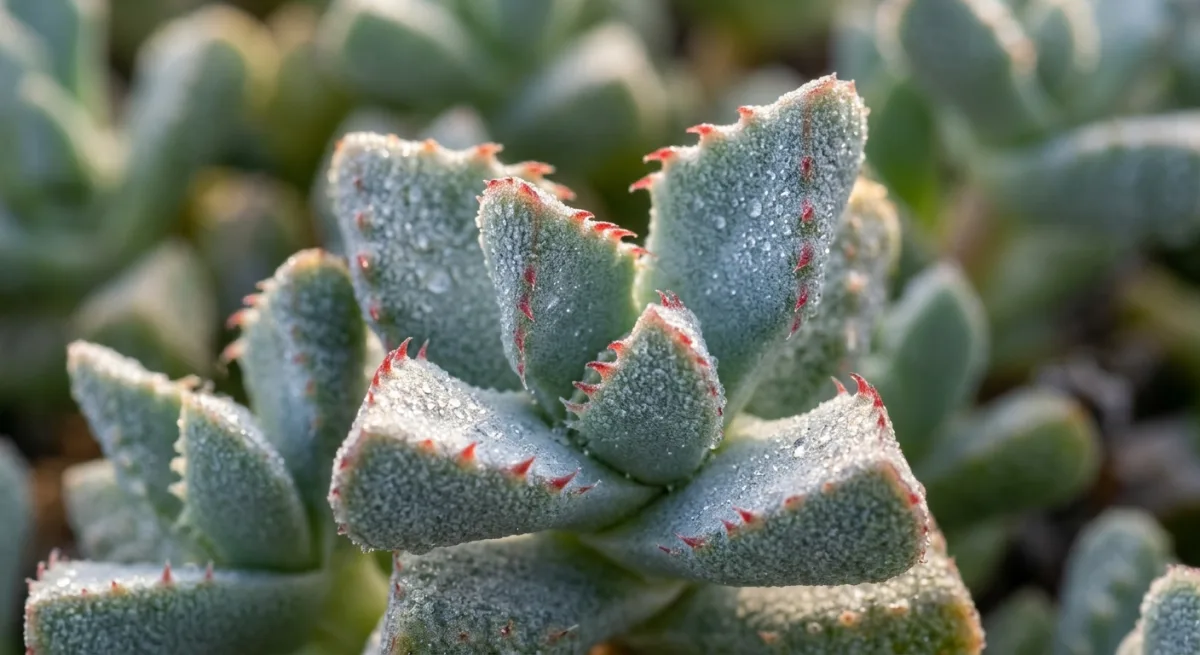
Morphologically, the first striking feature is the succulent's three-dimensional, prismatic (triquetrous) leaf profile. The leaves emerge in decussate opposite pairs, exhibiting a cool bluish-gray to silvery-glaucous hue. This coloration stems from a protective epicuticular farina layer composed of microscopic wax crystals designed to deflect excessive solar radiation. Under high UV exposure, the miniature serrated leaf margins and underlying stem tissues blush a radiant magenta, plum, or ruby red.
From late winter into mid-spring, the shrub covers itself in daisy-like composite flowers that emit a rich, heady fragrance reminiscent of sweet almonds or wild honey. A dense central cone of bright yellow stamens creates an arresting optical contrast against the shimmering pink ray florets. This flowering window is not merely an ornamental spectacle; it marks a critical physiological milestone signaling the plant's emergence from winter dormancy into vigorous metabolic activity.
2. Light Requirements and Indoor Placement
The Pink Vygie is an unapologetic sun worshipper that will never tolerate deep shade. Originating from high-elevation fynbos cliffs bathed in intense, unfiltered ultraviolet light, this succulent requires generous direct solar exposure to fuel its photosynthetic pathways and preserve its tight, internodal compactness.
Under suboptimal light, etiolation quickly sets in: the stem nodes stretch unnaturally, leaf spacing widens, and those breathtaking blue-gray, mauve, and ruby pigments fade into a washed-out grassy green. Most critically, inadequate lighting causes blossom initiation to halt entirely. For indoor living, secure a prime spot on an unobstructed south- or southwest-facing windowsill that provides a minimum of 5 to 6 hours of unfiltered direct sunlight daily.
3. Watering Discipline: The 'Soak and Dry' Principle
Like most members of the ice plant alliance, the greatest existential threat to Oscularia caulescens is well-intentioned overwatering. This species employs Crassulacean Acid Metabolism (CAM), keeping its stomata tightly sealed during scorching daylight hours to conserve internal moisture while opening them at night to assimilate carbon dioxide. Its cellular reserves are securely locked within the vacuoles of its thickened three-sided leaves.
The golden rule of cultivation is the rigorous 'soak and dry' method. When watering, saturate the substrate thoroughly until water drains freely from the pot's drainage holes, and promptly discard any runoff collected in the saucer. Before you even consider watering again, the entire root zone—down to the very bottom layer of the container—must dry out completely. Confirm this by inserting a wooden skewer to the base of the pot or learning to assess moisture by lifting the container to gauge its weight.
4. Ideal Substrate Formulation and Pot Selection
The fine, fibrous root system of the Pink Vygie will rapidly suffocate in conventional, moisture-retentive peat soils. In nature, its roots wedge into nutrient-poor mineral fissures where rain flushes through instantly. Your potting medium must emulate this rapid-draining, oxygen-rich volcanic profile.
Pot material is equally pivotal. Unglazed terracotta containers are unequivocally superior to plastic or glazed ceramic options. The micro-porous terracotta walls facilitate lateral evaporation, allowing the root system to breathe and preventing stagnant water accumulation. Plastic pots retain moisture far too long, compounding the risk of subterranean rot.
| Substrate Component | Volume Ratio (%) | Horticultural Function |
|---|---|---|
| Pumice (3-5 mm) | %40 | Ensures macro-porosity, preventing compaction and delivering oxygen. |
| Lava Grit / Zeolite | %25 | Supplies structural drainage, trace minerals, and antifungal stability. |
| Coarse Horticultural Sand / Quartz Grit | %15 | Maintains gritty texture and maximizes percolation velocity. |
| Sifted Cactus Peat / Leaf Mold | %20 | Provides a modest organic anchor for essential micronutrients. |
5. Step-by-Step Stem Propagation
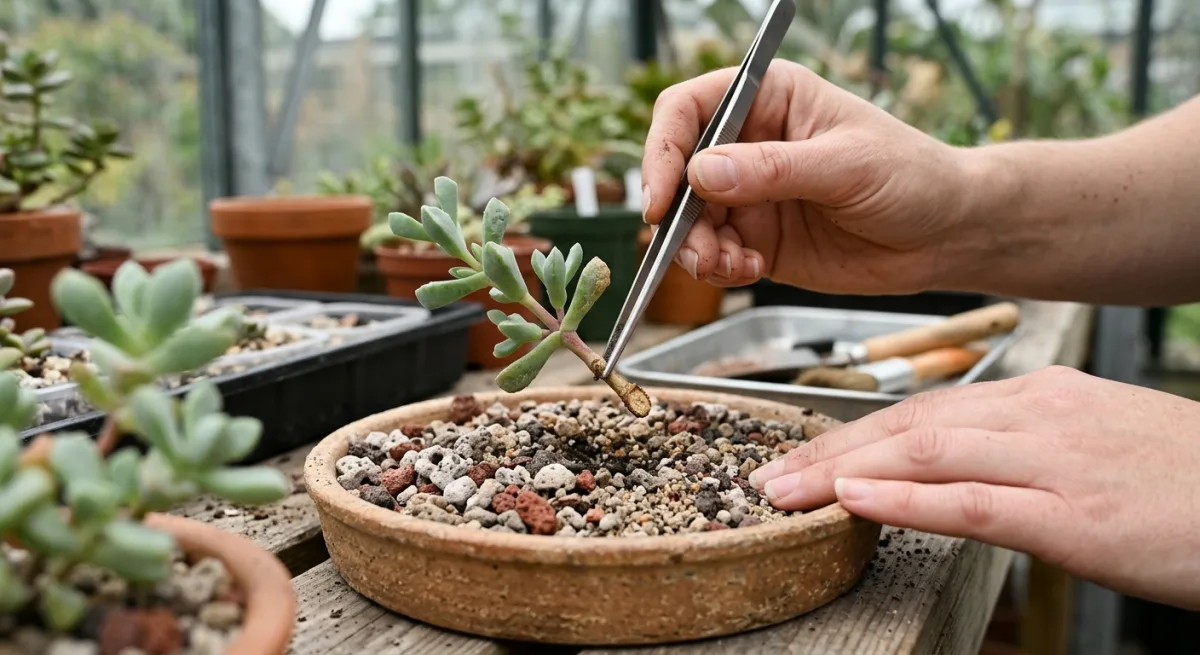
Propagating Oscularia caulescens is extraordinarily rewarding and reliable. While seed germination requires specific thermal cycles and patience, stem cuttings root with exceptional vigor when executed properly:
- Select a Healthy Shoot: In spring or early summer, use a razor-sharp, alcohol-sterilized bypass blade to excise a semi-woody, vigorous stem section possessing at least 3 to 4 healthy leaf nodes.
- Callus Formation: Never plant freshly cut succulent tissue into moist potting mix. Lay the cuttings in a warm, dry, shaded location with good airflow for 3 to 5 days, allowing the cut surface to synthesize a protective, corky callus tissue that prevents soil-borne infection.
- Dry Potting: Insert the callused stem base approximately 2 cm deep into the dry mineral mix formulated above. Do not apply any water for the first 5 to 7 days.
- Root Initiation: Place the potted cutting in bright, indirect ambient light away from harsh noon sun. After the first week, begin lightly misting the surface of the substrate once or twice weekly. Adventitious fibrous roots will establish within 3 to 4 weeks; a gentle upward tug will confirm resistance, indicating the cutting is rooted and ready for regular care.
6. Common Pests, Pathologies, and Interventions
While the Pink Vygie possesses remarkable inherent toughness, domestic indoor conditions can occasionally compromise its vitality:
- Root and Crown Rot: The direct consequence of poor drainage and persistent saturation. The stem base turns necrotic, dark, and spongy. To save the specimen, unpot immediately, excise all diseased tissue back to healthy green vascular bundles, allow the viable portions to callus, and re-root as fresh cuttings.
- Mealybugs (Pseudococcidae): These sap-sucking pests congregate in leaf axils and tender terminal growth tips, resembling small patches of cotton. Eradicate them mechanically using a cotton swab dipped in 70% isopropyl alcohol, or treat widespread infestations with cold-pressed neem oil or a systemic horticultural insecticide.
- Spider Mites: Thriving in excessively dry, hot indoor environments, these arachnids manifest as microscopic stippling (yellow pinpricks) and fine silky webbing along leaf junctures. Improve ambient ventilation and wipe down foliage with tepid water to break their reproductive cycle.
7. Seasonal Horticultural Calendar and Expert Notes
Spring (Active Growth and Flowering): As floral buds emerge, gradually increase your watering cadence to support hydration during blooming. A single monthly application of a low-nitrogen, high-potassium cactus fertilizer diluted to half-strength will prolong the floral display.
Summer (Mid-Season Rest): When ambient temperatures exceed 35°C (95°F), the plant may downregulate its metabolism and slip into semi-dormancy (estivation). Shield it from oppressive midday heatwaves and stretch the intervals between waterings to prevent root suffocation.
Autumn (Secondary Flush): Cooling nights trigger a brisk secondary growth phase. Maximize direct sunlight and maintain robust airflow so that stems and foliage harden off naturally ahead of the colder months.
Winter (Rest and Cold Hardiness): Maintain ambient temperatures strictly above 5°C (41°F). While a completely bone-dry root system can tolerate brief, dry cold snaps near 0°C (32°F), wet freezes are universally lethal. Withhold virtually all water throughout winter, offering only a light sip once a month to prevent extreme cellular desiccation.


Reader Reviews & Comments 4 Reviews
Eleanor Vance
Marcus Thorne
Julian Hayes
Clara Hughes
Leave a Review & Rating
Share your plant care tips, experiences, or questions with our succulent community.