






From the scorched desert basins of the Sonoran plains to the wind-buffeted Andean ridgelines towering over 13,000 feet, and winding deep into the dappled, humid canopies of tropical cloud forests, the family Cactaceae represents the plant kingdom's most radical evolutionary triumph. When you position a desert cactus on a sun-drenched windowsill, you are not merely decorating a room—you are welcoming millions of years of drought resilience, exquisite hydraulic architecture, and an enigmatic photosynthetic rhythm that breathes by night and rests silently beneath the daylight sun into your home.
Cactus cultivation far too often begins under the widespread misconception that these are 'invincible plants that never need water,' a naive premise that almost invariably culminates in premature root rot. Understanding a true cactus demands looking deeper: decoding the delicate cellular hydration balance within its cortical parenchyma, honoring the hormonal triggers that govern winter dormancy, and reading the structural legacy etched into every cluster of spines. Whether you are tending classic desert icons or branching into weeping rainforest varieties like the Christmas Cactus, welcome to an authoritative yet warm, mentor-guided expedition into the world's most fascinating succulent dynasty.
1. Taxonomic Identity, Areole Architecture, and Spine Morphology
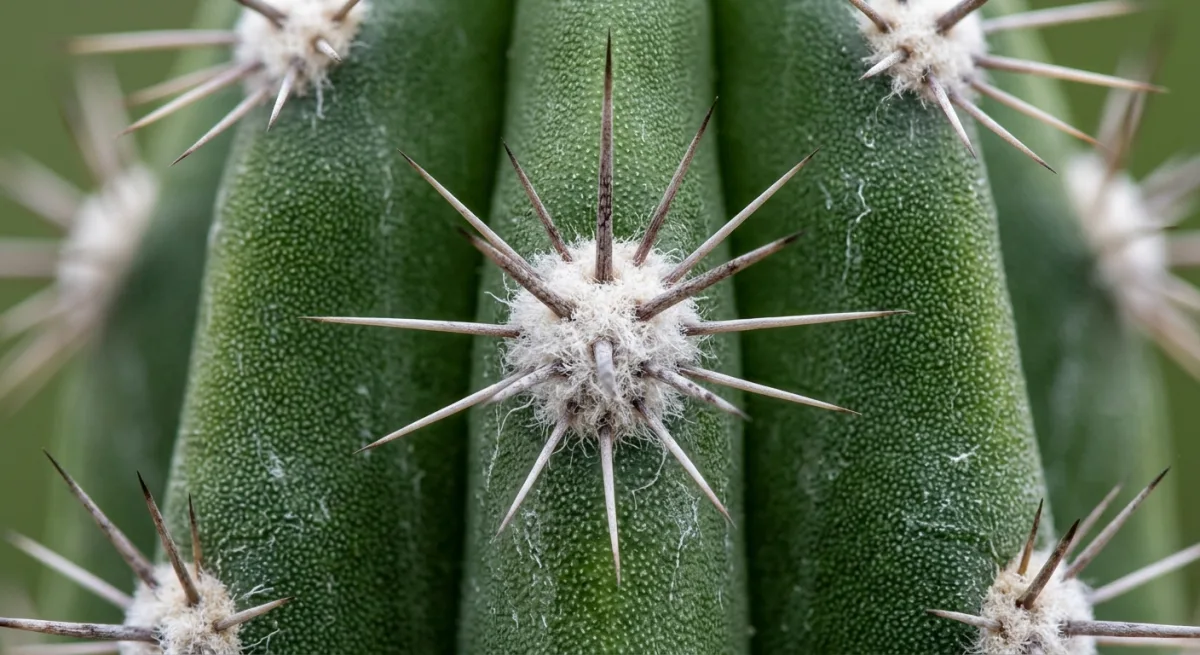
In classical botanical taxonomy, cacti comprise the family Cactaceae within the order Caryophyllales. Encompassing roughly 130 to 180 distinct genera and nearly 2,000 accepted species, this magnificent family is virtually endemic to the New World (the Americas). The solitary known wild exception, the mistletoe cactus (Rhipsalis baccifera), naturally colonized tropical Africa, Madagascar, and Sri Lanka via avian seed dispersal. While botanists hold that every cactus is functionally a succulent (possessing specialized tissue dedicated to water storage), definitely not every succulent is a cactus. The definitive morphological hallmark that indisputably assigns a specimen to the cactus family is the areole.
Areoles are radically condensed, specialized lateral bud cushions distributed across the stems and ribs. Spines, floral buds, adventitious branches, and—in genera such as Opuntia—microscopic, reverse-barbed hairs termed glochids emerge exclusively from these specialized structures. In evolutionary mimics like the desert spurges (Euphorbiaceae), spines emerge directly from the undifferentiated epidermis of the stem tissue. In a genuine cactus, however, every spine radiates from a felted or cushion-like areolar pad. Spines themselves represent evolutionary masterpieces: heavily modified foliar organs designed to reduce transpirational water loss to absolute zero, scatter intense ultraviolet radiation, condense nocturnal maritime fog and dew into drinkable moisture, and deter grazing herbivores.
Equally critical to their survival is CAM (Crassulacean Acid Metabolism) photosynthesis. Conventional C3 or C4 flora open their stomatal pores during daytime hours to assimilate carbon dioxide, losing vast reserves of moisture through transpiration in the process. Cacti take the opposite strategic path: they seal their stomata tightly throughout scorching daylight hours. Only when nightfall brings cooler temperatures and rising relative humidity do they open their pores, capturing CO2 and storing it temporarily as four-carbon malic acid within cellular vacuoles. As the sun rises, they process this stored malate via photosynthetic light reactions behind closed doors. Flooding a cactus with frequent waterings does not demonstrate care; it suffocates the subterranean root hairs, prevents nocturnal gas exchange, and swiftly asphyxiates the plant from beneath.
2. Light Spectrum, Solar Intensity, and Airflow Dynamics
The single most destructive pitfall for novice growers is relegating desert cacti to dimly lit bookshelf nooks or humid, unventilated bathroom counters. Classic desert forms—such as the Golden Barrel (Echinocactus), Barrel Cactus (Ferocactus), and Pincushion Cactus (Mammillaria)—require at least 5 to 6 hours of unfiltered, direct sunlight delivering high Photosynthetically Active Radiation (PAR) each day. Deprived of adequate light intensity, the cellular elongation process spirals out of control: the crown stretches, narrows, pales to a sickly yellowish-green, and produces weak, underdeveloped spines. This irreversible structural collapse is known as etiolation.
Conversely, tropical epiphytic and lithophytic cacti (such as Epiphyllum, the Christmas Cactus or Thanksgiving Cactus Schlumbergera, and Rhipsalis) evolved suspended high in tropical tree canopies beneath shifting leaf umbrellas. Harsh, direct midday sun will readily scorch their flattened cladodes (leaf-like stems), turning them bleached, purple, or blistered. Epiphytes require bright, dappled, indirect illumination. Paralleling the light equation is active air circulation. Stagnant, humid microclimates around stems invite opportunistic airborne fungal spores to germinate directly in the felt of the areoles. Keep indoor air gently circulating through open windows or oscillating fans, avoiding direct, freezing cold drafts.
3. Irrigation Dynamics and the Crucial Winter Dormancy Protocol
Cactus hydrology adheres to a simple yet unyielding foundational rule: Thoroughly drench the entire root system, and allow the substrate to dry out entirely down to the very base before watering again (the Soak-and-Dry method). Casual surface sips or light misting never reach the deepest primary root anchors and capillary taproots, while simultaneously creating a perpetually damp zone at the crown collar that invites stem rot. When you water, do so until liquid flows freely from the container's bottom drainage holes, and empty runoff drip trays immediately.
For abundant spring blossoms and long-term vitality, honoring winter dormancy is essential. In nature, winter coincides with dropping temperatures and prolonged arid conditions. From November through late February, relocate indoor desert cacti to a cool, luminous location where temperatures hover stably between 40°F and 54°F (5°C to 12°C), while reducing irrigation to an absolute minimum—often a mere tablespoon once a month, or none at all for mature specimens. Cold dormancy triggers a protective spike in cellular sugar concentrations (preventing cellular freezing), drops vegetative metabolic expenditure, and prompts floral meristem development within the areoles. A cactus kept warm, watered, and actively growing through winter loses its internal phenological clock, develops spindly growth, and will fail to bloom.
4. High-Mineral Substrates and Container Physics
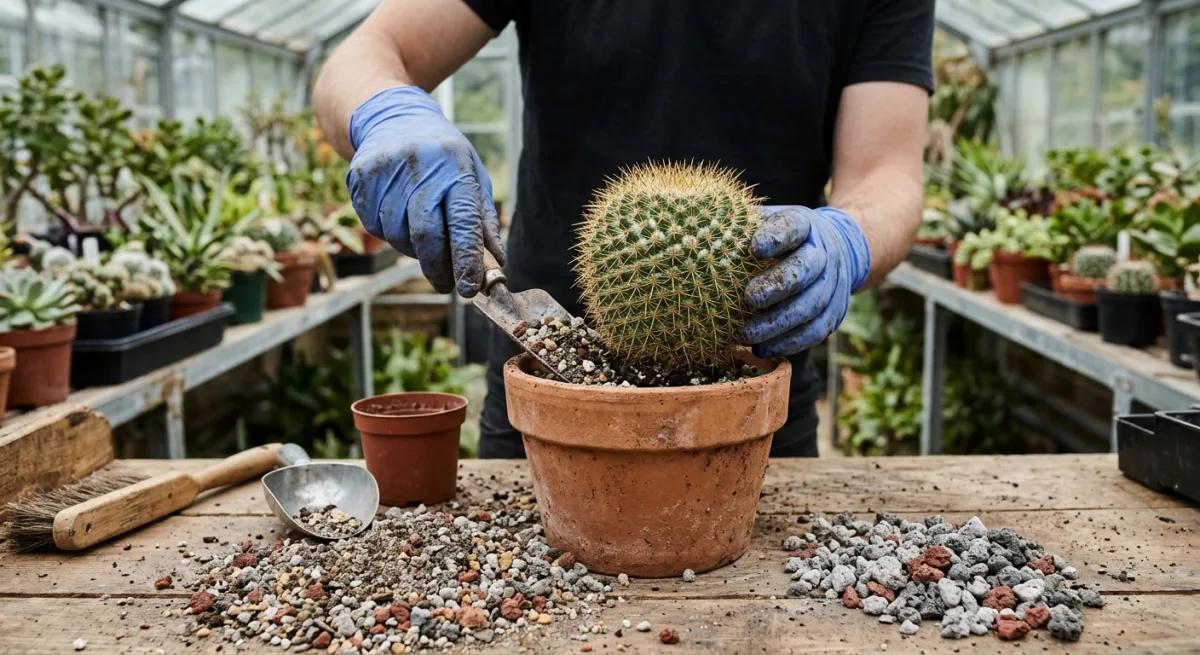
Off-the-shelf commercial potting soils and peat-dominant mixtures are a death sentence for desert cacti. These dense organic media absorb water like a sponge, staying saturated for days and starving delicate root systems of oxygen until pathogenetic suffocation occurs. The root systems of the Cactaceae require open, highly porous, gritty matrices where gravitational water percolates through in seconds, allowing fresh atmospheric oxygen to flush the rhizosphere immediately.
A reliable soil mix for desert cacti should contain at least 60% to 70% coarse inorganic minerals by volume. When choosing containers, unglazed terracotta pots are vastly superior to glazed ceramic or plastic. The porous clay walls breathe, allowing excess moisture to evaporate laterally through the vessel walls and halving the drying timeline. Glass terrariums or containers without unimpeded drainage holes should never be used for cacti.
| Substrate Component | Desert Cactus Mix (%) | Forest/Epiphytic Mix (%) | Botanical Function & Drainage Benefit |
|---|---|---|---|
| Pumice (3-6mm) | 40% | 25% | Superior aeration, structural pore retention, and neutral mineral carrier. |
| Crushed Lava Rock / Zeolite | 20% | 15% | Gradual micronutrient exchange; non-compacting root zone structural support. |
| Coarse Horticultural Grit / Quartz | 10% | 10% | Heavy, non-degrading ballast preventing medium compaction and settling. |
| Coco Coir / Screened Peat | 20% | 30% | Stable, hydrophobic-resistant organic anchor with low fungal risk. |
| Decomposed Pine Bark / Leaf Mold | 10% | 20% | Slow-release, mildly acidic organic matter mimicking tree bark pockets. |
5. Inducing Heavy Blooms and Nutritional Protocols
Growers frequently ask: 'Why won't my cactus bloom?' In nature, flowering is not an arbitrary event—it is the direct culmination of precise seasonal triggers and cyclical biological stress. To coax reliable spring and summer flowers from your cacti, align three fundamental factors: 1) A dry, cold, uninterrupted winter rest period; 2) A steady ramp-up of intense, direct morning sunlight as early spring arrives; and 3) A specialized low-nitrogen, high-phosphorus nutritional plan.
Standard houseplant fertilizers heavy in nitrogen are disastrous for cacti; excess nitrogen forces sudden stem bloating, weak skin walls prone to rupture, and leaves the plant susceptible to fungal penetration. From mid-spring through late summer, administer a specialized cactus fertilizer with an N-P-K ratio around 4-8-12 or 5-10-10, diluted to half-strength once per month alongside regular waterings. Once flower buds become visible within the areoles, maintain stable pot orientation—rotating the pot or moving it to a new location can cause sensitive buds to abort and drop.
6. Vegetative Propagation, Stem Cuttings, and Grafting
Members of the Cactaceae exhibit remarkable regenerative powers, propagating readily through both vegetative and seed-based generative methods. The simplest propagation technique involves removing baseline offsets (pups) or taking stem pads (cladodes). Using a sterilized surgical blade, excise the pup at its narrowest point of attachment. Never plant a fresh, moist cutting directly into damp soil. The wound must dry out completely in a shaded, warm spot for 4 to 10 days until a tough, corky, protective scar layer—the callus—forms over the exposed vascular tissue. Placing uncallused tissue into potting medium invites opportunistic fungal spores directly into the vascular bundles.
Another advanced technique is grafting. Achlorophyllous mutant varieties devoid of green chlorophyll (such as the vibrant red, yellow, or pink Moon Cactus, Gymnocalycium mihanovichii f. variegata) cannot survive on their own roots and must be grafted onto a vigorous, photosynthetic rootstock—typically the Dragon Fruit vine (Hylocereus undatus) or Myrtillocactus geometrizans. Grafting success hinges upon aligning the vascular cambium rings of both the scion and the rootstock, securing them under gentle, continuous downward elastic tension until their active cells fuse into a single functional transport network.
7. Combating Stem Rot, Corking Identification, and Pest Management
The primary threats to cactus collections are aggressive soil-borne fungal pathogens (including Phytophthora, Fusarium, and Rhizoctonia) alongside insidious mealybug infestations. Fungal rot typically begins silently in the roots before creeping up the central vascular cylinder. The moment the lower stem displays a watery, translucent, yellow-brown discoloration accompanied by a soft or mushy texture, emergency surgical intervention is required. Once internal tissues break down, the only recourse is decapitation: slice cleanly through the stem with a razor-sharp, sterilized knife well above the soft rot until you reveal spotless, uniform green-and-white vascular tissue. Dust the wound with elemental sulfur or ground cinnamon, allow a firm callus to develop over a week, and re-root the top cut in completely dry mineral grit.
Gardeners often mistake natural corking for fungal decay. As columnar and globose cacti mature, their basal stem tissue thickens and forms a rugged, brown, bark-like layer to support the plant's increasing weight. If the brown tissue is firm, dry, and woody when pressed gently with a fingernail, it is healthy corking rather than rot. For pests—especially mealybugs hiding deep within areole wool or between ribs—dab them individually using cotton swabs dipped in 70% isopropyl alcohol, followed by targeted applications of horticultural soap or systemic treatments for persistent infestations.


Reader Reviews & Comments 4 Reviews
Julian Vance
Clara Higgins
Marcus Sterling
Evelyn Reed
Leave a Review & Rating
Share your plant care tips, experiences, or questions with our succulent community.