






High among the misty summits of Eastern Anatolia and the Caucasus range, where fierce alpine gales whip across barren limestone cliffs, small emerald shields quietly defy the elements. Cataloged in botanical literature as Prometheum aizoon—and frequently dubbed 'Prometheus aizoon' or the Caucasian Alpine Stonecrop by collectors paying homage to the mythical titan who brought fire to humanity—this rare alpine succulent represents an ancient mountain dweller that has triumphed over nature’s most punishing trials. Adapted to survive sub-zero freezing spells, intense ultraviolet radiation, and little more than a pinch of mineral dust nestled inside rock fissures, this botanical gem brings the sculptural elegance of a high-alpine scree directly into our living spaces and rock gardens.
Coveted by discerning succulent connoisseurs, this species demands none of the pampering expected by delicate greenhouse plants; its true secret lies in roots that need to breathe the mountain breeze and thrive under the strict discipline of its craggy homeland. It serves as a profound reminder of our core horticultural tenet: watering succulents too frequently is never an act of affection—it simply suffocates the root system and deprives it of vital oxygen. Welcoming this high-altitude treasure into your collection allows you to honor millions of years of evolutionary mastery while admiring the geometric precision of its miniature rosette clusters.
1. Botanical Identity and Morphological Characteristics
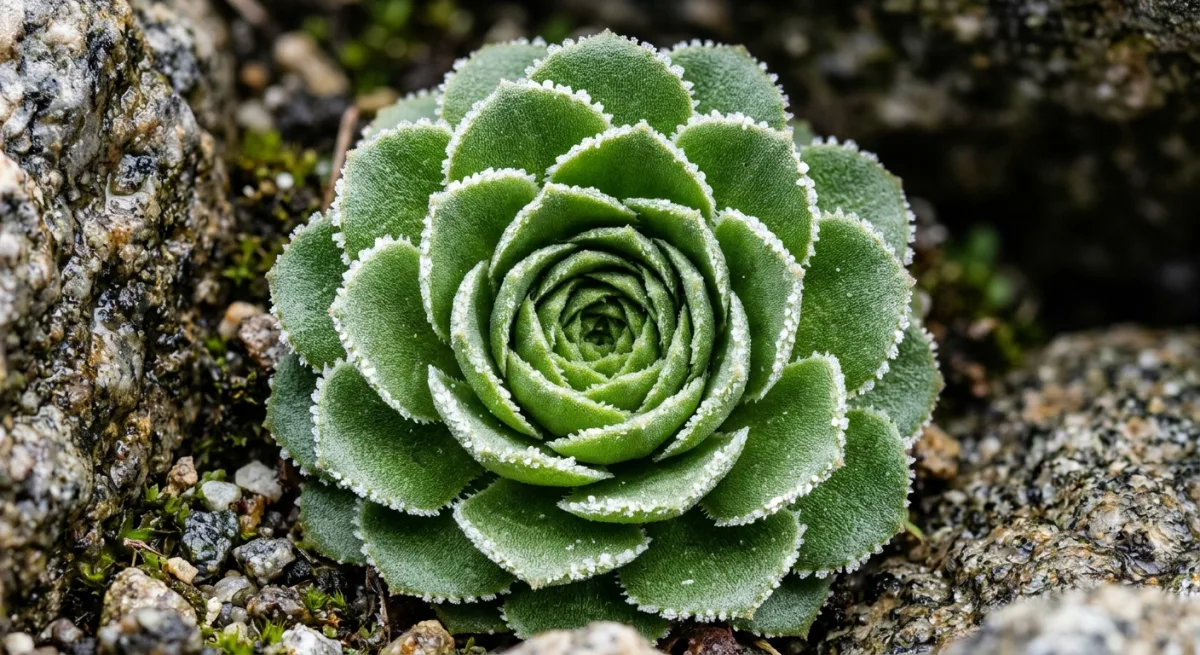
Prometheum aizoon (historically classified under Rosularia aizoon or confused in trade with forms of Sedum aizoon) is an exquisite alpine representative of the Crassulaceae (Stonecrop) family. The plant develops flattened, fleshy rosettes measuring 2 to 5 centimeters in diameter, readily producing multiple stoloniferous basal offsets to establish dense, mat-forming carpets. The leaf tissue is spatulate with blunt apexes, remarkably turgid and thickened to minimize cellular transpiration against desiccating mountain winds.
The most fascinating morphological feature of this species is the row of microscopic mineral and water-secreting pores known as 'hydathodes' lining the leaf margins. As the plant absorbs dissolved calcium and carbonate minerals from limestone crevices, it actively expels excess salts through these specialized pores, creating silvery-white crusts along the leaf perimeters. These encrusted margins not only provide an exquisite, lace-like ornamental edge but also act as physical solar mirrors, deflecting harsh ultraviolet radiation away from delicate internal mesophyll cells. Utilizing Crassulacean Acid Metabolism (CAM), Prometheum aizoon keeps its stomata sealed throughout the blazing day to halt water loss, opening them exclusively during the cool night hours to capture and store carbon dioxide.
2. Light Requirements and Indoor Positioning
Given its high-elevation origin, Prometheum aizoon is an uncompromising lover of bright, unfiltered sunlight. In its wild habitat thousands of meters above sea level where the atmospheric blanket is thin, it basks in raw, direct mountain sun. Cultivated indoors, it demands at least 5 to 6 hours of unfiltered direct sunlight daily. In sub-optimal lighting conditions, the plant rapidly demonstrates 'etiolation'—stretching upward, loosening its tight rosette geometry, widening leaf internodes, and fading from its deep glaucous-emerald hues into a pale, washed-out green.
When grown inside the home, south- or southwest-facing windowsills provide the prime exposure. However, the non-negotiable variable is continuous airflow. Stagnant, warm, and humid indoor air represents the greatest hazard to this mountain native. Opening nearby windows consistently or moving the pot outdoors to an open balcony, terrace, or rockery from early spring through late autumn will yield sturdier, far more resilient rosettes. During the peak of midsummer, if plants sit directly behind glass where heat can concentrate like a magnifying lens, light dappled shade during the hottest afternoon hours is advisable.
3. Watering Discipline: The 'Soak and Dry' Protocol
The swiftest way to ruin an alpine succulent is through well-intentioned overwatering. Prometheum aizoon exhibits phenomenal drought tolerance, but it possesses zero tolerance for moisture lingering around its subterranean crown. The golden rule is the strict application of the 'soak and dry' method: never provide a single drop of water until the potting medium has dried out completely—not merely on the topsoil, but down to the bottom drainage holes.
When applying water, take deliberate care never to let moisture sit inside the central crown (the apical meristem). Emulating natural rainwater washing through vertical rock faces, direct your watering stream strictly onto the surrounding mineral grit at soil level. Water droplets trapped inside rosette centers, particularly in low-airflow conditions, can trigger catastrophic fungal crown rot within a matter of hours. During the winter dormancy phase, water applications must be curtailed dramatically—limit watering to once a month, or offer a tiny splash only when the basal leaves begin to wrinkle slightly and lose turgor.
4. Ideal Substrate Formulation and Pot Selection
In wild screes, these alpine jewels colonize cracks almost entirely void of rich organic matter, thriving amidst decomposed schist, basalt shards, and crushed limestone. Consequently, commercial peat-heavy potting soils are death traps for Prometheum aizoon. An authentic growing medium must feature an exceptionally high ratio of porous volcanic grit, pumice, and zeolite, designed to shed moisture instantly while flooding the root zone with ambient oxygen.
For container materials, unglazed terracotta or carved natural volcanic tufa stone should always take precedence. Plastic, glazed ceramic, or glass planters impede transpiration and trap humidity, suffocating root hairs. Because this species features a shallow, laterally spreading root system rather than a deep taproot, choose broad, shallow pans or succulent bowls equipped with multiple unrestricted drainage holes.
| Substrate Component | Ratio (%) | Horticultural Function & Benefit |
|---|---|---|
| Pumice (2–4 mm grain) | 35% | Delivers superior microporosity, structural air pockets, and fast drainage. |
| Lava Grit / Zeolite | 25% | Stabilizes mineral nutrition and optimizes root gas exchange. |
| Coarse River Sand / Crushed Granite | 15% | Replicates natural scree texture, preventing compaction and water stagnation. |
| Crushed Limestone / Dolomite Grit | 5% | Provides essential calcium ions and maintains a stable, slightly alkaline pH. |
| Sterile Cactus Peat / Coir Fiber | 20% | Supplies minimal organic matrix for root anchoring without retaining excess moisture. |
5. Step-by-Step Propagation Techniques
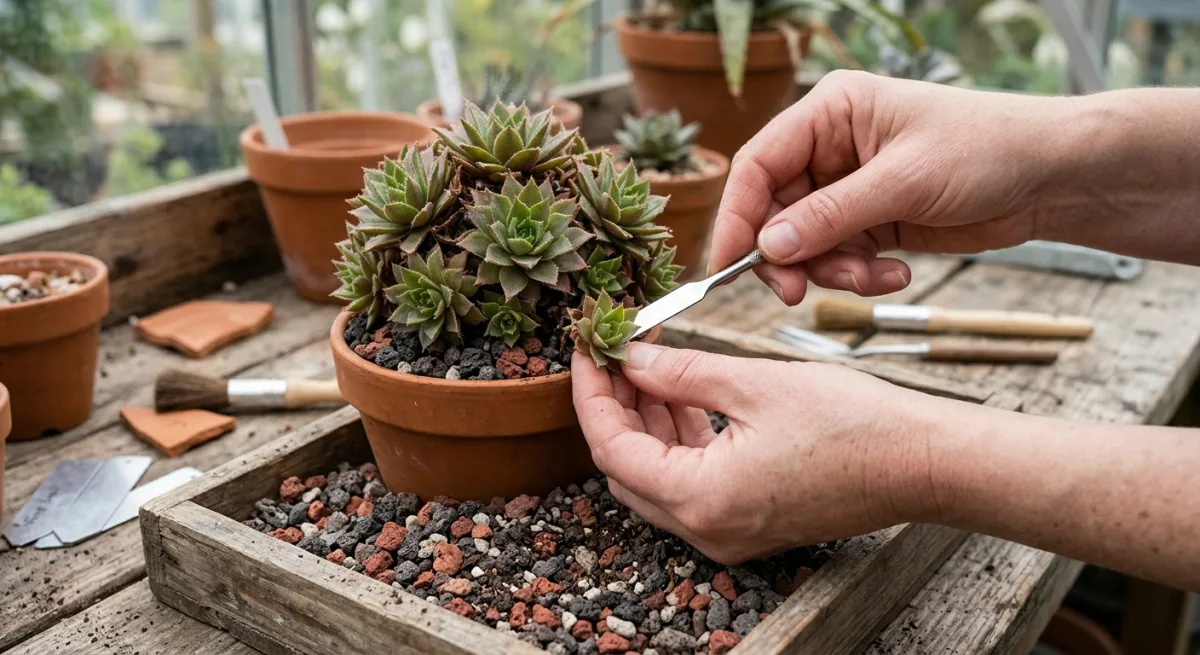
Propagating Prometheum aizoon is an immensely gratifying process that highlights the plant's natural colonial vigor. Once established, vigorous mother rosettes produce dense clusters of miniature offsets attached by short, stolon-like runners around their base.
- Separating Offsets (Pups): In mid-spring, select healthy offsets that have reached at least 1 to 1.5 cm in diameter. Using a sterile, razor-sharp scalpel or micro-snips, sever the connecting runner as close to the main stem as possible.
- Callus Formation: Never pot fresh offsets immediately. Place the cuttings in an airy, shaded, dry location for 2 to 3 days to allow the cut surface to produce a firm, dry protective scar (callus). This crucial step wards off soil-borne fungal pathogens.
- Bedding into Rooting Medium: Gently settle the callused rosettes onto a gritty rooting blend composed of 80% pumice and coarse sand, taking care not to bury the foliage.
- Light and Moisture Management: Position the tray in bright, indirect light shielded from direct noon sun. Until new roots anchor into the medium (typically 2 to 3 weeks), maintain minimal moisture by lightly misting the surface grit around the plant rather than drenching.
- Seed Propagation: If flowers are successfully pollinated during late summer, the plant produces dust-like seeds. After a brief period of cold stratification to simulate winter conditions, surface-sow the seeds over fine mineral grit in early spring.
6. Common Pathogens, Pests, and Treatments
While this rugged montane survivor is naturally pest-resistant, standard indoor cultivation oversights can leave it vulnerable to common issues:
- Crown and Root Rot (Fusarium & Phytophthora spp.): The primary killer of alpine succulents. Caused by stagnant, dense soils and chronic overwatering, resulting in blackening stems and translucent, jelly-like leaves. Treatment: Immediately trim away all decaying tissue, salvage healthy top rosettes, allow them to callus thoroughly, and reroot exclusively in pure mineral grit.
- Mealybugs (Pseudococcidae): These sap-sucking pests conceal themselves deep within tightly packed leaf axes and along the root flare, producing small, white, cottony secretions. Treatment: Remove visible colonies manually using a cotton swab dipped in 70% isopropyl alcohol; treat broader infestations with an organic systemic neem oil emulsion.
- Spider Mites (Tetranychidae): Thriving in hot, dry, stagnant indoor rooms, these pests leave fine micro-webbing and cause leaf surfaces to take on a stippled, bronzed appearance. Treatment: Substantially increase room ventilation and apply a sulfur-based organic acaricide or insecticidal soap spray.
- Edema: Blister-like ruptures on leaf undersides caused by roots absorbing moisture faster than leaves can transpire during cool spells. Treatment: Space out watering intervals and improve air movement around the bench.
7. Seasonal Care Calendar & Expert Growing Tips
Spring (Awakening & Vegetative Growth): Beginning in March, the plant breaks winter dormancy. Gradually increase exposure to direct sunlight and step up watering frequency in tandem with drying rates. A single application of a balanced, low-nitrogen, high-potassium liquid cactus fertilizer diluted to quarter strength will stimulate firm rosette development.
Summer (High-Heat Semi-Dormancy): When ambient temperatures exceed 32°C (90°F), the plant may enter a protective state of estivation to conserve fluids. Cut back on watering volume, provide slight midday sun protection if grown under glass, and ensure steady ambient air currents.
Autumn (Hardening Phase): As seasonal temperatures decline, the plant experiences a secondary burst of vitality. Cool night temperatures often tint the leaf tips with attractive reddish-bronze margins. During this phase, the plant gradually lowers its internal water content, concentrating its cellular sap to prepare for freezing temperatures.
Winter (Cold Vernalization): Prometheum aizoon is an authentic alpine subject capable of enduring severe frosts down to -15°C (5°F), provided its substrate is kept bone dry. To stimulate natural flower bud induction in spring, it requires an essential cold rest period of 6 to 8 weeks between 0°C and 8°C (32°F–46°F). Keeping this plant inside heated, warm living rooms all winter disrupts its biological circadian rhythm, preventing flower formation.


Reader Reviews & Comments 3 Reviews
Julian Vance
Marcus Sterling
Clara Higgins
Leave a Review & Rating
Share your plant care tips, experiences, or questions with our succulent community.