






Deep within the scorched expanse of Mexico's Chihuahuan Desert, concealed inside the fractured fissures of vertical limestone cliffs, dwells a botanical marvel: Ariocarpus. At first glance resembling weathered, geometric shards of native rock, these prehistoric relics stand among the plant kingdom's most patient and spellbinding masters of survival. Revered as crown jewels in high-end succulent collections, Ariocarpus species shatter conventional houseplant norms, inviting us to harmonize with the slowest, purest rhythms of the natural world.
Cultivating an Ariocarpus bears little resemblance to tending an ordinary potted plant; it is an exercise in decelerating time and sharing in nature's geological patience. In its endemic habitat, this genus buries nearly its entire vegetative body beneath the desert floor, retracting flush with the arid substrate during severe droughts until it becomes virtually invisible. Welcoming one onto your windowsill demands genuine reverence and a sophisticated grasp of botanical science.
If you aspire to sustain these enigmatic 'living rocks' in your living room or greenhouse, you must listen to their cellular whispers and master their specialized root physiology. An ill-suited pot or a single well-intentioned but surplus cup of water can dissolve decades of hard-won growth in mere days. Join me as we explore the exact scientific protocols and time-tested horticultural practices I rely on daily in my greenhouse to keep these majestic specimens thriving.
1. Botanical Biology and Physiological Foundations
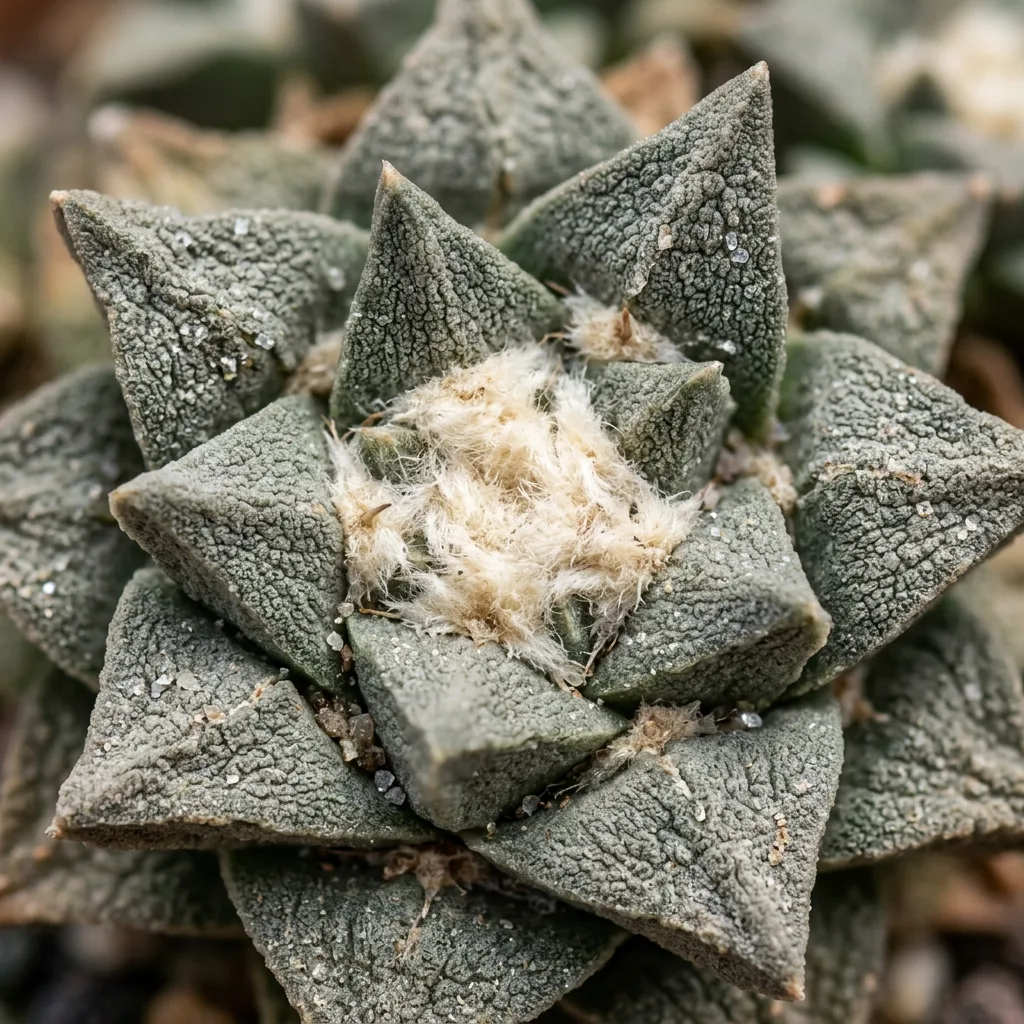
What elevates the genus Ariocarpus into a class of its own is the complete evolutionary replacement of traditional cactus spines with geometric, rugose, stone-textured foliar projections known as tubercles. These tubercles optimize surface-area-to-volume ratios, shield vulnerable growth tissue from sandblasting desert squalls, and deflect punishing solar radiation. Functioning via strict CAM (Crassulacean Acid Metabolism) photosynthesis, Ariocarpus opens its stomata exclusively under the cool mantle of desert nights to fix carbon dioxide into malic acid, sealing them tight against daytime heat to reduce transpirational water loss to absolute zero.
However, the true life-support system of Ariocarpus lies subterranean: a massive, succulent napiform taproot. This cavernous underground storage organ frequently amasses three to four times the biomass of the visible aerial crown. Designed to contract longitudinally during prolonged dry spells to pull the plant below the soil line, this taproot consists of expansive xylem parenchyma engineered for dense water and polysaccharide storage. Yet this specialized adaptation harbors a fatal vulnerability: stagnant moisture and soil hypoxia. The instant pore spaces saturate and starve the root zone of molecular oxygen, cellular respiration collapses into anaerobic fermentation. The resultant surge of toxic ethanol and lactate triggers instant tissue necrosis, inviting virulent soil-borne pathogens like Fusarium and Phytophthora to liquefy the taproot within days.
2. Accurate Diagnosis and Signs of Distress
Discerning whether an Ariocarpus is in peak physiological balance or declining toward root rot demands razor-sharp diagnostic observation. Because these plants grow at a glacial pace—frequently producing only one or two fresh tubercles per season—you must learn to read minute morphological cues:
- Insufficient Light and Etiolation: Loss of dense, symmetrical tubercle geometry, accompanied by an unnatural conical stretching of the apex and a shift from chalky grey-green to translucent neon green, indicates severe light starvation.
- Root Asphyxiation and Rot Warning: A dull yellowish-brown discoloration around the root neck (collar region), accompanied by mushy parenchymal softening and an anchored plant suddenly wobbling loosely in its medium, is an emergency indicator of advanced fungal root rot.
- Physiological Dehydration: Tubercle shriveling, inward curling, and the entire crown pulling downward into the potting grit during extended droughts are normal defensive responses. Once irrigated during the active cycle, the plant should regain turgor within 48 to 72 hours.
- Nutritional Stress and Chlorosis: Dry necrotic tip burn on mature tubercles or washed-out pale chlorosis on emerging tissue generally points to an absence of accessible calcium/limestone minerals, or conversely, severe root lock caused by high synthetic fertilizer salt buildup.
3. Step-by-Step Cultivation Protocol
To nurture an Ariocarpus toward cellular vitality and induce prolific autumn blooms, follow this rigorous step-by-step horticultural protocol:
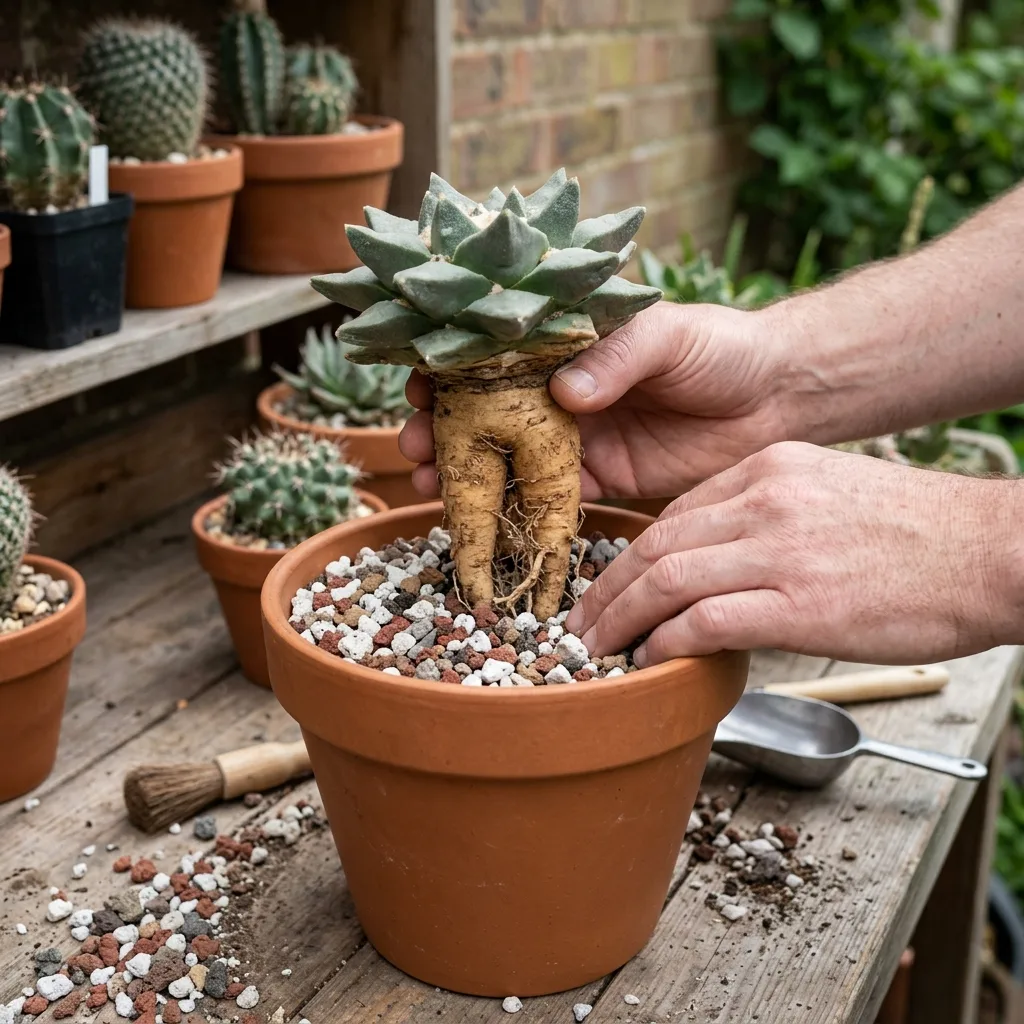
- Pot Selection: Choose deep, unglazed terracotta containers or specialized extra-deep plastic succulent pots fitted with abundant drainage holes. This accommodates the vertical elongation of the taproot. Shallow standard pans force the taproot to curl horizontally, sparking terminal root-tip necrosis.
- Root Collar Isolation: When positioning the plant, encase the critical junction between the upper taproot and aerial crown entirely in pure, coarse inorganic grit, pumice, or lava fines. Never allow organic materials to make direct physical contact with the root neck.
- Lighting Architecture: Provide unfiltered, direct sunlight throughout early mornings and late afternoons. During peak solar intensity at midday (particularly through blistering summer heat waves), temper the light with a light 20-30% shade cloth. Aim for a baseline of 6 to 8 hours of active photon exposure daily.
- Irrigation Dynamics (Soak-and-Dry): During active vegetative phases (late spring and early autumn), saturate the container thoroughly only when the substrate is parched to the core. Ensure excess water discharges instantaneously from the drainage holes. The mix must dry to bone-dry status between watering intervals.
- Winter Rest (Obligate Dormancy): From late autumn through early spring, once ambient temperatures drop below 12°C (54°F), withhold water completely. Overwinter the specimen in a bright, dry, well-ventilated location held strictly between 5°C and 10°C (41°F - 50°F).
4. Required Equipment, Materials, and Mix Formulations
Substrate chemistry and structural macro-porosity represent the single most decisive factor in Ariocarpus survival. Standard peat-based commercial potting soils are a guaranteed death sentence. Replicate their native alkaline, cliff-dwelling geology using the precision parameters below:
| Material / Parameter | Ideal Ratio / Target Value | Physiological Function & Botanical Merit |
|---|---|---|
| Horticultural Pumice | 40% (3-6 mm grain size) | Ensures rapid water drainage and maximum atmospheric oxygen diffusion to the taproot. |
| Crushed Lava Rock (Scoria) | 25% (2-4 mm grain size) | Supplies structural stability and slow-release iron trace elements without compacting. |
| Limestone Screenings / Zeolite | 15% (Calcite-based limestone) | Replicates endemic soil pH (7.5 - 8.2) and continuously donates calcium cations. |
| Sifted Leaf Mold / Decomposed Coir | 20% (Fine, low-humus fiber) | Provides minimal cation exchange capacity for fine ephemeral feeder roots. |
| Active Growth Temperature | 24°C - 34°C (75°F - 93°F) | Optimal enzymatic temperature range for nocturnal CAM malic acid decarboxylation. |
| Winter Dormancy Temperature | 6°C - 10°C (43°F - 50°F, bone dry) | Indispensable cold vernalization trigger for meristematic flower bud differentiation. |
5. 5 Common Pitfalls and Emergency Recovery Protocols
- Mistake: Using Standard Peat or All-Purpose Succulent Soil.
Consequence: High moisture retention collapses macropores, smothering the thick taproot and initiating runaway anaerobic necrosis within one or two waterings.
Recovery: Unpot immediately. Wash the taproot bare, excise all discolored or soft tissue back to healthy white parenchyma using a sterilized scalpel, dust wounds generously with sulfur powder, air-dry in shaded warmth for 10 to 14 days, and replant into an 80% mineral substrate. - Mistake: Planting in Wide, Shallow Containers.
Consequence: The taproot hits the bottom prematurely, bends back on itself, and constricts critical vascular bundles, stunting growth and creating chronic rot pockets.
Recovery: Move the specimen into a cylindrical, deep container with a depth at least 1.5 to 2 times the total height of the taproot. - Mistake: Providing 'Mercy Waterings' in Winter.
Consequence: In the absence of warm ambient temperatures and high solar transpiration, stagnant moisture breaks down root cell membranes, leading to rapid basal rot.
Recovery: Completely suspend irrigation from November through March. A thirsty Ariocarpus merely retracts; an overwatered winter Ariocarpus perishes. - Mistake: Overhead Watering Across the Central Wool.
Consequence: Moisture trapped in the dense areolar trichomes provides a breeding ground for fungal spores, rotting the apical meristem.
Recovery: Always water around the perimeter of the pot using a precision narrow-spout can, or bottom-soak momentarily. If the wool gets splashed, gently wick the moisture away using the corner of a sterile paper towel. - Mistake: High-Nitrogen Fertilization.
Consequence: Unregulated osmotic water uptake forces cell walls to expand too quickly, producing disfiguring, irreversible splits across the tubercles.
Recovery: Restrict feeding to once or twice a year during peak growth using a dedicated low-nitrogen, high-potassium mineral fertilizer diluted to 1/4 strength.
6. Seasonal Calendar and Long-Term Milestones
The biological clock of Ariocarpus ticks in precise synchronization with natural photoperiod and temperature shifts. When properly aligned with this seasonal rhythm, your management calendar will look like this:
- Spring (March - May): Rising ambient temperatures awaken the plant. Introduce the first light watering in mid-April to awaken dormant root hairs. Feeder root systems will begin to re-establish.
- Summer (June - August): Peak structural growth period. Drench the mineral medium thoroughly every 2 to 3 weeks once completely dry. Note: Under extreme heat waves exceeding 38°C (100°F), plants may enter summer aestivation; reduce watering frequency during these thermal peaks.
- Autumn (September - November): The apex of the Ariocarpus lifecycle! Most species—including Ariocarpus retusus, fissuratus, and kotschoubeyanus—push spectacular, silky pink, magenta, or cream flowers straight out of their central wool. Complete final deep irrigations by late October.
- Winter (December - February): Absolute dry dormancy. Maintain the plant in a cool, bright space completely devoid of water. This cold resting phase is essential for flower induction for the following autumn.
By honoring this meticulous cultivation protocol, you are doing far more than maintaining a potted plant; you are stewarding an enduring botanical living sculpture that can thrive across multiple generations, greeting each autumn with breathtaking blooms for decades to come.


Reader Reviews & Comments 3 Reviews
Julian Vance
Clara Hensley
Marcus Sterling
Leave a Review & Rating
Share your plant care tips, experiences, or questions with our succulent community.