






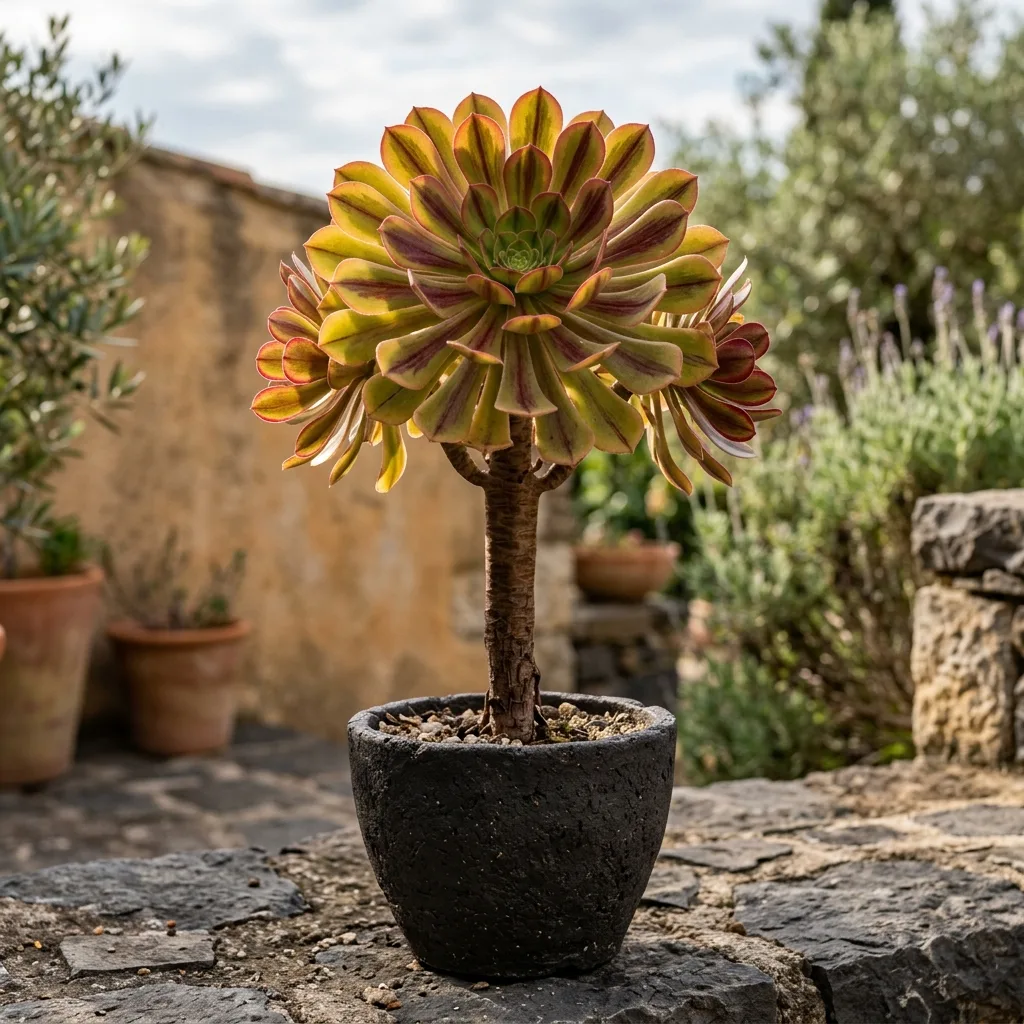
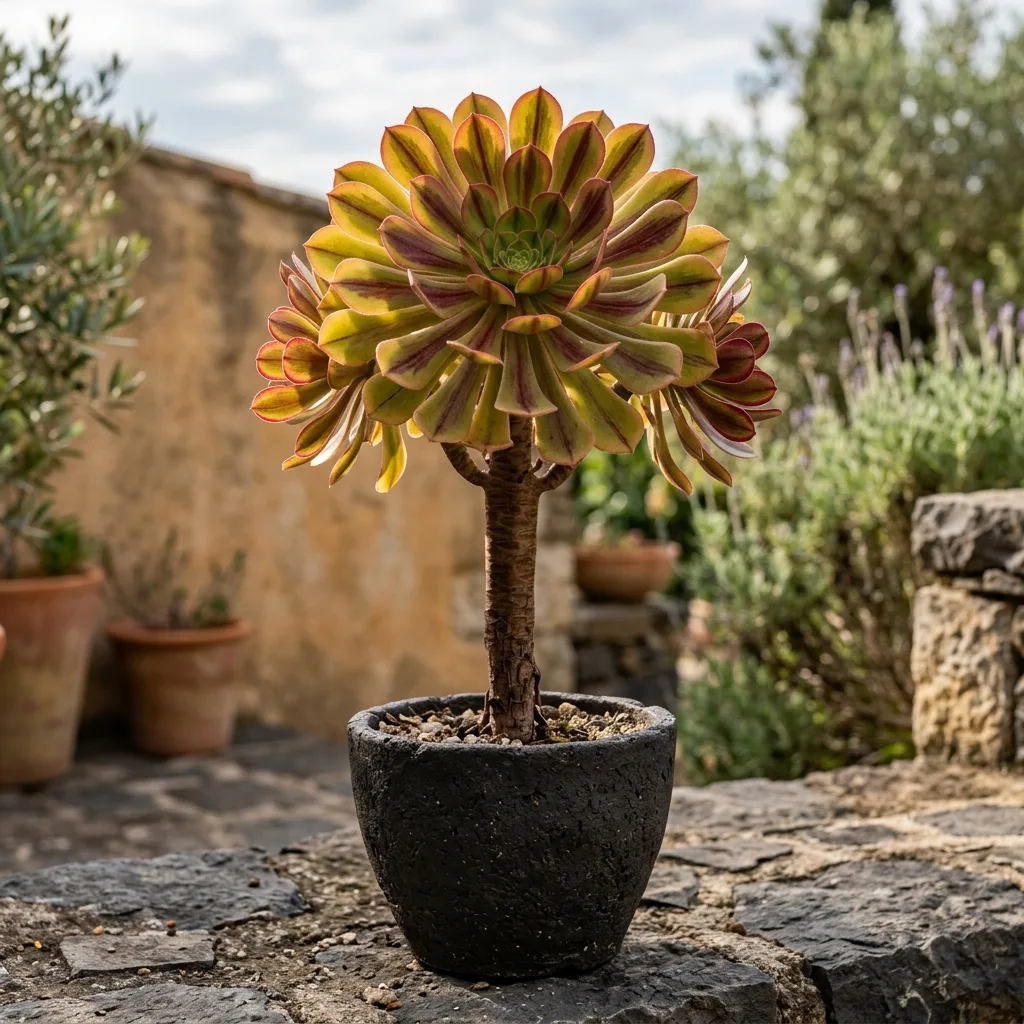
Look up at the wind-sculpted basalt cliffs of the Canary Islands, enveloped in oceanic sea mist, and you will witness one of nature's most magnificent sculptural feats: colossal rosettes hoisted proudly atop stately, woody arborescent stems. Celebrated across international collector circles and botanical literature as one of the most mesmerizing jewels of the succulent world, Aeonium arboreum var. rubrolineatum is an elite taxon that commands center stage in any curated plant collection thanks to the vivid crimson-burgundy veins tracing directly through the heart of its leaves.
Welcoming this magnificent specimen into your living room or balcony is far more than simply potting up a patch of greenery; it is becoming a custodian to an ancient evolutionary saga shaped over millennia by Atlantic gales and volcanic minerals. Unlike the standard uniform green Aeonium arboreum, its anthocyanin-rich, ruby-hued longitudinal stripes deepen in intensity with every kiss of natural sunlight. Yet, unlike conventional desert cacti, this exotic wonder operates on a distinct, counter-intuitive biological clock: it retreats into a restorative dormancy during the blistering heat of midsummer, only to awaken and surge with vigorous growth as the cool autumn breezes return.
If you wish to nurture this red-striped arboreal marvel for decades without leaf loss, stem rot, or dulling its breathtaking contrast, you have arrived at the right sanctuary. Join me amid the rich aroma of freshly brewed coffee drifting through my greenhouse, as we delve into the cellular wonders and practical horticultural protocols of this extraordinary variety.
1. Botanical Identity and Morphological Characteristics
A distinguished member of the Crassulaceae (stonecrop) family, Aeonium arboreum var. rubrolineatum is a semi-shrubby succulent characterized by upright branching, smooth, thickened woody stems, and terminal leaf rosettes. Capable of reaching 1 to 1.5 meters in height within its natural maritime habitat, this variety derives its botanical epithet from the Latin words 'rubro' (red) and 'lineatum' (striped). Its defining morphological hallmark is the crisp, continuous, dark crimson-to-burgundy longitudinal striation coursing along the midrib and occasionally flanking the margins of its fleshy, spatulate foliage.
Examine the leaf margins under a hand lens, and you will discover delicate, crystalline marginal hairs known as cilia, resembling miniature glass eyelashes. In its native coastal habitat, these specialized cilia capture microscopic water droplets directly from dense sea fog, funneling essential atmospheric moisture into the leaf tissue. The plant operates via Crassulacean Acid Metabolism (CAM); it maintains its stomata hermetically sealed during the scorching daytime heat to prevent transpirational water loss, opening them exclusively during the cool night hours to sequester carbon dioxide. As the trunk matures, it develops a smooth, grayish-brown suberized bark patterned with elegant, diamond-shaped leaf scars left behind by shed foliage.
2. Light Requirements and Indoor Positioning
The iconic crimson stripes of Aeonium arboreum var. rubrolineatum are essentially an organic signature inscribed by sunlight. The anthocyanin pigments concentrated in the dermal and mesophyll layers act as natural photoprotective sunscreens, shielding underlying photosynthetic cells from cellular stress induced by excessive ultraviolet radiation. Consequently, the higher the quality of bright, filtered sunlight the plant receives, the sharper and more dramatic these contrasting red lines become. In dim or poorly lit locations, these protective pigments dissipate, the leaves revert to an unremarkable uniform green, and the rosette begins to undergo unsightly, weak elongation known as etiolation.
Indoors, the premier position for this variety is an unobstructed south- or west-facing window, softened slightly by a sheer curtain during peak afternoon glare. During the cool mornings of spring and autumn, unfiltered direct early sunlight is exceptionally beneficial for tight, compact rosette architecture. However, a word of caution: the magnifying effect of window glass during the sweltering heat of midsummer can cause catastrophic cellular burns and leaf blanching. In high summer, shield the plant from harsh midday sun and relocate it to a well-ventilated, bright, partially shaded patio or well-lit interior alcove.
3. Watering Discipline: The 'Soak and Dry' Protocol
The most devastating mistake succulent growers make with the genus Aeonium is maintaining a perpetual, soggy moisture level in the container. Frequent, shallow watering is not an act of devotion; it systematically suffocates the root system. The fibrous roots of Aeonium arboreum var. rubrolineatum demand exceptionally high levels of dissolved rhizosphere oxygen; in waterlogged, muddy substrates, fine feeder roots succumb rapidly to cellular hypoxia, welcoming opportunistic fungal pathogens like Phytophthora and Pythium.
Our golden rule is unyielding: the 'Soak and Dry' protocol. Never apply water until the root ball has dried completely down to the bottom of the vessel. You can accurately verify deep soil moisture by plunging a clean wooden skewer all the way to the base of the pot; if it emerges completely dry with zero soil clinging to it, it is time to irrigate. When watering, saturate the substrate thoroughly until water drains freely from the bottom holes, and always empty the drip tray completely within 15 minutes to prevent reverse capillary saturation.
4. Substrate Formulation and Pot Selection
Without replicating the sharp, rapid drainage of the Canary Islands' volcanic talus slopes, maintaining this species successfully over many years is virtually impossible. Standard peat-heavy potting soils act like waterlogged sponges, generating a suffocating, anaerobic bog around the root flare. The ideal growing medium must be intensely gritty, highly porous, predominantly mineral-based, and structurally stable, allowing subterranean gas exchange to proceed unhindered.
Vessel selection is just as decisive as soil chemistry. Unglazed terracotta containers or highly porous volcanic stone planters are vastly superior to plastic or glazed ceramics because their microporous walls facilitate lateral moisture evaporation, keeping the subterranean zone cool and oxygenated. Never utilize any pot that lacks generous, functional drainage holes.
| Substrate Component | Ratio (%) | Botanical Function |
|---|---|---|
| Horticultural Pumice (3-6 mm) | 35% | Superior porosity, creates internal air pockets, prevents root rot |
| Crushed Red/Black Lava Rock | 25% | Slow-release volcanic trace minerals, structural weight, rapid drainage |
| Zeolite (Clinoptilolite) | 15% | Exceptional cation exchange capacity (CEC) and toxin buffering |
| Coarse Peat or Decomposed Leaf Mold | 15% | Gentle organic foundation and temporary root anchor support |
| Coarse River Sand / Quartz Grit | 10% | Prevents substrate compaction and establishes free-draining channels |
5. Step-by-Step Propagation Techniques
Propagating Aeonium arboreum var. rubrolineatum via individual leaf cuttings is notoriously difficult and rarely successful; the meristematic tissue at the petiole base lacks the vigorous adventitious shoot-forming capacity found in genera like Echeveria or Sedum. The most reliable, rapid, and horticulturally sound method is through terminal rosette stem cuttings.
- Timing is Everything: Perform propagation exclusively during the active vegetative growth window—from early autumn through mid-spring. Taking cuttings during midsummer dormancy almost inevitably leads to tissue dehydration or black rot.
- Making the Cut: Using a razor-sharp pruning knife or bypass shears sterilized with 70% isopropyl alcohol, excise a vigorous terminal rosette, leaving approximately 7-10 cm (3-4 inches) of clean, woody stem below the lowest leaves.
- Callus Formation: Never insert a freshly severed cutting directly into moist soil; an open vascular wound is an open gateway for soil-borne pathogens. Place the cutting in a dry, shaded, well-ventilated space for 4 to 7 days until the cut end forms a firm, whitish-gray, corky protective layer (callus).
- Planting into Dry Mineral Substrate: Insert the callused stem upright into the gritty mineral mix described above. Do not apply any water for the first 10-12 days; the absence of soil moisture encourages the stem node tissue to initiate endogenous root primordia in search of water.
- Gradual Moisture Introduction: After two weeks, begin lightly misting or bottom-watering the surface of the mix. Once fresh, brilliant green-and-red leaves emerge from the rosette core, functional adventitious roots have formed, and standard irrigation can commence.
6. Common Pests, Pathologies, and Interventions
Maintaining long-term vigor in your red-striped tree succulent requires sharp observation and early diagnosis of physiological signals at the cellular level:
- Mealybugs (Pseudococcidae): These pervasive pests establish dense, cottony colonies deep within the tightest axils of the inner rosette leaves, where they pierce tender epidermis to suck phloem sap, causing leaf twisting and yellowing. Treat immediately by dipping a fine cotton swab in 70% isopropyl alcohol for precise contact eradication, followed by horticultural neem oil or systemic insecticides in cases of extensive infestation.
- Root and Stem Rot: Indicated by blackening, softening, and water-soaking at the soil line, accompanied by lower leaves rapidly turning translucent, jelly-like, and dropping off. The sole remedy is immediate surgical intervention: unpot the plant, cut away the compromised stem cleanly until you reveal pristine, ivory-green vascular cambium, dust the wound with sulfur or cinnamon powder, allow it to dry, and re-root from scratch.
- Bruising and Scabbing: Physical rubbing or rough handling of the foliage leaves behind dark, calloused scuffs. These are not fungal infections; they are localized deposits of protective suberin and callose synthesized by the plant to seal micro-wounds. While cosmetically permanent, they require no chemical treatment—simply handle the leaves with greater care.
7. Seasonal Horticultural Calendar and Master Tips
Synchronizing your care regimen with the natural biological rhythms of this Macaronesian native guarantees optimal health year-round:
- Autumn (Awakening and Surge): When average daytime temperatures settle around 20-22°C (68-72°F), the plant breaks its summer rest. The rosettes unfold broadly. Gradually increase watering frequency, and feed once monthly with a low-nitrogen, balanced liquid succulent fertilizer diluted to quarter-strength.
- Winter (Active Growth and Light Pursuit): The metabolic engine of this variety runs steadily through the cool months. Keep it bathed in your brightest window, and ensure ambient temperatures remain above 8-10°C (46-50°F). It possesses zero frost tolerance; temperatures dipping below freezing cause instantaneous cellular rupture and stem collapse.
- Spring (Peak Coloration and Vitality): As the angle of the sun sharpens, the ruby longitudinal lines reach their peak chromatic vibrancy. Water thoroughly whenever the substrate dries, and begin acclimating the plant to sheltered outdoor conditions.
- Summer (Physiological Rest / Dormancy): As sustained summer heat arrives, the rosettes tighten into compact, ball-shaped configurations to protect the central growing point. Cease all fertilization completely, scale back watering to minimal maintenance levels, and move the plant to an airy, shaded location with good air circulation.


Reader Reviews & Comments 4 Reviews
Eleanor Vance
Julian Thorne
Marcus Sterling
Clara Higgins
Leave a Review & Rating
Share your plant care tips, experiences, or questions with our succulent community.