






Dancing with the Atlantic winds along the volcanic cliffs of the Canary Islands, the ancient genus Aeonium boasts one of its most breathtaking variegated cultivars in Aeonium 'Sunburst'. A living ode to natural illumination, this striking succulent features expansive rosettes that transition seamlessly from deep emerald green at the core to luminous creamy yellow along the margins, flushed with vivid ruby-rose along the leaf edges when kissed by the sun. As the summer solstice arrives on June 21—the longest day of the year in the northern hemisphere—ancient botanical traditions and contemporary living design coalesce around this radiant specimen. Incorporating living rosettes into summer solstice decor invites the sun's seasonal abundance and natural vitality directly into our living spaces.
For dedicated succulent enthusiasts, the summer solstice marks more than a date on the calendar; it is a sacred invitation to forge an intimate artistic bond with the botanical realm. Drought-tolerant, sculptural rosettes like Aeonium 'Sunburst' take center stage in handcrafted solstice wreaths, living botanical crowns, and weathered driftwood assemblages. Yet viewing this magnificent succulent merely as an ornamental flourish diminishes its biological wonder. Incorporating living plant tissue without compromising its vascular integrity—and later rooting it seamlessly into well-draining substrate—requires horticultural knowledge, patience, and a delicate hand.
Join us as we explore the cellular adaptations, sustainable solstice craft techniques, and seasonal physiological rhythms of this Canary Islands jewel, detailing the precise care protocols required to keep your specimen flourishing through midsummer and beyond.
1. Botanical Identity and Morphological Characteristics
Aeonium 'Sunburst' (frequently identified as a variegated hybrid linked to Aeonium davidbramwellii or Aeonium arboreum) is a caulescent, branched, woody-stemmed succulent shrub belonging to the diverse family Crassulaceae. Its crowning glory is its colossal, geometrically balanced rosette, which routinely achieves diameters of 25 to 30 centimeters (10 to 12 inches) under optimal conditions.
Morphologically, the leaves are spatulate, gently tapering toward the apex and bordered along their margins by minuscule, hair-like micro-serrations known as cilia. The chlorophyll-dense central midrib provides the structural photosynthetic backbone, whereas the broad, creamy-white margins are entirely devoid of chlorophyll. Exposed to intense luminous radiation, the epidermal cells synthesize anthocyanin pigments to shield their delicate cellular machinery from ultraviolet photodamage, imparting a dramatic carmine-pink blush to the leaf margins.
2. Summer Solstice Botanical Crafts: Living Art and Design Ideas
The June 21 summer solstice commemorates the zenith of solar energy, symbolizing vegetative vitality and flourishing abundance. The solar silhouette of Aeonium 'Sunburst' serves as an extraordinary living medium for seasonal botanical crafts. Rather than severing flowers to wilt within days, you can harness the plant's miraculous Crassulacean Acid Metabolism (CAM)—which allows it to absorb ambient moisture and endure for weeks without active root systems—to craft enduring living art:
- Midsummer Solar Wreath: Wrap a circular foundation of woven grapevine or willow branches with rehydrated sphagnum moss. Secure severed Aeonium 'Sunburst' terminal cuttings at the visual focal point using coated floral wire, taking great care not to constrict or bruise the stem. Flank the rosettes with dried golden wheat shafts, strawflowers, and fragrant dried lavender. This living display will maintain its turgidity on your doorway for weeks; by late summer, simply untie the rosettes and plant them in porous potting mix to establish new individual specimens.
- Living Midsummer Floral Crown: Woven from twisted natural jute cord and living succulent rosettes, botanical hair crowns are time-honored symbols of solstice festivals. NEVER apply hot glue or chemical floral adhesives, as they cause irreversible dermal burns and tissue necrosis; instead, fasten the stem tenderly to the headband using organic cotton twine.
- Solstice Driftwood Pedestal: Select ocean-tumbled driftwood with natural recesses. Line these pockets with a thin layer of damp sphagnum moss and tuck compact 'Sunburst' rosettes into the crevices, anchoring them with pea gravel. Serving as a living tribute to the dawn, this centerpiece provides an earthy focal point for midsummer dining.

3. Light Dynamics and Strategic Indoor Placement
True to its moniker, Aeonium 'Sunburst' craves abundant, high-intensity light. However, because its variegated margins lack protective chlorophyll, they are far more vulnerable to scorch from blistering, unfiltered midday sun than their solid-green counterparts. To prevent unsightly necrotic patches and leaf blistering, provide bright, dappled southern exposure or intense morning light filtered through a sheer curtain.
Conversely, isolating the plant in a dim room induces rapid etiolation: the stem stretches weakly toward the light source, the rosette flattens into an open, loose saucer, and the vibrant ruby margins fade into a dull, uniform pale green. Within home interiors, prime real estate includes unobstructed eastern windowsills—where gentle dawn rays illuminate the foliage—or south-facing verandas protected by sheer shade cloth (30-40% filtration).
4. Irrigation Protocols: Demystifying Summer Dormancy (Aestivation)
While standard summer-growing succulents push forth vigorous vegetative growth during hot months, the genus Aeonium employs an entirely inverted seasonal strategy. Adapted to the bone-dry, scorching summers of the Macaronesian archipelago, Aeonium 'Sunburst' enters aestivation (summer dormancy) whenever ambient temperatures consistently surpass 28–30°C (82–86°F). During this period, the plant throttles its internal metabolic processes to a near-complete standstill, cupping its peripheral leaves tightly inward like a chalice to minimize transpirational moisture loss.
Increasing irrigation during this dormant window is the most pervasive and fatal mistake in succulent culture. Frequent watering does not alleviate summer heat stress; instead, it suffocates dormant roots and creates a warm, hypoxic breeding ground for devastating root pathogens. Strictly adhere to the foundational 'Soak and Dry' rule, verifying that the root zone is entirely desiccated before offering moisture. Throughout the dog days of midsummer, administer merely a light sip of water around the pot's rim once or twice a month during the cool of the evening to prevent excessive lower-leaf dehydration.
5. Engineered Substrate Formulation and Pot Selection
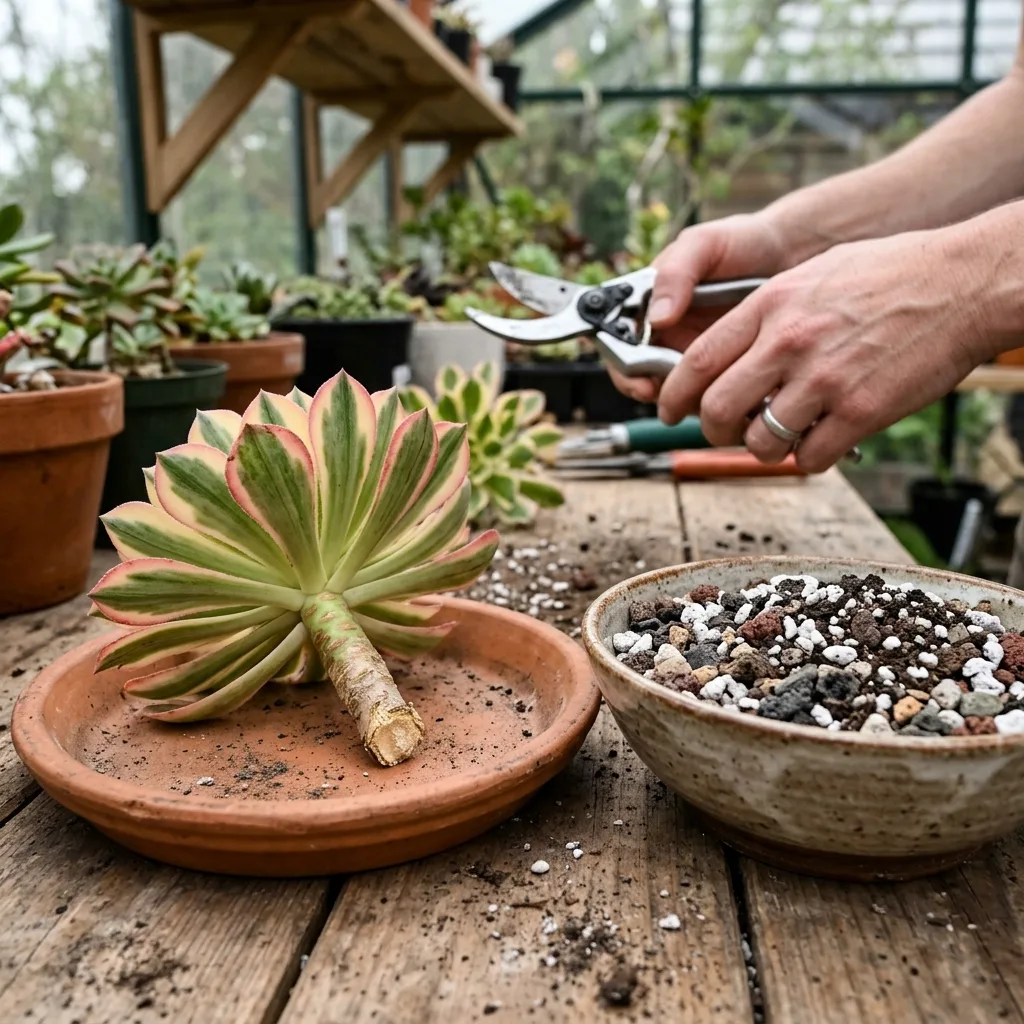
Aeoniums possess a shallow, fibrous root architecture that suffocates rapidly in heavy, clay-heavy, or moisture-retentive peat soils. High inorganic mineral porosity is imperative to keep the root xylem bathed in atmospheric oxygen. Always house your specimen in an unglazed terracotta pot featuring generous drainage apertures, which allows excess moisture to evaporate evenly through its porous clay walls.
| Substrate Component | Ratio (%) | Botanical Purpose and Functional Benefit |
|---|---|---|
| Coarse Horticultural Pumice (3–6 mm) | 35% | Creates critical macro-pores, enhances aeration, and prevents substrate compaction. |
| Red Volcanic Lava Rock / Zeolite | 25% | Supplies trace minerals, binds excess dissolved salts, and buffers excess moisture. |
| Washed Horticultural Coco Coir | 25% | Offers a clean, fiber-rich organic anchor for delicate root hairs while maintaining balanced pH. |
| Coarse Perlite or Graded River Grit | 15% | Maximizes rapid gravitational drainage, allowing excess water to clear the pot in seconds. |
6. Step-by-Step Propagation Protocols
Propagating Aeonium 'Sunburst' via single leaf cuttings is virtually impossible; the chimeric, variegated cells along individual leaves cannot successfully organize an autonomous meristematic growing point. The only reliable horticultural approach is apical stem cutting (beheading) or the separation of lateral offshoots:
- Select the Proper Window: Execute your cuttings during active growth periods—either early spring or early autumn. Rosettes featured in summer solstice crafts should be stored in a bright, dry, shaded spot until late summer temperatures cool down before planting.
- Perform a Sanitized Incision: Using a razor-sharp pruning knife disinfected with 70% isopropyl alcohol, sever the stem 5 to 7 centimeters below the base of the terminal rosette with a clean, horizontal cut.
- Facilitate Callus Formation: Never insert freshly cut succulent stems directly into moist soil. Rest the cutting on clean paper in a warm, dry, well-ventilated spot away from direct sunlight for 4 to 7 days until the cut stem forms a firm, suberized scar tissue (callus) that barricades soil-borne pathogens.
- Introduce to Dry Inorganic Medium: Insert the callused cutting into the dry mineral mix detailed above. Withhold water completely for 2 to 3 weeks. A rootless cutting possesses no vascular ability to intake moisture; watering premature cuttings inevitably causes fungal rot.
- Initiate Hydration: After several weeks, tug the stem very gently upward. If you encounter slight mechanical resistance, young adventitious roots have anchored into the grit. You may now commence moderate, gradual watering.
7. Diagnostic Guide: Pests, Pathogens, and Physiological Stress
The lush, tender variegated foliage of 'Sunburst' is particularly attractive to common sap-sucking insects and fungal spores. Monitor your plant for these key issues:
- Mealybugs (Pseudococcidae): Appearing as white, cottony masses tucked deeply into the crowded crevices of the rosette. Treat immediately by spot-swabbing insects with a cotton bud dipped in 70% isopropyl alcohol, followed by a targeted application of cold-pressed neem oil during evening hours.
- Stem and Rosette Rot (Fusarium / Pythium): Triggered by waterlogged soil during summer aestivation. The stem turns soft and black, causing leaves to drop at the slightest touch. Immediately excise all compromised tissue with a sterile blade until you reveal clean, green vascular rings. Dust the exposed cut with sulfur or cinnamon powder, allow it to recrawl, and re-root in fresh substrate.
- Melanin Spots and Solar Scorch: High ambient temperatures combined with direct ultraviolet rays produce dark brown, dry necrotic scars on upper leaves. Shift the pot to an airy, partially shaded microclimate immediately.
8. Seasonal Care Almanac and Master Calendar
Maintaining peak vitality in your Aeonium 'Sunburst' requires harmonizing your care with the classic Mediterranean climatic rhythm:
- Spring (March – May): The era of explosive vegetative growth. Apply a balanced, low-nitrogen succulent fertilizer diluted to quarter-strength every three weeks. Harvest apical cuttings and repot rootbound specimens.
- Summer (June – August): The solstice ushers in metabolic aestivation. Suspend all fertilization entirely. Shield foliage from harsh, direct midday sun and reduce irrigation to minimal evening sips once or twice monthly.
- Autumn (September – November): Ambient temperatures drop and the plant reawakens. Rosettes relax and open outward. Resume regular 'soak and dry' watering cycles and refresh potting soil as needed.
- Winter (December – February): Protect the plant from freezing conditions, as temperatures below 5°C (41°F) will burst cellular walls. Position it on your sunniest indoor sill in a cool room to encourage sturdy, slow-paced winter development.


Reader Reviews & Comments 3 Reviews
Eleanor Vance
Clara Hughes
Marcus Thorne
Leave a Review & Rating
Share your plant care tips, experiences, or questions with our succulent community.