






Under the scorching sun of the high, arid plateaus bordering South Africa and Namibia, a passing glance reveals little more than small, limestone-encrusted gravel. Yet, if you stoop down and inspect the rocky crevices closely, you will discover the remarkable Nananthus vittatus, blending seamlessly into the landscape with its miniature, tooth-like leaves. A captivating geophyte belonging to the Aizoaceae (ice plant or mesemb) family, this plant presents a modest cluster of ground-hugging rosettes above the surface while concealing a massive, swollen tuberous taproot below ground—the true biological engine of its desert survival.
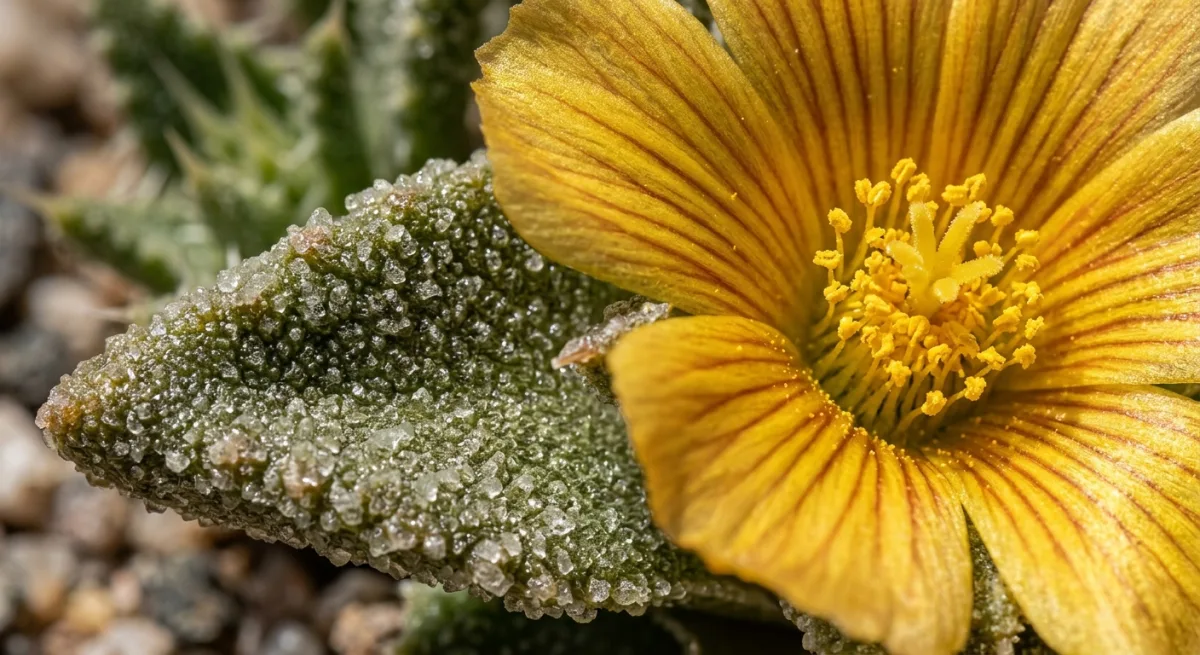
Treasured by seasoned mesemb collectors and caudex enthusiasts alike, this dwarf stone succulent bursts into bloom from late spring into autumn with stunning daisy-like blossoms, each petal proudly adorned with a distinct coppery-red central stripe. The rough, pale tubercles coating its leaf surfaces are not merely ornamental textures; they function as micro-scale hydrological traps designed to condense and harvest morning desert dew. Cultivating this rugged survivor indoors or in an alpine greenhouse offers a front-row seat to one of nature's most sophisticated evolutionary adaptations.
1. Botanical Identity and Morphological Features
In taxonomic classification, Nananthus vittatus belongs to the family Aizoaceae and the subfamily Ruschioideae. The specific epithet 'vittatus' translates from Latin as 'striped' or 'banded', directly honoring the enchanting bronze-to-carmine median line that runs down each ray petal. The plant grows in flat, tightly arranged rosettes that rarely exceed 5 to 6 cm in height; over time, however, it forms slowly spreading miniature colonies measuring 15 to 20 cm in diameter.
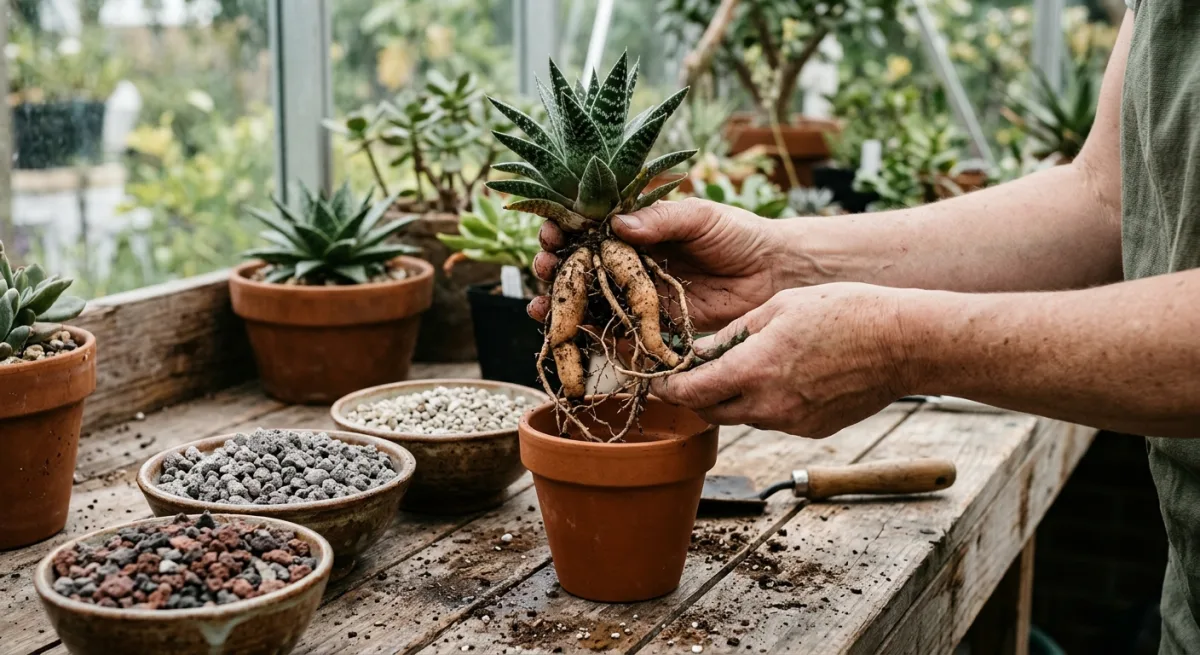
Its foliar morphology is highly specialized: the leaves are boat-shaped to lanceolate, slightly triangular in cross-section, and display a deep olive-green to slate-tinted hue. The epidermal surface is studded with prominent whitish, raised tubercles that scatter intense UV radiation and break laminar air currents to minimize transpirational water loss. The true botanical marvel of Nananthus vittatus, however, lies subterranean. It produces an exceptionally thick, fleshy, water-storing caudiciform taproot that acts as a reservoir of moisture and carbohydrates during months of uninterrupted drought. Many bonsai growers and succulent specialists take advantage of this anatomy by gradually elevating the tuberous root during repotting, staging it as a dramatic desert bonsai specimen.
2. Light Requirements and Indoor Positioning
Forged in the unyielding solar intensity of the Karoo and Free State velds, Nananthus vittatus is an obligate full-sun succulent. Under inadequate lighting, its biological architecture deteriorates rapidly: the rosettes stretch uncontrollably (etiolation), the leaves lose their rigid boat-like geometry, the surface tubercles fade, and the plant completely aborts its ability to initiate floral buds.
When growing indoors, your primary goal is to provide at least 5 to 6 hours of unfiltered direct sunlight daily. An unobstructed south-facing windowsill is the ideal residential microclimate, with a bright west-facing exposure serving as an acceptable alternative. Because window glass can trap stagnant, scorching heat during peak summer afternoons, maintain gentle ambient ventilation around the plant. If you cultivate this dwarf mesemb in northern latitudes or through overcast winters, supplementary illumination via a full-spectrum LED grow light (6500K daylight spectrum, delivering at least 250–300 µmol/m²/s PPFD at canopy level for 12 hours daily) is essential to preserve compact foliar density.
3. Watering Discipline: The 'Soak and Dry' Method
Hydrating Nananthus vittatus requires a delicate touch. Its massive geophytic taproot stores water with supreme cellular efficiency, rendering the plant practically immune to extended droughts, yet hyper-sensitive to soil saturation. Frequent, small sips of water are the quickest path to suffocating its root xylem tissues and introducing lethal pathogens.
The golden horticultural rule is strictly Soak and Dry. During active growth in spring and early autumn, drench the pot thoroughly until water flows freely through the drainage holes, but only after you have confirmed that the substrate has dried out completely from top to bottom. Discard any residual runoff sitting in drip trays immediately. When midsummer temperatures soar above 35°C (95°F), or during the freezing depths of winter, the plant enters a metabolic slowdown (dormancy). Curtail watering during these phases to once a month or just enough to prevent the leaves from deflating into deep, wrinkled folds.
4. Ideal Soil Mix and Pot Selection
Subjecting Nananthus species to conventional, peat-dominated potting soils is almost always fatal. In the wild, their roots anchor into nutrient-lean, highly porous, calciferous and gravelly substrates. To mirror these conditions, you must assemble a mineral-dominated, highly permeable mix that permits rapid air exchange and sheds excess water instantaneously.
Pot geometry is equally consequential. Unlike shallow-rooted mesembs such as Lithops or Conophytum, Nananthus vittatus requires a deep pot to accommodate its downward-plunging taproot. Choose a container with a minimum depth of 10 to 12 cm. Unfinished, unglazed terracotta is the gold standard; its microporous walls allow moisture to evaporate laterally from the root zone, keeping root temperatures cool and preventing stagnant moisture pockets.
| Substrate Component | Ratio (%) | Botanical Function |
|---|---|---|
| Pumice (3–6 mm) | 40% | Provides superior macroporosity and structural aeration |
| Lava Grit / Zeolite | 25% | Enhances cation-exchange capacity and structural grit |
| Coarse Quartz Sand / Grit | 15% | Creates free-draining channels and mimics natural scree |
| Sterilized Coir / Low-peat Mix | 20% | Supplies minimal organic matrix without waterlogging |
5. Step-by-Step Propagation Techniques
Propagating Nananthus vittatus can be achieved reliably through two distinct scientific approaches: seed cultivation and vegetative division of mature multi-headed clumps.
Method 1: Growing from Seed (Best for Symmetrical Caudex Development)
- Harvesting Seed Capsules: Wait for the post-bloom hydrochastic seed capsules to dry fully on the plant. Mimicking desert rainfall, mist the dry capsule with a single droplet of water; within seconds, the expanding valves will open to reveal microscopic seeds.
- Substrate Preparation & Sowing: Scatter the fine seeds across a pre-moistened surface composed of finely sifted pumice, perlite, and a dash of sterile coir. Because Nananthus seeds are photoblastic (requiring light to trigger germination), do not bury them; leave them gently pressed against the surface.
- Incubation & Air Circulation: Seal the sowing tray in a clear container under bright, indirect light at 20–24°C (68–75°F). Germination typically begins in 7 to 14 days. Gradually introduce fresh airflow once the cotyledons appear. Seed-grown plants develop the most balanced, symmetrical tuberous root systems.
Method 2: Division of Rosettes and Root Offsets
As specimens mature, secondary rosettes emerge from the crown perimeter. During early spring repotting, lift the plant from its substrate. Using a sterile, surgical scalpel, carefully slice an offset away, ensuring it retains a portion of the thickened taproot and feeder roots. Dust all cut surfaces with sulfur powder or powdered activated charcoal, allow the wound to callus in a dry, shaded location for 4 to 5 days, and pot into completely dry, gritty substrate.
6. Common Pests, Diseases, and Clinical Remedies
While remarkably resilient against abiotic stress, Nananthus vittatus can fall victim to specific cultivation missteps:
- Root and Stem Base Rot (Phytophthora / Pythium): The primary killer of geophytic succulents. Caused by overwatering or stagnant substrates, turning the taproot into a soft, brown, foul-smelling mass. Remedy: Unpot immediately, excise all necrotic root tissue with a sterile blade until only crisp, white flesh remains, treat with a systemic fungicide, dry the plant for a week, and repot into pure pumice.
- Root and Foliar Mealybugs (Pseudococcidae): Concealing themselves between overlapping leaf bases and along the taproot folds, these insects suck phloem sap, leading to stunted leaf tips and soot mold. Remedy: Dab visible colonies with a 70% isopropyl alcohol swab. For subterranean infestations, wash away all old substrate and drench roots with an insecticidal soak or systemic acetamiprid solution.
- Spider Mites (Tetranychidae): In hot, dry indoor settings with stagnant air, microscopic mites spin faint webs around leaf crowns, causing dull, bronze stippling. Remedy: Improve room ventilation and apply a specialized miticide or cold-pressed neem emulsion.
7. Seasonal Care Calendar and Horticultural Nuances
Aligning your cultivation routine with the natural phenology of the Karoo plateau will keep your Nananthus thriving and blooming year after year:
- Spring (Awakening & Primary Growth): As ambient temperatures stabilize above 15°C (59°F), resume deep soak-and-dry watering. Apply a low-nitrogen, potassium-rich liquid cactus fertilizer at quarter-strength once a month. Floral buds begin to swell within the central rosettes.
- Summer (Heat Torpor & Daily Blooms): In excessive heat (over 32°C/90°F), vegetative growth slows. Provide light midday shading or active airflow to prevent leaf scald. Water exclusively in the late evening so the root system can drink while ambient temperatures drop.
- Autumn (Secondary Growth Surge): As nights cool down, the plant directs energy back into thickening its geophytic taproot. Maintain steady watering whenever the grit dries out. Cease all fertilization by mid-autumn to prepare the tissues for winter dormancy.
- Winter (Cold Rest & Bud Induction): Provided its root ball remains bone-dry, Nananthus vittatus is remarkably frost-hardy, withstanding brief dips down to -5°C (23°F). Maintain a bright, unheated, well-ventilated space (5–10°C / 41–50°F) throughout winter. This chilling period is critical to initiate flower bud formation for the following season.


Reader Reviews & Comments 3 Reviews
Julian Vance
Clara Higgins
Marcus Sterling
Leave a Review & Rating
Share your plant care tips, experiences, or questions with our succulent community.