






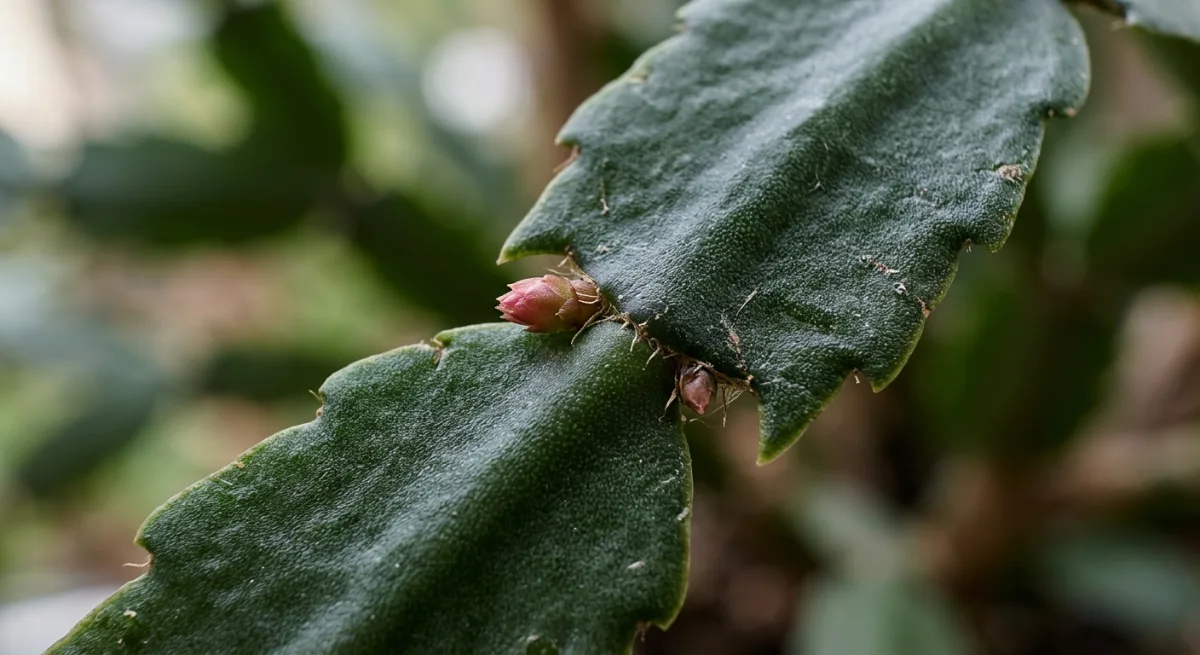
In the mist-shrouded coastal cloud forests of Brazil, epiphytic crab cacti (Schlumbergera truncata)—often affectionately dubbed the 'weeping crab' or 'false Christmas cactus' due to their dramatic, pendulous growth habit—spill down ancient tree trunks like living waterfalls. When welcomed into our homes, their segmented, toothed, fleshy stem pads (cladodes or phylloclades) gracefully yield to gravity, cascading over pot rims in a melancholy yet utterly captivating arch. Yet, when you seek to feature this living botanical sculpture within an open glass vessel, you must translate nature's wild, aerial canopy dynamics into the microclimate of your living room. The greatest misstep indoor plant enthusiasts commit is trapping these air-loving epiphytes inside sealed glass humidity chambers.
Epiphytic cactus tissues possess specialized intracellular vacuoles adapted to regulate moisture delicately rather than endure sustained saturation. In a closed terrarium, stagnant air and extreme vapor pressure overwhelm the plant's transpirational cooling mechanism. Unable to cope with unchecked osmotic pressure, cell walls burst, dissolving the plant into a gelatinous heap of rot within weeks. An open glass terrarium, by contrast, maintains continuous atmospheric exchange while giving the trailing weeping branches room to spill freely past the glass lip. In this master horticultural guide, we unveil the refined pruning techniques that shape your weeping crab cactus and the geological layer engineering required to keep its vulnerable epiphyte root system thriving forever.
1. Engineering the Drainage Sub-Layers (The False Bottom)
Cultivating an epiphyte within an undrained glass container requires meticulous mimicry of nature's subterranean hydrological cycles. When surplus irrigation cannot escape through drainage holes under gravity, anaerobic bacteria proliferate rapidly, colonizing the root zone and clogging vulnerable vascular bundles (xylem) with fungal pathogens. Watering succulents and forest cacti excessively is never an act of care; it is an accidental smothering of delicate root systems that crave oxygen above all else. For this reason, an engineered false bottom at the base of the glass is your plant's absolute lifeline.
The foundational layer must consist of coarse, highly porous volcanic lava rock and expanded clay pebbles (LECA) to break the capillary rise of standing moisture. Directly above this reservoir, spread a uniform layer of horticultural-grade activated charcoal pellets. This biological filter neutralizes organic decomposition byproducts, eliminates stagnant sulfurous odors, and arrests fungal spore incubation. To preserve this drainage architecture, lay down a tailored disc of synthetic geotextile fabric or fiberglass mesh over the charcoal; this barrier prevents finer mineral substrate particles from falling into the reservoir and choking the air pockets below.
2. Companion Species Selection & Biotope Pairing Rules
Unlike arid desert succulents that crave blistering direct sun, the weeping crab cactus (Schlumbergera truncata) is a subtropical epiphyte accustomed to dappled tree shade and humid, circulating jungle breezes. In its native habitat, its roots nestle into moss cushions and organic leaf litter tucked into bark fissures. Consequently, pairing a weeping crab cactus with scorching desert lovers like Echeveria or towering columnar cacti inside the same glass vessel is an ecological death sentence. Companion species must align precisely in Crassulacean Acid Metabolism (CAM) rhythms, photosynthetic light thresholds, and hydration cadences.
Ideal micro-ecological companions that harmoniously share this environment include Rhipsalis baccifera (Mistletoe Cactus), Haworthiopsis fasciata (Zebra Haworthia), and the trailing Peperomia prostrata (String of Turtles), which thrives in moist, sheltered rock crevices. While Haworthia anchors the lower, shaded zones of the glass vessel with structural rosettes, Rhipsalis echoes the weeping crab's cascading posture with contrasting slender, cylindrical stems. Together, this trio establishes a biologically stable, aesthetically balanced epiphytic terrarium biotope.
3. Layer Thickness & Material Prescription
The cross-sectional profile of an open glass terrarium should look as deliberate and stratified as a geological canyon. For a cylindrical or geometric glass vessel measuring 20–25 cm (8–10 in) in height, utilize the following scientifically proportioned substrate formula:
| Layer Order | Material Composition | Thickness | Botanical Function & Purpose |
|---|---|---|---|
| 1. Base Reservoir | Lava Rock (8–12 mm) & Expanded LECA | 3.0 – 4.0 cm | Isolates gravitationally drained water away from root tips |
| 2. Biological Filter | Activated Horticultural Charcoal Pellets | 0.5 – 1.0 cm | Absorbs impurities, controls odors, and suppresses pathogens |
| 3. Separation Barrier | Porous Geotextile Fabric / Fiberglass Mesh | 0.2 cm | Stops soil migration into drainage voids while letting water pass |
| 4. Epiphytic Substrate | Pumice (40%), Zeolite (20%), Pine Bark (20%), Cactus Peat (20%) | 6.0 – 8.0 cm | Provides superior rhizosphere aeration, low water retention, mild acidity |
| 5. Top Mulch & Accents | Washed River Pebbles & Crushed Slate Fragments | 1.0 – 1.5 cm | Keeps the stem collar dry, minimizes splash, adds visual depth |
4. Step-by-Step Assembly & Pruning Protocol
Before assembling your terrarium, the specimen crab cactus must undergo anatomical pruning and structural preparation. Pruning the weeping crab cactus is not merely cosmetic; it maintains a balanced architecture and triggers vigorous lateral branching, multiplying terminal blooming nodes for the upcoming flowering season. Unpruned specimens eventually grow leggy, heavy, and brittle, risking snapped branches and an uneven weight distribution in open glasswork.
The Art of Pruning the Weeping Crab Cactus
1. The Segment Twist (Pinching Technique): Never take shears or razor blades to a weeping crab cactus. Metal blades crush delicate parenchyma tissue, slice through main vascular bundles, and leave wide, ragged surfaces ripe for fungal infection. Instead, rely on the clean twisting method: anchor the lower segment securely between the thumb and forefinger of one hand, then grasp the target segment above it with your other hand. Gently rotate the upper pad 90 degrees clockwise while applying a slight outward tug. The segment will detach cleanly at the natural articulation node with a crisp, satisfying click, leaving minimal scar tissue.
2. Canopy Thinning & Bud Multiplication: If a single arching branch extends more than three or four segments beyond the glass rim, twist off the terminal one or two weakest pads. This breaks apical dominance, prompting the parent segment to sprout two or three fresh cladodes from the node margins come spring. Your weeping cascade will transform from a sparse, straggly fringe into a dense, luxurious curtain of foliage.
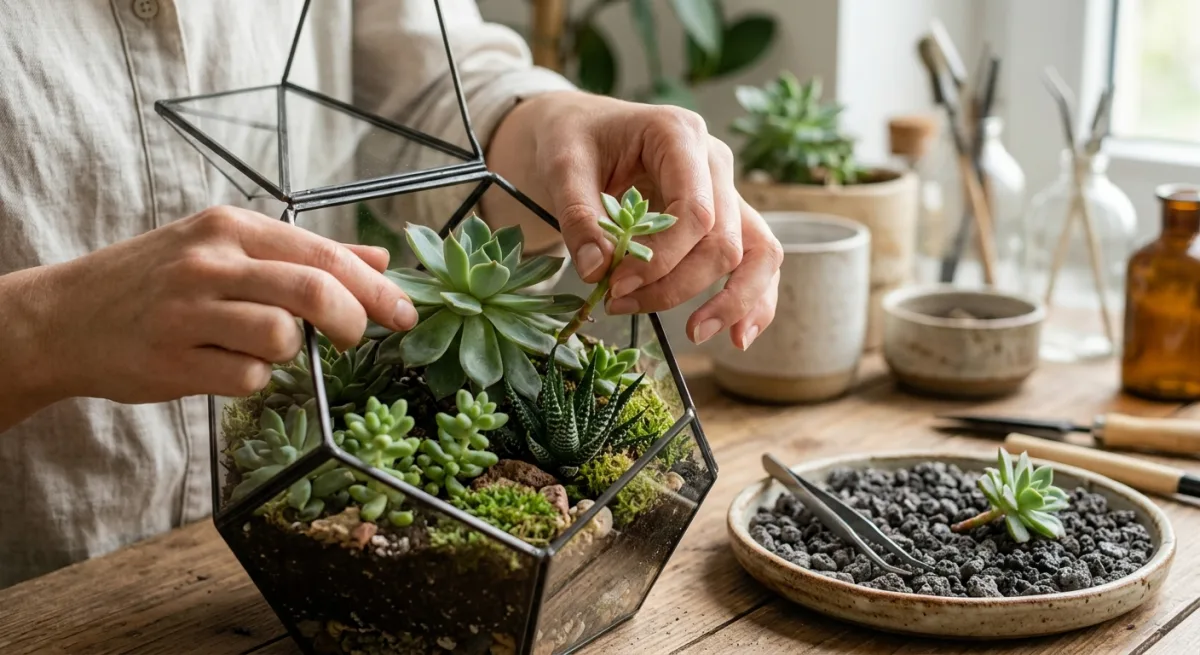
3. Root Cleansing & Sculpted Planting: Gently unpot the pruned specimen and tease away dense greenhouse peat from the fine root filaments without tearing them. Build a gentle slope of airy substrate toward the back-center of the glass vessel. Bed the crab cactus firmly into this elevated mound so its pendant stems naturally arch out and drape over the front and side lips of the glass. Cover the root system with substrate, verifying that the basal stem collar rests safely above the mineral gravel line.
5. Natural Sculptural Elements: Driftwood, Stone, and Quartz Accents
A master terrarium is more than an assemblage of plants; it is a three-dimensional living diorama. To honor the native epiphytic identity of Schlumbergera truncata, incorporate a sterilized piece of aged mopani or mangrove wood into your design. The weathered, grooved grain of natural wood provides an earthy foil to the succulent, emerald-green segments trailing over it.
For hardscape stone, opt for chemically inert materials that do not leach calcium or alter soil pH, such as volcanic basalt, dark grey slate, or black obsidian fragments. Steer clear of artificially dyed decorative sands, which can leach toxic pigments into the closed root environment over time. Instead, create naturalistic contours and mimic dried stream beds using raw river quartz, terracotta granules, or crushed red lava grit.
6. Micro-Irrigation & Light Management in Open Glass
Irrigating an open glass terrarium is a study in precision rather than volume. Set aside standard watering cans in favor of a narrow-nozzle laboratory wash bottle or angled squeeze bottle. Never squirt water directly into the crown or splash the phylloclades; trapped water droplets act like miniature magnifying lenses under light, causing unsightly scorch marks and encouraging bacterial soft rot (Erwinia). Deliver water in controlled trickles along the inner glass periphery and between accent stones, allowing it to percolate gently into the root zone.
Calibrate your irrigation intervals to the plant's seasonal cycle: during active spring and summer growth, hydrate only after the top 3 cm (1.2 in) of substrate has dried completely. In late autumn and winter dormancy, reduce watering to an occasional light wetting once or twice a month. Light-wise, the weeping crab cactus demands bright, dappled, indirect illumination. Direct, harsh midday sun breaks down photosynthetic chlorophyll, turning segments dull, purplish-red and leathery. An east- or bright north-facing window provides the soft morning rays needed to keep cladodes radiant, turgid, and laden with jewel-toned blossoms.


Reader Reviews & Comments 3 Reviews
Eleanor Vance
Marcus Sterling
Clara Higgins
Leave a Review & Rating
Share your plant care tips, experiences, or questions with our succulent community.