






Holding a succulent seed as delicate as a speck of dust in the palm of your hand and imagining that it will one day become a majestic Echeveria rosette native to Mexican canyons or an ancient Lithops gemstone of the Karoo desert feels like witnessing a true botanical miracle. Yet, this miracle demands one of nature's greatest tests of patience. How long does that tiny seed entrusted to the soil actually take to germinate, when does it develop its characteristic morphology, and at what point does it become a display-worthy, mature cornerstone of your collection?
Many plant enthusiasts inevitably face disappointment when they expect succulent seeds to shoot up within weeks like common beans or tomatoes. In reality, as consummate survival masters of arid landscapes, succulents proceed with extreme caution, taking strategic, deliberate steps as they construct their cellular water-storage mechanisms (Crassulacean Acid Metabolism, or CAM photosynthesis) and intricate root xylem vascular networks. Let us pull back the curtain and explore the biological realities behind this rewarding journey of green patience.
1. Botanical Identity and Morphological Characteristics
The growth rate and maturation tempo of succulent seeds depend fundamentally on the genetic architecture of their genus. In the botanical world, succulent seeds span a staggering spectrum—ranging from virtually microscopic dust particles to millimeter-wide spheres. For example, seeds of Crassula or Echeveria are as fine as talcum powder, whereas an Adenium obesum (Desert Rose) seed features a plump, fibrous structure. This morphological distinction directly dictates the embryo's endospermic nutrient reserves, which in turn govern the initial speed of development.
When we classify the developmental phases across a realistic calendar timeline, the progression unfolds as follows:
- Germination Phase (5 to 25 Days): Moisture enters through the seed coat's micropylar opening via imbibition, awakening the dormant embryo. First, a microscopic radicle anchors into the soil particles, followed shortly by the emergence of chlorophyll-rich seed leaves (cotyledons). Echeveria and Sedum species generally emerge within 7 to 14 days, living stone succulents like Lithops take 10 to 21 days, while tropical arid seeds like Adenium can germinate in a record 3 to 7 days under elevated warmth.
- Seedling and Primary Rosette Phase (2 to 6 Months): Following the cotyledons, the true leaves emerge, revealing the plant's authentic botanical identity. During this sensitive window, seedlings measure a mere 3 to 8 millimeters across. Water-storing parenchyma cells within the foliar tissue activate, and species-specific pigments along with the protective farina (epicuticular wax) layer begin to manifest.
- Juvenile Plant Phase (6 to 12 Months): The root system branches extensively into fibrous networks, and the stem thickens. Measuring an average of 2 to 4 cm in diameter, the young plants transition from fragile nursery infants into resilient, drought-tolerant individuals.
- Full Maturity and Flowering (1 to 3 Years): While many Crassula and Echeveria cultivars achieve their full structural size and reach reproductive maturity within 12 to 18 months, slower-growing taxa such as Lithops, Conophytum, and certain Haworthia species may require 2 to 3 full years before producing their maiden floral displays.
2. Light Requirements and Indoor Positioning
The paramount external factor governing the metabolic velocity of succulent seedlings is photon density and light spectral quality. However, growers face a delicate physiological paradox: while a mature specimen revels in direct, blazing sunlight, an emerging seedling—composed of translucent, microscopic tissues—can scorch, dehydrate, and collapse within minutes under intense solar radiation.
During germination and the initial 3-month seedling phase, the gold standard is bright, indirect, filtered light. An east-facing windowsill veiled by a sheer curtain delivers gentle morning rays that safely kickstart photosynthesis without overheating the microclimate. If natural illumination is deficient in your space, you can completely prevent etiolation (the weak, leggy stretching of stems toward light) by positioning 6500 Kelvin full-spectrum LED grow lights 25 to 30 cm above the containers for 12 to 14 hours daily, effectively doubling your growth rate.
As seedlings reach the 6-month threshold and develop true rosette structures, begin a gradual acclimatization process, introducing 1 to 2 hours of direct early morning sun to harden their epidermal tissues.

3. Watering Discipline: Moving Beyond the 'Soak and Dry' Method
The golden rule of mature succulent care—allowing the soil to dry out completely before saturating it thoroughly—is lethal to seeds and early-stage seedlings! This misunderstanding represents the single most common cause of failure among home propagators.
During the first 60 days following germination, embryonic root systems inhabit solely the upper 2 to 3 millimeters of the substrate. If this surface layer dries out entirely, the microscopic root hairs perish, causing the seedling to desiccate irreversibly. Consequently, during the first two months, the soil surface must remain consistently and evenly moist (never soggy or waterlogged), maintained via bottom-watering capillary trays or an ultra-fine mister using purified water.
Once seedlings attain 3 to 4 months of age and boast plump leaves capable of sustaining internal water reserves, you can transition step-by-step toward the classic soak-and-dry cycle. By month six, allow the top layer of substrate to dry out for 48 hours between watering sessions. This mild drought stress encourages the root system to dive deeper in search of moisture, triggering the synthesis of endogenous growth auxins.
4. Ideal Substrate Formulation and Container Selection
When cultivating succulents from seed, subterranean oxygenation (soil porosity) directly dictates root elongation and overall growth speed. A germination mix must feature a finer aggregate size than adult potting soil, while retaining peerless drainage characteristics. Coarse gravel makes it nearly impossible for delicate radicles to anchor, whereas heavy peat moss suffocates embryonic root systems by depleting oxygen.
Our laboratory-tested germination substrate recipe, optimized for maximum seedling vigor during the critical first year:
| Component | Proportion (%) | Agronomic Function & Growth Benefit |
|---|---|---|
| Sifted Fine Pumice (1-3 mm) | 35% | Creates vital micro-pore networks within the rhizosphere, ensuring constant oxygen delivery. |
| Sterile Fine Coco Coir | 30% | Retains uniform, fibrous moisture essential for germination without compacting. |
| Fine Zeolite or Crushed Lava (1-2 mm) | 20% | High cation exchange capacity (CEC) captures micronutrients and releases them steadily. |
| Micronized Fine Horticultural Perlite | 10% | Lightens overall substrate bulk density and accelerates excess water drainage. |
| Screened Pure Worm Castings | 5% | Delivers gentle, biologically active organic micronutrients required after month 3. |
Regarding containers, avoid deep pots entirely. For the first year of life, shallow nursery trays or seedling flats measuring only 4 to 5 cm in depth with generous drainage perforations are ideal. Excess volume in deep pots retains cold, stagnant moisture that the shallow root systems cannot reach, inevitably leading to anaerobic root rot.
5. Step-by-Step Propagation Protocol
Follow this chronological, systematic method to guide your succulent seeds from sowing to robust maturity with minimal attrition:
- Substrate Sterilization: Pasteurize your moistened soil blend in an oven at 100°C (212°F) for 30 minutes, or drench thoroughly with boiling distilled water to eliminate lurking fungal spores and pest eggs; let cool completely.
- Surface Sowing: Succulent seeds are positive photoblastic—they require light to trigger germination. Scatter seeds evenly across the pre-moistened surface; never bury them. At most, broadcast an ultra-fine dusting of 1 mm horticultural quartz sand to stabilize them against shifting.
- Establishing the Greenhouse Effect: Seal the propagation tray with a transparent dome or clean plastic wrap to create an internal relative humidity of 80% to 90%. Vent for 15 minutes daily to prevent stagnant air pockets and mold formation.
- Gradual Hardening Off (Month 2): Once roughly 70% of the seeds have sprouted and displayed cotyledons, crack the cover open for one hour daily. Over the subsequent 3 to 4 weeks, progressively remove the cover to acclimate seedlings to ambient room humidity.
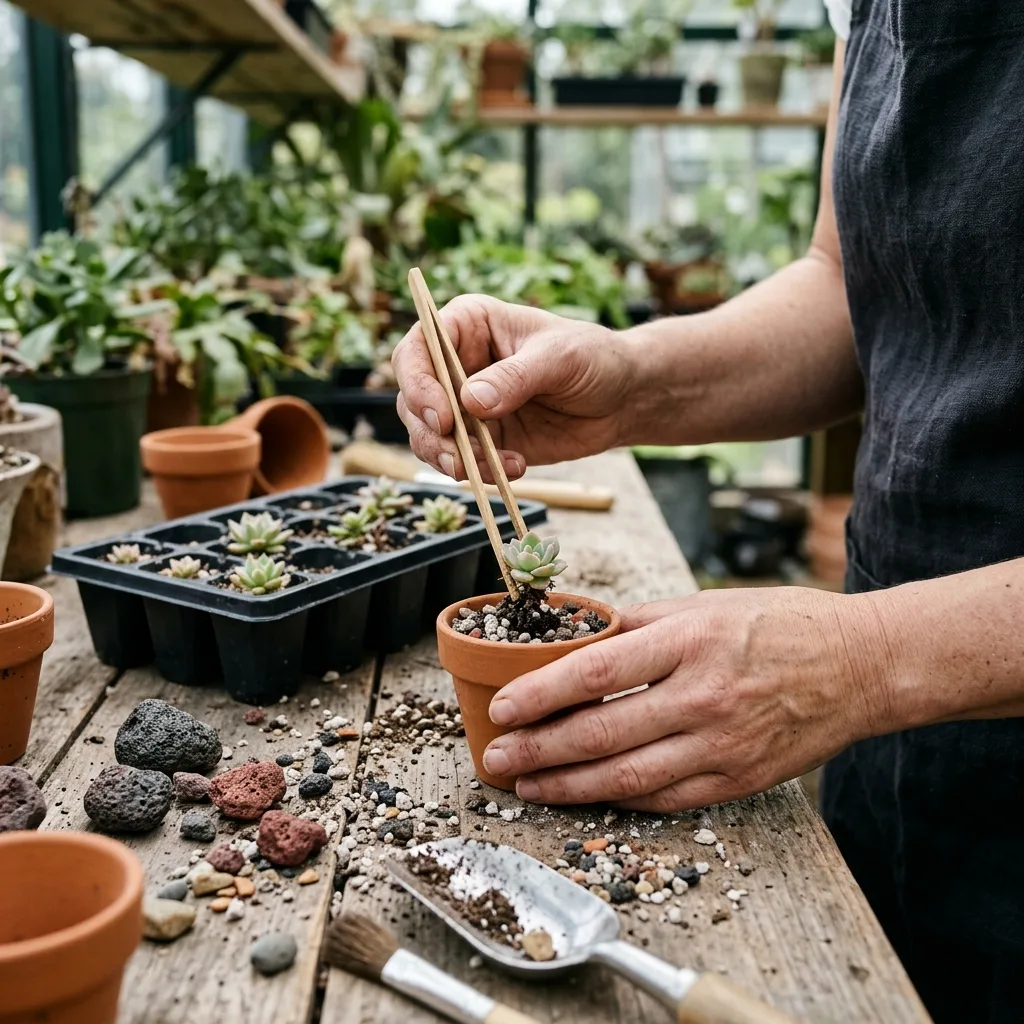
- The Maiden Repotting (Pricking Out - Months 6 to 9): When juvenile rosettes begin pressing against one another and root zones overlap, gently lift each individual using a specialized planting fork or clean tweezers, transplanting them into individual 5 cm nursery containers.
6. Managing Pests, Pathogens, and Cultural Setbacks
The most devastating hurdle in succulent seedling culture is damping-off, an aggressive fungal complex caused primarily by Pythium and Rhizoctonia species. A seedling that appears flourishing at dusk may collapse into a watery, translucent gel by dawn. Prevention remains your primary weapon: optimize air circulation, avoid over-saturating the medium, and insist on sterilized substrates. At the earliest sign of fungal presence, a gentle misting with diluted, cooled chamomile tea or cinnamon-infused water acts as an effective organic bio-fungicide.
Fungus gnats (Sciaridae) represent another relentless adversary. Their subterranean larvae feast voraciously on delicate root hairs, halting seedling development overnight. Combat them proactively using yellow sticky cards and by topping the substrate with a 2 mm layer of inorganic zeolite grit, which physically prevents adult gnats from depositing eggs in the organic medium.
7. Seasonal Growth Calendar and Horticultural Wisdom
Synchronizing your propagation efforts with the biological clock of your plants ensures optimal vigor:
- Spring (March to May): The golden window for sowing. Ambient temperatures between 20°C and 25°C (68°F–77°F) reliably trigger embryo activation, giving young seedlings a solid 6 to 8 months of vigorous development before winter dormancy.
- Summer (June to August): Intense heat (consistently exceeding 32°C / 90°F) can induce estivation (dormancy) in many winter-growing genera. Shield fragile young seedlings from oppressive midday sun and monitor moisture levels closely against rapid evaporative losses.
- Autumn (September to November): The secondary vegetative surge. With moderate temperatures returning, seedlings established in early spring are robust enough for their maiden repotting into dedicated nursery containers.
- Winter (December to February): Reduced photoperiods and lower ambient temperatures naturally decelerate cellular division. Shield indoor seedlings from cold window drafts and maintain surrounding temperatures above 15°C (59°F) with supplemental lighting.


Reader Reviews & Comments 3 Reviews
Clara Evans
David Miller
Julian Thorne
Leave a Review & Rating
Share your plant care tips, experiences, or questions with our succulent community.