






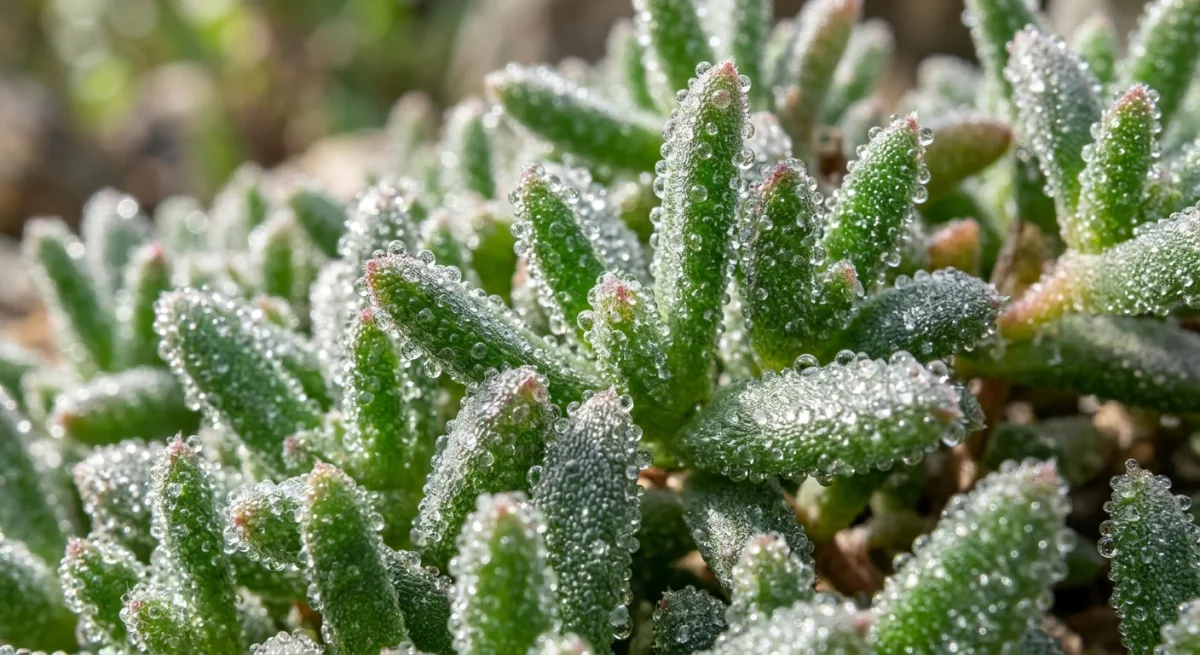
Strolling along the arid coastal bluffs of South Africa, you might witness rock crevices bathed in the morning sun, sparkling as if dusted with millions of microscopic diamonds. This luminous shimmer is neither an optical illusion nor lingering morning mist; it is one of nature's most sophisticated evolutionary armors against drought—Drosanthemum floribundum, affectionately celebrated by gardeners worldwide as the Royal Dewflower or Rosea Ice Plant. The spherical, water-storing epidermal cells blanketing its leaves impart the illusion of foliage permanently drenched in fresh morning dew, while the arrival of spring transforms the entire mat into a breathtaking cascade of iridescent magenta-pink blooms.
A resilient and spreading member of the Aizoaceae (ice plant) family, this botanical marvel thrives equally well cascading down hanging planters in a shimmering floral waterfall or anchoring dry-climate rockeries as a rugged, water-wise groundcover. Yet, the alluring charm of its crystalline idioblast cells demands a deliberate microclimate and a meticulously balanced mineral substrate in a home setting. Highly susceptible to moisture-induced root rot, this ancient South African treasure requires a nuanced understanding of its physiological rhythms. Below, we break down every botanical code necessary to cultivate a thriving specimen on your sunniest windowsill or balcony.
1. Botanical Identity and Morphological Characteristics
The generic name Drosanthemum derives from the classic Greek roots drosos (meaning dew) and anthos (meaning flower), while the specific epithet floribundum denotes 'abundantly flowering'—a descriptor this succulent fulfills with sheer botanical exuberance. Commonly known in the horticultural trade as the Royal Dewflower, Trailing Ice Plant, or Rosea Ice Plant, this species is a woody-based, decumbent perennial subshrub capable of self-layering and rooting wherever its nodes make firm substrate contact.
Its crowning morphological feature is the dense carpet of specialized epidermal papillate blisters—technically known as mesembryanthemoid idioblasts—covering the cylindrical, fleshy foliage. These modified water-storage cells function as miniature biological optical prisms: they scatter intense solar radiation, protecting deep photosynthetic tissues from UV degradation, reduce transpiration leaf surface temperatures, and condense micro-droplets of atmospheric humidity beneath the waxy cuticle layer. The leaves typically measure between 1 to 2 cm in length, displaying a muted, glaucous grayish-green coloration. As spring reaches its zenith, luminous lilac-pink to rich magenta ray petals surrounding a sunny crown of golden central stamens burst forth, spanning up to 2 cm across and completely cloaking the underlying stems. These blossoms exhibit pronounced photonastic movement, expanding exclusively under bright, unfiltered sunlight and closing tight during cloudy overcast periods and nocturnal hours.
2. Photoperiodic Demands and Ideal Indoor Positioning
In its native coastal terraces and calcareous limestone bluffs of the Western and Eastern Cape, Drosanthemum thrives under unyielding African skies; it is an unapologetic, obligate photophile (sun worshiper). To synthesize dense foliage and maintain the thick, reflective turgor of its crystalline bladder cells, this succulent demands a minimum of 6 hours of direct, unfiltered solar radiation each day.
When cultivated indoors, position it directly against your brightest south-facing or southwest-facing window. Insufficient ambient foot-candles will trigger immediate etiolation: internodal distances stretch unattractively, stems turn limp and brittle, the iconic crystalline dew effect dims to a dull green, and flower bud initiation ceases entirely. Transitioning your container outdoors to an open balcony, terrace, or sun-drenched porch during late spring and throughout the summer is immensely beneficial; the increased air movement and natural UV spectrum fortify cell walls and eliminate stagnant microclimates that invite fungal pathogens.
3. Irrigation Protocol: The 'Soak and Dry' Discipline
The single most destructive pitfall among indoor growers is interpreting the permanently 'wet', sparkling dew appearance on the leaves as an invitation to hydrate the plant constantly. While Drosanthemum leaves appear saturated with fresh droplets, its fibrous root architecture is exceptionally vulnerable to hypoxic conditions and pathogen invasion when subjected to sustained moisture. Frequent light watering is not an act of kindness—it literally suffocates the root hairs.
Adhere strictly to the classic botanical 'Soak and Thoroughly Dry' regimen:
- Active Vegetative & Blooming Season (Spring through Summer): Irrigate generously only after at least 75% to 80% of the soil column has completely dried out. Continue watering until water drains freely from the bottom exit holes, and always discard any standing runoff from the saucer within 10 minutes.
- Dormant/Rest Phase (Late Autumn through Winter): Due to depressed transpiration rates and cool temperatures, extend your watering interval to once every 3 to 4 weeks. During the depths of winter, supply modest sips of water only when the leaves display subtle basal wrinkling and a slight loss of hydrostatic turgor.
- Never mist the sparkling foliage from above or permit moisture to pool in the leaf axils. Always direct the water stream around the pot perimeter onto the exposed gravel surface, avoiding unnecessary wetting of the woody crown.
4. Engineered Substrate Architecture and Pot Selection
The native habitat of the Royal Dewflower features mineral-dense, organic-depleted, hyper-draining maritime scree and calcareous sandy slopes. For the vascular xylem of the root system to maintain cellular respiration, the potting medium must feature low moisture retention and exceptionally high macroporosity. Generic peat- or coir-based commercial potting soils act like a suffocating marsh for this arid specialist.
The following substrate recipe provides an optimal mineral matrix, safeguarding delicate root zones from fungal stagnation:
| Substrate Component | Ratio by Volume (%) | Botanical Function & Benefit |
|---|---|---|
| Pumice (1/8" to 3/16" / 3–5 mm) | 40% | Maximizes structural aeration and permanent capillary porosity |
| Lava Grit / Horticultural Zeolite | 20% | Supplies trace minerals and provides cation-exchange filtration |
| Coarse Horticultural Sand / Quartz Grit | 20% | Forms the rapid-draining structural skeleton, preventing compaction |
| Low-Peat Cactus Compost / Bark Fines | 20% | Delivers modest organic buffers and baseline nutrient holding capacity |
Regarding container dynamics, unglazed terracotta (baked clay) is the gold standard. The porous clay walls permit lateral gas exchange and accelerate evaporative drying, substantially mitigating hidden wet pockets. Because the Royal Dewflower forms a shallow, spreading, fibrous root system rather than a deep taproot, wide and shallow bulb pans or 'bonsai-style' terra pots are far superior to deep, narrow containers.
5. Step-by-Step Vegetative Propagation Protocol
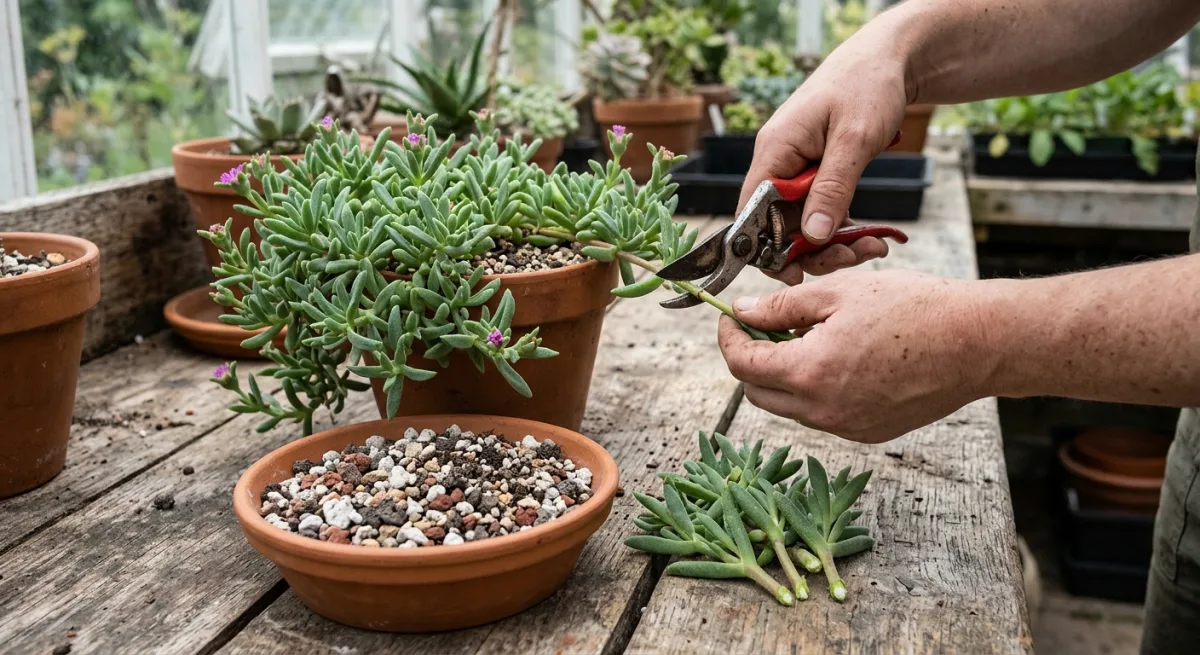
Thanks to its natural capacity for nodal adventitious rooting, Drosanthemum floribundum is one of the most rewarding and straightforward succulents to propagate from stem cuttings. The most opportune window is mid-to-late spring, when hormonal auxin activity and cellular division are peaking.
- Select and Harvest Stem Cuttings: Using a sterilized razor or fine scalpel, harvest non-flowering, robust, semi-woody lateral stem tips roughly 3 to 4 inches (7–10 cm) long.
- Strip the Basal Nodes: Carefully detach the leaves along the lower 1 inch (2.5 cm) of the stem to expose two or three bare growth nodes, which serve as future adventitious root initiation sites.
- Callus Formation: Do not insert fresh cuttings directly into moist soil. Lay them in a warm, dry, shaded, well-ventilated spot for 48 to 72 hours. This permits cut cells to form a suberized, dry callus shield, blocking opportunistic bacterial and fungal vectors.
- Dry Potting: Insert the callused cuttings roughly 1 inch (2 cm) deep into the dry, mineral-dominant propagation mix outlined above. Refrain from watering for the initial 5 days.
- Hydration and Establishment: Beginning on day 6, lightly moisten the top surface of the grit with a narrow-spout watering can. Within 14 to 21 days, roots will firmly anchor, signaled by vigorous new apical growth at the branch tips.
6. Common Pathogens, Pests, and Diagnostic Solutions
While fundamentally a tough survivor, sub-optimal cultural parameters in home settings can induce abiotic physiological stress, leaving the door open to biotic pests:
- Mealybugs (Pseudococcidae): These pervasive sap-sucking insects colonize sheltered leaf axils and root crowns, appearing as white, cotton-like wax clusters. Treatment: For light infestations, dab individuals with a cotton swab soaked in 70% isopropyl alcohol. For extensive infestations, apply cold-pressed neem oil emulsions or an appropriate systemic insecticide.
- Root and Crown Rot (Fungal Complex): Triggered by waterlogged, anaerobic soil mixes, resulting in blackened, soft root tissue and rapid collapse of bottom stems. Treatment: Unpot the plant immediately, pare away all infected root tissue using sterile shears, dust remaining healthy cuts with powdered sulfur or cinnamon, and replant in bone-dry mineral grit.
- Crystal Blackening & Leaf Scorching: Typically occurs when droplet water is misted onto foliage right before exposure to blazing midday summer sun, causing the dew blisters to rupture and scorch. Cease all foliar spraying.
7. Seasonal Stewardship Calendar and Expert Care Cycles
Synchronizing your care regimen with the natural phenotypic cycle of the Royal Dewflower ensures robust longevity and breathtaking annual floral displays:
- Spring (Awakening & Blooming): Maximize direct sunlight exposure and ramp up watering frequency as temperatures rise. Apply a low-nitrogen, high-potassium liquid succulent fertilizer diluted to quarter-strength once a month during budding.
- Summer (Heat Management): In regions where ambient temperatures exceed 95°F (35°C), the plant may enter a defensive summer semi-dormancy. Provide light afternoon shade to avoid thermal stress, and restrict irrigation to early morning hours.
- Autumn (Architectural Pruning): Cease all fertilization. Trim back overgrown, straggly stems by roughly one-third; this autumn pruning stimulates tight branching, ensuring a dense, floriferous habit the following spring.
- Winter (Cool Rest Period): Shield the plant strictly from freezing temperatures (maintain above 38–40°F / 3–5°C). Keep the substrate mostly dry, maximize ambient lighting, and ensure plenty of fresh, dry air circulation.


Reader Reviews & Comments 4 Reviews
Marcus Sterling
Eleanor Vance
Chloe Bennett
Julian Hayes
Leave a Review & Rating
Share your plant care tips, experiences, or questions with our succulent community.