






Hailing from the rugged, arid, and wind-scoured Andean slopes of northwestern Argentina, Parodia chrysacanthion—known affectionately in botanical circles by its classic synonym Notocactus chrysacanthion, or among houseplant enthusiasts as the Golden Powder Puff Cactus—stands as one of nature's most flawless geometric masterpieces. At first glance, it resembles a miniature ball of spun wool or a golden powder puff dusted with starlight. Yet this soft, lustrous exterior is actually an evolutionary shield: a dense vertical barricade developed to protect the plant from blistering ultraviolet (UV) radiation across high-altitude slopes.
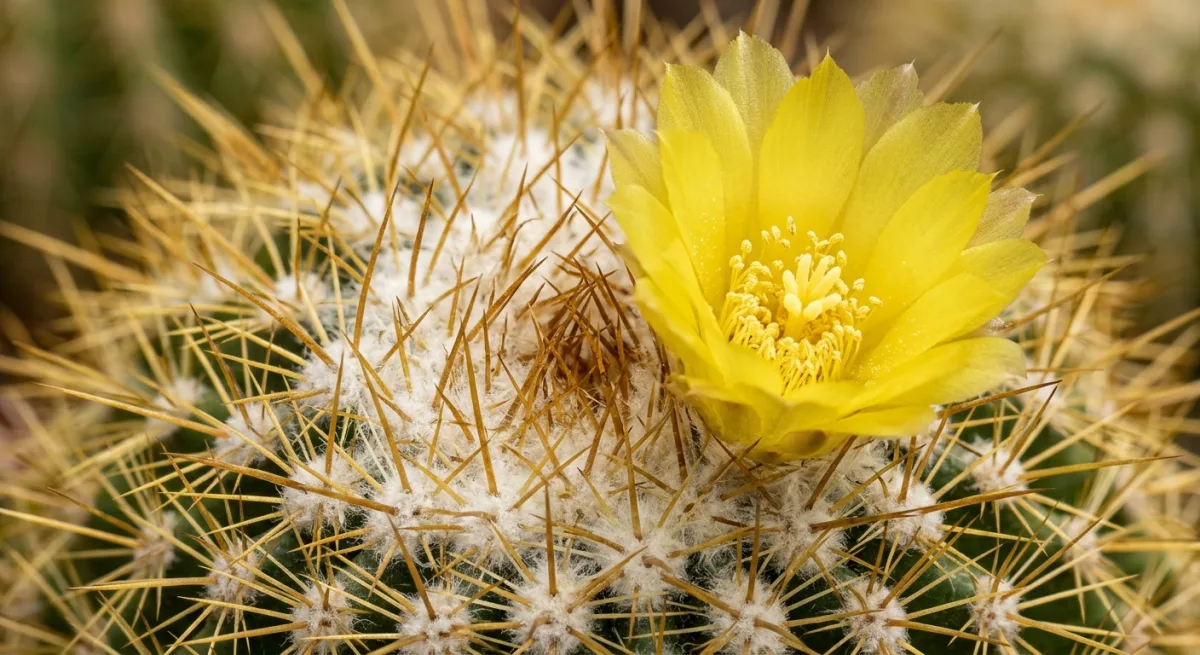
A cherished centerpiece on sun-drenched windowsills, this remarkable succulent delivers an exquisite surprise long before the gloomy gray days of winter fade: a luminous coronal halo of brilliant yellow blossoms bursting from the woolly areoles at its apex. Treasured across the succulent world for its luminous 'golden puff' silhouette, it is remarkably resilient and flourishes indoors when provided with a proper mineral balance and natural seasonal temperature fluctuations.
If you wish to capture this golden gleam on your windowsill and preserve this miniature mountaineer in prime health for decades without the dread of basal stem rot, you must replicate its ancestral winds, gravelly crags, and rapid-draining substrate. Let us explore the cultivation secrets of this radiant cactus step by step, unraveling everything from its cellular water reserves to its specialized root biology.
1. Botanical Identity and Morphological Characteristics
Parodia chrysacanthion belongs to the family Cactaceae. It exhibits a predominantly globular growth habit in its youth, gradually maturing into a short cylindrical silhouette over the years. Its native range is localized to the Jujuy and Salta provinces of Argentina, where it thrives anchored within steep rock crevices at elevations between 1,400 and 2,200 meters above sea level.
Key botanical traits that define its unique morphology include:
- Epidermis and Rib Architecture: The stem epidermis is a pale to medium green; however, the body is seldom visible beneath its dense mantle of interlocking spines. The stem features approximately 20 to 30 low, tuberculate ribs arranged in spiraling patterns around the central axis.
- Spine Morphology (The 'Golden Powder' Effect): Each areole bears between 30 and 40 slender, needle-like radial spines, accompanied by 3 to 4 slightly longer central spines emerging from the core. Their coloration ranges from glistening golden-yellow to warm amber, straw, or burnished brass. Their sheer density gives the plant the soft, tactile appearance of an artist's dusting brush or powder puff.
- Floral Biology: While many desert cacti wait until midsummer, P. chrysacanthion is an exceptionally early bloomer, producing flowers from late winter through early spring (February to April). Numerous bell-shaped blossoms, each roughly 2 centimeters in diameter, emerge in a tight circular crown from the thick white apical wool, opening in shades of gleaming lemon to deep canary yellow.
2. Light Requirements and Indoor Positioning
The Golden Powder Puff Cactus is a devoted sun worshipper; however, when cultivating it inside the home, both light quality and photoperiod must be carefully balanced. A Parodia deprived of sufficient illumination will rapidly forfeit its spherical symmetry, stretching awkwardly toward the light (etiolation), while its new golden spines become sparse, weak, and faded.
Follow these placement guidelines to maintain peak health:
- Ideal Exposure: Unobstructed southern or southeastern exposures provide the most beneficial growing environment. Aim for at least 5 to 6 hours of direct, intense sunlight daily to stimulate tight areole spacing and brilliant, deep-golden spine pigmentation.
- Midsummer Protection: During peak July and August heat, intense midday sun (between 12:00 PM and 3:30 PM) filtered through single-pane glass can create a magnifying-glass effect. A sheer curtain during these peak hours prevents thermal tissue damage and unsightly permanent brown scorching (sunburn).
- Winter Location: Never relocate your cactus to a dim room during winter. Even during its chilly resting period, it demands the brightest windowsill available to support spring flower bud initiation.
3. Watering Discipline: The 'Soak and Dry' Protocol
The most pervasive mistake in succulent care is offering plants a few superficial dribbles of water on a calendar schedule. Cacti are physiologically adapted to infrequent mountain storms: they require a thorough, drenching soak followed by complete and sustained root zone drying. For Parodia chrysacanthion, strictly enforce the soak-and-dry protocol.
When watering, saturate the substrate thoroughly until water drains freely from the pot's bottom drainage holes. Always discard any drainage water accumulated in the saucer within 15 minutes; standing water suffocates root hairs by depriving them of oxygen, inevitably triggering anaerobic root rot.
Seasonal Watering Frequency:
- Spring and Summer (Active Vegetative Phase): Water thoroughly only after the potting mix has dried out completely for 2 to 3 days. Under warm, well-ventilated conditions, this typically translates to an interval of once every 8 to 12 days.
- Autumn: As ambient temperatures decline and daylight diminishes, widen the interval to once every 15 to 20 days.
- Winter (Dormancy Period): When ambient temperatures sit around 10–12°C (50–54°F), suspend watering entirely, or provide merely a few tablespoons of moisture once a month along the pot edge to prevent root desiccation and excessive body shriveling.
4. Ideal Substrate Mix and Pot Selection
In its native Argentine habitat, this cactus anchors itself into mineral scree, decomposed granite, and volcanic rock crevices containing almost negligible organic debris. Planting a Parodia in rich, peat-heavy commercial potting soils is a recipe for disaster; peat acts like a wet sponge, retaining moisture for weeks and rapidly rotting the delicate root system.
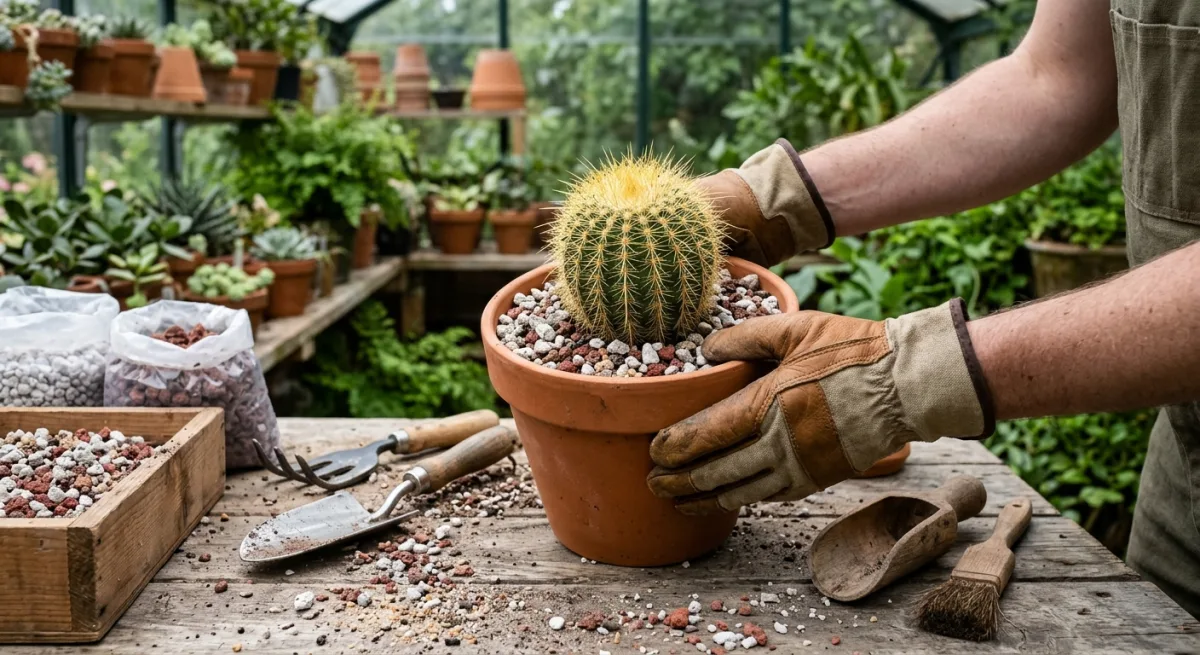
To allow the root cells to breathe and facilitate rapid drainage, blend an open, highly porous, inorganic mineral substrate:
| Component | Proportion (%) | Horticultural Function & Benefit |
|---|---|---|
| Horticultural Pumice (3–5 mm) | 40% | Maximizes macropore aeration and prevents compaction and root asphyxiation. |
| Crushed Lava Rock (Scoria) | 25% | Supplies trace minerals and iron while providing ballast to stabilize the pot. |
| Coarse Quartz Sand or Zeolite | 15% | Enhances water percolation and acts as a natural cation exchanger. |
| Sifted Low-Peat Succulent Soil | 20% | Provides baseline organic nutrients and modest moisture retention. |
Pot Selection: Unglazed, porous terracotta pots are the gold standard for Parodia. While plastic and glazed ceramic containers trap residual moisture within the root ball, terracotta's breathable walls allow water to evaporate laterally, speeding up the dry-out cycle. Choose a pot that is only 2 to 3 centimeters (about 1 inch) wider than the body of the cactus; excessively voluminous pots hold uncolonized soil that remains damp far too long.
5. Step-by-Step Propagation Techniques
Parodia chrysacanthion is predominantly a solitary species, only occasionally producing basal offsets (pups) in old age. Consequently, seed propagation is the most reliable, rewarding, and natural method for multiplication. However, if an older specimen produces a pup, division is straightforward.
Method 1: Seed Propagation Protocol
- Seed Collection and Timing: Early spring is the premier window for sowing. Collect dried seed pods that form at the woolly apex after the spring blooming cycle concludes.
- Substrate Preparation: Fill a shallow seed tray with a fine, sterile mix of sifted pumice, zeolite dust, and a whisper of peat. Moisten the medium from below via bottom-soaking until uniformly damp.
- Sowing: Scatter the dust-fine seeds evenly across the surface. Do not cover them with soil; Parodia seeds require ambient light to break dormancy and trigger germination.
- Humidity and Incubation: Seal the container with clear plastic wrap or an acrylic dome. Maintain a constant temperature of 21–25°C (70–77°F) in a bright spot shielded from direct, scorching sunlight. Tiny emerald spheres will emerge within 10 to 20 days.
- Acclimation: Once seedlings appear, introduce ventilation slits, gradually weaning the young cacti off high humidity over several weeks.
Method 2: Basal Offset Division
If your mature specimen develops a basal offset, slice it cleanly from the parent stem during early spring using a sterilized scalpel. Dust the cut surfaces with sulfur or cinnamon powder to discourage pathogens, and allow the offset to rest in a warm, shaded spot for 5 to 7 days until a firm callus forms. Plant the callused pup into dry mineral substrate, withholding water for the first 10 days before introducing light moisture.
6. Common Diseases, Pests, and Treatments
Thanks to its dense armor of spines and robust epidermis, the Golden Powder Puff Cactus is relatively trouble-free, yet cultural missteps can invite specific problems:
- Mealybugs: These sap-sucking pests congregate at the spine bases and within the woolly apex, appearing as white, cottony tufts. Treatment: Dip a fine paintbrush into 70% isopropyl alcohol and manually dab each pest. For pervasive infestations, treat with cold-pressed neem oil or a systemic horticultural insecticide.
- Basal Stem and Root Rot: The direct consequence of poor drainage, heavy peat soils, or unseasonable winter watering. The lower stem turns translucent, yellow-brown, and soft. Treatment: Immediately unpot the plant. Excise all blackened, decayed root tissue, sanitize healthy tissue with an organic copper fungicide, let the wound callus for a week, and repot in fresh, bone-dry mineral mix.
- Red Spider Mites: Thriving in hot, dry, stale indoor air, these microscopic pests cause rusty brown scarring and a dull grayish cast around the apical growth. Treatment: Elevate cross-ventilation and apply a botanical miticidal soap spray across all surfaces.
7. Seasonal Care Calendar and Tips for Inducing Blooms
To coax Parodia chrysacanthion into producing its legendary coronal ring of yellow flowers, a well-defined winter rest period (dormancy) is strictly mandatory. Without exposure to cool temperatures and drought, the apical meristem will fail to trigger floral vernalization.
- Winter (December – February): Shift the cactus to an unheated, brightly lit room, cool porch, or enclosed sunroom where temperatures hover consistently between 8°C and 12°C (46–54°F). Cease routine watering. This physiological chill arrests vegetative growth and stimulates flower bud formation.
- Spring (March – May): As soon as small yellow buds emerge through the apical wool, gradually resume watering and move the plant into warmer, sunny quarters. Provide a balanced, low-nitrogen cactus fertilizer diluted to 1/4 strength to support the flowering cycle.
- Summer (June – August): The active growth phase. Water whenever the substrate dries thoroughly, and provide generous outdoor or indoor air circulation to mimic breezy mountain slopes.
- Autumn (September – November): Taper watering intervals as daylight wanes. Bright autumn sunshine is essential for hardening new tissues and enhancing spine density before winter sleep.


Reader Reviews & Comments 4 Reviews
Clara Higgins
Eleanor Vance
Marcus Sterling
Julian Hayes
Leave a Review & Rating
Share your plant care tips, experiences, or questions with our succulent community.