






Picture a botanical marvel journeying from the sun-drenched, semi-arid ravines and rocky escarpments of Madagascar straight to your sunlit windowsill. Affectionately named the 'Aurora Borealis Succulent' or 'Lavender Scallops' in homage to the sky's most mesmerizing natural phenomenon, Bryophyllum fedtschenkoi 'Variegata' (botanically classified under its accepted synonym Kalanchoe fedtschenkoi f. variegata) leaves onlookers spellbound with its seafoam-green leaves bordered in creamy ivory and glowing coral-pink. In the succulent world, these pastel gradient shifts resemble a serene sunset across succulent foliage—serving not merely as an aesthetic spectacle, but as an ingenious cellular shield evolved to withstand relentless desert radiation and prolonged drought.
Welcoming this exquisite cultivar into your indoor collection invites the generous abundance of nature into your home. Along the scalloped margins of its leaves, microscopic miniature plantlets emerge like delicate biological lace, displaying one of the most prolific and fascinating reproductive strategies across the plant kingdom. However, preserving its variegated cell tissues and maintaining that fairy-tale blush pink hue demands a nuanced, scientific understanding of its botanical requirements.
1. Botanical Identity and Morphological Characteristics
Belonging taxonomically to the diverse stonecrop family, Crassulaceae, this species has historically alternated between the genera Bryophyllum and Kalanchoe in academic literature. While both classifications remain widely recognized, it is affectionately grouped under the Bryophyllum umbrella due to its distinctive ability to spontaneously develop 'pseudobulbils'—foliar miniature plantlets—along its leaf margins.
Morphologically, the plant exhibits a low-shrubby architecture with erect stems that gradually decumb and spread from the crown over time. Reaching 30 to 60 cm in height in optimal settings, its stems are densely lined with circular, obovate fleshy leaves. What elevates the 'Variegata' mutation is the localized cellular absence of chlorophyll along its leaf margins. When bathed in intense sunlight combined with subtle thermal shifts, these perimeter cells biosynthesize protective anthocyanin pigments. This cellular defense mechanism infuses the pale cream edges with electrifying shades of fuchsia, rose-coral, and lavender, mimicking the polar auroras.
2. Light Requirements and Indoor Positioning
Bryophyllum fedtschenkoi 'Variegata' is uncompromising when it comes to illumination. Because the ivory and magenta leaf margins lack photosynthetic chlorophyll, the plant depends solely on its green central bands to drive photosynthesis and energy storage. Consequently, it requires significantly higher luminous flux per square meter than its wild, fully green counterparts.
Indoors, prime positioning means placing it directly in an east- or southeast-facing window bathed in unfiltered morning rays. During blistering summer afternoons, magnified sunlight focused through double-paned glass can trigger solar necrosis (leaf scorch) on delicate variegated tissues; a sheer linen curtain provides the perfect dappled respite during peak hours. In dim or north-facing rooms, the plant rapidly undergoes etiolation: stems stretch and weaken, leaf internodes widen excessively, and the coveted pink margins fade into a dull, monochrome green.

3. Watering Discipline: The 'Soak and Dry' Protocol
The single most destructive pitfall in succulent stewardship is adhering to a strict calendar routine of frequent, shallow watering. Frequent light waterings are never a sign of care; they asphyxiate roots and deprive subterranean systems of oxygen. Bryophyllum fedtschenkoi utilizes Crassulacean Acid Metabolism (CAM photosynthesis), keeping its foliar stomata tightly sealed during daylight hours to virtually eliminate transpirational moisture loss.
The golden standard is the 'Soak and Dry' protocol. Never offer irrigation until the entire soil substrate has dried out down to the drainage hole. Confirm baseline dryness by inserting a wooden skewer to the bottom of the pot or simply by feeling the substantial weight loss of the container. When watering, saturate the substrate thoroughly until water drains freely from the base, and unconditionally discard any runoff pooling in the catchment saucer within thirty minutes.
4. Ideal Substrate Formula and Pot Selection
The fibrous root system of Bryophyllum fedtschenkoi is exceptionally sensitive to hypoxic, waterlogged conditions, falling prey rapidly to soil-borne oomycetes such as Pythium and Phytophthora. To maintain steady root zone oxygenation and ensure rapid gravitational drainage, an open, porous, mineral-rich substrate is vital.
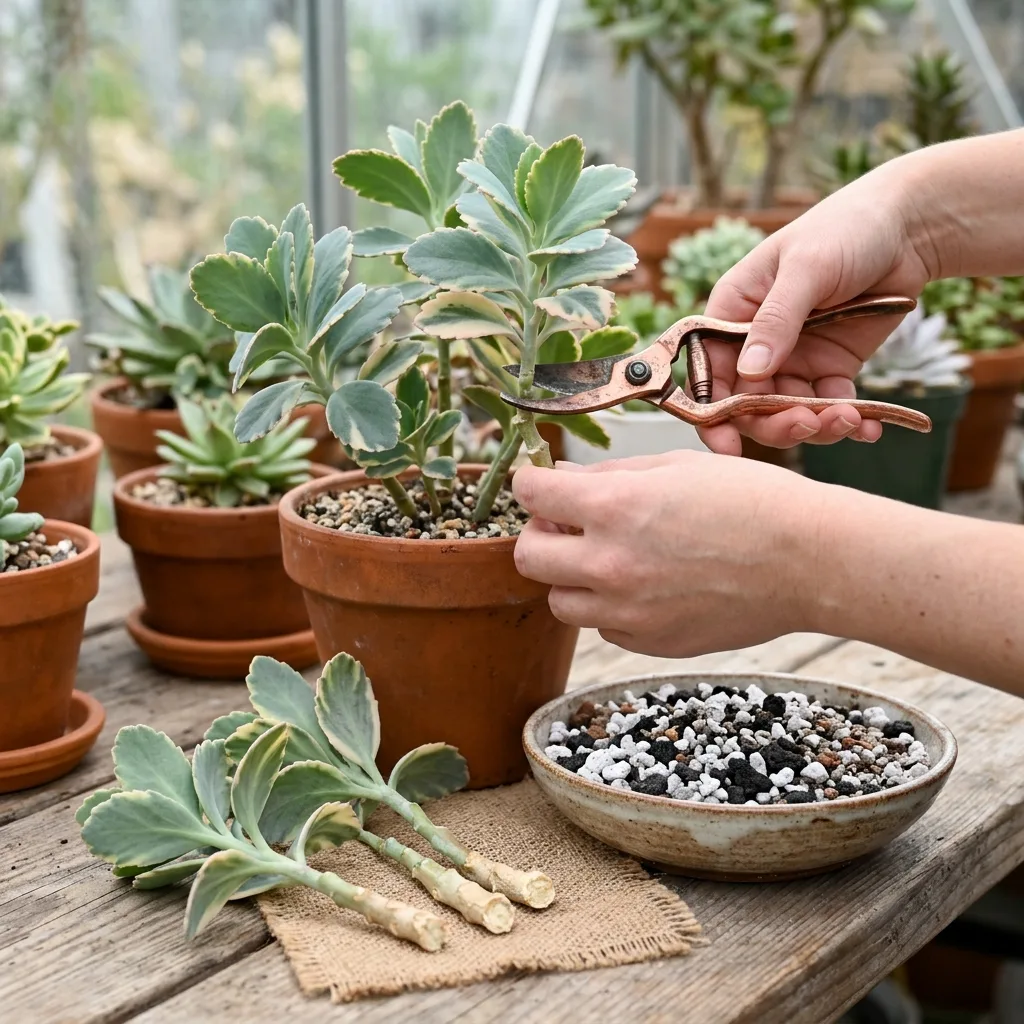
When selecting containers, unglazed porous terracotta reigns supreme. Terracotta walls breathe, permitting lateral moisture evaporation that safeguards delicate root structures. Non-porous plastic or glazed ceramic pots trap residual moisture inside, turning into an accidental root-rot chamber for variegated succulents. A generous bottom drainage aperture is non-negotiable.
| Substrate Component | Ratio (%) | Botanical Function & Soil Benefit |
|---|---|---|
| Coarse Horticultural Pumice | 35% | Creates an open macro-porous structure for constant airflow, preventing root compaction. |
| Lava Rock or Zeolite (3–5 mm) | 25% | Ensures lightning-fast drainage while binding trace micronutrients without retaining excess water. |
| Perlite | 10% | Lightens the overall mix density and prevents substrate settling. |
| Premium Succulent / Cactus Soil | 20% | Provides a stable organic anchor and baseline micro-elements for steady structural vigor. |
| Earthworm Castings or Leaf Mold | 10% | Offers gentle, slow-release humic compounds and biological soil conditioning. |
5. Step-by-Step Propagation Techniques
One of the true joys of cultivating the genus Bryophyllum is its boundless regenerative enthusiasm. For the 'Variegata' form, two reliable vegetative methods are commonly practiced:
- Apical Stem Cuttings: The most reliable way to maintain the exact chimeric variegation pattern. In spring or early summer, harvest a healthy 8–10 cm terminal shoot sporting at least 4–6 mature leaves using a sterile, razor-sharp blade. Rest the cutting in a dry, ventilated, shaded spot for 3–4 days to allow the raw cut to form a protective callous. Pot the calloused stem into bone-dry, gritty succulent substrate, withholding moisture for the first 5–7 days. Strong, functional roots develop in approximately 2 to 3 weeks.
- Foliar Margin Plantlets (Pseudobulbils): Dainty adventitious plantlets regularly form along the crenate notches of the leaf margins. Once these miniature gems detach with a gentle brush, gather and scatter them across the surface of a slightly moist, pumice-rich seedling mix. Take heed: If an individual plantlet is pure white or solid pink (devoid of all green tissue), it lacks the cellular machinery to produce sugars and will perish shortly after detaching from the mother leaf. Only plantlets displaying a hint of green chlorophyll at their core can thrive independently.
6. Common Pests, Pathogens, and Targeted Treatments
Variegated tissues, due to their thinner cellular makeup and reduced photosynthetic reserves, are naturally more vulnerable than standard green varieties. Keep a vigilant eye out for these challenges:
- Mealybugs (Pseudococcidae): Cottony white clusters gathering in leaf nodes and tender apical points, sap-sucking insects that weaken leaves and deform new growth. Treat small colonies mechanically using a cotton swab dipped in 70% isopropyl alcohol. For established infestations, apply cold-pressed neem oil emulsions or insecticidal potassium soaps during twilight hours to prevent foliar burn.
- Root Rot & Stem Blackening: Mushy, blackened stems creeping upward from the soil line accompanied by falling, translucent leaves indicate advanced root rot. Unpot the specimen immediately, excise all blackened rot tissue back to clean, crisp green flesh, dust the cut surface with sulfur or pure cinnamon powder, and re-root the salvaged top portion as a fresh cutting.
- Sun Scorch on Variegated Margins: Abrupt exposure to intense solar radiation following dry periods turns delicate cream-colored margins papery, crisp, and brown. These scorched areas cannot regenerate; promptly relocate your plant to an area receiving gentle morning sun or introduce a sheer curtain.
7. Seasonal Care Calendar and Horticultural Insights
As day lengths shorten in late autumn and winter, Bryophyllum fedtschenkoi 'Variegata' transitions naturally into its reproductive cycle as an obligate short-day bloomer. Long, architectural terminal inflorescences rise above the foliage, dangling clusters of exquisite, bell-shaped, salmon-pink and coral-apricot blossoms.
- Spring (Active Awakening): Resume consistent watering cycles as temperatures climb from March onward. Support vigorous leaf production with a monthly application of low-nitrogen, high-potassium liquid succulent fertilizer diluted to half-strength.
- Summer (Heat Shielding): When ambient temperatures exceed 35°C (95°F), the plant enters partial dormancy (estivation). Shield it from scorching mid-afternoon exposure and taper watering frequency slightly until the heat wave subsides.
- Autumn (Color Climax): Wide diurnal temperature variations (day-to-night drops of 10–12°C) combined with abundant autumn sunshine coax out the most brilliant fuchsia-pink highlights of the year.
- Winter (Dormancy and Flowering): Maintain ambient temperatures strictly above 8–10°C (46–50°F), as this tender succulent has zero frost tolerance. Place it in your brightest indoor spot, watering only when the substrate is completely bone-dry during its active floral display.


Reader Reviews & Comments 4 Reviews
Eleanor Vance
Marcus Sterling
Clara Higgins
Julian Thorne
Leave a Review & Rating
Share your plant care tips, experiences, or questions with our succulent community.