






Rising proudly among sun-bleached limestone slopes, coastal winds, and briny sea breezes throughout the Mediterranean basin, Mediterranean Spurge (Euphorbia characias) stands as one of the most architectural silhouettes in the botanical world. Welcoming compact juvenile specimens or fresh cuttings of this wild, aristocratic perennial into a clear glass vessel is akin to cultivating your own miniature Mediterranean maquis right in your living room. Yet, fashioning a thriving desert wonder behind glass demands far more than casually spooning potting soil into a bowl; it requires exacting substrate layer engineering.
Traditional terrarium design typically brings to mind enclosed, humid globes where tropical ferns and mosses dwell in constant condensation. However, for xerophytic species—particularly Euphorbia characias—a sealed glass enclosure is nothing short of an accelerated death sentence. High ambient humidity that cannot evaporate off the epidermis rapidly fosters pathogenic fungal outbreaks around delicate root xylems. Regularly showering succulents with water is not an act of devotion; it suffocates root hairs by starving them of oxygen. Consequently, the only botanically sound method for displaying Mediterranean Spurge indoors is an expansive, wide-mouthed 'open glass terrarium' that ensures unimpeded air circulation.
1. Drainage Layer Engineering
The foremost physical obstacle when cultivating plants in undrilled glassware is the perched water table phenomenon. While gravity pulls moisture downward through the soil column, capillary forces within fine substrate particles pull it upward. The interface where these two forces equalize creates a saturated zone devoid of oxygen, providing the ultimate breeding ground for swift root rot. In its native habitat, Euphorbia characias (Kew POWO) anchors its taproot deeply into calcareous rock fissures where water never lingers around the root crown.
To overcome this hydrological limitation inside an undrilled vessel, we must construct a clear bottom-to-top hydrodynamic hierarchy. The foundational inorganic reservoir collects gravitational runoff away from tender feeder roots, while an intermediate stratum of activated charcoal stabilizes gas exchange and curbs anaerobic bacterial colonies. To permanently prevent fine soil particles from washing down and clogging the drainage void, an ultra-porous, non-woven geotextile or fine fiberglass barrier must be placed between the reservoir and the root zone.
2. Companion Plant Selection and Pairing Guidelines
A flourishing open-glass arrangement relies not only on visual harmony, but on strict 'ecological fellowship.' Every companion plant introduced into the glass must share identical light intensity requirements, watering intervals, and seasonal dormancy rhythms. As a true Mediterranean xerophyte, Euphorbia characias demands relentless, bright light (at least 6 hours of direct or intensely filtered sunlight daily) and exceptionally low ambient humidity.
The finest botanical companions for juvenile spurge stems include:
- Sedum album and Sedum reflexum (Stonecrops): These ground-hugging succulents happily carpet the substrate, love calcareous soils, and offer a soft, creeping contrast to the upright verticality of the spurge.
- Crassula tetragona (Miniature Pine Tree): Replicates the rugged texture of coastal Mediterranean scrub while matching the spurge's drought tolerance step for step.
- Delosperma cooperi (Trailing Ice Plant): Features succulent, cylindrical foliage with exceptional water-retention capacity, mimicking vegetation growing out of dry stone crevices.
- Rosularia chrysantha: Native to rocky eastern Mediterranean alpine regions, these miniature rosettes cluster naturally at the base of the spurge stem to evoke an authentic desert oasis.
Never introduce tropical foliage plants, nerve plants (Fittonia), moisture-craving sheet mosses, or shade-dwelling ferns into this assembly. Mediterranean arid beauty thrives on pristine minimalism and mineral stone elegance.
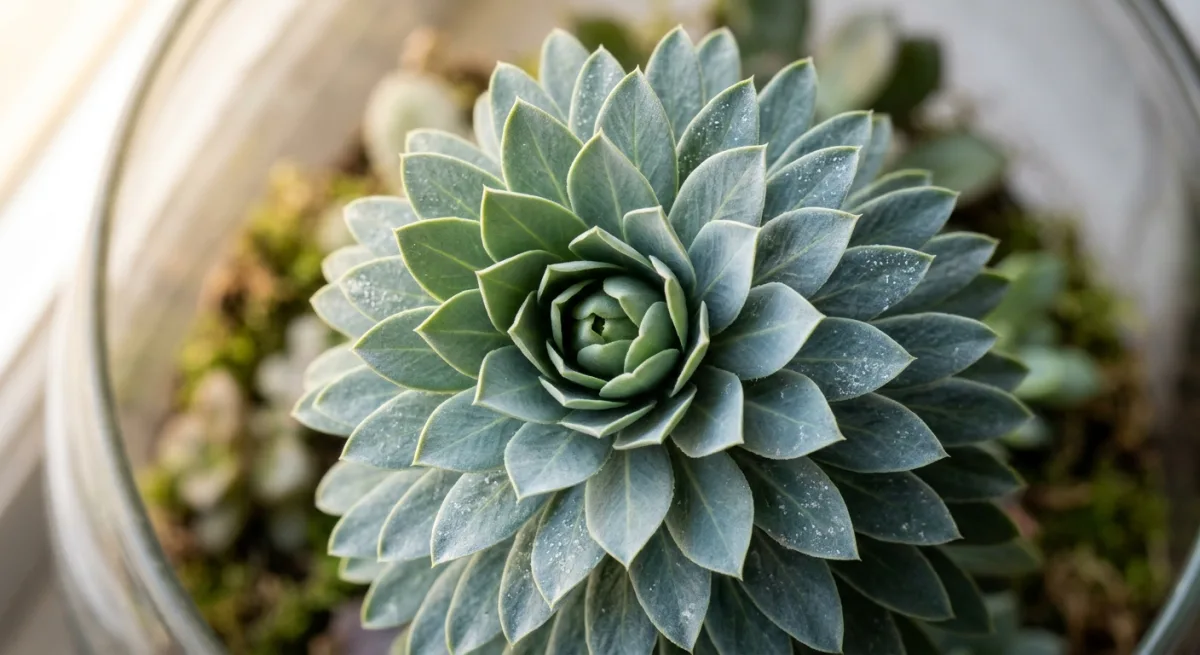
3. Layer Depths and Substrate Formulation Table
The following engineering specification is calibrated for a standard cylindrical or wide-bowl open glass container measuring 20–25 cm in height and 25–30 cm in diameter:
| Layer Order | Substrate Material | Target Thickness | Functional Botanical Purpose |
|---|---|---|---|
| 1. Base Drainage | Coarse Horticultural Lava Rock & Pumice (4–8 mm) | 3.0 - 4.0 cm | Aerated reservoir capturing gravitational water safely away from root contact. |
| 2. Water Purifier | Granular Horticultural Activated Charcoal | 0.5 - 1.0 cm | Adsorptive filter neutralizing fungal spores, sour odors, and anaerobic microbes. |
| 3. Separation Barrier | Thin Geotextile Fleece or Fine Fiberglass Mesh | Single Layer (< 1 mm) | Prevents fine mineral soil particles from sifting into and clogging drainage voids. |
| 4. Growth Substrate | 60% Pumice/Zeolite + 20% Crushed Limestone Sand + 20% Peat/Coco Coir | 5.0 - 7.0 cm | Highly porous, lime-stabilized, fast-drying Mediterranean planting medium. |
| 5. Top Dressing Mulch | Crushed Natural Limestone Chips & Washed River Grit | 1.0 - 1.5 cm | Protects vulnerable root crowns from moisture and slows surface evaporation evenly. |
4. Step-by-Step Assembly and Planting Guide
Before assembly, thoroughly cleanse your glass vessel with isopropyl alcohol and dry it until the interior glass walls are completely pristine and free of streaks.
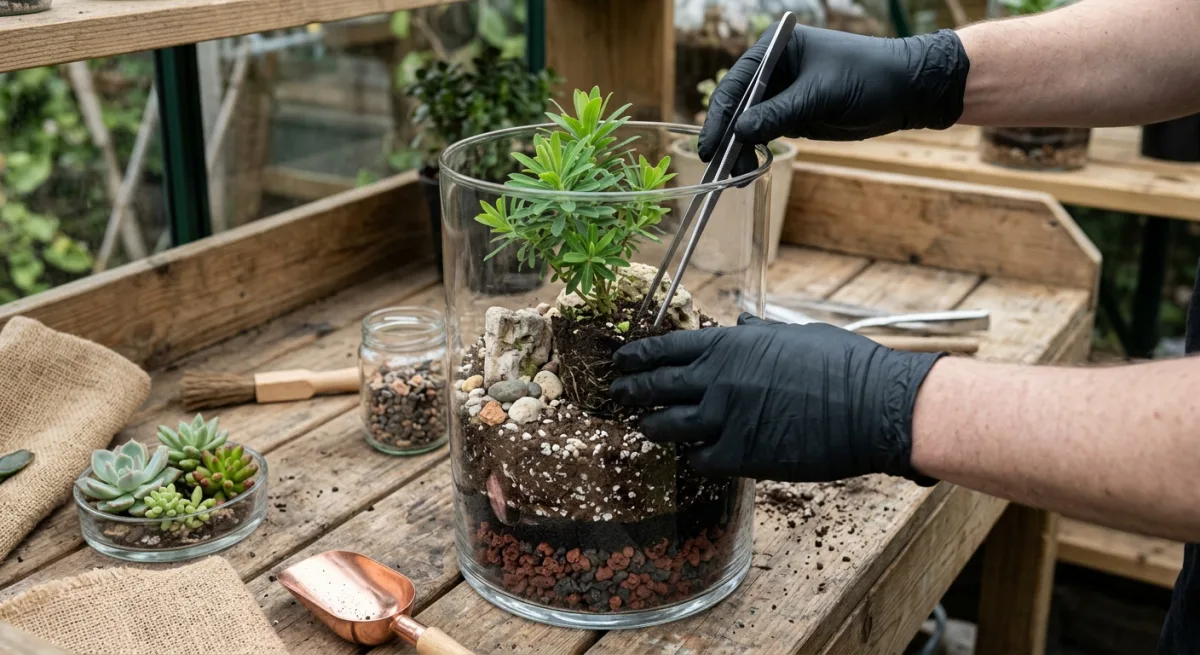
- Drainage and Adsorption Base: Gently distribute the washed, dry lava rocks across the container floor. Angle the vessel slightly while loading to prevent stones from scratching or chipping the glass. Scatter the activated charcoal granules uniformly across the lava rock bed.
- Cutting the Filter Barrier: Cut a circular piece of fiberglass mesh or geotextile roughly 1 cm wider than the container's interior diameter. Lay it flush over the charcoal, curving the edges upward slightly against the glass to prevent soil washouts along the perimeter.
- Grading the Substrate: Add roughly half of your mineral-rich substrate blend. Build a gentle upward slope toward the rear of the vessel to impart landscape depth and dimensional perspective.
- Root Preparation and Planting: Carefully unpot your young Euphorbia characias. Using a dry, soft-bristled brush, tease away approximately 80% of the dense nursery peat without tearing fine feeder roots. As highlighted by the Royal Horticultural Society (RHS), spurge roots must remain dry during root disturbance to seal microscopic abrasions against fungal pathogens.
- Anchoring the Focal Silhouette: Position the spurge either at the focal center or slightly off-center along the back third of the landscape (following the classic artistic rule of thirds). Plant your companion sedums and ice plants around it, ensuring the root crowns sit squarely level with the soil line, never buried deep.
- Mulching and Farina Preservation: Blanket the exposed substrate surface with crushed natural limestone gravel right up to the root crowns. Take extreme care not to brush against the spurge's foliage; its powdery, glaucous coating (epicuticular wax or farina) acts as a natural sun shield and will smudge if rubbed with bare fingers.
5. Natural Hardscaping: Rocks, Driftwood, and Mineral Sands
A master-level Mediterranean terrarium should radiate an aura of 'effortless, rugged wilderness.' Brightly colored, polished, or synthetic pebbles clash jarringly with the organic nobility of this spurge. Instead, source jagged, untreated limestone rocks that mirror coastal Mediterranean outcrops. Angle rock fragments deliberately into the substrate slope to evoke windward erosion.
If you wish to weave in wood accents, select decay-resistant, kiln-dried grapevine wood or aged olive tree bark. Avoid standard mangrove driftwood typically sold for humid tropical vivariums, as they easily shed fungal spores in dry, bright glass setups. Dusting warm ochre, soft beige, or slate-gray mineral sands across the limestone mulch will authentically evoke the arid clay fissures of the Mediterranean garrigue.
6. Precision Watering and Lighting Dynamics
Nearly 95% of succulent losses within open glass terrariums stem from a single misstep: applying moisture at the wrong time and in excessive volume. Without bottom drainage holes, you cannot drench the soil blindly. You must deliver measured amounts of water exclusively using a narrow-spout wash bottle, botanical watering syringe, or laboratory pipette.
When irrigating, never spray moisture directly over the foliage or central growth point. Dispense water in a steady perimeter ring along the top-dressing gravel around the root zone. Rather than adhering to a strict calendar schedule, let the substrate dictate your timing. Inspect the glass base: if you observe condensation or dark moisture patches among the bottom lava rocks, withhold water entirely. Even after the soil has completely dried out, waiting another 3 to 4 days encourages the plant's Crassulacean Acid Metabolism (CAM) cycle and stimulates deep, healthy root exploration.
Light is the engine that powers this entire living composition. Under dim domestic lighting, Euphorbia characias will quickly etiolate, producing elongated, weak stems with wide internode spacing, losing its sculptural character. Position your open terrarium directly on a sunny south- or west-facing windowsill where it receives generous unfiltered sunlight. If natural light drops during winter, mount a 6500 Kelvin full-spectrum LED horticultural grow light approximately 25 cm above the vessel for 10–12 hours daily to preserve its dense, compact crown.


Reader Reviews & Comments 1 Review
No comments yet. Be the first to share your succulent experience!
Leave a Review & Rating
Share your plant care tips, experiences, or questions with our succulent community.