






Windswept dunes shifting across arid horizons, endless desert plains, and rugged canyon gorges... Recreating this captivating natural grandeur inside a miniature open glass vessel or a handcrafted timber sandbox terrarium is nothing short of living art for houseplant enthusiasts. Yet, this serene desert showcase—frequently placed as a centerpiece on our coffee tables—can quickly become a silent, lethal trap for succulents if its biological foundation is flawed. Compacted fine sand that suffocates root respiration, stagnant water pooling at the unperforated bottom of glass containers, and trapped humidity can doom even the healthiest succulents to black stem rot in a matter of weeks.
Succulents are evolutionary marvels of arid climates; while their swollen parenchymal cells store precious water reserves through specialized Crassulacean Acid Metabolism (CAM), their subterranean root systems require copious oxygen and uncompromised macroporosity. The most catastrophic mistake made in DIY sandbox or open glass terrarium setups is burying plants directly into dense beach sand purely for visual appeal while ignoring drainage physics entirely. In reality, a successful desert arrangement balances pristine surface aesthetics with a carefully engineered hydrological foundation underneath. In this master guide, we will explore the biomechanical layer engineering and horticultural methods that prevent root asphyxiation, keeping your beloved succulents vibrant for years to come.
1. Engineering the Drainage System and False Bottom
The primary dilemma when designing a succulent sandbox or open glass terrarium is the absolute absence of drainage holes. In a conventional terracotta container, surplus water escapes freely via gravitational pull; in an unglazed or glass vessel, every single drop added stays sealed within the micro-ecosystem. When fine sand particles become saturated, capillary action pulls them tightly together, forming a dense, suffocating barrier that drives oxygen out of the substrate pores. Stripped of gaseous exchange around the delicate root xylem, anaerobic pathogens—most notably Pythium, Phytophthora, and Fusarium species—proliferate relentlessly, liquefying the root collar from within.
The secret to eliminating terrarium failure lies in engineering a non-collapsible 'false bottom' well below the decorative sand surface, creating a catchment basin that isolates standing water from root tissues. Coarse volcanic lava rock or expanded clay aggregate (LECA) forms the foundation of this reservoir, offering ample void space for excess moisture to settle safely. Spreading a generous layer of crushed horticultural activated charcoal directly over these rocks neutralizes volatile organic compounds and absorbs pathogens from stagnant water. Finally, a synthetic separation barrier—such as spun polyester aquarium filter floss or non-woven geotextile fabric—prevents the fine growing media above from trickling down and clogging the drainage reservoir.
2. Compatible Species Selection and Companion Rules
The second fatal flaw in succulent sandbox design is potting species with conflicting photoperiod and moisture requirements side by side in the same bed. For instance, planting an epiphytic tropical Christmas Cactus (Schlumbergera)—which thrives in filtered shade and humid conditions—next to a sun-worshipping Golden Barrel Cactus (Echinocactus grusonii)—which demands hours of intense light and weeks of bone-dry soil—will quickly lead to failure.
To build a lasting open sandbox arrangement, choose slow-growing specimens with exceptional drought resilience, compact root systems, and shared seasonal dormancy cycles. Below are the most reliable botanical candidates for desert terrarium scapes:
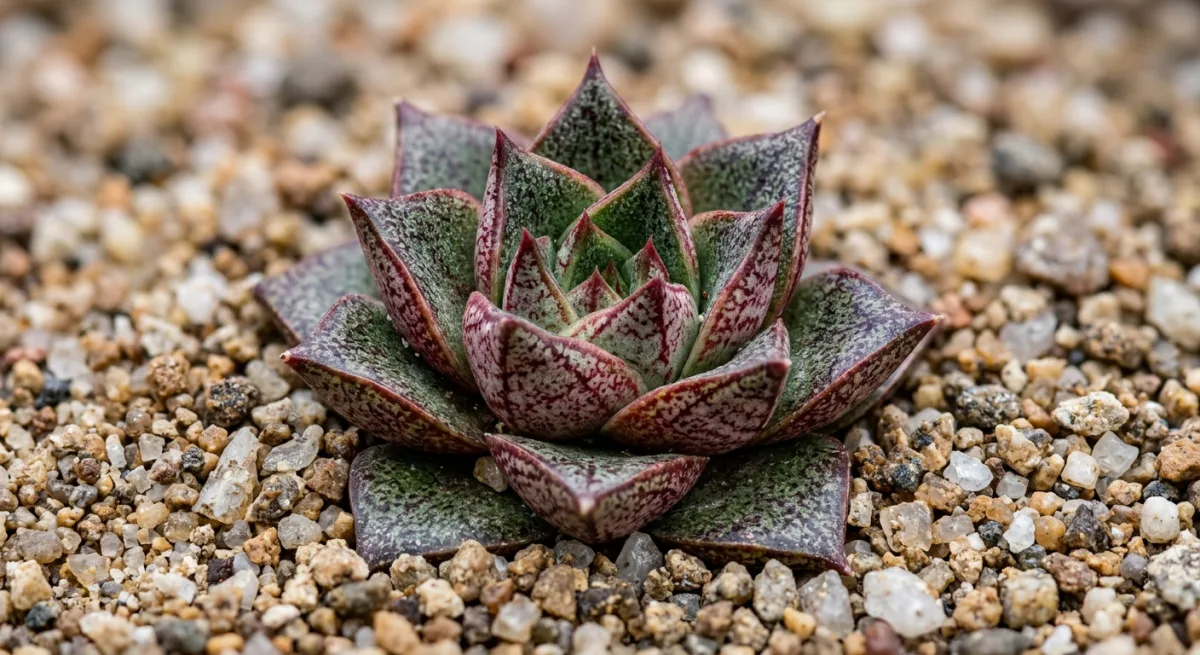
- Echeveria Species (e.g., Echeveria purpusorum, Echeveria agavoides): Prized for their tight geometric rosettes and protective epicuticular wax (farina), these species provide striking focal points. They remain naturally compact and shed lower foliage minimally when provided adequate light.
- Zebra Haworthia and Haworthiopsis (e.g., Haworthiopsis fasciata, Haworthiopsis limifolia): Outstanding candidates that thrive under bright indirect light. Their rigid, heavily textured leaves handle sandy top-dressings with remarkable resilience.
- Ox-Tongue Gasteria (e.g., Gasteria batesiana, Gasteria glomerata): Renowned for their slow growth rate and thick, architectural leaves, these durable gems maintain their structural integrity across prolonged dry spells.
- Compact Sedum and Crassula: Low-growing varieties such as Sedum clavatum or miniature button-shaped Crassula rupestris serve as ideal textural companion ground covers, filling negative space around larger stones.
3. Engineered Substrate Layer Thickness and Material Specifications
The long-term success of an open sandbox terrarium relies on creating an effective geological cross-section that looks beautiful through glass while functioning seamlessly. The engineering table below outlines the optimal vertical proportions for a standard open glass vessel or wooden sandbox with a depth of 15 to 20 cm (6 to 8 inches):
| Layer Sequence | Material Specification | Target Depth | Biomechanical Function |
|---|---|---|---|
| 1. Base Reservoir (False Bottom) | Coarse Lava Rock (8–12 mm) or Expanded Clay (LECA) | 3 – 4 cm (1.2 – 1.5 in) | Isolates excess drainage water away from roots; provides a buffer zone for air exchange. |
| 2. Water Conditioning | Pelletized Activated Horticultural Charcoal | 0.5 – 1 cm (0.2 – 0.4 in) | Adsorbs organic toxins, inhibits sour odors, and binds opportunistic pathogens. |
| 3. Separation Barrier | Non-Woven Geotextile Fabric or Dense Poly-Fil Floss | 1 Thin Sheet | Physically bars upper soil particles from washing down and clogging base drainage voids. |
| 4. Root Matrix Zone | 70% Inorganics (Pumice, Zeolite, Perlite) + 30% Succulent Peat/Coir | 5 – 7 cm (2.0 – 2.8 in) | Highly porous, gritty substrate that anchors roots while shedding excess moisture rapidly. |
| 5. Sandbox Top-Dressing | Coarse Silica Quartz or Natural Desert Sand (1–2 mm) | 1.5 – 2 cm (0.6 – 0.8 in) | Creates the arid surface aesthetic while keeping the crown and root collar completely dry. |
4. Step-by-Step Assembly and Planting Guide
Patience and systematic assembly are essential to prevent compaction, layer shifting, and root damage. Follow this professional order of assembly:
- Sanitize the Vessel: Clean your glass container or wooden sandbox thoroughly using isopropyl alcohol or a mild vinegar solution, then allow it to air-dry completely. Fungal spores and lingering bacteria have no place in a closed or semi-enclosed arrangement.
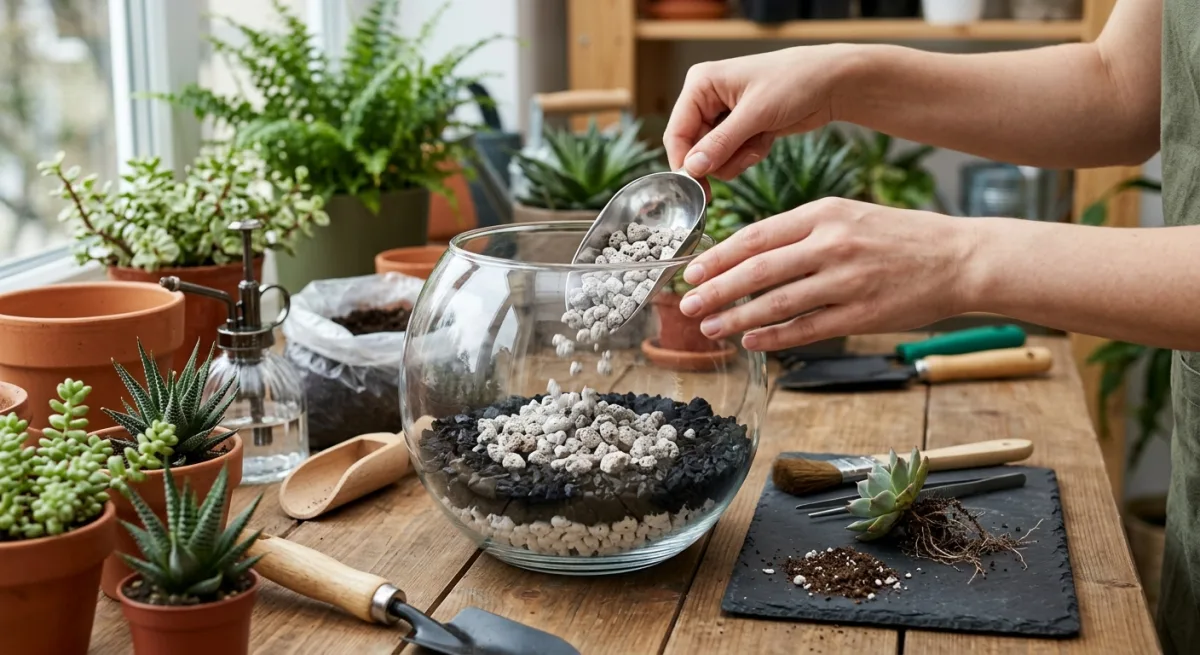
- Construct the Drainage Reservoir: Distribute the rinsed lava rock evenly across the bottom. Scatter the activated charcoal across the stones. Cut your geotextile fabric roughly 5 mm smaller than the internal glass perimeter; this keeps the white barrier invisible from the outside, preserving a clean geological profile.
- Deposit the Gritty Soil Blend: Pour your inorganic-dominant potting mix over the barrier. Slope the soil upward toward the back of the vessel to create a natural grade, adding visual depth and landscape perspective to your miniature dune scape.
- Bare-Root Preparation & Planting: Unpot your chosen succulents and gently brush away the compacted, nursery-grade peat from their root balls using your fingers or a soft detailing brush. Insert the clean, aerated root systems into pre-dug pockets in the soil bed, gently firming the mix around them.
- Apply the Sand Topcoat: Once planting is complete, use a small spoon, laboratory spatula, or narrow funnel to deposit your decorative coarse silica sand across the surface. Take care not to bury the basal leaves or compress the root collars.
5. Natural Hardscape Elements: Rocks, Driftwood, and Mineral Accents
An exceptional sandbox terrarium is more than just plants set in sand; it is brought to life by natural hardscape accents that echo real geological environments. To bring depth, contrast, and scale to your design, consider integrating miniature slate slabs, dragon stone, or vesicular red lava stones. Always seat heavy stones down into the main soil bed *before* planting; this anchors the hardscape securely and prevents heavy rocks from shifting or toppling over onto tender rosettes during maintenance.
When incorporating wooden accents, use only dense, rot-resistant hardwoods that have been heat-treated, such as cured mopani or red moor root branches. If you wish to create contrasting layered sand bands along the glass wall, avoid craft sands colored with synthetic dyes, which can bleed into the root zone. Instead, select naturally pigmented minerals, such as iron-oxide-rich red Australian desert sand, jet-black basaltic volcanic sand, or golden river quartz. Natural earth minerals remain chemically inert and will not alter substrate pH or introduce toxic residues into the root zone.
6. Precision Hydration and Light Management
In sandbox terrariums, the golden rule of watering is simple: 'When in doubt, wait.' Even in an open-topped glass vessel, air exchange is far more restricted than in a traditional, unglazed terracotta pot. Never mist the surface with a spray bottle, and avoid spraying water directly into the centers of your rosettes. Surface misting merely wets the top layer of sand, elevating humidity around the crown and encouraging leaf rot while leaving deeper taproots completely desiccated.
Instead, use a narrow-spouted wash bottle (laboratory wash bottle) to deliver measured amounts of room-temperature water directly beneath the sand line, targeting the root zone of each plant. Monitor the base reservoir closely: water should never pool more than 0.5 cm (0.2 in) deep in the bottom gravel. If you accidentally overfill the reservoir, immediately move the terrarium to a spot with gentle air circulation, or siphon out the standing pool using a clean syringe fitted with airline tubing.
For lighting, sandbox succulents require a minimum of 5 to 6 hours of bright, indirect sunlight daily. Be cautious with intense, direct midday summer sun shining through smooth glass, which can act as a magnifying lens and scorch foliage within hours. Conversely, insufficient light causes etiolation—unattractive, leggy stretching that irreversibly ruins compact rosette symmetry. An east- or southwest-facing window sill protected by sheer curtains provides the ideal balance of gentle morning light and safe, bright ambient illumination.


Reader Reviews & Comments 4 Reviews
Eleanor Vance
Marcus Sterling
Clara Higgins
Julian Thorne
Leave a Review & Rating
Share your plant care tips, experiences, or questions with our succulent community.