






There is a poignant contrast to nature's generosity when fresh-cut wedding flowers wither and end up discarded in the trash just days after the ceremony. Yet succulents—fleshy-leaved wonders hailing from the rugged limestone cliffs of Mexico to the arid expanses of Namaqualand—stand as the living embodiment of devotion, resilience, and a partnership that defies time. Incorporating living succulent arrangements in open glass terrariums for wedding decor does not merely impart architectural sculpture to reception tables; it transforms the memory of that sacred day into thriving botanical keepsakes that flourish for years to come.
However, designing with succulents in a glass vessel is by no means an ordinary repotting task. Glass containers inherently lack the drainage holes standard in traditional nursery pots. The most tragic mistake wedding designers and enthusiastic plant lovers make is confining succulents to closed jars or narrow-necked carboys, treating them like tropical rainforest terrariums. High relative humidity and stagnant air quickly overwhelm the cellular water-retention mechanisms of succulent foliage, locking their stomata and triggering fungal rot (notably Fusarium and Phytophthora pathogens) within hours.
In this comprehensive guide, we explore open geometric glass prisms and wide-mouth vessels that harmonize effortlessly with wedding themes. We cover the substrate layering engineering essential for allowing root xylem to breathe, select companion species—such as the Zebra Haworthia (Haworthiopsis fasciata), Burro's Tail (Sedum burrito), and porcelain-like Echeverias—that thrive under reception lighting, and outline the scientific protocol ensuring your living centerpiece endures long after the last dance.
1. Drainage Layer Engineering in Glass Vessels
The golden rule of sustaining succulents in undrained glass containers is to isolate the root zone entirely from gravity-settled, free-standing water. In their native habitats, succulent root systems evolved to breathe freely within loose rock fissures, volcanic deposits, and mineral beds rich in oxygen. Because glass lacks an exit hole, we must construct an artificial aquifer (water collection reservoir) right at the base.
The foundation of this engineering consists of a 2 to 4 cm layer of coarse, porous volcanic lava rock (scoria) and pumice. These porous stones allow excess water to drain swiftly away from the root zone. Over this inorganic reservoir, sprinkle a uniform layer of granular activated carbon (activated charcoal). Activated carbon biochemically inhibits anaerobic bacteria, mold, and sour odors in standing water by adsorbing volatile gases and organic decomposition byproducts, keeping the subterranean environment sterile.
Instead of the synthetic landscape fabric often used in traditional terrariums—which can impede root travel and look unsightly through clear glass—opt for a thin barrier of washed coarse quartz sand or inorganic zeolite. Directly on top of this barrier sits the primary growth medium: a gritty succulent substrate consisting of no more than 20% organic matter and 80% inorganic minerals (pumice, zeolite, perlite, and calcined clay). This ensures root hairs draw moisture through capillary action without ever being submerged in stagnant liquid.
2. Species Selection and Pairing Rules for Aesthetic Synergy
For wedding decor, succulents must offer more than just visual charm; their metabolic rates, photoperiod requirements, and water uptake cycles—specifically their Crassulacean Acid Metabolism (CAM) rhythms—must exist in complete physiological harmony. Planting a fast-growing, thirstier species alongside a desert variety entering summer dormancy will lead to inevitable root failure.
The Crassulaceae family offers the most stunning and reliable candidates for romantic, pastel, and sculptural table designs. As cataloged in the Kew Plants of the World Online database, species that retain a tight, compact rosette form provide ideal horizontal spatial balance:
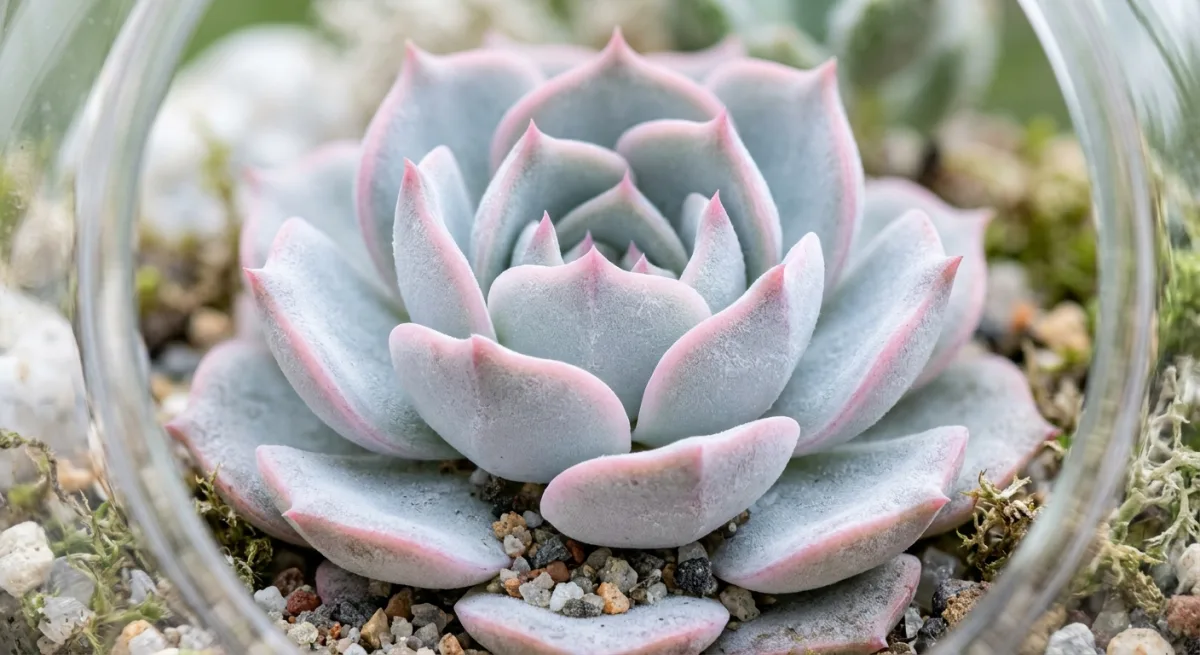
- Echeveria 'Lola' and Echeveria 'Tippy': Resembling sculpted porcelain roses with delicate pink tips, these hybrids are living floral gems for centerpieces. Their dense epicuticular wax (farina) casts an ethereal, matte luminescence under ballroom lighting.
- Sedum clavatum and Burro's Tail (Sedum burrito): These varieties spill gracefully over glass facets, introducing a soft, cascading visual flow to structural geometric containers.
- Zebra Haworthia (Haworthiopsis fasciata): Exceptionally tolerant of low light and ambient banquet hall conditions. It maintains its rigid, upright architecture even under muted candlelight and table lamps.
- Gollum Jade (Crassula ovata 'Gollum') or Rosary Vine (Crassula rupestris): Upright, structural companions that develop woody stems, lending architectural height and textural depth to the composition.
3. Layer Thicknesses and Substrate Stratification
Visual elegance in an open glass vessel relies heavily on clean horizontal stratification. When guests sit at eye level with the centerpieces, the glass sides should showcase an intentional geological cross-section rather than an untidy heap of dirt.
| Stratum Level | Material Type | Recommended Depth | Biological & Structural Function |
|---|---|---|---|
| 1. Base Aquifer | Coarse Lava Rock & Pumice (4-8 mm) | 2.0 - 3.5 cm | Serves as a catchment basin, separating gravity-drained water from root tips. |
| 2. Purifier | Granular Activated Charcoal | 0.5 cm | Adsorbs anaerobic toxins, eliminates foul odors, and inhibits mold spores. |
| 3. Separation Filter | Zeolite / Coarse Quartz Sand (1-2 mm) | 0.5 - 1.0 cm | Prevents upper soil particles from migrating downward into drainage voids. |
| 4. Growth Medium | 80% Gritty Mineral Succulent Substrate | 4.0 - 6.0 cm | Aerates root xylem cells, facilitates rapid dry-back, and anchors root mass. |
| 5. Top Dressing | Crushed Limestone or Washed River Quartz | 0.5 - 1.0 cm | Regulates evaporation and prevents basal leaves from contacting wet substrate. |
4. Step-by-Step Planting and Arrangement Protocol
Assembling centerpieces 3 to 4 days prior to the wedding allows the plants to settle into their microclimate and provides micro-abrasions on roots sufficient time to callus over. Follow this methodical assembly workflow:
- Sanitize the Glassware: Clean your geometric prism, cube, or bowl using 70% isopropyl alcohol and let it air-dry completely. This step eradicates residual mold spores and leaves the glass streak-free.
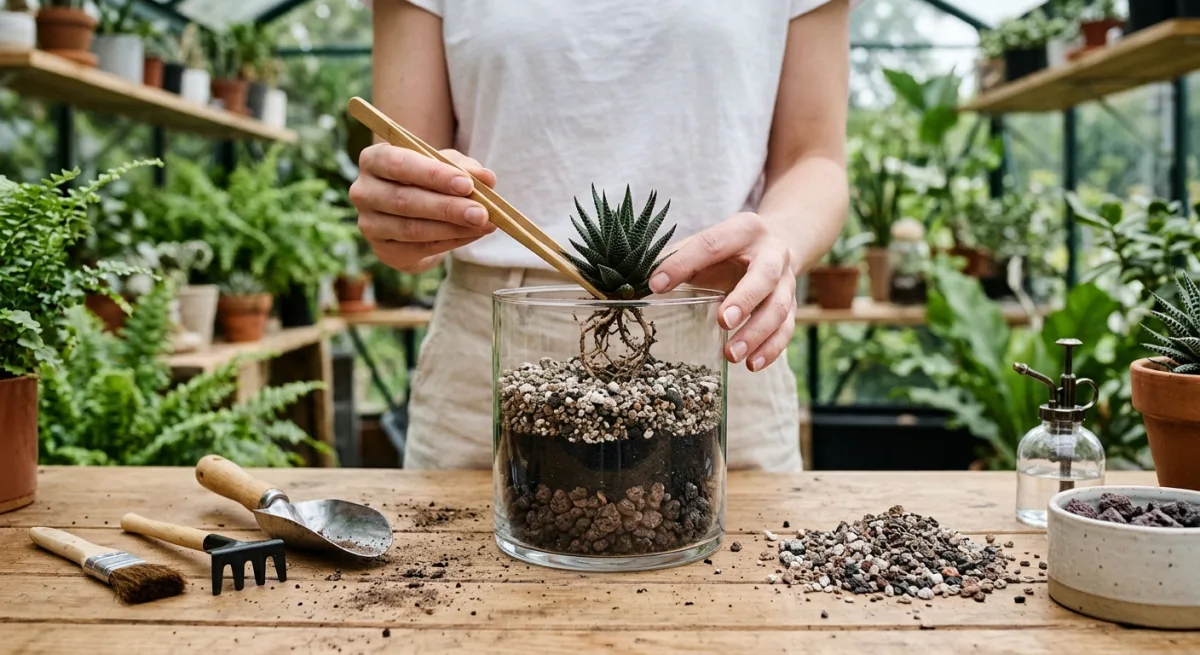
- Build the Structural Layers: Carefully pour the coarse pumice or scoria base according to the stratification table. Layer the activated charcoal and zeolite separation barrier evenly around the edges for sharp visual definition.
- Add Substrate and Shape Topography: Pour in the inorganic succulent blend. Rather than leaving the surface flat, sculpt a gentle 15-to-20-degree slope rising toward the rear. This topographical slope ensures seated guests can appreciate every plant from any angle.
- Prepare the Root Systems: Unpot your nursery succulents and gently brush away compacted peat moss or coconut coir using a soft paintbrush. At least 70% of the root zone should be clean and ready to contact the mineral substrate. If root breakage occurs, let the plants rest in a shaded spot for 24 hours to form protective wound callus before planting.
- Position the Focal Point and Companions: Place your primary rosette (such as a specimen Echeveria 'Lola') slightly off-center at an inviting angle. Use long planting tweezers to bed the vertical Haworthiopsis behind it and position trailing Sedum along the edges, ensuring the root crowns remain positioned right at the soil line.
- Apply the Top Dressing: With a narrow spoon, place a layer of clean white quartz chips or micro river pebbles beneath the lowest leaves. Keeping basal foliage separated from damp mineral mix prevents bottom-leaf rot entirely.
5. Natural Accents: Driftwood, Dragon Stone, and Mineral Sands
Wedding themes generally hinge on a curated palette—Rustic, Bohemian, Modern Minimalist, or Mediterranean Coastal. Natural accents can bring these narratives to life inside an open terrarium without compromising root health.
For Bohemian and rustic celebrations, small pieces of autoclaved driftwood, cork bark, or fragments of petrified wood evoke a miniature mountain valley. In modern, architectural themes, sharp-edged gray basalt stones or textured dragon stone (ohko stone) form an arresting juxtaposition against the curved rosettes of succulents.
If you wish to incorporate colored sands, steer completely clear of artificially dyed aquarium gravels. Synthetic dyes often leach chemicals into undrained soil when watered, poisoning root tissue. Instead, use natural mineral grits: crushed red jasper, green serpentine, or pure black volcanic basalt. Layered in gentle waves along the inner perimeter of the glass, natural sands transform your substrate into an evocative geological art piece.
6. Precision Irrigation and Post-Event Lighting Management
Whether these living works of art thrive in your guests' homes for years depends directly on irrigation discipline before and after the ceremony. Succulents should never be watered as an emotional gesture; excessive moisture in unperforated containers suffocates roots.
Terrariums should receive zero water during the 48 hours leading up to the celebration. Bone-dry substrate during the event prevents glass fogging and condensation, guaranteeing crystal-clear wedding photography. Furthermore, completely dry roots withstand venue air conditioning and sudden temperature swings without succumbing to shock.
After the wedding, never water these arrangements using spray bottles or overhead misters. Instead, use a narrow-spout precision wash bottle or syringe. Deliver water directly onto the top dressing a few centimeters away from the plant stems, keeping moisture away from the central rosettes. A modest volume of 30 to 50 ml is plenty for an average centerpiece; it hydrates the active root layer without ponding in the bottom reservoir. Placed beside a bright window receiving filtered sunlight, this living wedding keepsake will thrive for years to come.


Reader Reviews & Comments 1 Review
No comments yet. Be the first to share your succulent experience!
Leave a Review & Rating
Share your plant care tips, experiences, or questions with our succulent community.