






Madagascar’s red granite outcrops and arid brushlands are home to some of nature’s most rugged botanical masterpieces. Among the hidden treasures of this isolated ecosystem is the Lance-Leaf Madagascar Periwinkle (Catharanthus lanceus), a semi-xerophytic perennial that shatters the fragile image of typical flowering houseplants with its slender, arching foliage and delicate pink-lilac petals. Introducing this plant into your living space brings far more than an ornamental bloom—it introduces millions of years of evolutionary survival architecture, transforming into a captivating living sculpture when paired with the right natural vessel.
All too often, drought-adapted specimens suffocate in moisture-retentive potting soils and rigid plastic pots that stifle root respiration. To thrive, their root systems crave natural, porous materials that encourage steady gas exchange. The compact water-storage tissues of succulents and the resilient, semi-woody root collar of Catharanthus lanceus achieve perfect ecological harmony when housed within a hollowed, reclaimed natural log. Remember: watering succulents constantly is never an expression of love; it deprives their roots of oxygen and inadvertently drowns them. In this masterclass guide, we will fuse the organic warmth of salvaged wood with structural mineral substrates to construct a rustic log planter that prevents root rot while elevating your home into a refined botanical gallery.
1. Essential Materials, Tools, and Safety Precautions
When turning a fallen piece of timber into a flourishing plant sanctuary, selecting rot-resistant hardwood and sealing the interior chamber with non-toxic, plant-safe sealants is paramount. Always equip yourself with safety goggles and a particle mask to avoid inhaling fine sawdust and wood debris during carving.
- Natural Log Body: A seasoned olive, cedar, or sweet chestnut log measuring 35–45 cm (14–18 inches) in length with natural fissures (hardwoods rich in natural tannins and protective resins are strongly preferred).
- Living Plant Material: One robust Catharanthus lanceus specimen, complemented by cascading Burro's Tail (Sedum burrito), structural Gollum Jade (Crassula ovata ‘Gollum’), and powdery silver-blue Blue Chalksticks (Senecio serpens) cuttings to build compositional depth.
- Carving & Drilling Equipment: Power drill equipped with hole saws (a 35 mm Forstner bit and a 10 mm extra-long wood auger bit), hand chisels, and a wooden carving mallet.
- Natural Moisture Barrier: A warm, melted blend of pure beeswax and cold-pressed linseed oil (flaxseed oil) to protect internal wood grain from persistent soil moisture.
- Bespoke Inorganic Substrate Blend: Fine horticultural pumice (40%), crushed red volcanic scoria/lava rock (25%), clinoptilolite zeolite (20%), and washed coconut coir with coarse perlite (15%).
- Personal Protective Equipment (PPE): FFP2/N95 dust mask, heavy-duty workshop gloves, and side-shield eye protection.
2. Structural Dimensions and Substrate Ratios
To ensure unimpeded oxygen diffusion throughout the rhizosphere and prevent stagnant water from pooling against the raw timber, the carved trough and drainage channels must adhere to precise geometric specifications:
| Structural Component / Layer | Ideal Measurement / Ratio | Horticultural Function & Purpose | Curing / Preparation Time |
|---|---|---|---|
| Carved Wood Basin | Length: 40 cm | Depth: 8–10 cm | Width: 12 cm | Provides ample lateral root expansion and optimal capillary gas exchange | Naturally cured wood (Moisture <12%) |
| Drainage Exit Weep Holes | 10 mm Diameter (Min. 4 points along base) | Allows gravitational water to escape instantly, preventing basal saturation | Immediate planting following drilling |
| Internal Organic Sealant | 70% Cold-Pressed Linseed Oil + 30% Natural Beeswax | Prevents timber swelling and stops fungal mycelium colonization naturally | 12 hours between coats (24 hrs total) |
| Inorganic Drainage Bedding | 1.5–2 cm depth (8–12 mm Crushed Scoria) | Completely isolates lower root tips from potential moisture pooling | Rinse and air-dry prior to installation |
| Porous Mineral Matrix | 4:2.5:2:1.5 (Pumice : Lava : Zeolite : Coir/Perlite) | Preserves open macropores for roots balancing CAM and C3 photosynthetic pathways | Homogenously mixed until uniform |
3. Step-by-Step Carving, Preparation, and Assembly
Sculpting seasoned hardwood into a hospitable microclimate without erasing its natural, weathered character requires a patient, methodical workflow:
- Hollowing the Planting Basin: Inspect your log to determine its natural resting point and stable base. Outline an elongated, organic oval planting zone along the top contour. Using your power drill and a 35 mm Forstner or hole saw bit, bore a series of adjacent relief holes to an exact depth of 8–9 cm. Carefully chip away the remaining wood bridges with a hand chisel and mallet, smoothing the floor of the cavity while keeping the outer bark perimeter beautifully intact.
- Boring the Drainage Escape Routes: Drill 4 drainage weep holes (10 mm diameter) through the bottom floor of the cavity, angling the bit slightly downward toward the bottom exterior. Water trapped inside unsealed timber is the quickest killer of the drought-loving Lance-Leaf Madagascar Periwinkle.
- Applying the Non-Toxic Sealant: Gently melt your natural beeswax and linseed oil together over a double boiler. Brush two generous coats over the interior carved wood cavity. This hydrophobic barrier shields the grain from continuous soil contact without releasing the volatile organic compounds (VOCs) that synthetic polyurethane varnishes emit into vulnerable root hairs.
- Establishing the Drainage Foundation: Cover each bottom drainage hole with a small square of breathable plastic mesh to prevent substrate loss. Lay down a level 2 cm layer of rinsed volcanic scoria to establish a pristine drainage terrace.
4. Planting and Arranging Your Periwinkle and Succulents
Assembling a harmonious arrangement requires positioning each specimen according to its natural growth habit, root anatomy, and structural morphology. The Lance-Leaf Madagascar Periwinkle (Catharanthus lanceus) boasts an upright, woody subshrub silhouette, making it the undeniable vertical focal anchor for the center-rear quadrant of the log.
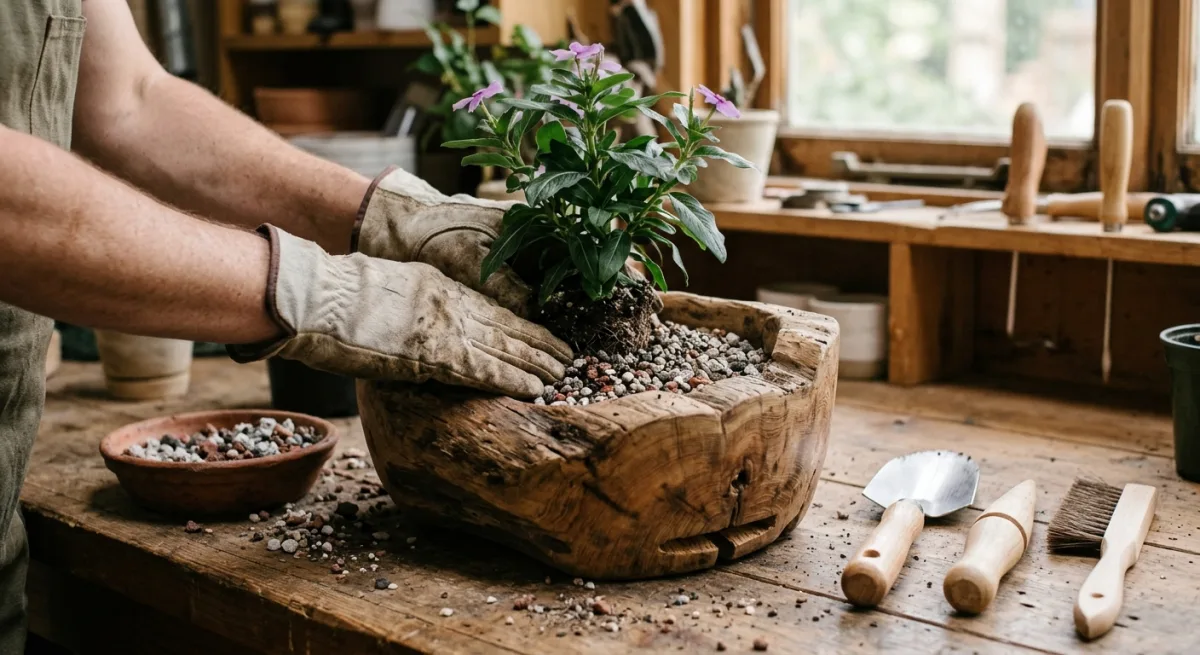
Ease the periwinkle out of its container and gently separate the nursery soil using your fingers, clearing out dense peat without stripping the primary root architecture. Add a base layer of your customized pumice and zeolite mix into the log, then seat the root ball so that its crown sits comfortably 1 cm below the natural lip of the wood rim.
Next, arrange your companion xerophytes around the periwinkle. Position trailing Burro's Tail (Sedum burrito) stems along the front crest so they tumble naturally over the rugged bark. Tuck structural Gollum Jade (Crassula ovata ‘Gollum’) into the middle tier, and anchor the silver-blue fingers of Blue Chalksticks (Senecio serpens) near the edges to create stunning textural and color contrast. Pour your remaining mineral mix into every void, tapping the sides of the log lightly to settle the gravel and eliminate hidden air pockets around tender root tips.
5. Watering Regimen and Microclimate Maintenance
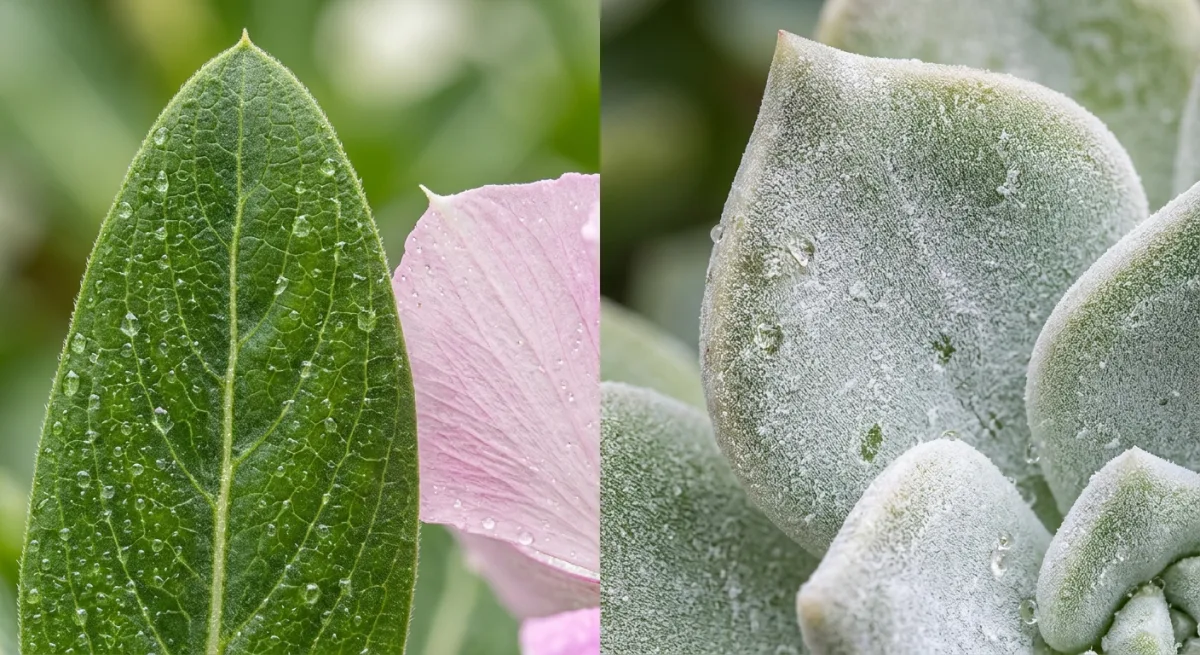
The long-term success of this living wooden centerpiece rests entirely on your understanding of moisture dynamics. While Catharanthus lanceus displays remarkable drought tolerance far surpassing conventional garden periwinkles, its elongated leaves are sensitive to lingering atmospheric moisture. The fine farina wax dusting its foliage serves as nature’s built-in sunscreen; avoid rubbing this protective coating off and never mist the leaves directly with spray bottles.
Hydrate the planter using a narrow gooseneck watering can, directing room-temperature water strictly onto the mineral substrate around the root bases. Soak the grit thoroughly until you see excess water draining out cleanly through the bottom weep holes. Always allow the substrate to dry out 100% from top to bottom before watering again. (To verify dryness, insert a slender wooden skewer into the center of the cavity for 5 minutes; if it emerges bone dry with no grit clinging, it is time to water). During the short, cool days of winter when metabolic rates slow down, pull back watering intervals to roughly once a month.
6. Ensuring Long-Term Display Longevity and Wood Health
Wood is a dynamic, organic medium that expands and contracts with changes in seasonal temperature and ambient humidity. Preserve the beauty of your artisanal planter for years with these foundational care tips:
- Lighting Requirements: Display your finished arrangement where it receives 4 to 6 hours of bright, filtered morning sunlight daily, such as near an unobstructed south- or west-facing window. Insufficient light causes Catharanthus lanceus to stretch weakly and forces surrounding succulents into unsightly etiolation.
- Annual Exterior Wood Rejuvenation: Each spring, use a soft cotton cloth to wipe a thin coat of pure cold-pressed linseed oil over the dry exterior bark and cut edges. This nourishes the natural wood grain and prevents deep splitting, keeping the vessel sturdy.
- Promote Gentle Airflow: A rustic log planter is fundamentally different from a closed glass terrarium. Stagnant indoor air invites mildew spores and opportunistic wood-boring fungi. Keep room air circulating with a gentle cracked window or an oscillating ceiling fan on low.


Reader Reviews & Comments 3 Reviews
Eleanor Vance
Julian Thorne
Hannah Campbell
Leave a Review & Rating
Share your plant care tips, experiences, or questions with our succulent community.