






Emerging from the cool morning mists of Kyoto's historic Mibu district, Mibuna mustard greens (Brassica rapa var. niposinica)—frequently cherished alongside its sister green Mizuna—have long captivated gardeners with their slender, lance-shaped foliage and subtly peppery, mustard-oil aromatics driven by natural glucosinolates. When we welcome this fast-growing, nutrient-dense heirloom brassica into modern indoor spaces, we face an intriguing botanical puzzle: balancing soil moisture without compromising aesthetic structure. Enter our signature dual-chamber urban countertop garden box, harmonizing the minimal moisture demands of rock-dwelling succulents like the Zebra Haworthia (Haworthiopsis fasciata) with the cool-season moisture requirements of culinary Mibuna.
Practicing horticulture is far more than dropping seeds into damp earth; it is an intimate exercise in listening to the distinct metabolic rhythms of contrasting botanical families and engineering micro-ecosystems where they thrive side-by-side. Succulents—fortified with thick cuticular waxes (epicuticular farina), succulent parenchyma tissues, and nocturnal carbon fixation via Crassulacean Acid Metabolism (CAM)—provide a striking aesthetic and physiological counterpoint to Mibuna's rapid C3 photosynthetic biomass accumulation. In this masterclass guide, we will walk step by step through crafting a food-safe, dual-chamber wooden planter that lets you harvest gourmet heirloom greens directly on your sunny kitchen counter while enjoying the sculptural, timeless beauty of desert foliage in the backdrop.
1. Essential Materials, Woodworking Tools, and Food-Safety Protocols
The structural backbone of this project is a partitioned solid wood planter box engineered to completely isolate the moisture-retentive, nitrogen-rich organic substrate needed by Mibuna's fibrous root system from the highly porous, gritty mineral mix demanded by succulent roots to avert basal rot (Phytophthora and Pythium). Balancing these polarized moisture regimes within a single container without risking wood decay represents our primary horticultural engineering objective.
- Solid Timber Casing: Naturally rot-resistant, thermally modified pine (thermo-pine) or Western red cedar boards (18 mm nominal thickness).
- Chamber Partition Barrier: A 3 mm thick sheet of waterproof acrylic or food-grade rigid plexiglass to seal off the moisture boundary between compartments.
- Moisture Proofing & Interior Finishes: Pure cold-pressed raw linseed oil (flaxseed oil) or melted natural organic beeswax, complemented by porous non-woven geotextile fabric liner.
- Bespoke Succulent Gritty Mix: 70% inorganic aggregates (pumice, crushed volcanic lava rock, graded zeolite) and 30% mature screened leaf compost.
- Mibuna Seedling Substrate: 50% screened coconut coir (or peat moss), 30% organic worm castings (vermicompost), and 20% horticultural perlite.
- Certified Seed Stock: Fresh, high-germination Japanese Mibuna (Brassica rapa var. niposinica) heirloom seeds.
- Selected Companion Succulents: Compact, slow-spreading cultivars such as Zebra Haworthia (Haworthiopsis fasciata), Echeveria 'Lola', or Blue Spruce Stonecrop (Sedum reflexum).
- Joinery Tools: Miter saw, cordless drill-driver, D4-rated waterproof polyurethane wood glue, countersink bits, 120-grit sandpaper, and protective eye gear.
2. Technical Dimensions and Soil Substrate Specifications
The engineering matrix below outlines the exact dimensional tolerances, substrate formulations, and functional physiological roles for each compartment within your dual-zone desktop kitchen planter:
| Component / Chamber | Dimensions / Volume | Substrate Recipe / Material | Functional Botanical Purpose |
|---|---|---|---|
| Outer Timber Framework | 50 cm L x 20 cm W x 14 cm H | 18 mm Cedar or Thermally Modified Pine | Decay-resistant chassis supporting the dual-climate system |
| Front Mibuna Basin | 32 cm L x 16 cm W x 12 cm D | 50% Coco Coir + 30% Worm Castings + 20% Fine Perlite | Consistently aerated, humus-rich, nitrogenous seedbed |
| Rear Succulent Basin | 14 cm L x 16 cm W x 12 cm D | 35% Crushed Lava + 35% Pumice + 30% Gritty Potting Soil | Fast-draining, high-porosity bed optimizing root oxygenation |
| Plexiglass Partition Barrier | 16.4 cm W x 11.8 cm H x 3 mm T | Laser-cut acrylic sealed with aquarium-grade silicone | 100% barrier against lateral hydraulic moisture seepage |
| Base Drainage Ports | Ø 12 mm holes (3 per chamber) | Stainless steel mesh + 1 cm volcanic gravel barrier | Immediate gravitational water runoff to prevent stagnation |

3. Step-by-Step Planter Construction and Assembly
The long-term viability of this miniature indoor ecosystem hinges entirely on physical isolation: preserving Mibuna's moist micro-rootzone while keeping the succulent quadrant dry. Once your cedar or thermo-pine boards are cleanly cut to size, proceed with assembly:
- Framework Joinery: Secure the side panels to the baseboard using D4 waterproof wood adhesive and stainless steel trim screws. Pre-drill every joint with a 2.5 mm pilot bit and countersink to prevent split grain.
- Drainage Engineering: Bore three 12 mm drainage holes through the base of the Mibuna chamber and two through the succulent chamber. Affix small silicone bumper feet beneath the wooden base to maintain a 5 mm air gap above the bottom catchment drip tray for unrestricted aeration.
- Installing the Moisture Barrier: Route or cut an internal channel 3 mm wide into the side walls, or firmly seat the acrylic panel in place. Seal the vertical and bottom edges hermetically using 100% aquarium-grade, solvent-free pure silicone. Allow 24 hours to cure, forming an impermeable dam that prevents hydraulic diffusion between substrates.
- Food-Safe Protective Treatment: Generously apply two coats of warm, cold-pressed raw linseed oil to all exterior and interior wood surfaces. Allow the oil to absorb deep into the wood grain for 24 hours before wiping off any surplus.
- Drainage Mesh Layering: Cover the base drainage ports with fine stainless steel wire mesh screen, followed by a 1 cm layer of coarse lava gravel to stop fine soil particles from washing through and clogging drainage.
4. Planting Succulents and Sowing Mibuna Seeds
With the physical vessel constructed and sealed, we turn to living material. Sequence matters: plant your succulents first to establish their root anchorage cleanly, followed by sowing your delicate Mibuna seeds.
Planting the Succulents: Fill the smaller compartment with your mineral-heavy gritty blend. Carefully unpot your Haworthiopsis fasciata (Zebra Haworthia) or rosette-forming Echeveria, gently disentangling root balls from peaty nursery plugs. Settle the root crowns flush with the soil line. Top-dress the surface with a 5 mm layer of pure zeolite, calcined clay, or red pumice grit. This non-organic decorative mulch prevents the lower succulent leaves from sitting directly against damp soil, eliminating the risk of fungal leaf melt.
Mibuna Sowing and Germination Protocol: Fill the larger chamber with your light, moisture-retentive seed starting mix up to 2 cm below the rim. Gently level the surface without packing it down:
- Sowing Density: For tender 'baby-leaf' harvesting, broadcast seeds evenly roughly 2–3 cm apart. If you prefer harvesting full, mature clustered rosettes, space seeds 8–10 cm apart.
- Seeding Depth: Mibuna seeds are diminutive. Dust them with no more than 0.5 cm of finely sifted worm compost and coco coir; brassicas germinate most vigorously when daylight can still lightly penetrate the uppermost soil interface.
- Initial Irrigation: Mist the seedbed thoroughly using an ultra-fine hand mister or pump sprayer. Avoid heavy pouring, which displaces tiny seeds into uneven corners or drowns them too deep.
- Germination Dynamics: Maintained at comfortable room temperatures between 15°C and 20°C (59°F–68°F), Mibuna cotyledons typically germinate and emerge in just 3 to 5 days.
5. Balanced Irrigation and Culinary Harvest Protocols
Daily maintenance of this dual-climate planter follows one fundamental rule: never treat both chambers as one. The cell architectures of these plants operate under entirely divergent hydrological laws.
Mibuna (Brassica rapa) features thin, delicate cell membranes and an expansive foliar surface area, driving active transpiration. The root zone must remain evenly moist—around 60% to 70% of field capacity—without becoming soggy. If Mibuna undergoes severe drought stress, it initiates an emergency survival reflex known as bolting: shooting prematurely into flower, which turns the leaves unpleasantly fibrous, bitter, and sharp. Hydrate the Mibuna bed 2 to 3 times per week using a precision narrow-spout watering can directed cleanly at the soil base, keeping the tender leaves dry.
In stark contrast, the succulent chamber must be managed under the strict 'soak and dry' principle. Water should only be introduced when the gritty substrate has dried out completely (at least 90% dry), typically every 10 to 18 days depending on ambient household humidity and ambient heat. Never let water pool in the crowns of rosette succulents like Echeveria to preserve their natural powdery farina wax coating; direct moisture strictly to the surrounding stone mulch.
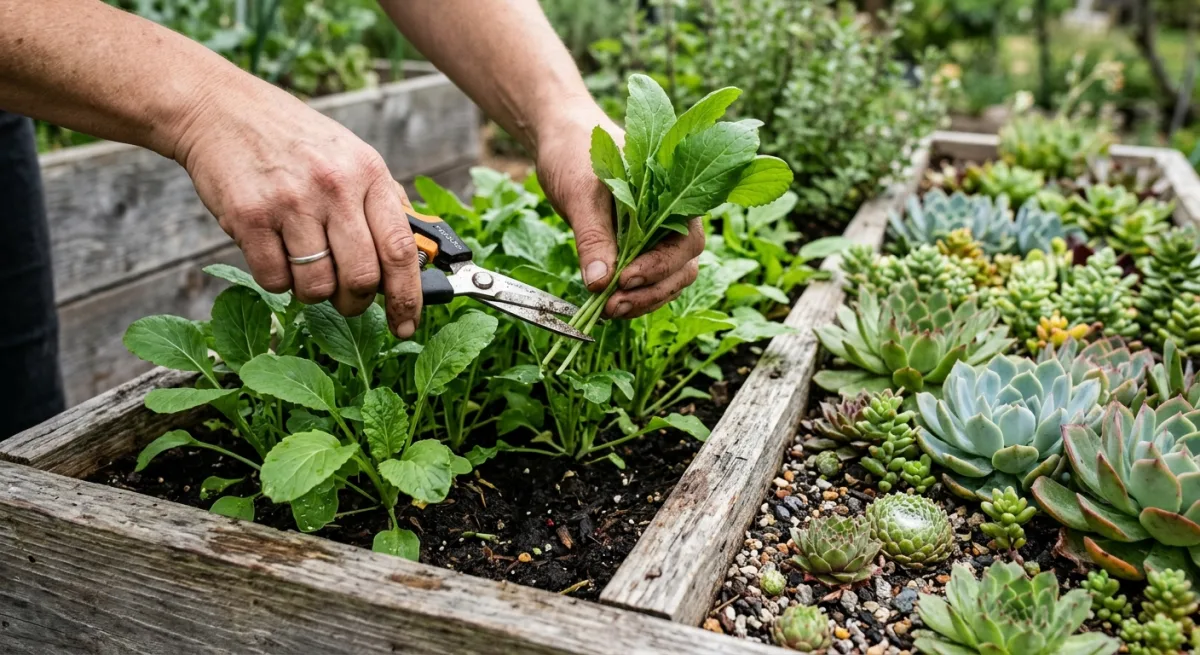
Cut-and-Come-Again Harvest: Around 25 to 30 days after sowing, Mibuna's tender green spears reach 10 to 15 cm in height. Using sharp kitchen shears, snip the outer leaves roughly 2 cm above the soil crown. As long as you keep the central growing tip (apical meristem) intact, each plant will swiftly regenerate fresh foliage, yielding 3 to 4 abundant culinary cuttings for fresh salads, light stir-fries, or authentic Japanese nabe soups.
6. Long-Term Durability, Nutrition, and Pest Prevention
To preserve both the living vigor of your botanical setup and the integrity of your hand-crafted wooden planter across multiple growing seasons, maintain these preventative habits:
- Targeted Organic Nutrients: Continual leaf harvesting depletes soil nitrogen. After every second harvest, blend a gentle quarter-strength organic cold-water kelp extract or diluted liquid worm casting tea into Mibuna's water. Never feed this nitrogen-rich formulation to the succulent compartment, as it causes soft, bloated, rot-prone growth.
- Timber Conditioning: Once a year, when turning over the Mibuna soil after several harvest cycles, wipe down the dry interior wood edges with pure melted beeswax or a fresh coat of raw linseed oil to seal wood fibers against moisture ingress.
- Organic Pest Control: Tender brassica foliage can occasionally attract aphids indoors. If detected, avoid commercial synthetic pesticides; mist leaves with a mild organic potassium soap solution or cold-pressed neem spray. For succulents, tackle occasional mealybugs instantly with a cotton swab dipped in 70% isopropyl alcohol.
- Cool-to-Warm Season Crop Rotation: Mibuna excels during the cooler days of spring, autumn, and mild winter windows. During high summer heat, rotate out the Mibuna basin by planting heat-loving culinary herbs like dwarf Greek basil or edible purslane (Portulaca oleracea), beautifully matching the high-temperature resilience of your companion succulents.


Reader Reviews & Comments 4 Reviews
Chloe Davenport
Eleanor Vance
Marcus Sterling
Julian Hayes
Leave a Review & Rating
Share your plant care tips, experiences, or questions with our succulent community.