






Climbing the sheer limestone ravines of Veracruz and Oaxaca in southern Mexico reveals an extraordinary botanical silhouette spilling down the rocks like silvery-blue waterfalls: Sedum morganianum. Known affectionately around the world as Burro's Tail or Donkey's Tail (and cherished in Mediterranean plant nurseries as 'Eşek Kuyruğu'), this captivating member of the Crassulaceae family ranks among the most dramatically sculptural hanging succulents you can welcome into your home.
Countless plant enthusiasts bring this species home with immense excitement, only to watch in dismay as plump, fleshy leaves shower to the floor at the gentlest brush of a hand. Always remember the fundamental grower's adage: watering succulents too frequently is never an expression of love; it simply suffocates root tissue by depriving it of oxygen. Once you decode the anatomy of this delicate yet surprisingly resilient cliff-dweller and grant its roots the porous, aerated environment they crave, it rewards you with decades of mesmerizing, glaucous bead-like strands.
1. Botanical Identity and Morphological Characteristics
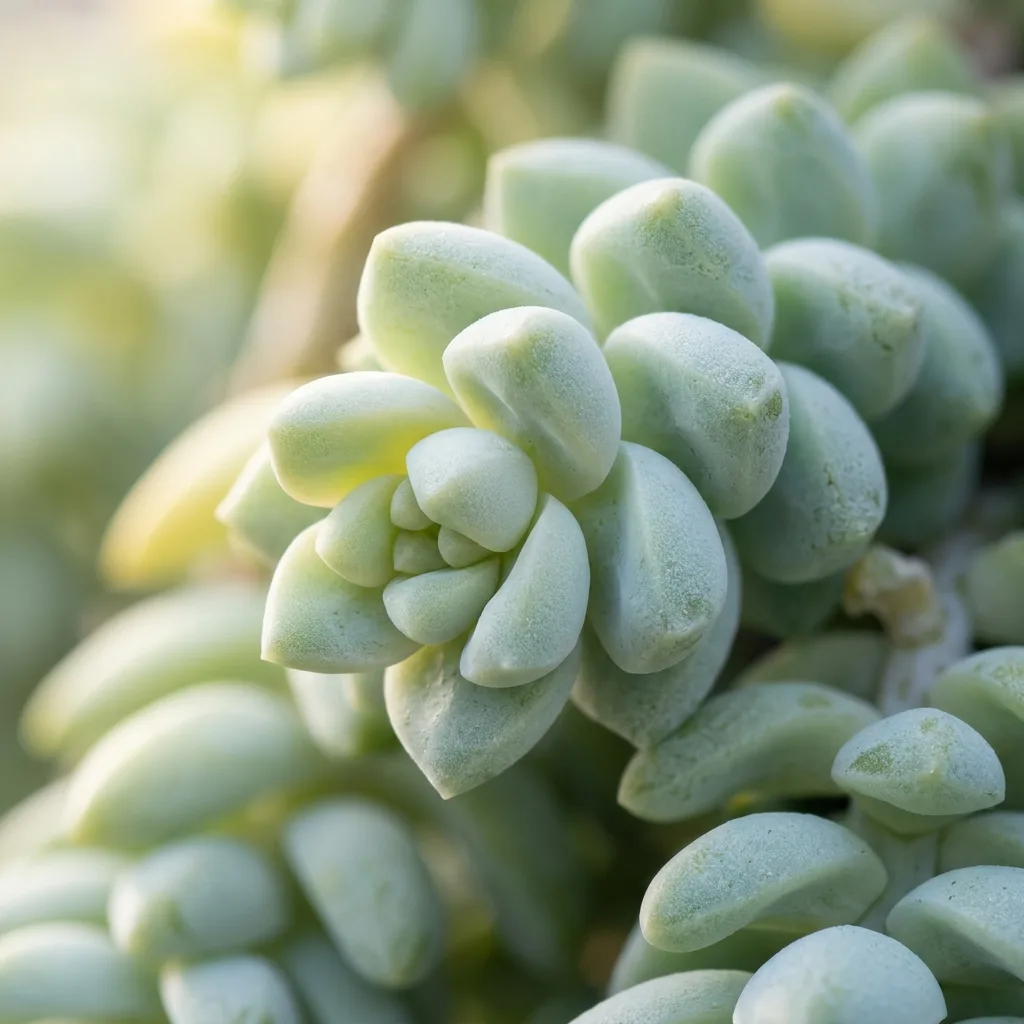
Sedum morganianum is a perennial, rupicolous (rock-dwelling) succulent belonging to the Crassulaceae family. In its natural cliffside habitat, it sends forth trailing stems that can extend well over 3 feet (1 meter) in length. These pendulous stems are densely clad in overlapping, fleshy, lanceolate-cylindrical leaves with delicately pointed tips.
The powdery, silvery-blue cast blanketing every leaf surface is known botanically as farina (an epicuticular wax coating). 'The silvery farina layer is the plant's proprietary botanical sunscreen; never wipe it off or handle leaves with greasy fingers.' Farina serves a dual evolutionary purpose: it deflects harsh ultraviolet radiation to safeguard internal cell structures and seals moisture in to minimize transpirational water loss. In midsummer, mature terminal stems produce terminal clusters of diminutive, star-shaped pinkish-red blossoms—a well-earned reward following winter dormancy and vibrant spring sunshine.
2. Light Requirements and Indoor Placement
Hailing from the partially sheltered, sun-drenched ravines of its native Mexican microclimate, Burro's Tail demands an abundance of bright, filtered light. Receiving at least 4 to 6 hours of direct morning sunlight is essential to keep internodal spacing compact and prevent weak, spindly stem elongation.
Under inadequate light conditions, the plant undergoes etiolation: the gaps between leaf nodes stretch, the stems thin out, and that prized, densely packed architectural aesthetic unravels. Conversely, intense midday summer sun magnified through window glass can scorch the delicate farina coating, leaving permanent necrotic brown patches. The premier indoor vantage point is an unobstructed south- or west-facing window dressed with sheer curtains during peak afternoon heat. Once suspended in its hanging basket, leave it stationary; routine handling or positioning it near high-traffic hallways and drafts will trigger rapid leaf shedding.
3. Watering Discipline: The 'Soak and Dry' Protocol
Burro's Tail hoards copious water supplies inside specialized parenchymal vacuoles. Coupled with Crassulacean Acid Metabolism (CAM photosynthesis)—opening its stomata under the cool veil of night to absorb carbon dioxide while conserving hydration—this succulent is built to withstand profound drought. Its primary adversary is never thirst, but rather a persistently damp root ball.
The golden standard for irrigation is the strict 'Soak and Dry' protocol. Never introduce additional moisture until the substrate has desiccated completely throughout the entire root column. The most reliable tactile diagnostic is leaf turgor: if the foliage feels firm and plump, refrain from watering; when the lower pearls soften and show microscopic longitudinal wrinkles, saturate the container thoroughly until water flows freely from the drainage apertures.
4. Substrate Engineering and Container Selection
Anchoring itself naturally in rocky fissures, Sedum morganianum demands rapid drainage above all else. Standard peat-heavy potting soils retain moisture far too long, quickly drowning sensitive feeder roots. The ideal potting medium must feature a pronounced mineral fraction with outstanding macro-porosity.
| Component | Ratio (%) | Botanical Function |
|---|---|---|
| Pumice (3-5 mm grit) | 40% | Ensures maximal aeration and prevents subterranean substrate compaction. |
| Crushed Lava Rock / Zeolite | 25% | Supplies trace micro-minerals and balances moisture retention without waterlogging. |
| Sifted Coir or Premium Seedling Peat | 25% | Forms a gentle organic matrix for delicate root hair anchoring. |
| Horticultural Perlite or Coarse River Sand | 10% | Enhances rapid water percolation while lightening total basket weight. |
When selecting containers, unglazed terracotta or high-fired porous ceramic pots with functional drainage holes are vastly superior to plastic. While plastic hanging planters offer lightweight convenience, the breathable walls of terracotta enable moisture to wick sideways and evaporate, drastically cutting the risk of overwatering.

5. Step-by-Step Propagation Techniques
One of the most rewarding qualities of Burro's Tail is that while its foliage dislodges with ease, each leaf harbors an astounding drive to regenerate. Every healthy fallen pearl represents a viable new clone.
- Leaf Propagation: Gather detached, undamaged leaves (or gently twist mature leaves from the base). Set them on a dry paper towel in a shaded, well-ventilated spot for 2 to 3 days until a protective corky callus develops over the detachment scar. Lay them horizontally atop slightly moist, pumice-rich succulent substrate. Refrain from deep watering until adventitious pink roots emerge, offering only light surface misting.
- Stem Cuttings: Sever 4- to 6-inch (10-15 cm) terminal stems using a sterilized blade, particularly from sparse or etiolated branches. Carefully strip the bottom 1.5 inches of foliage. Allow the severed cut end to callus in dry shade for 3 to 4 days, then insert the bare stem into dry gritty mix. Withhold water for roughly 10 to 12 days until root initials form before initiating normal irrigation.
6. Common Pests, Diseases, and Curative Protocols
The primary predatory threat to this species is the citrus mealybug (Pseudococcidae). These sap-sucking pests nestle deep within the dense leaf axils along the stem, feeding on nutrient sap and producing cottony white protective webbing. For light infestations, spot-treat pests directly using a cotton swab dipped in 70% isopropyl alcohol. For established colonies, apply a cold-pressed neem oil emulsion or incorporate a targeted systemic insecticide during active growth.
On the pathological front, waterlogged soil encourages virulent oomycetes and fungi, specifically Fusarium and Phytophthora, culminating in lethal stem and root rot. If the base of a stem turns translucent, blackened, and mushy, sever the upper healthy foliage well above the necrotic tissue with a sterile blade and re-root it as a fresh cutting—it is the only way to salvage the specimen.
7. Seasonal Maintenance Calendar
Spring (Active Awakening): The vegetative cycle begins. Apply a balanced, low-nitrogen liquid succulent fertilizer diluted to quarter-strength once monthly. Gradually align watering intervals with warming temperatures.
Summer (Peak Vegetative Growth): Monitor root-ball drying times closely during hot spells. If ambient temperatures exceed 95°F (35°C), the plant may enter semi-dormancy to conserve resources; suspend fertilization and extend watering intervals until extreme heat subsides.
Autumn (Seasonal Transition): As daylight diminishes and cool evenings arrive, reduce irrigation frequency. Outdoor specimens must be transitioned indoors before night temperatures drop below 50°F (10°C) to prevent cold shock.
Winter (Rest Phase): Growth halts during dormancy. Reduce watering to the absolute minimum—typically a modest sip once every 4 to 6 weeks is plenty to prevent stem desiccation. Ensure hanging baskets are positioned far from forced-air heat vents and freezing window drafts.


Reader Reviews & Comments 3 Reviews
Chloe Henderson
Marcus Sterling
Eleanor Vance
Leave a Review & Rating
Share your plant care tips, experiences, or questions with our succulent community.