






Look out across the rugged steppes of Anatolia, the limestone crevices of Mediterranean maquis shrublands, or the heavy clay slopes of semi-arid plateaus, and you will witness nature’s most resilient partners thriving side by side: architectural ornamental grasses dancing in the wind, and miniature succulents anchored deeply into sun-baked fissures. For many gardeners, heavy clay soil is perceived as a terrifying adversary—a dense, soggy sponge that suffocates fine roots. Yet, with precise horticultural amendments and macropore management, clay can be transformed into the single most nutrient-dense, moisture-stabilizing medium in your entire botanical repertoire.
The tactile contrast between the compact, geometric rosettes of succulents and the fine, cascading vertical movement of ornamental grasses offers an exceptional opportunity to capture wild, untamed ecological harmony on a patio, balcony, or living room console. In this comprehensive guide, you will master the soil physics needed to convert heavy, impenetrable clay into a free-draining botanical haven. Furthermore, you will learn to handcraft a rustic, organic clay bowl that unites Blue Fescue grass (Festuca glauca) with hardy rock succulents into a breath of living steppe art.
In horticultural science, colloidal clay platelets resemble microscopic wet playing cards compacted tightly on top of one another. When you introduce coarse volcanic aggregates to wedge those platelets apart, you establish permanent aeration channels. In this liberated substrate, the fibrous root network of ornamental grasses and the drought-adapted roots of succulents cultivate a synergistic microbial symbiosis without competing for moisture. Roll up your sleeves, embrace the primal beauty of earth and stone, and let us build this sculptural ecosystem step by step.
1. Essential Materials, Tools, and Safety Precautions
For this living sculpture, we will both shape a handcrafted clay bowl vessel and amend dense native clay into an open, high-porosity growing medium tailored to the root morphology of ornamental grasses and succulents. Before beginning, protect your work surface with heavy plastic sheeting and keep a lightweight dust mask nearby when handling mineral aggregates.
- Natural Grogged Sculpting Clay (Terracotta / Red Stoneware): Coarse-grained, grogged earthenware clay known for its structural strength and porosity. It can air-dry naturally or be bisque-fired at low temperatures (approximately 2–3 kg / 4.5–6.5 lbs).
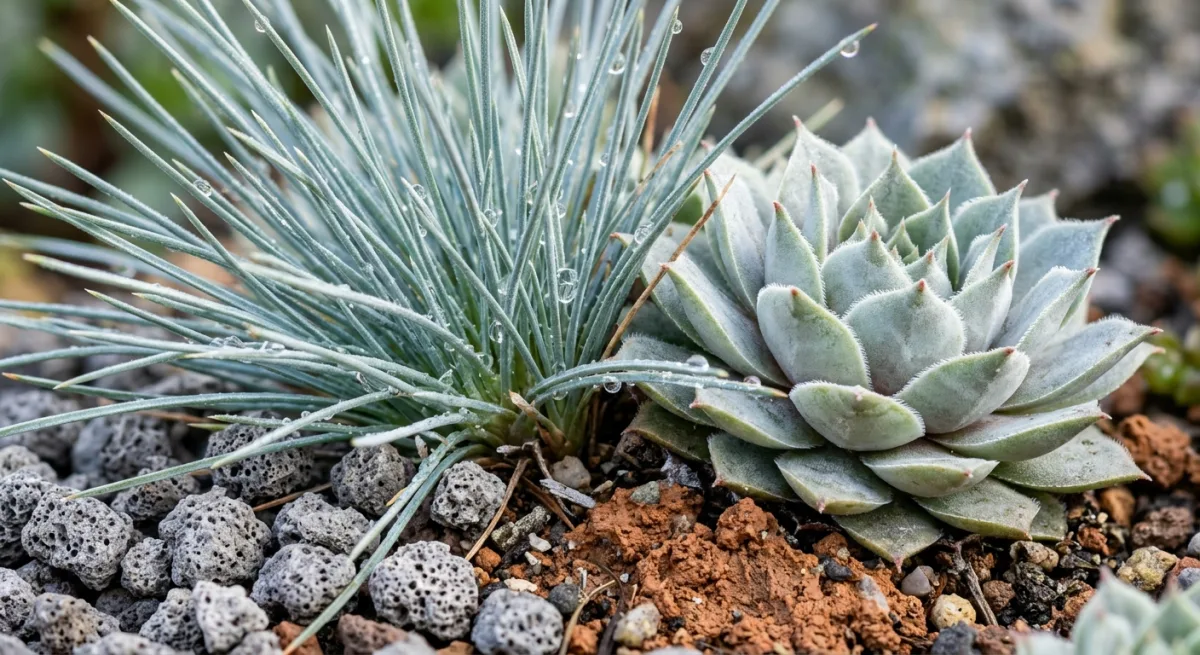
- Living Plants: 1 mature root clump of Festuca glauca (Blue Fescue grass—renowned for its extreme drought tolerance and affinity for mineral-rich substrates), 2 robust rosettes of Sempervivum tectorum (Hens and Chicks / Common Houseleek), and 3 rooted cuttings of trailing Sedum spurium (Caucasian Stonecrop) or Sedum album (White Stonecrop).
- Soil Amendment and Drainage Aggregates: Dense native garden clay (or heavy loam base), 3–6 mm volcanic pumice, porous crushed lava rock (scoria), and coarse horticultural expanded perlite.
- Organic Soil Conditioner: Well-aged leaf mold or sifted, sterile worm castings (essential for providing humic acids that granulate colloidal clay).
- Tools: Wooden modeling spatula, rolling pin, fiberglass drainage mesh, fine-mist spray bottle, hand trowel, and a piece of coarse linen cloth.
- Safety Precaution: When sifting and blending dry pumice and volcanic lava rock, wear an FFP2/N95 dust mask or lightly pre-moisten the aggregates to prevent inhaling microscopic airborne silica dust.
2. Component Dimensions and Substrate Formulation Table
The following table outlines the structural dimensions of the clay vessel alongside the precise volumetric substrate ratios engineered to optimize cation-exchange capacity while ensuring instantaneous free drainage around sensitive root collars:
| Component / Parameter | Dimension / Ratio (by Volume) | Horticultural Function & Purpose | Curing / Prep Time |
|---|---|---|---|
| Natural Grogged Clay | Diameter: 28–32 cm, Depth: 8–10 cm | Breathable, mineral-rich artisan vessel | 3–5 days slow shaded curing |
| Heavy Garden Clay | 30% | High Cation-Exchange Capacity (CEC) & trace minerals | Sifted clean of weed debris |
| Volcanic Pumice (3–6 mm) | 40% | Creates permanent macropores & oxygen chambers | Blend immediately |
| Crushed Lava Rock (2–4 mm) | 15% | Iron/magnesium reserves & substrate structural stability | Blend immediately |
| Aged Leaf Compost / Castings | 15% | Humic binders that aggregate clay platelets | Blend immediately |
| Basal Drainage Outlets | Diameter: Min. 2.5 cm (2 holes) | Prevents anaerobic pooling & Pythium root rot | Punched while clay is leather-hard |
3. Step-by-Step Vessel Handcrafting and Construction
In this phase, we will shape a wide, shallow, organic earthenware bowl inspired by ancient Mediterranean pottery that provides ample surface area for our living steppe landscape.
- Kneading and De-Airing the Clay: Place your grogged terracotta clay onto a clean marble slab or smooth wooden surface. Knead the clay vigorously using the 'ram’s head' or spiral wedging technique for at least 5 minutes. Eliminating microscopic trapped air pockets is vital to avoid fractures during drying.
- Rolling the Slab: Lay your wedged clay across a textured linen cloth. Using a uniform wooden rolling pin, roll the clay out into a broad oval slab roughly 1.5 cm (0.6 in) thick. Avoid rolling too thin; a robust 1.5 cm wall thickness provides the tensile strength required to anchor moist, gravelly clay soil without warping.
- Flaring the Rims (Chamfering): With your thumbs and palms, gently turn the outer edges of the slab upward to create an irregular, sweeping wall 8–10 cm (3–4 in) high. Rather than aiming for sterile, geometric perfection, introduce undulating, wind-swept rim contours reminiscent of an eroded canyon rim.
- Carving Drainage and Aeration Channels: Use a wooden dowel or ceramic hole-cutter to bore two 2.5 cm (1 in) drainage holes into the lowest interior depressions of the bowl. Tool gentle shallow gutters along the vessel base directing water naturally toward the exit holes.
- Gradual Curing: Keep the newly formed bowl far away from direct midday sunlight, heaters, or forced airflow. Rapid drying shrinks clay unevenly, triggering spider-web fractures. Drape a loose, perforated plastic sheet over the piece and allow it to dry slowly to 'leather hardness' over 4 to 5 days, followed by full atmospheric drying. (If accessible, low-fire bisque firing at 950–1000°C / Cone 06 provides permanent weatherproofing; however, thick grogged clay remains sturdy unbaked for indoor or sheltered patio use).
4. Botanical Planting and Succession Layout
Now arrives the rewarding botanical union: settling the fibrous, hair-like root system of Festuca glauca alongside the drought-hardy flesh of alpine succulents into our custom mineral blend.
Begin by cutting small squares of fiberglass mesh to lay over the base drainage holes, keeping aggregates inside while allowing water to escape freely. Spread a 4–5 cm bed of your aerated substrate (mixed strictly according to the Table 2 formula) across the floor of the bowl.
Gently unpot your Festuca glauca (Blue Fescue). Using your fingertips, loosen the outer root ball, teasing out circled fibers so they contact the new soil directly. Position the grass toward the back or slightly off-center on an elevated micro-mound. Pay obsessive attention to planting depth: the crown collar—where the blue foliage emerges from the root tissue—must sit precisely at or slightly above the final soil line. Sinking the crown beneath clay soil inevitably invites crown rot.
Next, arrange your Sempervivum tectorum rosettes along the descending forward slopes of the arrangement, wedging their root tendrils into the mineral blend. Lay the trailing Sedum spurium stem cuttings horizontally across open pockets, dusting their lower nodes with a fine layer of the aggregate mix. Once positioned, dress the entire visible substrate surface with a 5 mm inorganic top-dressing layer of crushed red lava rock or river pebbles. This mulch serves as a vital hygienic barrier, keeping fleshy succulent leaves elevated away from damp clay particles.

5. Watering Techniques and Long-Term Display Care
While clay soil retains valuable minerals and moisture deep within its crystalline matrix, its dense nature requires a strictly observant, tactile watering philosophy: 'verify before you hydrate.'
- Initial Hydration Protocol: Withhold water entirely for the first 3 to 4 days after planting. This dry settling period allows microscopic root tears sustained during planting to suberize (callus), shielding them from fungal pathogens. On day four, apply room-temperature, filtered water around the base of the grass and succulent clusters using a narrow-spout watering can.
- Substrate Moisture Monitoring: High-clay mixes reveal their internal moisture state visibly: they appear rich dark brown when damp and lighten to a pale matte hue when dry. Insert your index finger 3 cm (over an inch) into the root zone. If you feel cool dampness, postpone watering. Water succulents and ornamental grasses only when the top few centimeters are dry.
- Light & Photoperiod Requirements: To synthesize the crystalline epicuticular wax (farina) that gives Festuca glauca its mesmerizing metallic silvery-blue luminescence, this living bowl demands at least 5 to 6 hours of direct, unfiltered sunlight daily. Deprived of strong sunlight, blue fescue dulls to muddy green, and accompanying succulents will stretch awkwardly (etiolate), losing their compact geometry.
6. Long-Term Durability, Pruning, and Steppe Styling Tips
To ensure this handcrafted miniature biome remains a sculptural centerpiece on your terrace or bright sunroom for years to come, integrate these effortless seasonal maintenance rituals into your gardening routine:
In early spring, don soft gardening gloves and gently comb out the dead, straw-colored interior winter thatch from your Blue Fescue using your fingers. If the clump has grown oversized or floppy, shear the foliage cleanly into a rounded dome about 5–6 cm (2 inches) above the crown. Stimulated by the slow-release mineral reserves of the clay, fresh metallic-blue spikes will erupt within weeks.
As the Sedums thrive, their trailing branches will drape gracefully over the sculpted terracotta rims. To propagate or maintain balance, snap off elongated stem segments and press them directly into bare patches; they will strike roots in this porous volcanic-clay matrix within 10 to 14 days. During freezing winter periods in regions prone to sub-zero temperatures, bring raw, unglazed clay bowls into a sheltered porch or bright sunroom, as cyclic freeze-thaw expansion of damp clay walls can compromise unbaked vessels.


Reader Reviews & Comments 4 Reviews
Eleanor Vance
Julian Thorne
Marcus Sterling
Clara Higgins
Leave a Review & Rating
Share your plant care tips, experiences, or questions with our succulent community.