






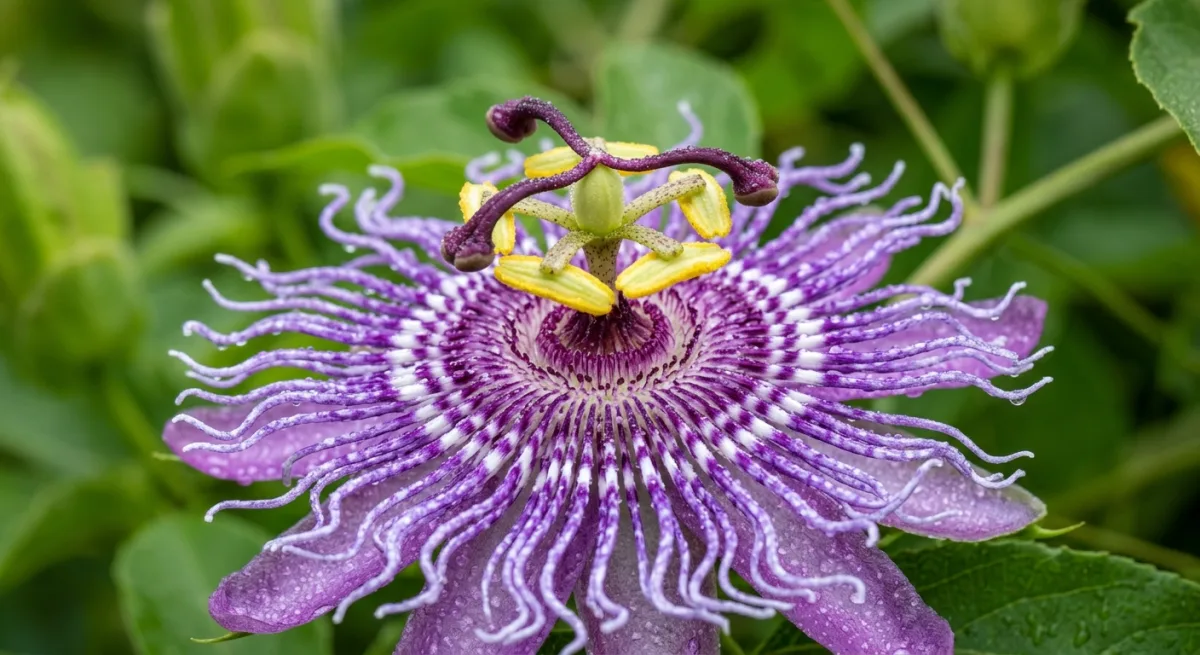
Inspired by the sun-drenched meadows and woodland edges of North America, the Purple Passionflower (Passiflora incarnata)—widely cherished as the wild Maypop—is among the plant kingdom's most astonishing feats of biological architecture. With its ethereal coronal filaments, prominent androgynophore, and floral structure resembling an intricate celestial map, this vigorous perennial vine is anything but ordinary. Yet how can one pair such an expansive, moisture-demanding climber with compact, moisture-averse rock succulents within a single vertical installation? The secret lies in deliberate horticultural craft: managing subterranean rhizosphere dynamics and mechanically separating two distinctly opposed hydration regimes.
Many container gardeners assume that deep-rooted, thirsty climbers and hyper-drained succulents cannot share the same living space. Nature, however, tells a different story. Along fractured limestone cliffs and canyon escarpments, native Passiflora vines anchor their resilient roots deep into subsoil moisture fissures, while surface crevices right above them are populated by tenacious colonies of Sempervivum and creeping Sedum. In this masterclass guide, we design and construct a bespoke 'Dual-Chamber Vertical Living Trellis' tailored for a balcony, terrace, or patio—allowing the Maypop passionflower to surge skyward while anchoring its base in a sculpted, vibrant succulent apron.
1. Essential Materials, Tools, and Safety Precautions
For your living trellis to endure seasonal temperature swings and persistent outdoor weathering, timber selection and drainage architecture are paramount. Instead of using chemically pressure-treated lumber that can compromise delicate root microbiomes, opt for naturally decay-resistant timbers like western red cedar, cypress, or kiln-dried roasted pine.
- Structural Framework: 4 pieces of natural cedar or chestnut battens (5x5 cm / 2x2 in, 150 cm / 5 ft long) for primary uprights and perimeter framing.
- Climbing Grid Lattice: 2 cm spaced natural unbleached jute cord or a marine-grade 316 stainless steel cable tensioning kit (the tactile matrix for clinging passionflower tendrils).
- Base Succulent Chamber: 15 mm exterior-grade marine plywood or solid 1-inch cedar planks (dimensions: 60 cm wide, 25 cm deep, 15 cm front height, 30 cm rear height to create an ergonomic 45° angled planter bed).
- Hydraulic Separation Barrier: 45-mil EPDM pond liner or heavy-gauge geotextile pond underlayment (to isolate internal timber from rot and prevent lateral moisture migration between root compartments).
- Fasteners & Hardware: Exterior-grade 316 stainless steel deck screws (4x50 mm) and waterproof polyurethane wood glue (Gorilla or Titebond III).
- Personal Protective Equipment (PPE): ANSI-approved safety goggles, cut-resistant work gloves, and an N95 dust mask for timber cutting and perlite substrate mixing.
2. Technical Dimensional Specifications & Substrate Matrix
Structural integrity, root zone aeration, and precise hydrological partitioning depend entirely on adhering to calibrated proportions. The engineering specs and botanical soil blends are mapped below:
| Component / Structure | Dimension / Substrate Ratio | Botanical Function & Purpose | Curing / Establishment Timeline |
|---|---|---|---|
| Main Trellis Uprights | 60 cm x 150 cm vertical plane | Climbing scaffold tailored for Passiflora tendril grip | Penetrating oil curing: 24 hours |
| Rear Passionflower Trough | 40 cm depth, isolated rear chamber | Voluminous, moisture-retentive organic reservoir | Permanent taproot establishment: 3-4 weeks |
| Angled Succulent Pocket | 45° angled face, 10-12 cm depth | Rapid-draining cradle for saxicolous rock succulents | Instant runoff verification |
| Succulent Substrate Mix | 40% Pumice, 30% Volcanic Scoria, 20% Zeolite, 10% Aged Worm Castings | Zero waterlogged stagnation around root necks, CAM respiratory support | Completely dry prior to planting |
| Passiflora Substrate Mix | 50% Loamy Potting Soil, 30% Leaf Compost, 20% Horticultural Perlite/Coarse Sand | High cation-exchange capacity, continuous moisture, heavy shoot growth | Moist blended assembly |
3. Step-by-Step Construction and Structural Assembly
The core innovation of this vertical planter is the 'dual-tier subterranean barrier' engineered inside the base basin. This architectural divider guarantees that the passionflower drinks deeply and feeds heavily without drowning the moisture-sensitive xerophytes positioned merely centimeters away.
- Fabricating the Angled Planter Box: Rip your cedar boards to dimensions. Cut the two side panels at a 45-degree bevel, transitioning smoothly from a 30 cm back wall height to a 15 cm front wall height. Join the base and sidewalls using exterior wood glue and countersunk stainless steel screws.
- Installing the Interior Partition: Insert a 10 mm cedar divider board or thick rigid EPDM-wrapped baffle vertically down the planter box, isolating a deep 15 cm rear zone from the shallow front succulent face. Drill copious 12 mm (1/2 in) drainage weep holes strictly across the base of both compartments; never omit these perforations.
- Erecting the Trellis Framework: Secure the two 150 cm uprights directly onto the rear outer edges of the planter trough with heavy-duty structural carriage bolts. Bridge them across the top and center with cedar crosspieces. Mount stainless steel eyelet screws every 10 cm along the inner faces, and lace the jute twine or coated wire under high tension in a diagonal crosshatch lattice.
- Applying Natural Surface Finishes: Coat every exposed surface with raw, food-safe cold-pressed linseed oil. Allow the finish to polymerize deeply into the wood pores in a shaded, well-ventilated space for 24 hours before filling with substrate.
4. Substrate Layering and Succulent Planting Protocol
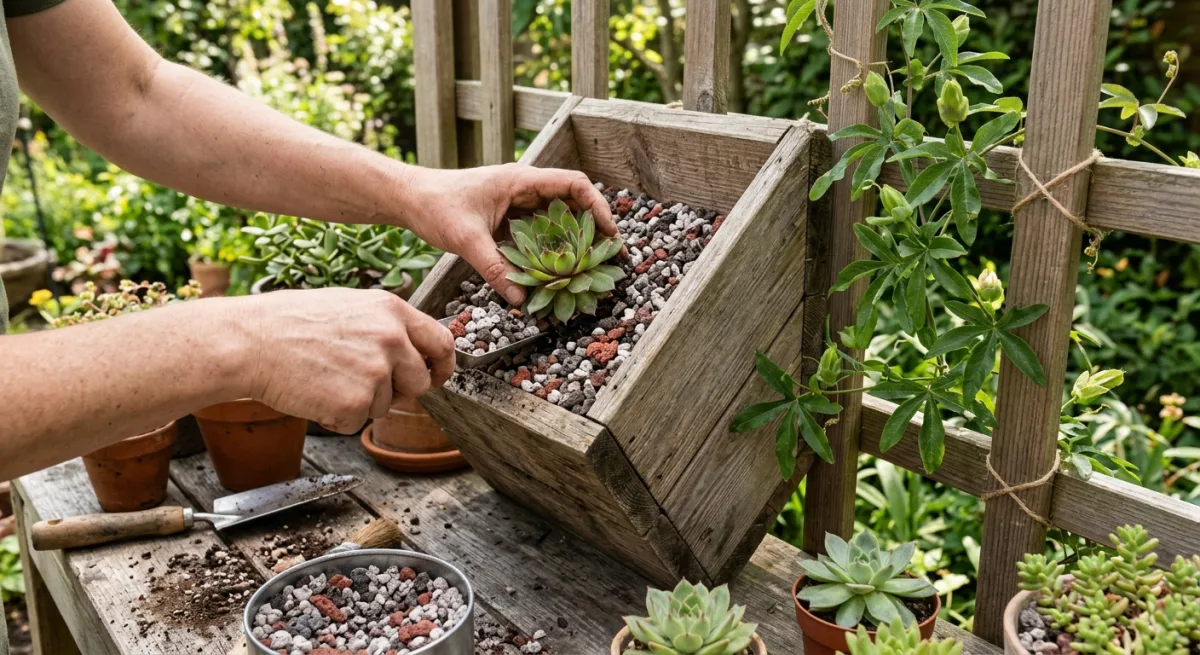
Planting day harmonizes the biological and aesthetic components of your living installation. Begin by filling the rear deep reservoir with your loamy, rich organic blend. Unpot your Purple Passionflower (Passiflora incarnata) seedling, gently unravel any circling taproots, and settle it so its root flare sits flush with the surface line. Water it in thoroughly to settle air pockets.
Next, fill the front angled compartment with the ultra-gritty, mineral-dense succulent mix. Here, we introduce cold-hardy, drought-resilient succulents that drape beautifully over natural wood and visually soften the planter's lines without risking fungal collapse:
- Sempervivum tectorum (Common Houseleek / Hens and Chicks): Forms tight, fleshy geometric rosettes that grip the sloped surface and boast absolute sub-zero winter hardiness.
- Sedum spurium & Sedum album (Stonecrop): Fast-maturing carpet formers that spill gracefully over the cedar rim, softening geometric timber edges.
- Delosperma cooperi (Purple Ice Plant): Produces radiant, magenta-purple daisy-like blooms that mirror the coronal hues of the passionflower throughout midsummer.
Once your succulents are anchored, dress the entire surface of the front bed with a 1 cm topdressing of coarse crushed pumice or river pea gravel. This dry mineral mulch forms a protective break, preventing succulent leaves and sensitive root necks from touching damp soil particles after rain, practically eliminating basal collar rot.
5. Strategic Irrigation and Microclimate Balance
Managing this dual-zone installation successfully requires adhering strictly to two divergent watering routines:
The Passiflora Hydration Zone: Maypop passionflowers operate at phenomenal transpirational rates during their peak vegetative push from May through August. Check the rear soil weekly; when the top 2-3 cm feels dry, soak the reservoir deeply until runoff emerges from the bottom weep holes. If the soft upper shoots flag or wilt during midday heat, xylem sap pressure has plummeted—deliver an immediate deep drench.
The Succulent Crest: The porous mineral matrix in the front pocket caters to Crassulacean Acid Metabolism (CAM). Provide water only when the bottom tiers of rosettes show faint softening or deflation lines. Use a long, narrow-spout watering can to direct moisture solely into the gravel grit around the roots. Never douse the rosettes overhead; preserving the powdery epicuticular wax (farina) is essential for sun protection and pest prevention.
6. Longevity, Wintering, and Seasonal Pruning
Passiflora incarnata is uniquely adapted among passion vines for cold resilience. In temperate winter zones, its extensive top growth naturally dies back to the soil level as the plant enters winter dormancy. Do not panic—energy reserves are safely cached in thick subterranean rhizomes. Simply prune the spent, desiccated vines back to 10-15 cm above the soil surface in late autumn.
Simultaneously, the frost-hardy succulents up front will concentrate intracellular sugars and protective osmoprotectants, weathering sub-zero freezes unscathed. As spring awakens and ambient soil temperatures surpass 15°C (60°F), vigorous Maypop shoots will burst from the crown, racing upward to cover your trellis anew. Inspect your hardware connections annually, reapply a quick coat of natural linseed oil each March, and enjoy the breathtaking interplay of exotic purple blossoms and architectural succulents for years to come.


Reader Reviews & Comments 3 Reviews
Arthur Pendelton
Clara Higgins
Marcus Vance
Leave a Review & Rating
Share your plant care tips, experiences, or questions with our succulent community.