






Deep within the mist-kissed expanses of South Africa's Richtersveld desert, nestled among endless fields of gleaming white quartz, hides a succulent so masterfully camouflaged that it is virtually indistinguishable from the surrounding translucent pebbles. Known colloquially as the King Dumpling Mesemb, Conophytum herreanthus subsp. rex derives its royal epithet not merely from its architectural grace, but from the extraordinary cellular water-retention strategy it developed to endure one of the harshest deserts on Earth. Many succulent enthusiasts, deceived by its plump and fleshy silhouette, unintentionally cut its life short through overwatering; yet treated with patience, this botanical jewel infuses our indoor spaces with the quiet, contemplative rhythm of the desert.
In skilled horticulture, saturating succulents with frequent drinks is not an expression of affection—it is an accidental suffocating of delicate root structures. With this exceptional subspecies of the Conophytum genus, water can either be the elixir of life or, when offered out of season, a destructive catalyst triggering catastrophic cellular rupture and lethal root rot. In this master guide, we will unpack the biology of this prized collector's specimen, examining everything from its fragile root anatomy to its nighttime photosynthetic adaptations.
1. Botanical Taxonomy and Distinct Morphology
As a distinguished member of the ice plant family Aizoaceae (Mesembryanthemaceae), this regal taxon was formally classified by botanist Steven Hammer. It diverges dramatically from traditional button-like, globose, or slit-bodied Conophytum species. Verified taxonomic and distribution records for the species can be accessed via the Kew Plants of the World Online database. While classic conophytums consist of pairs of leaves fused almost entirely into spherical buttons, the subgenus Herreanthus produces distinctly cleft, sharply keeled leaf pairs with prominent triangular cross-sections.
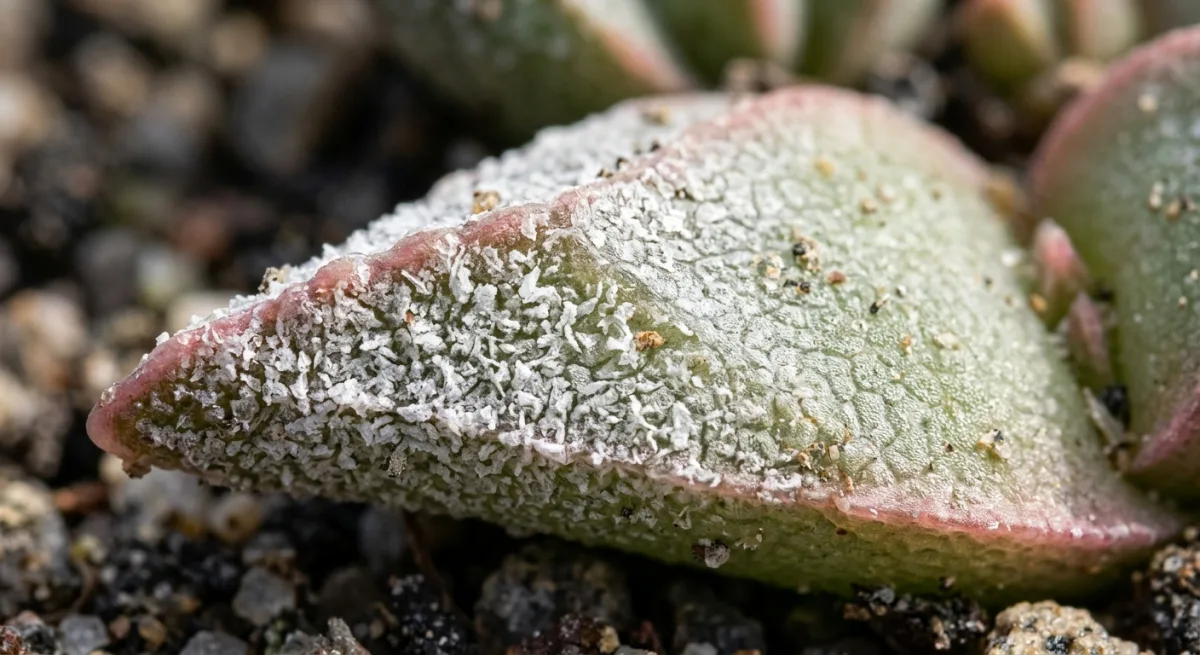
The plant's epidermis is enveloped in a chalky, pale bluish-green epicuticular wax layer, known botanically as farina. This silvery farina functions as the plant's built-in botanical sunscreen; avoid rubbing or handling the leaves directly, as oils from human fingers will smudge this protective coating permanently. Under intense sun exposure, leaf margins and keels blush with soft rose-pink pigments. In late autumn and winter, fragrant diurnal blossoms ranging from pristine white to delicate lavender emerge from the central cleft, elevating the plant's visual majesty to its zenith.
2. Light Requirements and Temperature Dynamics
Having evolved under the fierce, unfiltered ultraviolet radiation of exposed Richtersveld quartz ridges, the King Dumpling Mesemb demands intense, luminous light. Deprived of adequate illumination, its architectural leaves stretch unnaturally (etiolation), losing their sharp keels, fading to a weak green, and falling prey to opportunistic fungal pathogens.
For indoor culture, an unobstructed south- or west-facing windowsill provides optimal irradiance. If cultivating under artificial illumination, deploy full-spectrum horticultural LED fixtures delivering at least 250–300 µmol/m²/s PAR for an uninterrupted photoperiod of 14–16 hours daily. Regarding ambient temperatures, this cool-season grower thrives when nighttime temperatures dip between 5–8°C (41–46°F) in winter; this cool respite is an absolute biochemical requirement for its CAM (Crassulacean Acid Metabolism) cycle, during which it opens its stomata at night to capture carbon dioxide. In contrast, during blazing summer heat exceeding 35°C (95°F), the plant enters deep aestivation (summer dormancy), during which turbulent, active air circulation is non-negotiable.
3. Root Sensitivity and Seasonal Watering Discipline
While the terms 'succulent' and 'fleshy' accurately describe the moisture-filled storage parenchyma of its leaves, they also serve as a reminder of the plant's vulnerability to overwatering. This species strictly adheres to a winter-growth cycle. From late spring through late summer, the outer leaf pair surrenders its stored fluids, drying into a paper-thin, parchment-like protective sheath as the plant retreats into dormancy.
Your watering regimen must never follow a calendar schedule; instead, let the tactile and visible cues of the plant guide your hand:
- Summer Dormancy (May to August): Keep the potting medium entirely dry. To prevent excessive cellular desiccation, lightly mist the perimeter of the pot once or twice a month strictly after nightfall, imitating the coastal advective fogs of the Richtersveld.
- Awakening and Active Growth (September to December): As autumn arrives and evening temperatures consistently cool, deliver the season's first deep soak. The dry sheath splits, and the pristine inner leaf pair swells with firm turgor pressure. Water thoroughly only when the substrate has dried out completely.
- Winter Blooming and Leaf Absorption (January to April): After flowering concludes, taper watering down significantly. The emerging new leaf pair forms deep inside, slowly absorbing the water and nutrients stored within the older outer leaves. Watering during this critical turnover period causes the outer leaves to turn to mush, strangling the new growth within.
4. Curated Mineral Substrate and Pot Selection
In its native habitat, Conophytum herreanthus subsp. rex anchors itself in weathered quartz and granite debris, surviving in pockets virtually devoid of organic matter. Standard peat-based commercial potting soils are a guaranteed death sentence. The function of the substrate is not to supply heavy nutrition, but to anchor the plant physically, ensure unrestricted gas exchange (porosity), and shed water instantaneously.
The optimal collector-grade mineral recipe is detailed below:
| Component | Ratio (%) | Particle Size | Horticultural Purpose |
|---|---|---|---|
| Hard-Fired Japanese Akadama | 30% | 2 - 4 mm | Moisture buffering, cation exchange capacity (CEC), and root anchoring |
| Horticultural Pumice | 35% | 2 - 5 mm | Structural macroporosity, intense aeration, and rapid drainage |
| Zeolite (Clinoptilolite) | 15% | 2 - 3 mm | Binds heavy metals, inhibits fungal proliferation, and stabilizes substrate humidity |
| Crushed Quartz & Granite Grit | 15% | 1 - 3 mm | Replicates natural Richtersveld substrate matrix and physical stability |
| Sterilized Worm Castings or Coco Coir | 5% | Finely sifted | Minimal organic baseline to support beneficial microflora |
Always house your King Dumpling Mesemb in unglazed terracotta or artisanal porous ceramic containers equipped with generous drainage holes. Plastic pots trap moisture against the root ball for far too long, virtually ensuring fatal root rot.
5. Propagation Challenges and Safe Production Methods
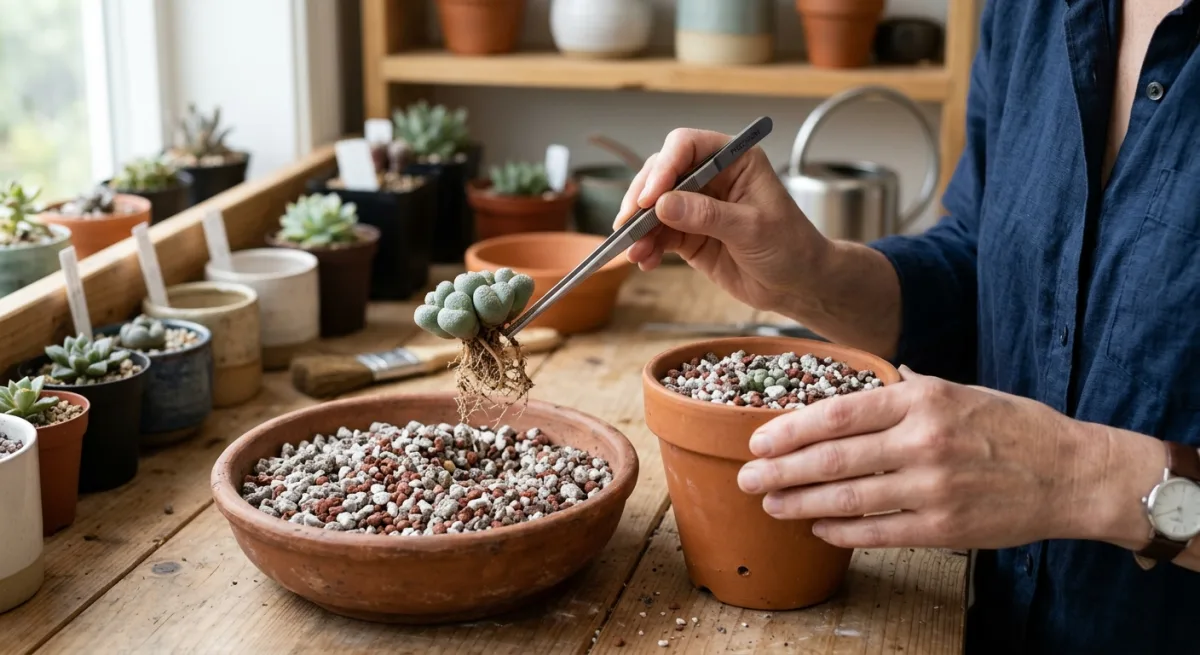
Propagating Conophytum herreanthus subsp. rex demands patience, botanical precision, and immaculate hygiene. This species cannot be propagated via individual leaf cuttings; propagation is restricted strictly to seed germination or careful division of mature, multi-headed clumps.
Growing from Seed
The seeds are microscopic, resembling fine dust. Sow them during early autumn when the diurnal temperature fluctuation reaches 10–12°C between day and night. Scatter the seeds over a pre-moistened, sterile mineral mix. Maintain high humidity under a propagation dome for the first 14 days until germination occurs. Crucially, introduce active ventilation from the third week onwards to protect delicate seedlings from damping-off fungi. It takes approximately 3 to 4 years of diligent care for a seedling to attain mature dimensions and express its iconic leaf keels.
Clump Division (Vegetative Propagation)
Specimens that have gradually multiplied into two or three distinct heads can be divided just as they emerge from dormancy in early autumn. Using a flame-sterilized surgical scalpel, carefully sever the connective tissue, ensuring each head retains an intact portion of the taproot. Dust the cut surfaces immediately with sulfur powder, allow the wound to callus in a warm, shaded location for 3 days, and pot into completely dry mineral substrate. Withhold water for the first 10 days to allow the cut roots to settle safely.
6. Conservation, Maintenance, and Collector Stewardship
Due to severe habitat degradation and rampant illegal poaching, all wild populations of miniature Mesembs are under immense ecological pressure. The paramount duty of an ethical collector is to procure specimens exclusively grown from seed by certified nurseries adhering strictly to CITES and international biodiversity guidelines.
To safeguard your plant's vitality and heritage value across decades:
- Apply a 3–5 mm top-dressing of pure white quartz gravel over the soil surface. This mineral collar insulates the fragile root neck from standing moisture while scattering light back upwards against the undersides of the leaves.
- Fertilize only once per year, precisely at the start of the autumn growth flush (October), using a highly diluted (one-quarter strength) cactus fertilizer low in nitrogen and rich in potassium and phosphorus. Excess nitrogen causes the succulent tissue to split irreparably.
- If overwintering your collection in a sunroom, enclosed glass balcony, or greenhouse, operate a small fan continuously. Stagnant air is the single most insidious adversary of miniature succulent mesembs.


Reader Reviews & Comments 1 Review
No comments yet. Be the first to share your succulent experience!
Leave a Review & Rating
Share your plant care tips, experiences, or questions with our succulent community.