






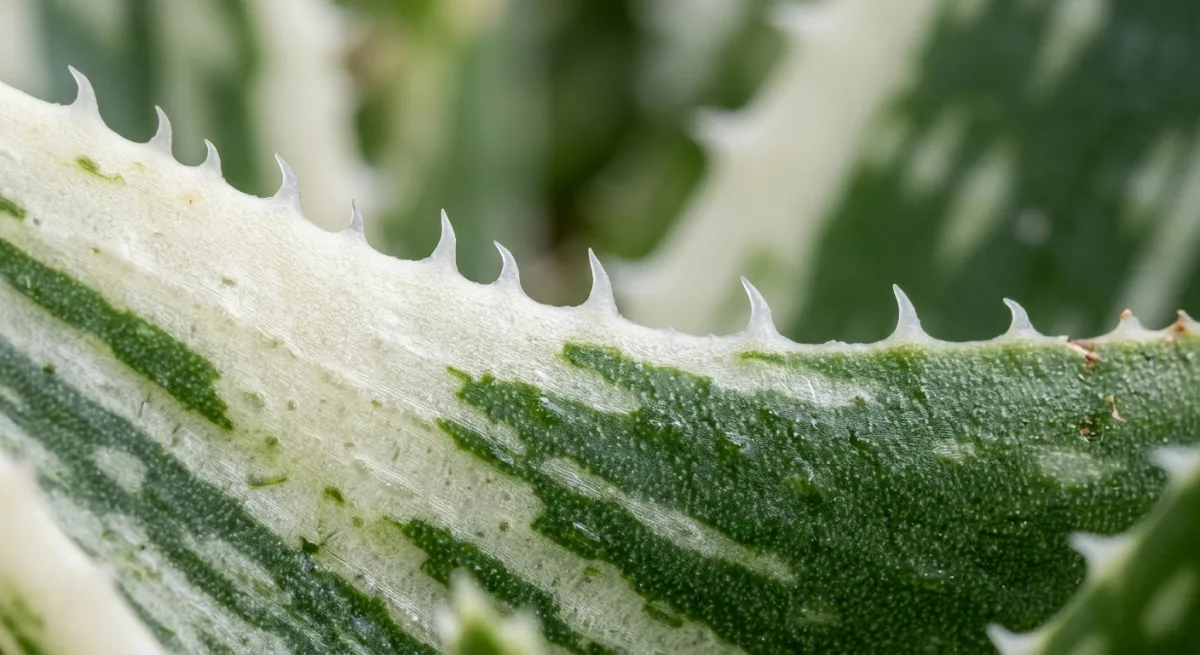
Clinging to the sheer sandstone precipices of South Africa's Western Karoo amidst scorching desert winds, wild Aloe perfoliata (formerly classified as Aloe mitriformis, commonly known as Mitre Aloe) displays one of the most resilient geometric architectural forms in the botanical kingdom. Yet, out of these harsh cliffs occasionally emerges a profound genetic marvel: a chimeric masterpiece created when chlorophyll-producing genes are partially silenced during meristematic cell division—Aloe perfoliata f. variegata (Variegated Mitre Aloe). Its leaves, lined with sharp, ivory-white teeth and adorned with sweeping longitudinal ribbons of creamy gold, pale alabaster, and deep emerald green, elevate this succulent from a rugged survivor to a living, sculptural work of art.
Displayed in the brightest corner of your living space or conservatory, this living sculpture bears the deep evolutionary memory of intense ultraviolet radiation and prolonged drought endured by its ancestors on mountain slopes. However, its variegated form possesses a far more delicate photosynthetic equilibrium due to tissues devoid of chlorophyll. Cultivating a variegated Mitre Aloe involves far more than merely watering a potted plant; it is an art of managing cellular energy balance, keeping the root xylem oxygenated and active without rot, and protecting delicate non-chlorophyll tissue from irreversible scorch to preserve its show-stopping geometry for decades.
1. Taxonomy and Rare Morphological Characteristics
Belonging to the family Asphodelaceae, Aloe perfoliata is taxonomically grouped within the 'Mitriformes' complex, renowned for its decumbent, sprawling, and branching stem architecture. In botanical literature and trade nurseries, it earned the common name 'Mitre Aloe' due to its tightly curving, symmetrically arranged triangular leaves resembling a bishop's mitre. The variegated form arises from spontaneous somatic mutations in which the L1 and L2 apical meristem cellular layers lose their ability to synthesize functional chloroplasts, rendering the plant a periclinal or sectorial chimera.
Morphologically, this coveted form produces thick, fleshy rosettes bearing prominent, ivory-white or pale primrose-yellow marginal teeth (tubercles) along the edges and occasionally along the keeled undersides. The variegation manifests primarily in clean, longitudinal stripes. Because the white and cream sectors lack functional chlorophyll, they cannot carry out photosynthesis and exist in a metabolic balance, relying on carbohydrates manufactured by adjacent green sectors. Leaf succulence is remarkably pronounced due to densely packed water-storage parenchyma cells. However, these thick water reservoirs face rapid cellular lysis (tissue collapse) if the osmotic balance of the root cell membranes is compromised by overwatering.
2. Precision Light and Temperature Dynamics
The greatest biological dilemma for variegated succulents is their narrow light tolerance threshold. A typical green Aloe perfoliata thrives under harsh, direct sun by producing protective carotenoids and anthocyanins, which tint the foliage deep bronze and brick red. In the variegata mutation, however, the white bands possess significantly lower levels of protective pigments and a thinner epicuticular farina wax coating. Unfiltered midday sun (particularly between 11:00 AM and 4:00 PM) can rapidly induce photo-oxidative stress and irreversible scorched white patches (solar necrotic scarring).
Conversely, placing the plant in dim light triggers rapid etiolation. The compact mitre shape elongates, internodes stretch uncharacteristically, and the plant—desperate to capture photons—may actively suppress variegated cellular lines to produce all-green leaves, losing its chimera variegation permanently. The ideal setting is bright indirect light or dappled morning sun delivering 25,000 to 35,000 lux, or a specialized horticultural full-spectrum LED fixture (4500–6500K) positioned 30 cm above the canopy for 12 to 14 hours daily.
Diurnal temperature variation is equally vital. Operating on Crassulacean Acid Metabolism (CAM photosynthesis), this species opens its stomata exclusively at night when ambient temperatures drop to 15–18°C (59–64°F) to absorb and store carbon dioxide as malic acid. Daytime temperatures between 24–28°C (75–82°F) and nighttime drops to 16–19°C (61–66°F) facilitate optimum metabolic turnover. A cool winter rest period is essential to maintain tissue compactness, but temperatures must never plunge below 5°C (41°F). Freezing conditions cause internal moisture reserves to crystallize, rupturing cellular membranes and turning leaves into mush within hours.
3. Root Biology and Watering Protocol
Frequent watering is never a sign of attentive plant care; in succulents, it simply starves roots of subterranean oxygen. Aloe perfoliata f. variegata produces a fibrous, laterally spreading root network rather than a single taproot. In soggy, poorly aerated substrates, the cortical cells of the roots suffer acute hypoxia within 24 hours. This invites aggressive soil-borne fungal pathogens, such as Fusarium oxysporum and Pythium species, to penetrate the root epidermis and travel upward into the vascular bundles.
The only reliable watering protocol is the disciplined 'soak and dry' method. Water according to core substrate moisture, never an arbitrary calendar schedule. Never apply water until the root zone is completely dry. Use a wooden skewer or digital moisture meter inserted to the bottom of the pot to confirm that the deepest substrate layer is bone dry before the next watering cycle.
4. Specialized Mineral Substrate and Pot Composition
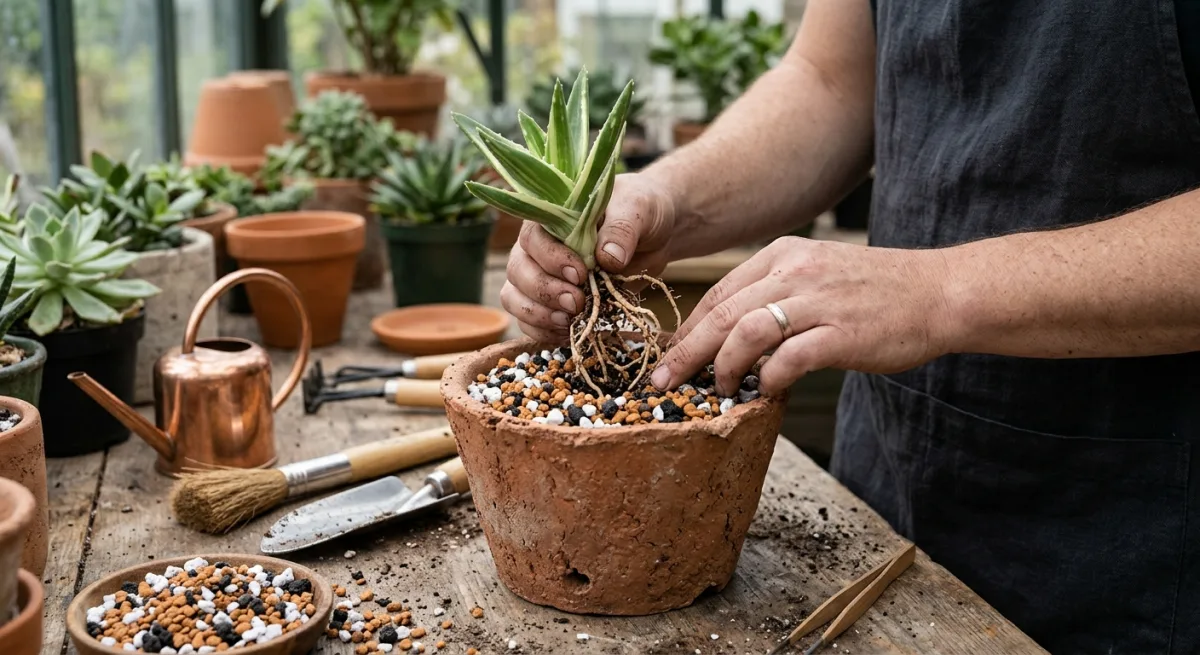
Standard peat-heavy, commercial potting mixes are a death sentence for variegated Mitre Aloes. Peat moss and dense compost retain moisture far too long, compact over time, suffocate delicate feeder roots, and turn acidic, which disrupts beneficial rhizosphere microflora. Rare chimera selections require a granular, structural, mineral-heavy blend that provides abundant air pockets and near-instant drainage.
The following custom mineral recipe mimics the weathered sandstone and granite scree of the Western Karoo, adapted with time-tested Japanese bonsai and collector techniques:
| Component | Grain Size | Ratio (%) | Botanical Function & Benefit |
|---|---|---|---|
| Hard Akadama (Double Red Line) | 3 - 6 mm | 30% | High cation-exchange capacity (CEC); stores micro-nutrients without structural collapse; stimulates root branching. |
| Horticultural Pumice | 3 - 5 mm | 30% | Provides sustained macroporosity, aerates the root ball, and prevents substrate compaction. |
| Scoria / Lava Rock | 2 - 4 mm | 20% | Releases trace iron and magnesium minerals; adds ballast to stabilize sprawling decumbent stems. |
| Clinoptilolite Zeolite | 2 - 5 mm | 10% | Adsorbs toxic salts and heavy metals, prevents nutrient scorch, and deters root pathogens. |
| Sterile Coconut Coir (Triple-Washed) | Screened fiber | 10% | Serves as an organic moisture buffer and provides an anchor for beneficial mycorrhizae. |
Container selection is just as decisive. Plastic and glazed ceramic pots prevent gas exchange through their walls, forcing evaporation to occur solely at the soil surface. Unfinished, high-fired terracotta or unglazed bonsai pottery allows moisture and oxygen to transpire through the pot walls, establishing balanced root aeration and thermal stability.
5. Propagation Complexities and Safe Offsetting Techniques
Propagating Aloe perfoliata f. variegata cannot be accomplished through simple leaf cuttings. Unlike Crassula or Echeveria, Aloe leaves lack detached, adventitious meristematic tissue at their petiole bases; single leaves simply callous and rot without producing shoots. Furthermore, adventitious bud formation from variegated leaf tissue would rarely maintain the chimera structure and would likely produce all-green plants.
The safest and most reliable way to produce an identical clone is by harvesting natural basal pups (offsets) that emerge from the rhizomatous crown. Observe the following biological safeguards when dividing offsets:
- Offset Maturity: Never sever a pup until it reaches at least one-third the size of the parent rosette and has begun initiating its own independent root adventitia.
- Chlorophyll Assessment: Avoid detaching completely white or pale yellow offsets (albino sports). Lacking functional chloroplasts, an albino offset cannot survive independently and will perish within weeks once separated from the mother plant's vascular support. Ensure the offset features at least 30% to 40% solid green longitudinal striping.
- Sterile Surgery and Callousing: Using a scalpel disinfected with 70% isopropyl alcohol, make a precise cut as close to the main stem connection as possible. Dust the wound with elemental sulfur powder or powdered activated charcoal. Allow it to air-dry in a warm, dry, shaded room for 4 to 7 days. Planting uncalloused offsets invites instantaneous bacterial infection.
- Rooting Medium: Settle the calloused pup into slightly damp pure pumice or fine zeolite. Do not water for the first 10 days; allow ambient relative humidity to awaken dormant root primordia.
6. Long-Term Preservation and Collector Maintenance
Acquiring a genuine variegated Mitre Aloe represents a long-term investment. The two greatest threats to its market and aesthetic value are etiolation (loss of its tight geometry) and genetic reversion (reverting to solid green). If the newest 2 to 3 leaves emerge completely solid green without creamy striping, the plant is signaling low-light or excess-nitrogen stress and attempting to maximize photosynthetic surface area. Immediately reduce nitrogen fertilization to zero and increase filtered light levels.
Among pests, the microscopic Aloe Mite (Aceria aloinis) is the most destructive threat. This eriophyid mite infests growing tips, injecting growth-disrupting enzymes that cause distorted galls and tumorous tissue, commonly referred to as 'Aloe Cancer.' Quarantining any new collection plant for at least three to four weeks is imperative. Additionally, avoid heavy foliar sprays like pure neem oil on variegated tissues, as horticultural oils can clog stomatal chambers on delicate non-chlorophyll cells and induce chemical burning. For dust removal, use a soft, dry sable brush.


Reader Reviews & Comments 4 Reviews
Julian Montgomery
Eleanor Brooks
Marcus Aurelius Thorne
Claire Vance
Leave a Review & Rating
Share your plant care tips, experiences, or questions with our succulent community.