






Picture a luminous golden column gleaming under the blazing sun along the arid Andean foothills of western Argentina. Known in botanical literature for decades as Trichocereus spachianus, and classified today as a distinguished member of the Cactaceae family under the botanical name Echinopsis spachiana, this extraordinary succulent is celebrated worldwide as the 'Golden Torch'. Draped in a dense cloak of warm, amber-gold spines that resemble a flickering flame, this architectural wonder channels the unyielding resilience of desert wilderness directly into our sunniest living spaces.
Many houseplant lovers instinctively envision fleshy, rosette-forming specimens whenever succulents are mentioned; botanically speaking, however, cacti represent the pinnacle of succulent evolutionary engineering—towering marvels of water-storage par excellence. Echinopsis spachiana not only infuses interiors with a statuesque, sculptural presence thanks to its imposing vertical growth, but it also stages an unforgettable spectacle on warm summer nights, unfurling magnificent, snow-white blossoms that last only a fleeting few hours. If you wish to grace your botanical collection with an enduring, character-rich masterpiece, there is no better companion than the Golden Torch.
1. Botanical Identity and Morphological Characteristics
Echinopsis spachiana is a columnar succulent within the family Cactaceae that naturally forms clustered colonies by producing abundant basal offsets. Reaching heights of 1.5 to 2 meters and stem diameters of 6 to 10 cm in its native habitat, its cylindrical trunk features between 10 and 15 pronounced longitudinal ribs. These ribs function like an accordion bellows—contracting safely during extended periods of drought and swelling smoothly as cellular parenchyma hydrates, thereby preventing the epidermal tissue from tearing under internal pressure.
The defining feature that earned this species the moniker 'Golden Torch' is the vibrant armor radiating from its woolly nodes, termed areoles. Each areole produces 8 to 10 radial spines flanked by 1 to 3 stouter, more prominent central spines. On juvenile growth flushes, these spines emerge in brilliant shades of amber, honey, and spun gold, gradually mellowing into a distinguished silvery-gray as the plant matures. Far from serving purely as a defensive deterrent against herbivores, these spines cast micro-shadows across the epidermis and disrupt boundary-layer winds, dramatically reducing transpirational water loss in scorching conditions.
2. Sunlight Requirements and Indoor Positioning
By evolutionary design, the Golden Torch is an uncompromising lover of direct sunlight. Abundant ultraviolet exposure drives more than vital photosynthetic and Crassulacean Acid Metabolism (CAM) cycles; it triggers the dense, robust production of its iconic golden spination. In dimly lit interiors, the apex begins to taper, turning a faint, anemic green while the spacing between areoles widens—a classic symptom of irreversible morphological stretching known botanically as etiolation.
The optimal indoor location for this cactus is immediately behind an unobstructed south- or west-facing window. Receiving a minimum of 6 hours of unfiltered, direct sunlight daily directly dictates its structural vigor and health. Should you choose to relocate your specimen outdoors to a patio or terrace in late spring, always implement a 7 to 10-day gradual acclimatization period in dappled shade; sudden exposure to intense sun will overwhelm winter-softened tissues, causing irreversible photo-oxidative sunburn.

3. Watering Discipline: The 'Soak and Dry' Protocol
The swiftest route to killing a cactus is well-intentioned, excessive pampering. Dribbling small sips of water onto a succulent at frequent intervals is not an act of care; it keeps the root zone perpetually damp without oxygen, steadily asphyxiating the delicate root hairs. The Golden Torch's dense, mucilaginous parenchyma tissue stores vast hydration reserves. Consequently, your watering philosophy must adhere strictly to the classic desert principle: let the entire substrate desiccate completely, then drench it thoroughly.
During the active vegetative phase of spring and summer, soak the pot deeply only after confirming the growing medium is parched down to the drainage holes (typically every 10 to 14 days, depending on ambient warmth and airflow). Ensure excess water streams freely through the bottom holes, and never let the pot linger in a saucer filled with standing water. From late autumn through early spring, the plant transitions into mandatory winter dormancy, during which irrigation should cease almost entirely. A specimen resting in a cool room (8–12°C / 46–54°F) requires only a minimal splash every 4 to 6 weeks—just enough to keep the finest root fibrils from desiccating completely.
4. Ideal Substrate Formulation and Pot Selection
The fibrous root network of Echinopsis spachiana deteriorates rapidly in dense, unamended peat or clay-heavy soils due to subterranean anoxia (oxygen starvation). To thrive, it demands a gritty, mineral-dominant mix characterized by rapid percolation and exceptional macroporosity. Coarse volcanic pumice and scoria supply essential root aeration while guaranteeing that the vulnerable root collar dries promptly after watering.
When choosing containers, prioritize unglazed terracotta pots fitted with ample drainage apertures. Terracotta's micro-porous walls allow lateral moisture evaporation, keeping the root sphere cooler during summer heatwaves. Furthermore, the natural weight of terracotta provides a stable ballast that anchors the top-heavy columnar stem, effectively preventing accidental tip-overs.
| Substrate Component | Ratio (%) | Botanical Function |
|---|---|---|
| Coarse Horticultural Pumice (3–6 mm) | 40% | Aeration backbone and root-rot prevention |
| Crushed Lava Rock / Zeolite | 20% | Trace micronutrients and anchoring stability |
| Perlite / Washed Coarse River Sand | 15% | Enhances capillary flow and prevents compaction |
| Screened Organic Peat / Leaf Compost | 25% | Nutrient delivery and baseline water retention |
5. Step-by-Step Propagation Techniques
Propagating the Golden Torch is an immensely rewarding and reliable horticultural endeavor. The species readily produces basal offsets (pups), offering growers prime genetic clones that root with minimal resistance.
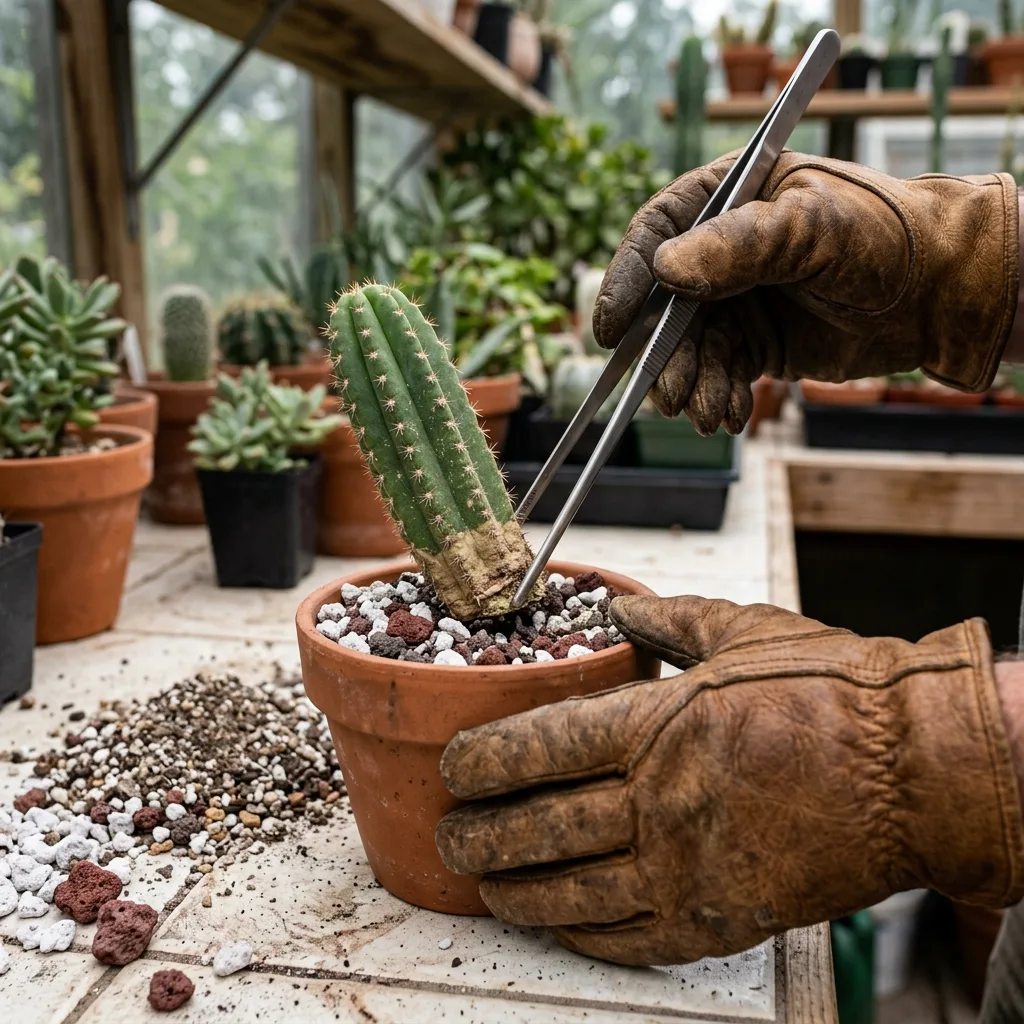
- Offset Selection and Detachment: In mid-spring, select a vigorous offset that has reached at least 8 to 10 cm in length. Using a flame-sterilized, razor-sharp grafting knife, sever the connection as close to the parent column as possible with a clean, smooth cut.
- Callusing the Wound: Do not pot freshly harvested cuttings immediately! Dust the cut surface lightly with sulfur powder or ground cinnamon to deter fungal pathogens, and position the cutting in an airy, shaded room for 5 to 7 days. The exposed tissue must desiccate into a tough, grayish-white barrier layer (callus).
- Dry Potting: Stand the callused cutting upright in a small pot filled with the gritty mineral mix described above. Use sterile lava pebbles around the base to stabilize the column without burying it excessively deep.
- Root Inducement Phase: Withhold all moisture for the first 10 days; in searching for hydration, the base will naturally stimulate adventitious root primordia. Afterward, mist or lightly moisten the top surface. Within 3 to 4 weeks, vigorous anchoring roots will firmly secure the new specimen.
6. Common Pests, Pathologies, and Interventions
While Echinopsis spachiana boasts exceptional vigor, suboptimal cultural conditions can invite pathological and entomological challenges:
- Basal and Stem Rot (Fusarium / Phytophthora): Triggered almost exclusively by waterlogged, anaerobic soil. The stem base turns brownish-yellow, softening into a mushy cavity. Immediate surgery is imperative: sever the upper green stem horizontally until zero vascular discoloration remains, allow the healthy cutting to callus thoroughly, and reroot in fresh, sterile mineral medium.
- Mealybugs (Pseudococcidae): These sap-sucking pests congregate in the woolly furrows of the areoles and spine clusters, resembling sticky white cotton flecks. Eradicate small colonies manually using cotton swabs dipped in 70% isopropyl alcohol; manage extensive infestations with cold-pressed neem oil emulsions or systemic imidacloprid soil drenches.
- Spider Mites (Tetranychidae): Thriving in warm, bone-dry, stagnant indoor air, these microscopic mites pierce the epidermis, leaving behind a characteristic rusty-brown, sandpapery scarring accompanied by ultra-fine webbing. Boost room ventilation and treat thoroughly with a dedicated horticultural miticide.
7. Seasonal Care Calendar and Master Horticultural Tips
Inducing Echinopsis spachiana to yield its magnificent, nocturnal blossoms—measuring up to 20 cm in diameter with a celestial floral fragrance—requires honoring its native climatic cycles:
- Spring (Reawakening): From late March onwards, step up watering frequency progressively. Introduce a low-nitrogen, high-potassium liquid cactus fertilizer formulated with chelated micronutrients once every four weeks.
- Summer (Active Growth & Blooming): Maximize sun exposure. Saturate the root ball once the substrate dries out completely. Once flower buds emerge on the upper areoles, never alter the pot's orientation or move the container; abrupt environmental shifts provoke bud abortion. Blossoms unfurl near dusk and close by midday—take time to appreciate their scent.
- Autumn (Hardening): Terminate all fertilizer applications by late September. Space watering intervals further apart to encourage tissue lignification and cell sap condensation ahead of cold winter months.
- Winter (Dormancy Induction): Bud induction requires a dedicated chill period: maintain the specimen in a bright space kept reliably between 8°C and 10°C (46–50°F). Cacti kept in centrally heated living spaces throughout winter often skip flowering entirely during the subsequent season. Keep irrigation to an absolute bare minimum.


Reader Reviews & Comments 3 Reviews
Julian Vance
Eleanor Brooks
Marcus Sterling
Leave a Review & Rating
Share your plant care tips, experiences, or questions with our succulent community.