






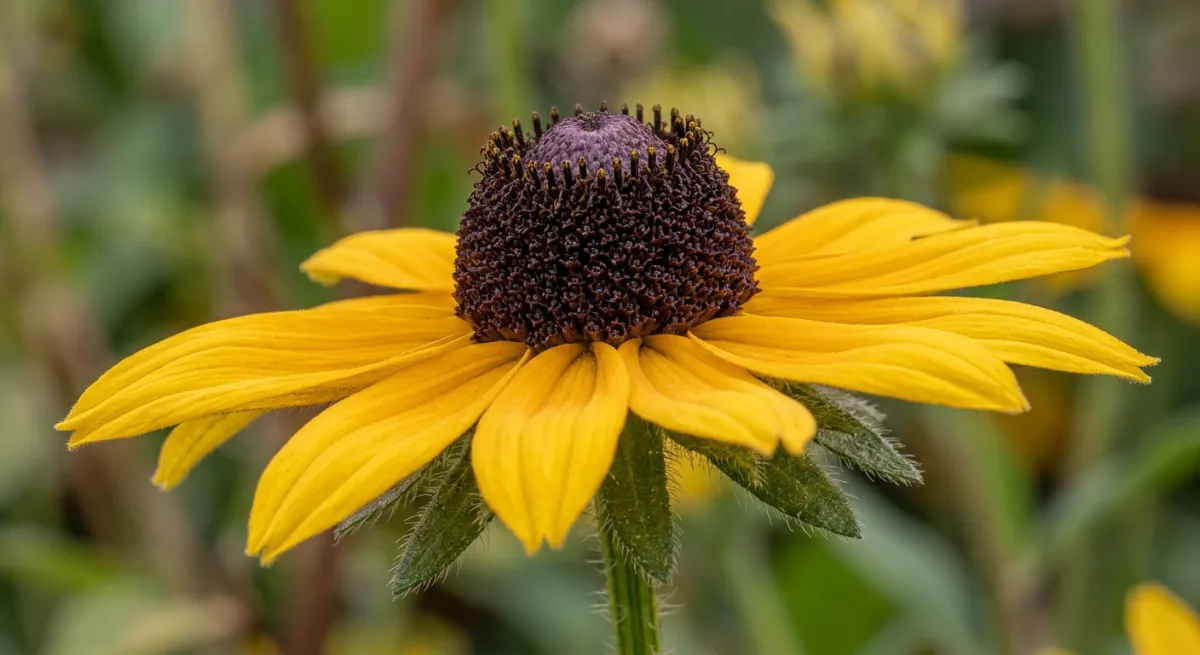
Hailing from the expansive meadows, prairies, and limestone glades of North America, Rudbeckia fulgida var. sullivantii 'Goldsturm' has earned its standing as one of the most reliable and steadfast companions in succulent rockeries and xeric landscapes. Universally cherished as the 'Black-Eyed Susan' or 'Orange Coneflower', this perennial tour de force produces radiant, golden-yellow ray florets surrounding a dense, dark chocolate-brown conical disc, staging a botanical fireworks display from midsummer right through to the first autumn frosts. When harmonized with fleshy Sedum, geometric Sempervivum, and architectural Yucca species, its luminous blooms establish a captivating morphological contrast that enriches your outdoor spaces with vital dynamic rhythm and pollinator biodiversity.
Unlike tender houseplants that demand delicate coddling, the 'Goldsturm' cultivar craves generous direct sunlight and well-aerated root rhizosphere drainage above all else. Whether established in display terracotta planters or directly in landscape borders, preserving structural macro-porosity around its root crown is the single greatest secret to cold-hardiness during harsh winter freezes and vigorous vegetative emergence come spring. In this master botanical guide, we unveil the physiological adaptations and practical horticultural strategies that will allow this durable taxon to thrive in your landscape, terrace, or sun-drenched courtyard.
1. Botanical Identity and Morphological Characteristics
A distinguished member of the Asteraceae (daisy) family, Rudbeckia fulgida var. sullivantii 'Goldsturm' was selected in 1937 by Heinrich Hagemann at the Gebler Nursery in the Czech Republic and introduced to the horticultural world as an exceptional, award-winning cultivar. It distinctly surpasses wild varieties thanks to its compact, self-supporting habit (typically reaching 60–75 cm in height with a 45–60 cm spread) and profuse blooming capacity. The composite inflorescence (capitulum) represents an exquisite evolutionary architecture consisting of two distinct floral types: a central raised cone of fertile, dark purplish-brown tubular disc florets encircled by an outer perimeter of sterile, intensely pigmented golden ray florets.
Morphologically, the foliage is lanceolate to broadly ovate, deep forest green, and noticeably coarse in texture. The lamina is densely cloaked in stiff micro-trichomes (surface hairs) that significantly curb cutaneous transpiration by trapping a micro-boundary layer of air, thereby assisting the plant in sustaining critical cellular turgor pressure during blistering summer heatwaves. Beneath the soil line, 'Goldsturm' develops a fibrous yet deep rhizomatous crown matrix; this underground reservoir stores vital carbohydrate reserves throughout winter dormancy and confers extraordinary cold-hardiness down to -30°C (USDA Zones 3–9).
2. Light Requirements and Outdoor Positioning
'Goldsturm' is an obligate heliophyte—a bona fide sun-worshipper. For its photosynthetic enzymes to operate at peak biological efficiency and to yield stout, wind-resistant stems, the plant mandates a minimum of 6 to 8 hours of unfiltered, direct sunlight daily. When relegated to partial shade or dense understories, the plant succumbs to etiolation: stems turn weak and spongy, internodal spacing elongates drastically, and the floral scapes become unable to support the structural weight of their own blooms, leading to unseemly lodging and flopping.
Open south- or west-facing patios, sunny terraces, and unrestricted rock garden berms represent optimal microclimates. If you intend to overwinter or showcase container-grown specimens within a bright glass atrium or sunroom, position them immediately behind unshaded, south-facing glass where convective ventilation is active. Suboptimal light indoors shortens the blooming window and dramatically multiplies the incidence of fungal foliar pathogens.
3. Watering Discipline: The 'Soak and Dry' Protocol
Despite its prairie heritage and profound drought tolerance once established, 'Goldsturm' is not a desert cactus. During its first vegetative establishment season following planting, it demands consistent substrate moisture to anchor its crown and root network into the surrounding soil. However, waterlogged conditions choke root tissue, inviting pathogenic anaerobic bacteria to invade xylem channels and trigger fatal root rot. The golden benchmark for container and rock garden cultivation is the time-tested 'Soak and Dry' protocol beloved by succulent enthusiasts.
Always verify that the top 4 to 5 cm (roughly 2 inches) of soil has dried out completely before reaching for the watering can. When irrigating, direct the stream exclusively onto the root zone and basal crown, steering clear of wet foliage and flower heads. Overhead watering in the late evening leaves free moisture clinging to dense leaf trichomes for hours, creating the ideal microclimate for powdery mildew spores to germinate.
4. Ideal Soil Mixture and Container Selection
While Rudbeckia fulgida demonstrates admirable adaptability across soils ranging from clay loams to sandy substrates, flawless aggregate stability and unimpeded drainage become non-negotiable when growing in containers and elevated succulent parterres. Avoid non-breathable plastic pots in favor of porous, thick-walled terracotta or unglazed ceramic vessels that facilitate gas exchange and lateral root aeration. The container must feature multiple unimpeded basal drainage holes.
For planters and curated garden beds, our custom substrate blend prevents root compaction, balances organic fertility, and guarantees lightning-fast water percolation:
| Substrate Component | Ratio (%) | Horticultural Function & Botanical Benefit |
|---|---|---|
| Loamy Garden Soil / Neutral Peat | %40 | Base moisture retention and fundamental cation-exchange capacity |
| Horticultural Pumice (3–6 mm) | %25 | Permanent macro-porosity, oxygenation, and compaction resistance |
| Coarse River Sand / Granular Zeolite | %20 | Rapid drainage conduit that protects the crown from moisture saturation |
| Well-Aged Worm Castings / Leaf Compost | %15 | Slow-release organic bio-nutrients and beneficial mycorrhizal inoculation |
5. Step-by-Step Propagation Techniques
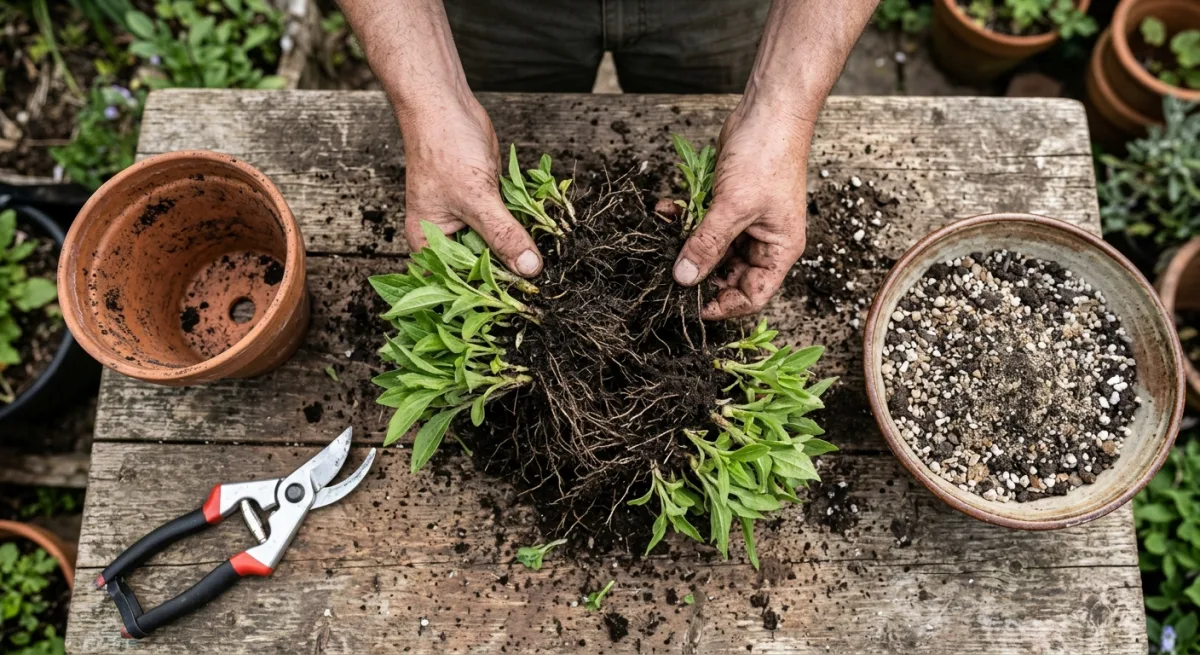
Propagating the 'Goldsturm' cultivar from collected garden seeds often leads to genetic variation and phenotypic drift, meaning the offspring may fail to retain the exceptional compact habit and heavy bloom performance of the parent plant. To preserve true clonal purity and botanical vigour, propagation should be carried out via early spring crown division or softwood stem cuttings taken in early summer.
- Crown Division (The Preferred Standard): In early spring, just as tender new basal rosettes emerge 3 to 5 cm above the soil surface, carefully lift the mature clump using a garden spade, keeping the root ball intact. Using a sterile, razor-sharp hori-hori knife or spade, slice through the root mass, ensuring each divided section retains at least 2 to 3 vigorous growth crowns (eyes) with an abundance of fibrous roots. Replant the divisions immediately into moistened, well-draining media at the exact original depth.
- Softwood Stem Cuttings: In late spring or early June, select healthy, non-flowering vegetative basal shoots measuring 8 to 10 cm in length. Sever them cleanly just below a node, strip away the lower leaves, dip the cut end into rooting hormone, and insert into a moistened mixture of 70% perlite and 30% pumice. Maintained at 20–22°C under bright, indirect light with modest humidity, rooted plantlets establish in 3 to 4 weeks.
6. Common Pests, Diseases, and Proactive Treatments
In open, sun-drenched settings with steady air currents, 'Goldsturm' is exceptionally robust. Nevertheless, overcrowded plantings or humid, overcast microclimates can expose the plant to specific physiological and pathological stressors:
- Powdery Mildew (Golovinomyces cichoracearum): Manifests as a talcum-like, whitish-gray powdery coating on the adaxial leaf surfaces. Mitigate this by widening plant spacing to promote breeze penetration, pruning out heavily blighted basal leaves, and spraying with a potassium bicarbonate solution or cold-pressed neem oil emulsion at the earliest sign of infection.
- Septoria Leaf Spot (Septoria rudbeckiae): Appears as tiny, circular, dark brown to purplish necrotic lesions on lower leaves that gradually coalesce. Immediately discontinue overhead watering, remove diseased debris from the soil surface, and apply an organic copper-based fungicide to halt fungal sporulation.
- Slugs and Snails: These nocturnal mollusks target emerging spring crown shoots with devastating speed. Construct a physical barrier by scattering coarse diatomaceous earth, horticultural grit, or crushed eggshells around the base of the crown.
7. Seasonal Maintenance Calendar and Expert Care Rules
Spring: As the soil warms and active vegetative budbreak commences, prune back old, dead overwintered stems down to 5 cm above ground level. Top-dress the root zone with a thin layer of aged worm castings or balanced slow-release organic granules. Early spring is the premier window for dividing congested clumps.
Summer: The climax of floral productivity. Practice systematic deadheading—snipping faded blooms back to a strong leaf node or emerging lateral bud—to redirect the plant's resources into fresh flower bud development rather than premature seed production. During extended dry spells, maintain the 'Soak and Dry' watering cycle.
Autumn & Winter: Following the cessation of blooming in late autumn, taper watering down significantly. Leave late-season seed cones intact to feed winter birds and lend structural beauty to the frost-covered landscape. In regions with severe sub-zero winters, safeguard the root crown from freeze-thaw cycles by applying a light mulch of pine bark or airy shredded leaves.


Reader Reviews & Comments 4 Reviews
Eleanor Vance
Marcus Bennett
Clara Higgins
Julian Miller
Leave a Review & Rating
Share your plant care tips, experiences, or questions with our succulent community.