






Creating your own indoor or balcony succulent garden is far more than simply arranging a few charming rosettes side by side in a dish; it is the deliberate art of constructing a living micro-ecosystem that captures the rugged winds of the Oaxaca cliffs, the arid grace of the South African Karoo Desert, and the dramatic volcanic slopes of the Canary Islands right in your home. A thoughtfully curated succulent arrangement, showcasing geometric rosettes such as Ghost Plant (Graptopetalum) and cascading trails of String of Pearls (Curio rowleyanus) beneath the morning sun, serves as both a tranquil botanical sanctuary and a living exhibition of nature's architectural brilliance.
However, what begins as an inspired project for many enthusiastic plant lovers can quickly turn into heartbreak when species with opposing moisture and light demands are crowded into the same vessel, or when delicate root systems suffocate in non-draining decorative pots. In this comprehensive guide, blending the refined precision of an experienced nursery horticulturist with the proven tenets of plant physiology, you will discover the essential blueprint to cultivate a thriving, enduring succulent bowl that retains its compact vigor for years to come.
1. Botanical Identity and Morphological Characteristics
The foundational step in designing a cohesive succulent garden is understanding the structural morphology and physiological adaptations of the companion plants you wish to assemble. Succulents are drought-tolerant xerophytes that hoard high volumes of water within specialized parenchyma tissues located in their fleshy leaves, stems, or caudices. Most of these species utilize Crassulacean Acid Metabolism (CAM photosynthesis), an evolutionary adaptation where stomata remain tightly closed during hot daytime hours to prevent desiccation and open exclusively at night to capture carbon dioxide.
To produce a visually dynamic yet structurally balanced succulent arrangement, horticulturists categorize species into three structural design roles:
- Focal (Thriller) Species: Upright growers or striking solitary specimens that anchor the design (e.g., Tree Aeonium [Aeonium arboreum], Molded Wax Agave [Echeveria agavoides], or African Milk Tree [Euphorbia trigona]). These form the sculptural backbone of your container.
- Filler Species: Medium-sized, mounding, or clustering rosettes that weave between focal points (e.g., Ghost Plant [Graptopetalum paraguayense], Zebra Haworthia [Haworthiopsis fasciata], or Moonstones [Pachyphytum oviferum]).
- Spiller (Groundcover) Species: Trailing or carpeting specimens that spill gracefully over container rims to soften hard borders (e.g., Burro's Tail [Sedum morganianum], String of Pearls [Curio rowleyanus], or White Stonecrop [Sedum album]).
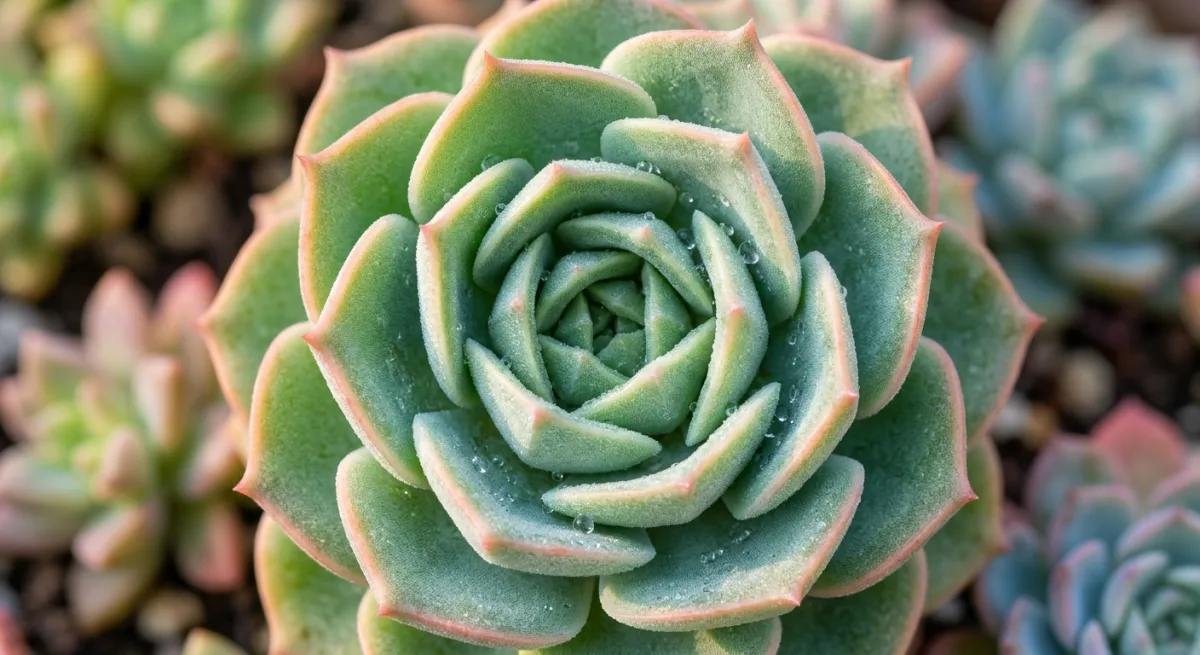
Another captivating feature of many rosette succulents is their farina (epicuticular wax), a chalky, powdery coating that functions as a natural ultraviolet screen and moisture-retention shield. Blending varied foliage textures—powdery, velvet-pubescent, smooth, or translucent-windowed—enriches visual depth and microclimatic resilience.
2. Light Requirements and Optimal Indoor Positioning
Sustaining the compact geometry of your succulent garden and preventing unsightly stretching (etiolation) relies entirely on delivering adequate photosynthetically active radiation (PAR). When light levels fall short, rosettes stretch frantically toward the nearest light source, their internodes elongate, stems weaken, and vivid anthocyanin pigments fade to a pale, washed-out green.
As an unyielding rule, mixed succulent bowls require at least 5 to 6 hours of bright, filtered sunlight daily. Unobstructed south- or west-facing windowsills represent the prime indoor location. However, spatial lighting nuance is essential: while semi-shade lovers like Zebra Haworthia (Haworthiopsis) and Ox Tongue (Gasteria) scorch under harsh, unshielded midday sun, desert lovers like Echeveria and Stonecrop (Sedum) inevitably lose their tight structure without full sun. Curate arrangements using species whose light saturation thresholds comfortably align around 1,000–2,000 foot-candles.
3. Watering Discipline: The 'Soak and Dry' Protocol
Excessive moisture is the undisputed primary killer of containerized succulents. Dribbling frequent, tiny splashes of water into an arrangement is not an act of care; it starves bottom roots of hydration while maintaining constant, suffocating moisture around the root collar. Instead, you must mirror the torrential downpours followed by prolonged droughts native to arid lands using the 'Soak and Dry' method.
Because multiple plant root systems share a single volume of soil, water must permeate all substrate layers uniformly while exiting immediately through bottom drainage holes. Never re-water until the potting mix has dried completely down to the bottom of the container. Verify substrate moisture before irrigating by inserting a wooden skewer deep into the root zone or lifting the container to gauge its weight.
During winter, ambient evaporation drops and CAM transpiration slows significantly. Reduce watering frequency to once a month or only when lower foliage shows subtle signs of soft wrinkling. Always use room-temperature, low-mineral water to avoid thermal shock.
4. Custom Mineral Substrate and Container Selection
The secret to keeping multiple succulent root systems healthy in a community planter is engineered porosity. Standard peat-heavy potting mixes act like dense kitchen sponges, staying soggy for weeks—a lethal scenario for root systems susceptible to anaerobic rot.
Select unglazed terracotta or porous ceramic shallow bowls measuring 10–15 cm (4–6 inches) in depth, equipped with generous bottom drainage apertures. These materials allow atmospheric gas exchange through their sidewalls, accelerating root-zone dry-down. Non-draining glass terrariums are inherently hazardous and strongly discouraged for mixed succulent arrangements.
| Substrate Component | Ratio (%) | Biological & Physical Function |
|---|---|---|
| Pumice Stone (3–6 mm) | 40% | Provides high macro-porosity, root oxygenation, and prevents compaction |
| Lava Rock (Scoria) / Zeolite | 20% | Enhances Cation Exchange Capacity (CEC) and provides structural root anchorage |
| Sifted Peat Moss or Coir | 25% | Supplies baseline organic matter and safe, temporary moisture buffering |
| Coarse Horticultural Grit / Perlite | 15% | Preserves continuous drainage pathways and prevents fine soil siltation |
5. Step-by-Step Propagation and Garden Construction Techniques
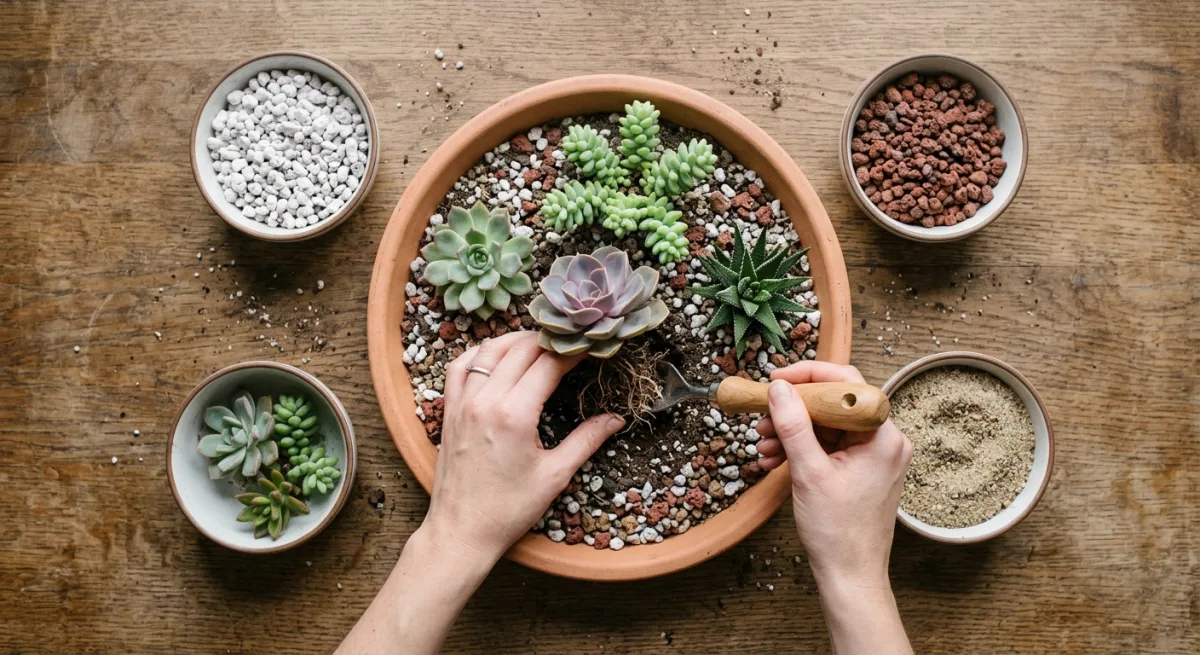
Whether assembling a centerpiece succulent bowl from scratch or propagating fresh offsets to fill voids, follow this precise horticultural procedure:
- Vessel Preparation: Cover the drainage holes of your shallow planter with mesh to prevent substrate loss, then spread a 2 cm (0.8 in) stabilizing base of coarse lava rock. Fill the vessel with your custom mineral mix, stopping roughly 2 cm below the rim.
- Root Cleansing & Layout Planning: Unpot your nursery specimens carefully and tease away old, peat-heavy transport soil from the root systems. Prune dead or desiccated roots using sterilized snips. Before planting, set the dry plants gently on top of the soil to evaluate height, color contrast, and spacing.
- Staged Planting: Anchor your primary focal species slightly off-center or toward the back. Surround it with your filler rosettes, angling them outward slightly. Position trailing varieties along the perimeter so their stems can spill over the rim. Keep foliage elevated above the soil line.
- Mineral Top Dressing: Once planted, spread a 1 cm (0.4 in) layer of coarse pumice, river grit, or calcined clay across the exposed soil surface. This top dressing prevents leaf contact with wet soil (thwarting fungal rot) while anchoring the substrate and delivering an elegant desert aesthetic.
- The Dry Cure Period: NEVER water immediately after assembly. Allow the arrangement to sit in bright, indirect light completely dry for 5 to 7 days. This allows minor root micro-abrasions to form protective wound callus tissue before taking on water, preventing rot.
6. Common Pathogens, Pests, and Treatments
In a multi-plant succulent garden, diseases and insect infestations can travel between adjoining specimens far faster than in isolated pots. Vigilant scouting and early bio-remedies are paramount:
- Root and Stem Rot (Fusarium & Phytophthora): Foliage turns translucent, waterlogged, and gelatinous, accompanied by blackened stem tissue at the base. Protocol: Immediately unpot the diseased specimen, excise all infected tissue back to clean, green flesh, let it callus for a week, and re-root it in dry pumice. Withhold water from the rest of the arrangement immediately.
- Mealybugs (Pseudococcidae): Appears as tiny, cotton-like masses sheltered within rosette crevices and leaf axils, sucking cell sap. Protocol: Dab colonies directly with a cotton swab soaked in 70% isopropyl alcohol for isolated infestations. For broader outbreaks, apply cold-pressed neem oil solutions or systemic insecticides away from direct midday light.
- Etiolation (Stretched Growth): Rosettes lose their tight geometry, stretching out with pale, widely spaced leaves due to light starvation. Protocol: Gradually transition the garden to brighter illumination over two weeks. For severely stretched specimens, execute a clean 'beheading' (stem cut), allow the top rosette to callus, and replant.
7. Seasonal Maintenance Calendar and Expert Tips
Keeping your succulent garden vibrant year after year requires tuning your care habits to natural seasonal rhythms:
- Spring (Active Awakening & Growth): The prime metabolic period. Resume regular 'soak and dry' watering as daylight expands. Apply a balanced, low-nitrogen, high-phosphorus/potassium cactus and succulent liquid fertilizer diluted to one-quarter strength once a month.
- Summer (Heat Stress & Color Intensification): During sustained heatwaves exceeding 35°C (95°F), many rosettes enter semi-dormancy. Protect delicate species from scorching midday sun with sheer shade netting. Sun stress stimulates protective anthocyanin pigments, turning leaves rich shades of red, purple, and orange.
- Autumn (Seasonal Transition): Begin transitioning outdoor balcony succulent bowls indoors before night temperatures drop below 8–10°C (46–50°F). Cease all fertilizer applications completely.
- Winter (Dormant Rest): Lengthen watering intervals to once every 3 to 5 weeks. Provide cool temperatures (12–15°C / 53–59°F) in a high-light position. This cool resting phase satisfies the vernalization requirement that stimulates profuse spring flowering.


Reader Reviews & Comments 3 Reviews
Eleanor Vance
Marcus Sterling
Chloe Bennett
Leave a Review & Rating
Share your plant care tips, experiences, or questions with our succulent community.