






The succulents gracing our greenhouses and living rooms evolved over millions of years, dancing with drought across arid plateaus, the Karoo semi-desert of South Africa, and the rugged, sun-drenched canyons of Mexico. When you gaze at a succulent, those plump, sculptural leaves are in fact nature's most sophisticated water reservoirs. Yet, when welcomed into our homes, their greatest peril is not prolonged drought, but an excess of water masquerading as affectionate care.
The query plant lovers type most relentlessly into search engines—and the very first question visitors pose to me in our greenhouses—is invariably the same: 'Rıfat, how many days should I wait between waterings?' Off-the-cuff, mechanical prescriptions like 'every five days' or 'once a week' do little more than consign your plant's delicate root system to a slow, subterranean suffocation. True hydration is never a matter of the calendar; it is a dynamic, living art governed by soil microbiology, photon intensity, ambient relative humidity, and the metabolic pulse of the plant itself.
So, pour yourself a fresh cup of coffee, and let us venture deep into the cellular sanctuary of succulents. Together, we shall trace the hidden journey of water from root xylem to the nocturnal shifts of microscopic stomata, deciphering the subtle somatic cues your plant whispers when it genuinely thirsts.
1. Botanical Identity and Morphological Adaptations
The term 'succulent' does not designate a solitary botanical family; rather, it describes a convergent morphological adaptation shared by xerophytic plants across diverse taxonomic lineages, including Crassulaceae, Aizoaceae, Euphorbiaceae, and Apocynaceae. Their unifying evolutionary trait is the presence of specialized, highly vacuolated parenchyma tissues engineered specifically to sequester water across protracted dry spells.
At the cellular frontier, succulents carry out a specialized photosynthetic adaptation known as Crassulacean Acid Metabolism (CAM). By keeping their microscopic leaf pores (stomata) tightly sealed beneath the blistering daytime sun, they dramatically curtail transpirational water loss. Only when the cool evening air settles do they open these pores, capturing atmospheric carbon dioxide and fixing it organically as malic acid. Consequently, irrigating your succulent in the heat of midday is akin to submerging a tissue that is neither actively transpiring nor driving hydraulic uptake into cold, saturated mud.
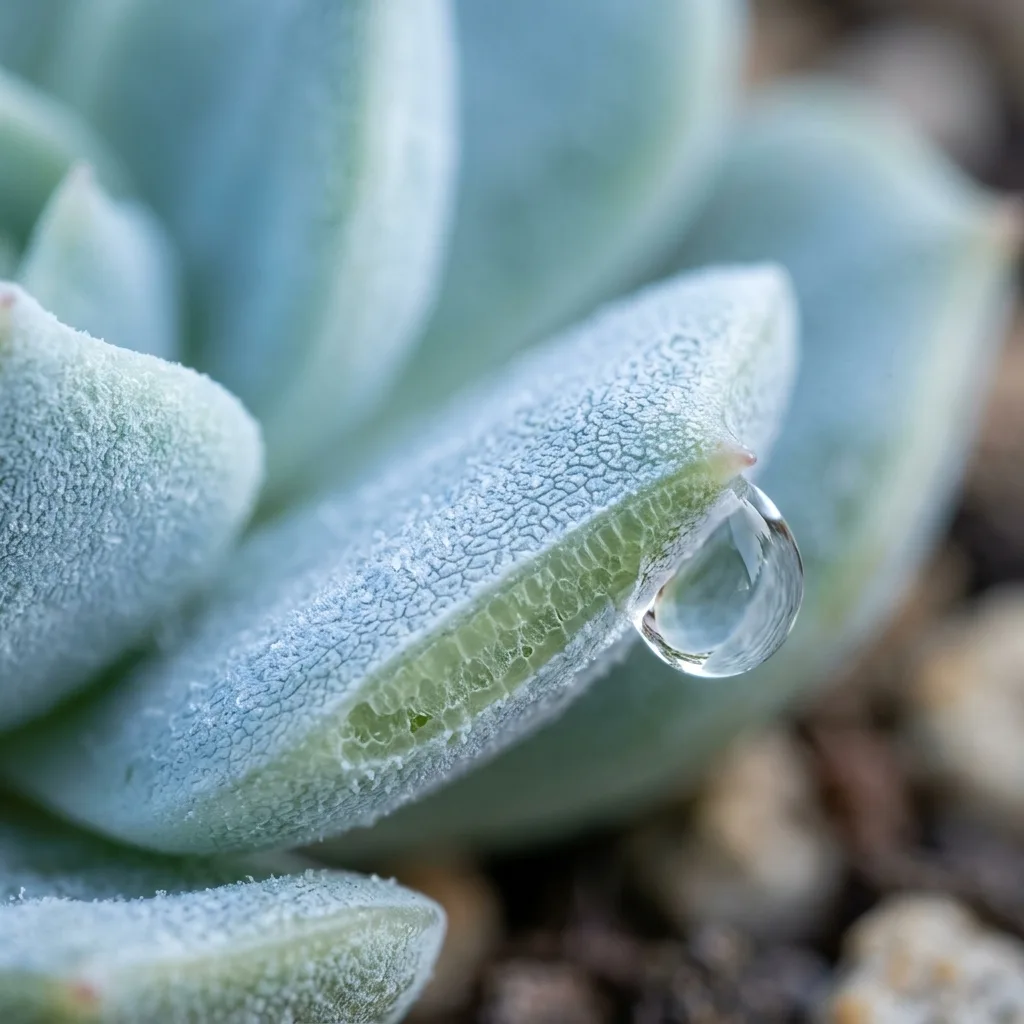
Furthermore, that powdery, ethereal, silvery bloom observed on the foliage of many rosette-forming succulents (such as Echeveria, Pachyphytum, and Graptopetalum) is known botanically as 'farina' (epicuticular wax). Farina serves far beyond simply beading water droplets away from the epidermal tissue; it forms an indispensable natural shield that reflects excess ultraviolet radiation and prevents internal moisture from evaporating. Carelessly wiping this delicate patina with your fingers leaves the plant acutely vulnerable to accelerated desiccation and permanent sunburn.
2. Light Requirements and Indoor Placement Dynamics
The foremost environmental parameter dictating irrigation frequency is photon irradiance. The higher the rate of photosynthesis, the stronger the hydraulic pull generated by transpiration tension within the root xylem. An Echeveria basking in 6 to 8 hours of brilliant, direct filtered sunlight on a south- or west-facing windowsill may thoroughly exhaust its soil moisture reserve within 4 to 6 days. Conversely, an identical specimen stranded in the dim recesses of a north-facing window might leave that very same substrate waterlogged for more than three weeks.
Deprived of adequate lumens, succulents undergo etiolation: their stems stretch unnaturally, leaf spacing widens, and rich pigmentation fades into an anemic pale green. If you persist in irrigating an etiolated succulent on a routine domestic schedule, its root hairs will swiftly succumb to anaerobic pathogens in stagnant moisture. The golden rule is uncompromising: as light levels diminish, watering intervals must be lengthened exponentially.
3. Irrigation Discipline: The 'Soak and Dry' Method
The sole, scientifically sound answer to 'How often should I water my succulents?' is this: Only after the entire potting substrate has dried to the bone, and the foliage displays its initial signs of cellular thirst! In horticultural science, this practice is celebrated as the 'Soak and Dry' protocol.
Many well-meaning hobbyists administer a timid tablespoon or a few superficial spritzes of water once a week. This is arguably the most detrimental habit one can inflict upon a succulent! Shallow, superficial watering prevents roots from driving downward, yielding a fragile, surface-bound root system incapable of sustaining the plant. The proper technique demands a decisive regimen:
- Substrate Verification: Insert a slender wooden skewer down to the very base of the pot. It must emerge entirely clean and bone-dry, with no damp particles clinging to the wood.
- Foliar Body Language: Gently touch the lowest tier of leaves. If they feel slightly soft, show subtle horizontal creases, or lack their firm, turgid resistance, the plant is ready for water. If the leaves feel hard as river stones and firmly engorged, withhold water unconditionally.
- Thorough Saturating Drench: Pour room-temperature, dechlorinated water generously over the substrate until it flows freely and copiously from the bottom drainage apertures. The entire root ball must be comprehensively hydrated.
- Drainage Evacuation: Empty the drainage saucer completely 15 minutes after watering. Never allow the container to sit in a standing pool of runoff.
As a baseline guideline: during the active vegetative cycle in spring and summer, this drying cycle typically recurs every 7 to 12 days; in mid-to-late autumn, every 14 to 20 days; and during winter dormancy, anywhere from 25 to 40 days, contingent upon the species and ambient temperature.
4. Ideal Substrate Formulation and Pot Selection
The success of your watering rhythm depends directly on how swiftly moisture vacates the container. Off-the-shelf peat moss and standard potting soils hold moisture like a kitchen sponge for weeks on end, virtually guaranteeing basal rot. An exemplary succulent substrate should consist of at least 60% to 70% inorganic, porous aggregate components.
The formulation below represents the standardized potting matrix refined and tested through decades of greenhouse cultivation, engineered to preserve the optimal air-to-water ratio around root hairs:
| Component | Proportion (%) | Function and Botanical Significance |
|---|---|---|
| Pumice (3-6 mm) | 35% | Porous structure holds micro-oxygen reserves and prevents compaction. |
| Lava Rock / Zeolite | 25% | Enhances root anchoring and supplies trace structural minerals. |
| Coarse Perlite or Quartz Grit | 10% | Forms rapid drainage channels and prevents silt accumulation. |
| Organic Cactus Peat / Coir | 30% | Provides controlled cation-exchange capacity and gentle moisture buffering. |
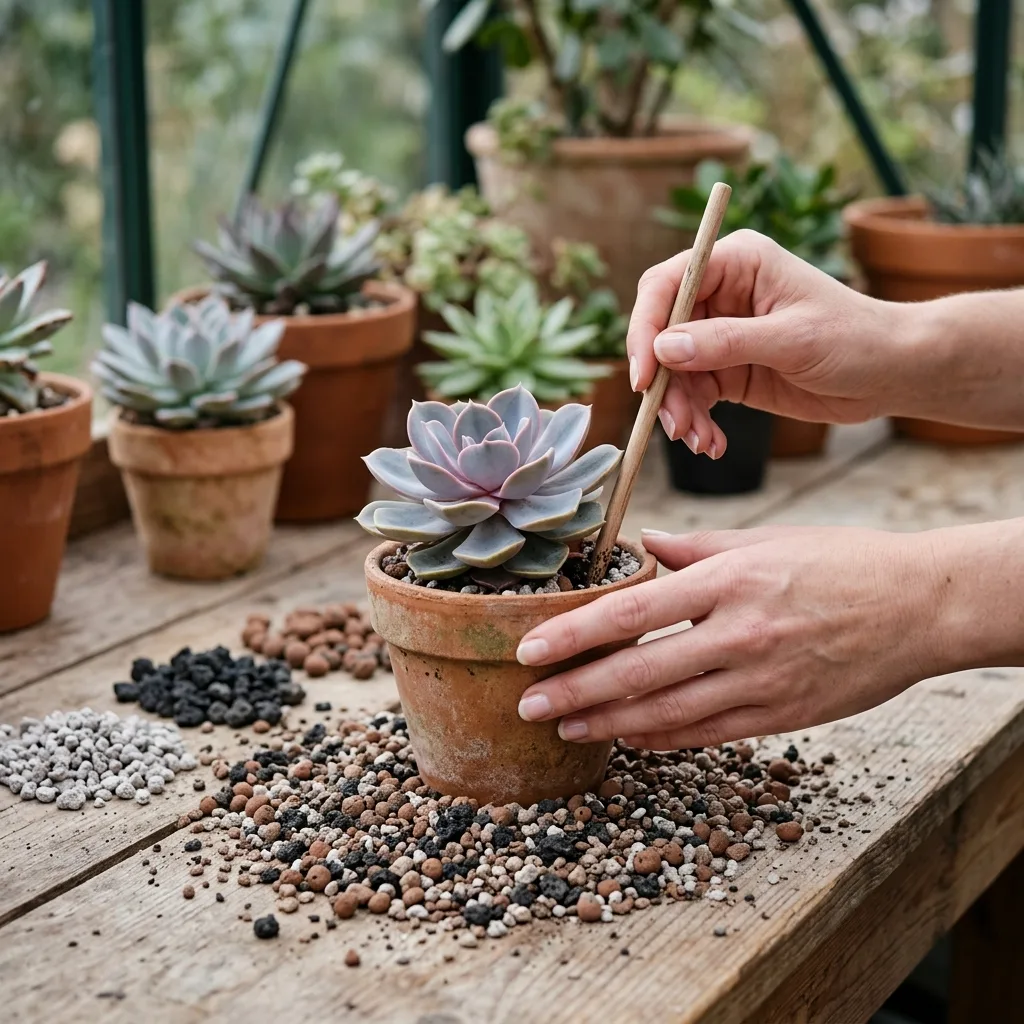
Regarding containers, unglazed terracotta stands uncontested as the gold standard. Its porous earthenware walls breathe, permitting moisture to evaporate through the sides of the pot as well as the surface. In plastic or glazed ceramic vessels, evaporation occurs at less than half that speed; if you opt for them, you must adjust your intervals accordingly. Planting succulents into containers lacking functional drainage holes is a perilous wager, even for veteran botanists.
5. Step-by-Step Propagation Techniques
The remarkable regenerative prowess of succulents is intimately tied to smart hydration management. Propagating vibrant new specimens from healthy foliage or stem cuttings is exceptionally rewarding when executed methodically:
- Harvesting Viable Tissue: Gently wiggle a plump, mature leaf from side to side at its junction with the main stem until it releases with a clean, audible snap. It is paramount that the basal meristematic tissue at the leaf attachment point remains completely intact and unfrayed.
- Callus Formation: Rest the severed leaves in a dry, well-ventilated, shaded position for 3 to 5 days. Any uncallused, open cellular wound placed in contact with soil will swiftly invite pathogenic fungal colonization.
- Placement on Dry Substrate: Lay the callused leaves flat atop completely bone-dry succulent soil—never moist soil. Do not apply a single drop of water until roots actively appear! The leaf relies entirely on its internal moisture reserve to generate a miniature adventitious rosette and delicate pink rootlets.
- Initiating Hydration: Once the delicate roots reach 1 to 2 cm in length and anchor toward the soil, begin applying minimal targeted moisture around the root zone using a precision dropper or pipette.
6. Common Pathologies, Pests, and Diagnostic Solutions
When hydration falls out of equilibrium, succulents broadcast unmistakable physiological distress signals. Use this diagnostic matrix to read your plant's leaves accurately:
- Overwatering (Edema and Basal Root Rot): Lower leaves turn translucent, turn a pale sickly yellow, take on a squishy, jelly-like consistency, and drop at the slightest graze. If black necrotic lesions appear on the stem, unpot the specimen immediately, excise all blackened root tissue with a flame-sterilized blade, allow the remaining tissue to air-dry for 4 days, and repot into dry, mineral-rich substrate.
- Underwatering: Leaves lose their high-sheen turgidity, becoming dull, deflated, and puckered like crepe paper. Remediation is delightfully simple: administer a deep, thorough drenching soak. Within 24 to 48 hours, the vascular system will re-pressurize and leaves will plump back up.
- Mealybugs (Pseudococcidae): These pervasive sap-suckers congregate in cottony, white nests nestled deep within leaf axils, thriving on plants weakened by stagnant moisture and poor ventilation. Dab them away individually using a cotton swab saturated with 70% isopropyl alcohol, followed by a targeted application of cold-pressed neem oil.
7. Seasonal Horticultural Calendar and Master Guidelines
Aligning your watering practices with the succulent's internal phenological clock will naturally eliminate common watering errors:
- Spring (Awakening): Vegetative hormones peak as days lengthen. Hydrate thoroughly whenever the substrate dries completely (roughly every 7 to 10 days). Supplement monthly with a balanced, urea-free succulent fertilizer diluted to half strength.
- Summer (Active Growth vs. Summer Estivation): While genera like Echeveria and Kalanchoe flourish in summer warmth, winter-growers such as Aeonium and Dudleya enter metabolic dormancy (estivation) when temperatures surpass 30°C (86°F). Restrict watering for dormant species to a light monthly sip, while continuing regular 'Soak and Dry' routines for active growers.
- Autumn (Acclimatization): As nocturnal temperatures decline, plants build cellular resilience for winter. Gradually space out your irrigation cycles to every 12 to 15 days.
- Winter (Dormancy and Cold Protection): Metabolic respiration slows to a trickle. Keeping the root ball bone-dry is the single best protection against cold and frost-induced cellular collapse. For plants wintered in cool indoor rooms or sheltered porches, water sparingly every 25 to 40 days, selecting a mild, sunlit morning only when lower leaves exhibit distinct puckering.


Reader Reviews & Comments 3 Reviews
Eleanor Vance
Sophia Reynolds
Marcus Thorne
Leave a Review & Rating
Share your plant care tips, experiences, or questions with our succulent community.