






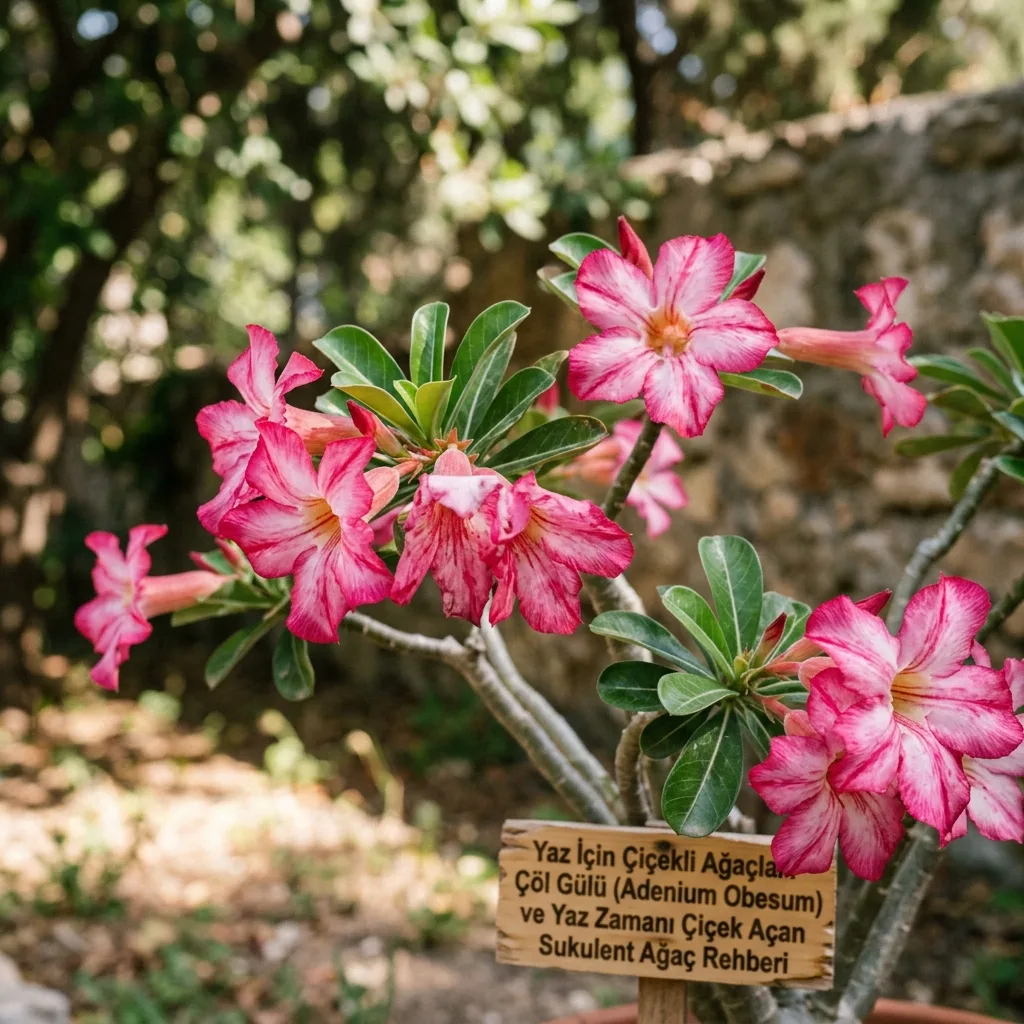
When summer heat reaches its zenith and most ornamental foliage wilts or slips into semi-dormancy, certain botanical wonders unleash their most brilliant displays. When plant collectors search for 'flowering trees for summer' or 'summer blooming miniature trees', the undisputed champion is the Desert Rose (Adenium obesum), celebrated worldwide for its dramatic, swollen caudex and vibrant, tubular petals.
Native to the arid, rocky plains and plateaus of East Africa and the Arabian Peninsula, the genus Adenium belongs to the dogbane family, Apocynaceae. These woody succulents evolved to thrive amidst punishing environmental conditions. By storing generous water reserves within their massive swollen stems throughout prolonged droughts, they deftly convert scorching ultraviolet radiation and intense summer heat into a breathtaking floral exhibition.
Cherished as 'living sculptures' among succulent connoisseurs, Adeniums embody the ultimate intersection of bonsai aesthetics and succulent resilience. Whether gracing sunny interior windowsills or thriving on sun-baked outdoor patios, their continuous blooms make them the undisputed queens of the summer botanical landscape.
1. Botanical Identity and Morphological Characteristics
Adenium obesum is morphologically classified as a pachycaul (thick-stemmed) succulent. Its most definitive signature is the massive basal caudex, an evolutionary reservoir engineered for water retention. Within its specialized parenchyma cells, the caudex holds substantial moisture and nutrient reserves, allowing the specimen to remain turgid and viable through months of severe drought.
The foliage is lustrous, spatulate, and leathery. A delicate, waxy cuticular coating minimizes stomatal transpiration during peak daylight hours. The blossoms are actinomorphic, featuring five flared petals with striking pigmentation. Ranging from snowy whites and soft pinks to deep ruby reds, variegated bicolors, and intricate double-flowered cultivars, these persistent blooms solidify Adenium's status as a peerless summer flowering tree.
2. Light Requirements and Indoor Placement
To preserve their compact, tree-like architecture and generate abundant flower buds throughout summer, Desert Roses demand unfiltered, direct sunlight. A minimum of 6 to 8 hours of direct sun daily is essential. Inadequate exposure leads to etiolation (weak, elongated branches), a softened caudex, and premature bud drop.
For indoor culture, place the plant directly in front of an unobstructed south-facing window. During summer, once nighttime temperatures reliably hold above 20°C (68°F), relocate your Adenium outdoors to a sun-drenched balcony, deck, or terrace. Direct sunlight accelerates caudex lignification (woodiness), giving the plant its iconic, ancient bonsai appearance.

3. Watering Discipline: The 'Soak and Dry' Method
Although the Desert Rose is an arid-adapted succulent tree, its active vegetative and blooming phases during summer call for significantly more hydration than standard desert cacti. However, irrigation must always adhere strictly to the 'Soak and Dry' protocol.
Once the growing medium dries out completely, water thoroughly until moisture flows freely from the container's drainage holes. Never allow excess runoff to sit in saucers for longer than 15 minutes; stagnant water starves root tissue of oxygen and invites fatal bacterial pathogens. As autumn temperatures taper off, taper irrigation proportionately, reducing watering to once or twice monthly during winter rest.
4. Ideal Substrate Formulation and Potting Dynamics
Standard garden loam or dense peat-based mixes are fatal to Adenium obesum. The root system requires rapid drainage and generous aeration. Irrigation water must never pool or remain suspended within the root zone; gravity should clear it within seconds.
Opt for shallow, wide-mouthed unglazed terracotta or ceramic bonsai pots fitted with multiple drainage holes. Porous clay walls facilitate gas exchange, prevent root asphyxiation, and encourage the caudex to expand horizontally rather than stretching deep underground.
| Substrate Component | Ratio (%) | Botanical Function |
|---|---|---|
| Coarse Pumice (3–6mm) | 40% | Cellular root aeration and moisture buffering without compaction |
| Lava Rock / Volcanic Scoria | 20% | Porous structure, pot stability, and gradual micronutrient release |
| Sterile Coco Coir | 20% | Lightweight organic fiber matrix with controlled moisture retention |
| Coarse River Sand / Zeolite | 10% | Facilitates rapid drainage pathways and binds ambient toxins |
| Coarse Horticultural Perlite | 10% | Reduces mix density and cushions delicate root hairs |
5. Step-by-Step Propagation Protocols
You can propagate this architectural summer flowering tree through two reliable techniques: seed propagation or vegetative stem cuttings.
- Propagation from Seed: Growing from seed is the only method that naturally produces the prized, symmetrical, swollen caudex. Soak fresh seeds in lukewarm water for 2 to 4 hours. Press them horizontally into a 50/50 pumice-perlite blend and lightly cover with 2–3 mm of gritty mix. Maintain bottom warmth between 28–32°C (82–90°F) under high humidity; germination typically occurs within 7 to 10 days.
- Propagation via Stem Cuttings: In early summer, take 10–15 cm semi-woody cuttings from actively growing branches using a sterile scalpel. Rinse away the toxic white latex sap at the cut, then allow the cutting to dry in shaded warmth for 3 to 4 days until a firm callus develops. Plant into slightly moist pumice and perlite. While cutting-grown Adeniums flower reliably, they develop a fibrous root system and will not form the massive basal caudex characteristic of seed-grown specimens.
6. Common Pathogens, Pests, and Curative Treatments
Despite its remarkable drought endurance, Adenium obesum can succumb to physiological stress when environmental parameters are neglected:
- Caudex & Root Rot (Fusarium / Phytophthora): Caused by overwatering combined with poorly draining soil. Remedy: Immediately unpot the plant. Excise all blackened or decaying tissue down to healthy green-white flesh with a sterilized blade. Dust wounds with sulfur powder or ground cinnamon, dry for 7 days bare-root, then replant into completely dry mineral substrate.
- Spider Mites (Tetranychidae): Proliferate during hot, dry spells, producing fine silken webbing and stippled yellow foliage. Remedy: Thoroughly wash leaf undersides with an organic neem oil solution or apply an appropriate acaricide.
- Mealybugs (Pseudococcidae): Cluster in cottony colonies around fresh branch tips and flower pedicels. Remedy: Dab colonies directly with an isopropyl-alcohol-soaked cotton swab, followed by a systemic insecticide application.
7. Seasonal Maintenance Calendar and Cultivation Wisdom
Spring (March – May): Waking from winter rest. Gradually increase watering frequency. As fresh leaves emerge, apply a balanced, low-nitrogen, high-phosphorus liquid succulent fertilizer at half-strength every two weeks.
Summer (June – August): Peak flowering display. Keep plants outdoors in direct sun. Water deeply as soon as the substrate is fully dry. Deadhead spent blossoms promptly to channel botanical energy into setting new buds.
Autumn (September – November): When evening temperatures drop below 12–15°C (54–59°F), transition plants indoors to a sunny window. Cease fertilization completely and taper watering.
Winter (December – February): Winter dormancy phase. Adeniums naturally drop some or all foliage. Maintain in a bright room kept at 10–15°C (50–59°F), watering very sparingly—just enough to keep the caudex from shriveling severely.


Reader Reviews & Comments 3 Reviews
Julian Vance
Eleanor Sterling
Marcus Bradley
Leave a Review & Rating
Share your plant care tips, experiences, or questions with our succulent community.