






Arriving on our balconies from the sun-scorched, rocky slopes of Argentina, Uruguay, and southern Brazil, Portulaca grandiflora is undoubtedly one of the most cheerful and generous members of the botanical kingdom. Known colloquially as 'moss rose', 'sun rose', or 'eleven o'clock' due to its delicate, rose-like floral rosettes, this extraordinary plant boasts an evolutionary succulent blueprint crafted specifically to defy blistering heat and arid, scree-laden terrain. While casual gardeners often misjudge it as a fragile bedding annual, it is, in reality, a true xerophytic champion capable of storing cellular water reserves under the most punishing conditions.
In its native habitats, moss rose carpets sandy riverbanks, arid washes, and rocky canyon shelves, transforming desolate ground into a vibrant living tapestry. Opening its satiny petals to greet the early morning rays and closing them at dusk to conserve cellular energy, this tender survivor will bloom relentlessly all summer long when paired with the proper cultural protocol. If your indoor or outdoor plant journey calls for a resilient, drought-tolerant species that rewards minimal care with dazzling colors, it is time to immerse yourself in the art of growing moss rose.
1. Botanical Profile and Morphological Architecture
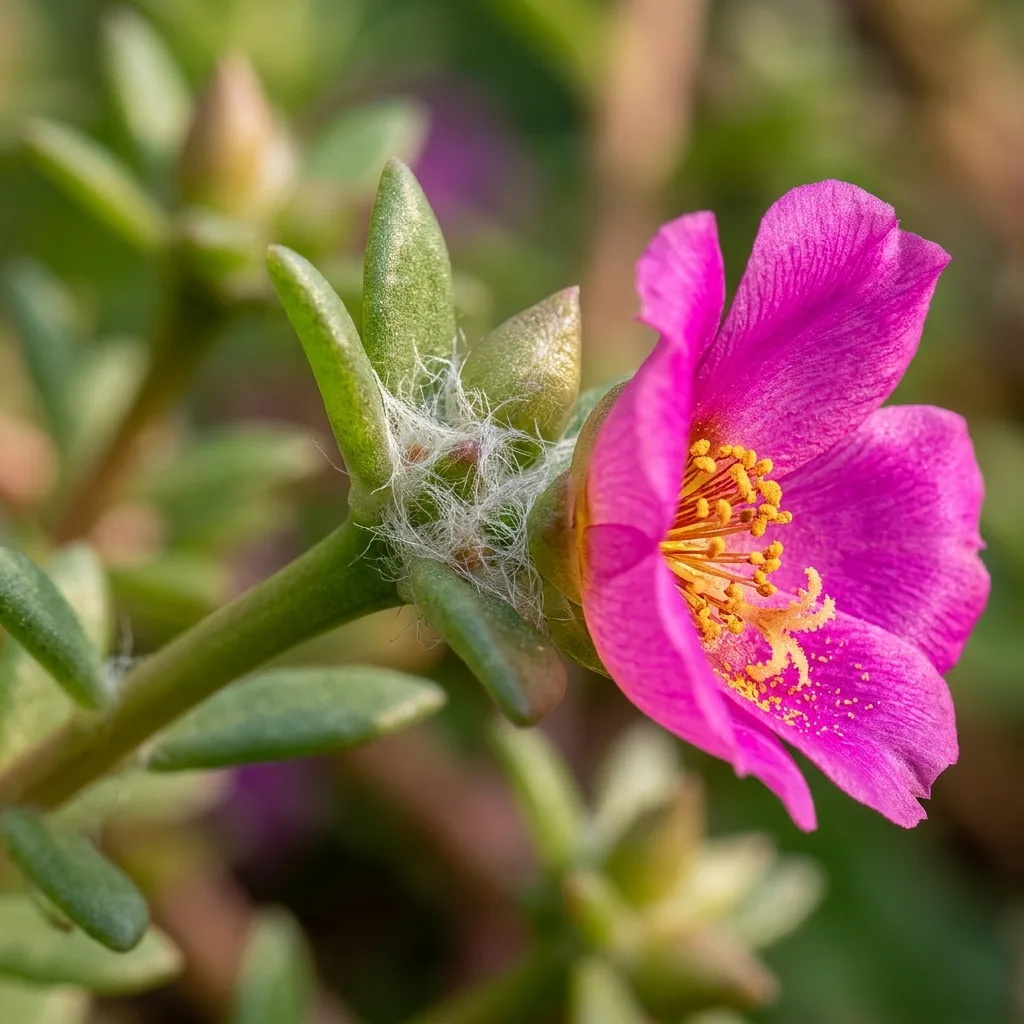
Portulaca grandiflora embodies the classical evolutionary traits of the family Portulacaceae. Its most defining vegetative characteristic is its spiraled arrangement of succulent, cylindrical, needle-shaped leaves. These foliage structures minimize surface area to dramatically suppress transpiration and water loss, serving as highly efficient micro-reservoirs. The mucilaginous water stored within this succulent tissue allows the plant to preserve cellular turgor pressure even across weeks of relentless drought.
The common name 'moss rose' honors the dense tufts of whitish, woolly trichomes (hairs) found clustered at the leaf axils and stem nodes. Far from being merely decorative, these epidermal hairs trap morning dew and condense atmospheric moisture directly toward the root zone, while simultaneously acting as microscopic parasols that shield tender meristem tissues from ultraviolet sunburn during intense midday heat. The blossoms, available in both single and fully double forms, exhibit a delicate, tissue-paper sheen across shades of intense magenta, brilliant yellow, flame orange, salmon, pure white, and striking bi-colors.
2. Light Requirements and Strategic Placement
Portulaca grandiflora is an obligate heliophyte—a plant that genuinely thrives on blazing, relentless sunlight. Without direct solar radiation, its cellular machinery cannot sustain efficient photosynthesis or support generous floral bud differentiation. Provide your moss rose with at least 6 to 8 hours of unfiltered, direct sun daily. Under subpar light conditions, the internodes stretch drastically (etiolation), stems become fragile and spindly, and the dense, carpet-like habit collapses into weak growth that halts blooming altogether.
If you cultivate moss rose indoors, place it directly on your sunniest south- or southwest-facing windowsill. While the concentrated thermal energy behind clear window glass would scorch delicate foliage plants, moss rose harnesses this ambient heat to supercharge its photosynthetic pathways. In outdoor spaces, high-exposure balcony railings, hanging baskets, and elevated spots in rock gardens represent optimal microclimates where this succulent can bask in radiant heat.
3. Irrigation Protocol: The 'Soak and Dry' Method
Because moss rose is a specialized succulent, watering it too frequently is not an act of kindness—it literally suffocates the root system by depriving root hairs of essential oxygen. While Portulaca grandiflora demonstrates world-class drought tolerance, its root epidermis has virtually zero defense against prolonged saturation. Your foundational watering strategy must strictly adhere to the classic 'soak and dry' cycle.
Always verify soil moisture before irrigating by inserting a wooden skewer to the very bottom of the pot; if it emerges with any damp soil cling, withhold water entirely. When the substrate is bone dry, saturate the container thoroughly until water flows freely from the drainage holes, ensuring you empty runoff trays within 15 minutes. Avoid overhead sprinkling onto the foliage; the woolly axillary trichomes can trap trapped droplets, encouraging opportunistic fungal pathogens and rot.
4. Substrate Composition and Pot Selection
Replicating native scree conditions is essential for long-term root health. Dense, peat-heavy commercial potting soils or heavy clay garden soils retain far too much water and will rapidly suffocate Portulaca roots. The ideal substrate must be coarse, porous, highly aerated, and dominated by inorganic mineral aggregates.
Regarding container materials, unglazed terracotta pots remain the premier choice. Because terracotta is naturally porous, it breathes, allowing excess moisture to evaporate evenly through its walls and keeping the subterranean root zone properly oxygenated. Plastic or glazed ceramic pots, by contrast, retain residual moisture for far too long. Use the following mineral-rich formulation to achieve ideal drainage:
| Ingredient | Ratio (%) | Functional & Botanical Benefit |
|---|---|---|
| Horticultural Pumice (3-5 mm) | 35% | Provides internal microporosity, structural aeration, and prevents soil compaction. |
| Lava Grit or Coarse Quartz Sand | 25% | Adds anchoring ballast and creates permanent free-draining percolation channels. |
| Low-Peat Cactus Substrate | 30% | Supplies just enough light organic buffer for delicate feeder roots to anchor. |
| Zeolite or Horticultural Perlite | 10% | Buffers nutrient exchange (CEC), adsorbs excess salts, and stabilizes aeration. |

5. Step-by-Step Propagation Techniques
Few succulents root with the sheer vigor of moss rose. You can expand your collection effortlessly using two reliable methods: stem cuttings or seed propagation.
Stem Cutting Propagation (The Fast & Reliable Method)
- Select Healthy Growth: Choose a vigorous, non-flowering stem tip roughly 7-10 cm (3-4 inches) in length packed with plump, hydrated leaves.
- Perform a Sterile Cut: Sever the stem cleanly just below a leaf node using razor-sharp shears disinfected with isopropyl alcohol.
- Strip Lower Foliage: Gently strip off the cylindrical leaves along the lower 3 cm of the cutting to expose bare nodal points where adventitious roots will emerge.
- Callus Formation: Do not plant immediately. Place the cutting in a dry, shaded, well-ventilated spot for 24 to 48 hours to allow cut tissues to form a protective suberin callus.
- Potting and Rooting: Insert the callused stem into barely moist, gritty succulent soil. Withhold water for the first 3 to 4 days. Strong adventitious roots typically anchor within 10 to 14 days, quickly followed by fresh apical growth.
Propagation from Seed
Following flowering, mature seed capsules open along a transverse seam to release hundreds of microscopic, metallic-sheened seeds. Scatter these seeds directly over a gritty, moist seedbed after all spring frost risks have passed. Because Portulaca seeds require ambient light to break dormancy, do not cover them with soil; press them lightly into the surface and mist with distilled water.
6. Common Pests, Diseases, and Preventative Treatments
While Portulaca grandiflora displays natural pest resistance, compromised environmental conditions can make it susceptible to common horticultural pests:
- Mealybugs (Pseudococcidae): The woolly trichomes clustered in the leaf axils provide camouflage for sap-sucking mealybugs. If you discover cottony white clusters along the nodes, dab them with a cotton swab soaked in 70% isopropyl alcohol or apply diluted cold-pressed neem oil.
- Root Rot (Drainage Pathology): Arises whenever roots are deprived of oxygen in heavy, sodden soil. If stems become soft, dull, and translucent, unpot the specimen, prune decayed roots, dust remaining tissue with activated sulfur or charcoal powder, and repot into bone-dry mineral grit.
- Spider Mites: Under hot, stagnant, bone-dry microclimates, two-spotted spider mites can spin faint webs between leaf axils. Enhance local airflow around the foliage and apply an organic insecticidal soap spray to control infestations.
7. Seasonal Maintenance Calendar and Expert Tips
Spring (Waking & Vegetative Surge): Move outdoor containers outside once nighttime temperatures consistently hold above 15°C (59°F). Feed once monthly with a balanced liquid succulent fertilizer diluted to half-strength to support vigorous branching.
Summer (Peak Flowering Flush): This is the zenith of growth. Regularly pinch spent blossoms just behind the seed capsule (deadheading). This simple botanical practice prevents the plant from diverting valuable metabolic sugars toward seed production, channeling energy into continuous flower bud creation.
Autumn (Dormancy Transition): As daylight hours shorten and temperatures drop, widen the intervals between waterings and cease all supplemental feeding. If you intend to overwinter your specimen as a perennial, bring containers indoors before night temps fall below 10°C (50°F).
Winter (Rest Phase): Portulaca grandiflora cannot tolerate freezing temperatures (hardy only to USDA Zones 10-11). While frequently treated as an annual outdoors, it will rest comfortably on an indoor south-facing sill. During the cold months, water sparingly—only enough to keep the foliage from severely shriveling—and keep the root ball mostly dry.


Reader Reviews & Comments 4 Reviews
David Miller
Sophia Reynolds
Emma Watson
Oliver Harris
Leave a Review & Rating
Share your plant care tips, experiences, or questions with our succulent community.