






Journeying from the arid savannas of East Africa and the sun-drenched expanses of the Arabian Peninsula directly into our living spaces, Adenium obesum—universally celebrated as the Desert Rose—resembles a living botanical sculpture far more than a conventional potted houseplant. Anchoring the specimen is its swollen water-storage organ (the caudex), a morphological adaptation honed over millennia to endure severe drought stress and a stunning testament to evolutionary engineering. Thriving across rocky cliffs in habitat without a single drop of rain for months, this stately succulent transforms throughout spring and summer into a dazzling desert mirage, smothered in radiant scarlet, blush pink, and porcelain white blooms.
Many plant enthusiasts mistake the Desert Rose for an exotic tropical shrub upon first encounter; taxonomically, however, Adenium obesum is a bona fide pachycaul succulent of the dogbane family (Apocynaceae), armed with exceptional water-retentive parenchymal tissues. Cultivating one at home brings the dynamic resilience of the desert indoors. Always remember: frequent watering is never an act of botanical affection—it deprives root tissues of vital oxygen and invites insidious rot. Drawing upon decades of greenhouse observations and plant physiological science, this definitive guide provides step-by-step strategies to keep your Adenium's caudex rock-solid while encouraging explosive bud production year after year.
1. Botanical Identity and Morphological Characteristics
The defining visual and structural hallmark of Adenium obesum is undoubtedly its basal caudex—a dramatically swollen stem base. By storing abundant water and soluble polysaccharides within specialized parenchymal cells, this structure serves as a physiological buffer against sustained drought. Arranged spirally along the fleshy, branching stems are obovate (teardrop-shaped), glossy emerald-green leaves, fortified by a dense waxy cuticle designed to curb transpirational moisture loss.
Terminal cymes give rise to striking clusters of five-petaled, funnel-form blossoms that span monochromes of deep crimson and velvety black-red to picotee edges and pure ivory. Another critical botanical signature of Adenium is the milky latex exuded whenever stems or foliage are nicked. This sap contains potent cardiac glycosides (notably ouabain and adonidin), an evolutionary chemical shield against herbivores that renders the plant toxic if ingested by pets or curious children.
2. Sunlight Requirements and Indoor Placement
Adenium obesum is an obligate heliophile. Accustomed to unfiltered equatorial sun across open arid plains, it responds to sub-par indoor lighting by stretching out: stems become etiolated and spindly, internodes widen, and the caudex turns disappointingly soft and spongy. To fuel sustained caudex expansion and prolific floral bud initiation, the plant demands at least 6 hours of direct, unfiltered sunlight daily.
Indoors, prime positioning means placing your container immediately before an unobstructed south- or southwest-facing window. Where outdoor patio or garden space is accessible, transition the plant outdoors from late spring through early autumn once all threat of frost has passed. Outdoor air movement and intense ambient ultraviolet radiation stimulate robust cork formation across the bark and foster a stocky, compact silhouette. Avoid abrupt shifts from dim winter quarters into scorching summer sun to prevent cutaneous sunburn; acclimate specimens gradually over a 7- to 10-day transition period in dappled shade.
3. Watering Discipline: The 'Soak and Dry' Protocol
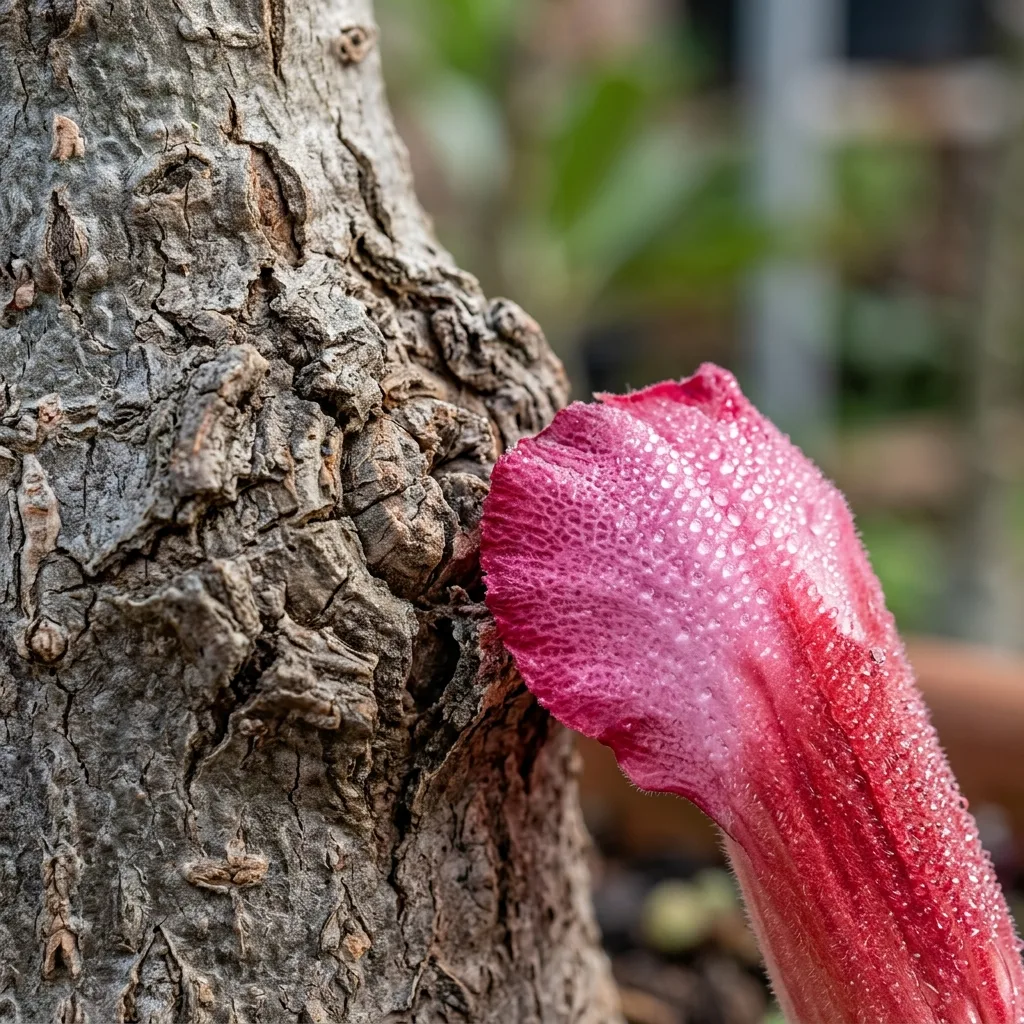
The golden axiom of Desert Rose hydration is the strict 'Soak and Dry' principle. Adenium root systems rely heavily on atmospheric gas exchange within root-zone pores. Heavy, soggy potting compost strips rhizosphere oxygen, breaking down root epidermises within 48 hours and triggering systemic root rot.
The most dependable indicator for watering is ensuring the substrate has dried down completely to the bottom of the pot, verified by a gentle tactile test of the caudex base. If the trunk feels stone-hard, defer watering entirely; if it displays a slight, supple give and the mix is bone-dry, irrigate thoroughly until runoff escapes freely through drainage holes. Discard any saucer reservoir water within 15 minutes. As autumn cools and ambient temperatures settle below 15°C (59°F), deciduous leaf drop signals the onset of winter dormancy. During this rest period, throttle watering back to once a month, supplying just enough moisture to prevent total caudex desiccation in temperate rooms.
4. Ideal Substrate Formulation and Container Selection
Desert Rose roots demand a loose, hyper-porous, highly aerated growing medium. Standard peat-heavy potting soils retain excessive moisture and must never be utilized straight out of the bag. An optimal mix balances gritty, porous inorganic aggregates with a modest fraction of organic matter to cushion the roots.
| Substrate Component | Ratio (%) | Botanical Function |
|---|---|---|
| Pumice Stone (3-6 mm) | 35% | Open cellular matrix supplies oxygen to root hairs; zero waterlogging. |
| Lava Rock / Zeolite (3-5 mm) | 25% | Enhances structural root anchorage and increases cation-exchange capacity (CEC). |
| Coarse Horticultural Grit / Perlite | 15% | Maximizes gravitational drainage and eliminates substrate compaction. |
| Quality Succulent Blend / Coco Coir | 25% | Provides essential trace nutrition and retains minimal baseline root humidity. |
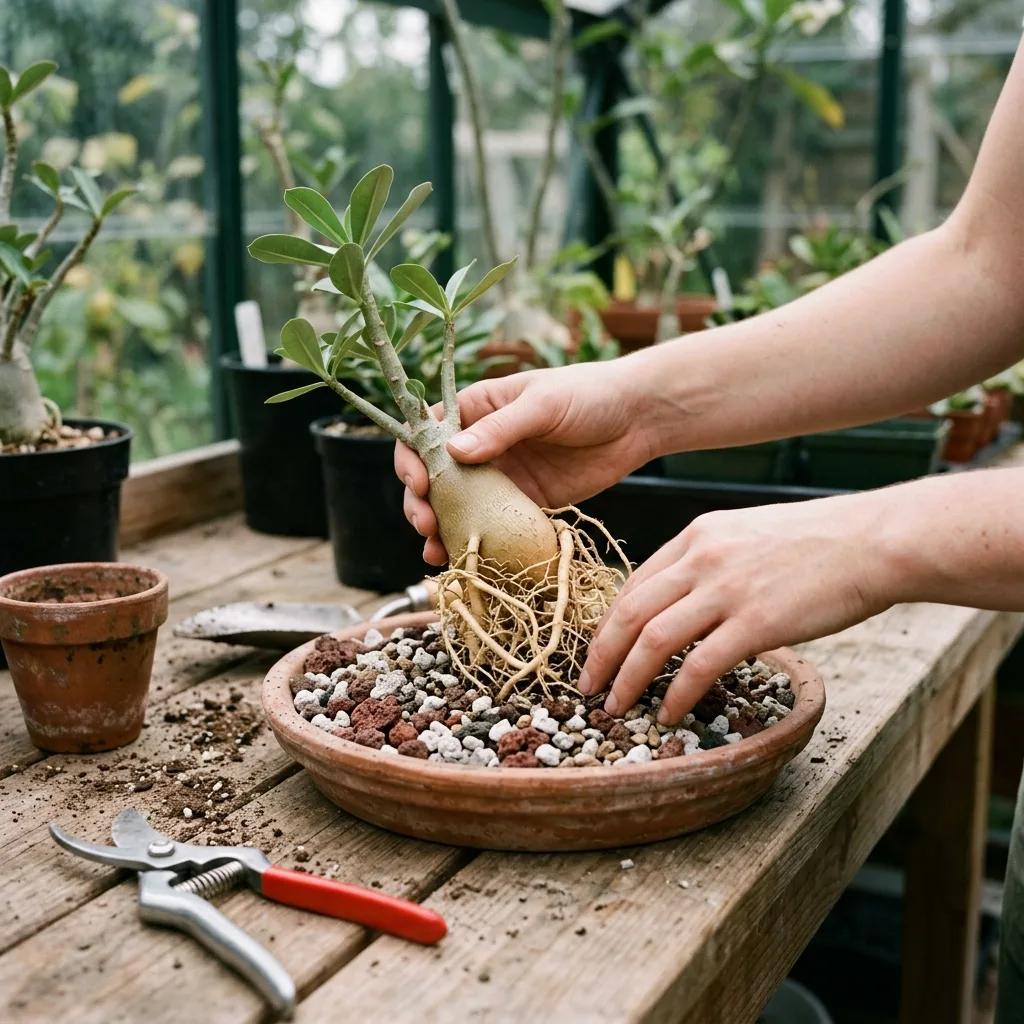
Regarding containers, favor broad, shallow bonsai-style bowls over deep pots, accommodating the natural horizontal sprawl of the root architecture. Unfinished terracotta remains the gold standard, as its porous clay walls allow moisture evaporation from all sides, dramatically slashing root rot hazards. Always verify that multiple functional drainage holes are present.
5. Step-by-Step Propagation Methods
Cultivators propagate Adenium obesum via two primary avenues: sexual reproduction through seed or vegetative propagation via stem cuttings. Take note: that iconic, voluptuously swollen caudex emerges almost exclusively in seed-grown plants. While stem cuttings root and bloom readily, they generally develop slender, upright trunks rather than classic swollen bases.
- Growing from Seed: Pre-soak fresh seeds in lukewarm water for 3 to 4 hours. Lay them horizontally across a pre-moistened seed flat consisting of 60% perlite and 40% sterile coco peat, dusting them under a shallow 0.5 cm layer of mix. Maintained at 25-30°C (77-86°F) inside a high-humidity mini-propagator, viable seeds germinate within 7 to 14 days.
- Stem Cuttings: In mid-spring during active vegetative push, sever a 10-15 cm semi-woody branch using a sterile blade. Rinse away the weeping latex and let the cutting rest in an airy, shaded nook for 4 to 7 days to form a firm callus over the wound. Insert the callused cutting into a moist pumice-perlite medium and maintain in bright, warm conditions until new adventitious roots anchor.
6. Common Pests, Pathologies, and Interventions
While structurally robust, Adenium obesum exhibits vulnerability under incorrect environmental parameters:
- Root and Caudex Rot: Opportunistic fungal pathogens induced by overwatering or dense media. Early symptoms include soft spots on the caudex alongside yellowing, dropping foliage. Unpot immediately, excise every trace of blackened tissue with a flame-sterilized scalpel until clean, healthy white flesh is visible, dust cuts with sulfur or cinnamon powder, air-cure for 7 days bare-root, and replant into completely dry, gritty mineral mix.
- Spider Mites (Tetranychidae): Thriving in dry, warm indoor atmospheres, these microscopic arachnids cast delicate silk webbing across leaf axils and produce silvery-yellow stippling. Treat foliage comprehensively with cold-pressed neem oil or horticultural insecticidal soap solutions once weekly for three weeks.
- Mealybugs (Pseudococcidae): These cottony sap-feeders settle into hidden growing tips and unopened flower bracts. Spot-eradicate individual colonies using a cotton swab saturated in 70% isopropyl alcohol; severe infestations necessitate systemic insecticidal drenches during active spring growth.
7. Seasonal Care Calendar and Master Protocols
- Spring (Awakening): As temperatures reliably climb past 18°C (64°F), gradually step up watering intervals. Apply a low-nitrogen, high-phosphorus/potassium balanced succulent fertilizer (such as NPK 10-20-20) diluted to quarter strength once monthly. This season offers the prime window for pruning and repotting.
- Summer (Peak Flowering & Vegetative Drive): Maximize sun exposure by moving specimens outdoors. Water thoroughly each time the potting mix dries out completely. Feed every two weeks with a specialized bloom-boosting liquid fertilizer to fuel continuous floral flushes.
- Autumn (Acclimatization): As daylight wanes and evening temperatures decline, withdraw all fertilizers entirely and widen watering intervals. When night temperatures approach 12-13°C (54-55°F), move outdoor containers inside to bright winter spots.
- Winter (Dormancy): Partial or total leaf defoliation during winter is normal. Overwinter specimens above 12-15°C (54-59°F) on bright, sunny windowsills. Withhold moisture until the caudex displays a subtle softening, applying only sparse hydration to prevent deep tissue shriveling.


Reader Reviews & Comments 3 Reviews
Eleanor Vance
Marcus Sterling
Julian Thorne
Leave a Review & Rating
Share your plant care tips, experiences, or questions with our succulent community.