






A breathtaking saga of survival bridging the windswept rocky foothills of East Asia to the weathered clay tiles of ancient temples: Orostachys iwarenge, universally cherished as the 'Chinese Dunce Cap'. This extraordinary representative of the Crassulaceae family steals the spotlight in any succulent collection with its symmetrically sculpted, miniature rosettes washed in silvery-blue and its dramatic autumn spikes that ascend like pointed spires. Naturally adapted to the unforgiving mountain climates of Japan, Korea, and Eastern China, this botanical marvel plays by fundamentally different rules than your pampered indoor houseplants.
Frequently searched by newcomers intrigued by its comical name, this unique plant derives its moniker from its elongated flower spike that mimics a pointed wizard's hat or vintage dunce cap. Yet behind this charming silhouette lies one of the botanical world's most poignant biological farewells. Keeping this living sculpture flourishing on your windowsill or in an alpine rockery begins with understanding its montane origins, physiological adaptations, and breathtaking life cycle.
1. Botanical Profile and Morphological Characteristics
Orostachys iwarenge is an offset-producing, stoloniferous succulent belonging to the Crassulaceae family with a monocarpic life cycle (flowering only once per individual rosette before setting seed and expiring). In its natural habitat, it colonizes volcanic fissures, rocky talus slopes, gravelly riverbanks, and old tiled rooftops across Japan and the Korean Peninsula. Its Japanese name, 'Iwarenge', translates literally to 'rock lotus'—an evocative descriptor of its capacity to anchor into nearly soil-less, hostile lithic environments.
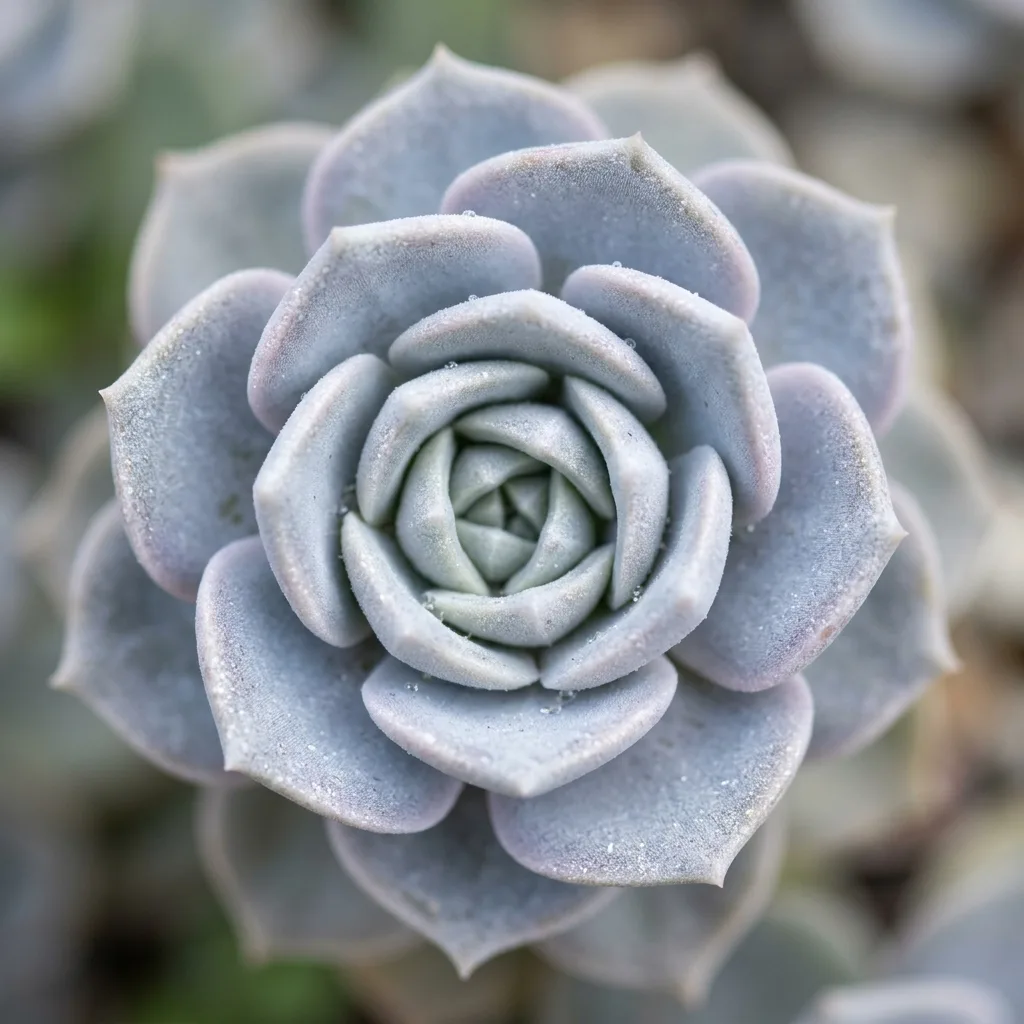
During its vegetative phase, the plant develops compact, circular rosettes measuring 3 to 8 cm in diameter. The leaves are thick and fleshy, spatulate with subtly pointed tips, and flushed in an arresting chalky blue-lavender tone. What makes this species genuinely exceptional is its prolific stolon mechanism: thin, cord-like runners radiate outwards from the central mother plant, each bearing an offset clone at its tip to forge a protective, crowded colony. Come late summer and autumn, the mature mother rosette elongates vertically, metamorphosing into a dramatic 15-25 cm conical tower densely packed with hundreds of tiny, star-shaped, pale yellow to creamy-white blossoms.
2. Sunlight Requirements and Indoor Positioning
Having evolved on high-altitude, unshaded mountain ledges, Orostachys demands substantial light intensity (lux) for optimal photosynthetic efficiency and architectural compactness. To fuel its CAM (Crassulacean Acid Metabolism) pathway and unveil those sought-after lilac and blush-pink stress margins, the plant necessitates at least 6 hours of direct, unfiltered sunlight each day.
In deficient lighting, the plant rapidly succumbs to etiolation—stretching weakly towards the light source. The tightly woven rosette structure loosens, foliage shifts to a dull, watery green, and individual leaves reflex downward. Beginners often mistake this unhealthy elongation for premature flowering. Indoors, place your pot directly on an airy south- or west-facing windowsill. If an outdoor balcony, porch, or patio is available, maintaining your plant outdoors from mid-spring through autumn will substantially amplify stem vigor, farina density, and compact geometry.
3. Watering Protocol: The 'Soak and Dry' Method
The cardinal sin in succulent cultivation is adhering to rigid calendar-based watering schedules and dispensing timid surface spritzes. Frequent light misting does not show love; it suffocates and rots roots while leaving core tissues dehydrated. Orostachys iwarenge exhibits remarkable drought resilience thanks to the water stored in its spongy leaf parenchyma, but it has absolute zero tolerance for stagnant water lingering around its root zone.
The gold standard is the strict 'soak and dry' method. Water the substrate thoroughly until moisture escapes freely through the drainage holes at the bottom of the pot, but only after confirming the medium has dried out completely to the absolute base (verify this by plunging a dry wooden skewer down to the bottom; it must emerge bone-dry). Never allow the pot to sit in a water-filled drainage saucer—discard excess runoff immediately. During the deep winter dormancy period, watering must be suspended almost entirely.
4. Substrate Composition and Pot Selection
The root system of an Orostachys is an obligate oxygen lover; its root xylem requires substantial macro-pore spaces between mineral aggregates to breathe. Conventional peat-heavy houseplant potting mixes are death traps for this species, retaining moisture like a saturated sponge and turning root systems into black mush within weeks.
Ungrooved, unglazed terracotta pots are the premier choice, as their porous clay walls facilitate bilateral evaporation and root aeration. Choose wide, shallow saucer or bowl-shaped planters over deep containers. Orostachys maintains a fibrous, shallow root structure rather than a deep taproot, and wide vessels provide ample surface territory for the stolon-borne daughter offsets to root and form a dense carpet.
| Substrate Component | Ratio (%) | Horticultural Function |
|---|---|---|
| Pumice (2-4 mm) | 40% | Maximizes continuous air channels and protects roots from compaction. |
| Lava Rock / Zeolite | 25% | Supplies structural drainage and slow-release micronutrients. |
| Coarse Horticultural Sand / Quartz | 15% | Replicates natural high-altitude talus and prevents medium clumping. |
| Screened Cactus Peat or Coco Coir | 20% | Provides a lean organic base for controlled, steady nutrient uptake. |
5. Step-by-Step Propagation Techniques
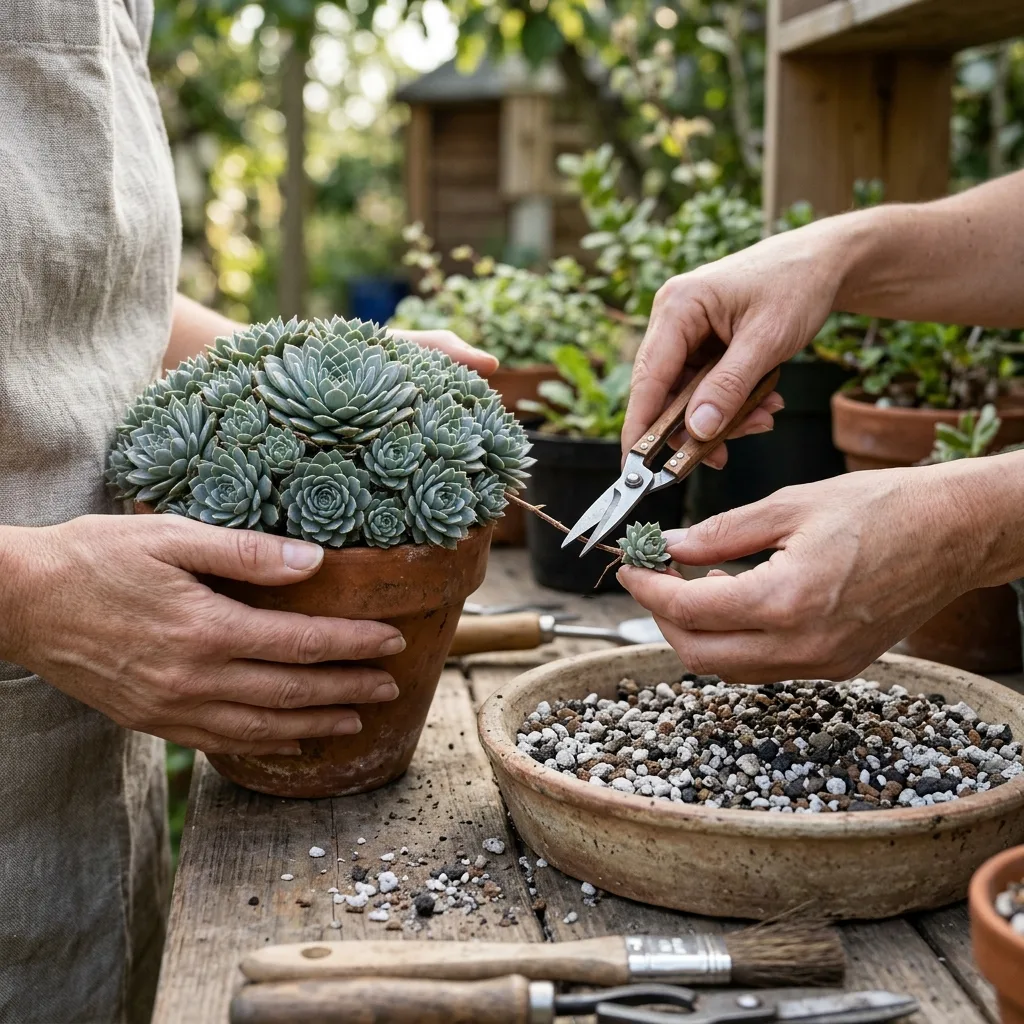
Because Orostachys species are monocarpic, the mother rosette naturally dies back after flowering. While this may sound alarming to beginners, nature balances the loss with an extraordinarily generous reproduction strategy: a single rosette produces dozens of vigorous stolon pups before completing its cycle. Follow these steps to harvest and root them effortlessly:
- Ideal Timing: The optimal propagation window is late spring to early summer when rosettes enter their active growth surge. Ensure offsets measure at least 1-1.5 cm across.
- Severing Stolons: Using a sterilized razor blade or precision pruners, snip the slender connective runner cord close to the parent stem.
- Callus Formation: Avoid planting freshly cut offsets directly into moist soil. Rest them in a dry, bright spot out of direct sun with good airflow for 24 to 48 hours until the severed cut dries and forms a firm callus tissue, sealing out fungal spores.
- Placement on Dry Substrate: Gently set the calloused offsets onto the surface of a dry, highly mineral-based soil mix. Do not bury the rosettes; their undersides simply need intimate surface contact.
- Root Initiation: Keep the substrate dry for the first 7 to 10 days. Afterwards, apply light, targeted moisture around the perimeter. Within 2 to 3 weeks, fine pinkish-white adventitious roots will anchor firmly into the grit.
6. Common Pests, Pathogens, and Treatments
The most persistent pest plaguing Orostachys is the mealybug (Pseudococcidae). These sap-sucking insects wedge themselves deep into the tightly layered leaf axils and beneath trailing stolons, draining sap and weakening tissue. At the first sign of cottony white masses, immediately douse a fine cotton swab in 70% isopropyl alcohol and remove them mechanically, following up with a localized cold-pressed neem oil emulsion or systemic horticultural insecticide.
The second major threat is root rot induced by waterlogged conditions (commonly Phytophthora). Symptoms manifest when lower leaves become squishy, translucent, and turn a sickly yellow or black. Unpot the plant immediately, amputate every trace of blackened, necrotic root, slice away compromised stem tissues using a sterile blade, let the healthy apical crown dry for several days, and re-root it afresh in sterile, highly porous mineral grit.
7. Seasonal Care Calendar and Professional Tips
Spring (Waking Phase): As temperatures climb in March and April, winter-dormant rosettes uncurl and turn lush. Progressively resume watering. Apply a half-strength, low-nitrogen, high-potassium succulent fertilizer once a month.
Summer (Active Colony Expansion): Growth and offset production peak during early summer. Water deeply whenever the pot is completely dry, but provide light afternoon shade during extreme, scorching heatwaves to prevent tissue stress.
Autumn (The Floral Swan Song): The central spires ascend and bloom. The gradual decline of the blooming rosettes is purely natural; channel your energy into encouraging the surrounding daughter offsets to establish independent root systems.
Winter (Dormancy and Cold Hardiness): Orostachys boasts astonishing frost tolerance, surviving outdoor drops down to -15°C to -20°C (5°F to -4°F) without flinching! In late autumn, the plant desiccates its outermost leaves, retracting tightly into a rock-hard, shriveled brownish ball resembling a tiny pinecone. This is not death—it is an impenetrable survival shield. Keep dormant plants completely dry in a sheltered outdoor spot throughout the cold months.


Reader Reviews & Comments 4 Reviews
Eleanor Vance
Julianne Reed
Marcus Thornton
David Miller
Leave a Review & Rating
Share your plant care tips, experiences, or questions with our succulent community.