






In the rain-shadowed wilderness of South Africa's Succulent Karoo and Namaqualand ecosystems, nature crafts miniature living sculptures nestled among shimmering white quartz stones and wind-polished rock outcroppings. A resilient and distinctive representative of the Aizoaceae (ice plant or mesemb) family, Antimima ventricosa—popularly celebrated among collectors as the Fat-Leaf Mesemb—derives its species epithet from the Latin ventricosus, meaning 'swollen' or 'pot-bellied'. This distinct morphological trait highlights nature's pure genius in drought adaptation and water storage. At first glance, it evokes the quiet stillness of an ancient rock formation, shrinking slightly and slipping into suspended animation during scorching droughts, only to awaken with shimmering magenta-pink, daisy-like blossoms whenever the rightful seasonal rains arrive.
Welcoming this rare desert marvel into the microclimate of our living spaces or temperate conservatories requires a deep appreciation for its evolutionary heritage. Nurturing an Antimima ventricosa means honoring the high oxygen levels demanded by its root hairs, the microscopic water reservoirs embedded within its waxy cuticular mantle, and its Crassulacean Acid Metabolism (CAM) photosynthetic rhythm. Within this master guide, we have assembled every horticultural nuance you need: from bespoke gritty substrate formulations and disciplined watering protocols to decoding foliar wrinkles and respecting its delicate dormancy calendar.
1. Botanical Identity and Morphological Characteristics
Antimima ventricosa (L.Bolus) H.E.K.Hartmann was historically classified within the broader genus Ruschia. However, groundbreaking comparative studies of its capsule anatomy, locule structures, and distinct branching architecture led botanists to establish its rightful place within the independent genus Antimima. The generic name stems from the Greek term for 'imitator' or 'mimic', reflecting how these remarkable plants visually echo characteristics found across both Ruschia and select dwarf forms of Argyroderma.
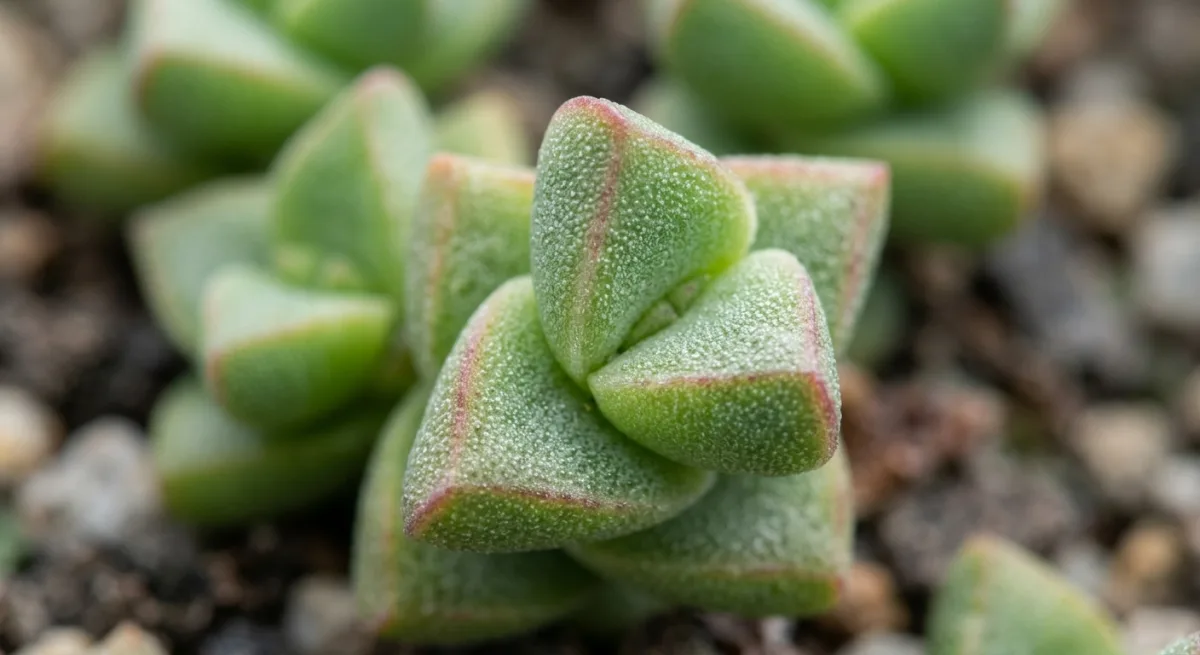
Structurally, this succulent develops as a dwarf, semi-woody perennial subshrub branching profusely from its woody base, generally reaching a modest height of 10 to 15 cm (4 to 6 inches). Its most captivating feature is its paired leaves, which are partially fused (connate) at the base. These leaves display a distinctly swollen, triangular, keeled contour dressed in serene hues of powdery blue-gray to glaucous muted green. When subjected to intense sun exposure and moisture stress, their margins develop dramatic purplish-crimson flushes. Microscopically, the epidermal layer is armored with a thick, waxy cuticle designed to halt transpiration, protecting vast arrays of internal spongy water-storage parenchyma cells.
Flowering typically commences from late winter through mid-spring. Elevated on short terminal pedicels, solitary daisy-like blossoms spanning 1.5 to 2 cm (0.6 to 0.8 inches) across emerge with vibrant magenta, violet, or soft pink petals encircling a prominent central cluster of creamy-yellow stamens. True to their desert lineage, these blooms open wide during peak midday sunshine and gracefully fold shut as the cool twilight descends.
2. Light Requirements and Indoor Positioning
Having evolved under the fierce, unfiltered irradiance of the Karoo desert skies, Antimima ventricosa possesses an uncompromising demand for direct light to sustain cellular photosynthetic efficiency and maintain its tight, compact architecture. A bare minimum of 5 to 6 hours of direct, unfiltered sunlight daily is essential to prevent unsightly stretching (etiolation) and to preserve its hallmark plump, chubby leaf profiles.
For indoor cultivation, the gold standard location is an unobstructed south- or southwest-facing windowsill. In light-deprived environments, the plant rapidly loses its silvery-blue glaucous bloom, the leaves elongate abnormally, and the stems weaken, struggling to support their own mass. However, during the height of summer, intense midday sun intensified behind enclosed window panes can generate extreme greenhouse heat; without adequate ambient air movement, this can cause thermal leaf burn. Ensuring steady, fresh ventilation and gentle air circulation around your plant is paramount.
3. Watering Discipline: The 'Soak and Dry' Protocol
The single most catastrophic mistake in mesemb cultivation is 'sipping'—administering tiny drops of water on a frequent, shallow schedule. For Antimima ventricosa, hydration must faithfully replicate the rare, drenching cloudbursts of its natural habitat. The legendary 'Soak and Dry' method is the definitive standard: saturate the pot thoroughly until water flows freely from the bottom drainage holes, and then strictly withhold all water until the potting substrate has dried out completely from top to bottom.
To accurately gauge moisture levels, insert a slender wooden skewer down to the bottom of the root ball; it must emerge completely clean and dry before you even consider re-watering. Furthermore, watch the plant itself: a subtle loss of turgor pressure accompanied by faint horizontal wrinkles on the lowest pair of leaves is the plant's natural visual signal that its internal xylem vessels are ready for hydration.
4. Ideal Substrate Formulation and Pot Selection
The fibrous roots of Antimima ventricosa will quickly suffocate and perish in standard peat-heavy houseplant soils or dense garden loam. Its delicate root hairs require oxygen-rich microscopic air pockets nestled between mineral particles. Therefore, your growing medium must contain at least 75% to 80% coarse, porous, inorganic aggregates.
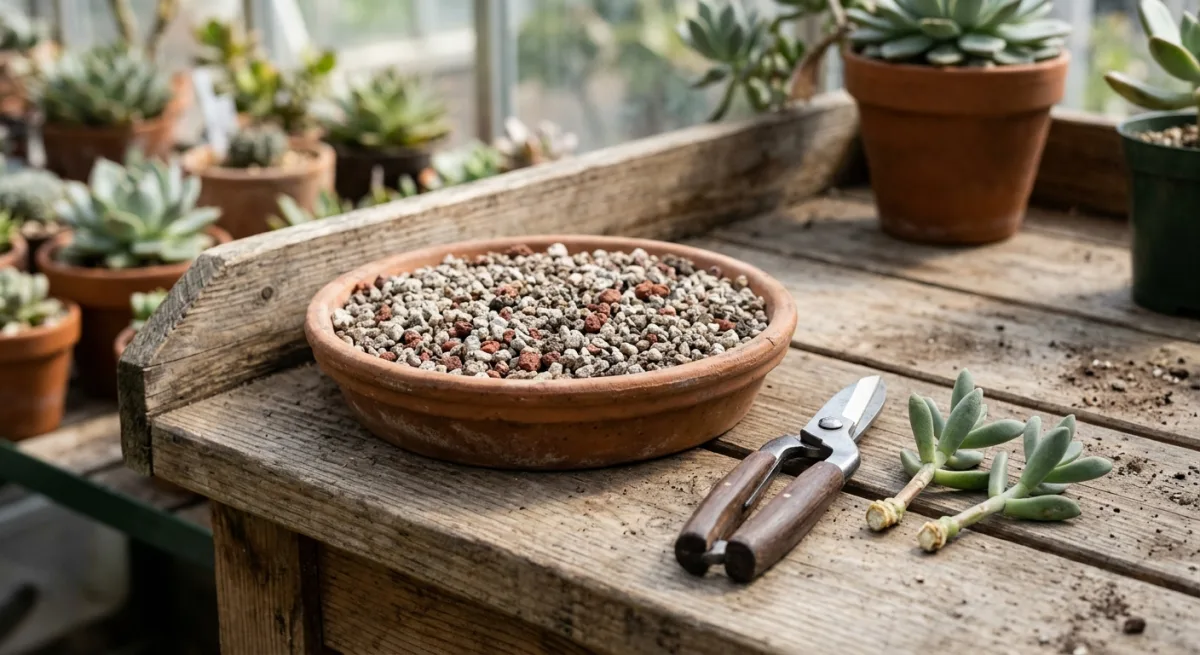
When selecting containers, unglazed terracotta pots are universally superior. The porous earthenware walls allow moisture to evaporate laterally through transpiration, promoting rapid dry-down cycles while keeping the root zone pleasantly cool. Generous drainage holes at the container base are non-negotiable; solid decorative pots lacking drainage are an absolute death sentence for this species.
| Component | Proportion (%) | Horticultural Function |
|---|---|---|
| Horticultural Pumice (3–5 mm) | 40% | Provides structural drainage, high aeration, and porous air channels |
| Crushed Lava Rock (Scoria) & Zeolite | 30% | Supplies trace minerals, structural weight, and high cation exchange capacity (CEC) |
| Coarse Quartz Grit / Diatomite | 10% | Prevents water pooling around the sensitive root collar; mimics natural scree |
| Low-Peat Cactus Mix or Pure Coco Coir | 20% | Supplies minimal organic nutrient retention and micro-element buffer |
5. Step-by-Step Propagation Techniques
Antimima ventricosa can be propagated via two primary routes: semi-hardwood stem cuttings and seed germination. Note that individual mesemb leaves cannot regenerate into a new plant on their own; propagating material must include viable stem tissue containing active nodes.
Stem Cutting Propagation (The Most Reliable Method):
- Timing: The ideal window to take cuttings coincides with the plant's active vegetative flush in early autumn or early spring.
- The Cut: Using a sterilized, surgical-grade scalpel or razor, excise a healthy 4 to 6 cm (1.5 to 2.5 inch) semi-hardwood lateral branch featuring at least 2 to 3 healthy leaf pairs.
- Callusing: Never plant freshly severed cuttings directly into moist soil. Lay them on a sterile, dry paper towel in a bright, shaded, warm area with good air circulation for 3 to 5 days. Allowing the cut wound to form a tough suberized callus reduces pathogen invasion by up to 90%.
- Potting: Insert the callused end 1 to 2 cm deep into the gritty mineral substrate described above, securing it firmly upright.
- Establishment: Keep the cutting in bright, indirect light away from harsh direct sun for the first 7 to 10 days without water. From day 10 onward, apply light, bottom-up misting or a modest sprinkle around the base. A robust secondary root system will form within 3 to 4 weeks.
6. Common Pests, Diseases, and Clinical Remedies
While inherently rugged and exceptionally resilient against environmental stress, Antimima ventricosa can stumble when subjected to overwatering, stagnant air, or inadequate light.
- Stem and Root Rot (Fusarium / Phytophthora): Manifests as waterlogged, translucent foliage turning pale yellow, followed by a soft, blackened collapse of the lower stem collar. Root cause: organic, soggy substrate and chronic overwatering. Remedy: Immediately unpot the plant, excise every trace of discolored, mushy tissue with a sterile blade, dust wounds with sulfur or systemic fungicide, and re-root healthy top shoots as fresh cuttings.
- Mealybugs (Pseudococcidae): Look for small, cottony white clusters nestled deeply inside leaf axils and beneath the root crown. These sap-suckers deplete cellular fluids and stunt growth. Remedy: Manually douse pests with a cotton swab dipped in 70% isopropyl alcohol. For extensive infestations, apply cold-pressed horticultural neem oil (in low-light conditions) or a targeted systemic insecticide.
- Spider Mites (Tetranychidae): Thrive in dry, warm indoor environments, leaving behind faint, silvery-bronze stippling across the leaf surfaces and fine microscopic webbing in stem crevices. Remedy: Boost room ventilation and treat thoroughly with an organic miticide or insecticidal soap.
7. Seasonal Care Calendar & Expert Growing Tips
Mastering the seasonal heartbeat of winter-rainfall desert regions is the golden key to keeping this miniature shrub thriving for decades:
- Autumn (Revitalization Period): As ambient temperatures settle into the comfortable 20–25°C (68–77°F) range, the plant naturally breaks dormancy. Resume structured 'soak and dry' watering. This is the optimal window to feed once with a balanced, low-nitrogen, high-potassium succulent fertilizer diluted to 25% strength.
- Winter (Active Growth & Blooming): Protect completely from freezing temperatures (maintain a safe minimum of 5°C / 41°F). Place the pot in your sunniest indoor location. Water only on warm, sunny mornings when the soil is completely bone dry. Flower buds will swell and burst open during this phase.
- Spring (Post-Bloom & Resource Storage): As blossoms fade, seed capsules may develop. Continue mindful watering matched to rapid substrate drying times. Early spring is the premier window if your plant needs repotting.
- Summer (Aestivation / Deep Dormancy): Once daytime highs surpass 30°C (86°F), dramatically curtail your watering routine. Move the plant to an airy spot with bright, gently filtered light to prevent tissue scorch. Provide just a minimal splash of water along the pot perimeter on a cool evening once a month to keep the root framework alive.


Reader Reviews & Comments 4 Reviews
Julian Vance
Clara Higgins
Marcus Sterling
Sophie Bennett
Leave a Review & Rating
Share your plant care tips, experiences, or questions with our succulent community.