






Perched upon the sheer limestone crags of northern Peru's Marañón River valley, where cloud forest mists intermingle with the arid microclimates of deep canyon beds, Matucana madisoniorum stands out as one of the most mesmerizing paradoxes in the succulent and cacti world. At first glance, it might evoke the rugged spirit of a desert warrior; yet closer inspection reveals an epidermis coated in a matte, slate-grey, velvet-like texture, accentuated by delicate, curved spines that gracefully shed as the plant matures, giving it the sculpted presence of a fine porcelain artifact. Widely known among collectors as the 'Madison Cactus' or affectionately referred to as the 'Sea Urchin Cactus' due to its spineless, globular adult form, this Peruvian endemic transports the untamed breezes of the Andes right into our living spaces.
Unlike typical desert-dwelling cacti, the Madison Cactus did not evolve to endure scorching sand dunes or prolonged, bone-dry droughts. Instead, its heartbeat aligns with the cool morning vapours of river canyons, buffered sunlight, and hyper-aerated root zones. Tucked tightly inside rock crevices in habitat, it shields itself from harsh vertical solar radiation—a delicate equilibrium it expects us to recreate at home. When you provide the right ambient conditions on a bright windowsill, it rewards your devotion with extraordinary, asymmetrical crimson floral tubes emerging directly from its crown.
1. Botanical Identity and Morphological Characteristics
Classified under the subfamily Cactoideae within the Cactaceae family, Matucana madisoniorum (often treated under botanical synonyms such as Submatucana madisoniorum or Borzicactus madisoniorum) is a dwarf, slow-growing cactus endemic to a narrow ecological niche in the Amazonas Region of Peru. In its juvenile stage, it forms a flattened, solitary globe that gently elongates with maturity into a subglobose or short columnar cylinder, rarely exceeding 15 cm in height and 10 cm in diameter. Its body is organized into 10 to 12 broad, low ribs that are seamlessly divided into rounded, flattened tubercles.
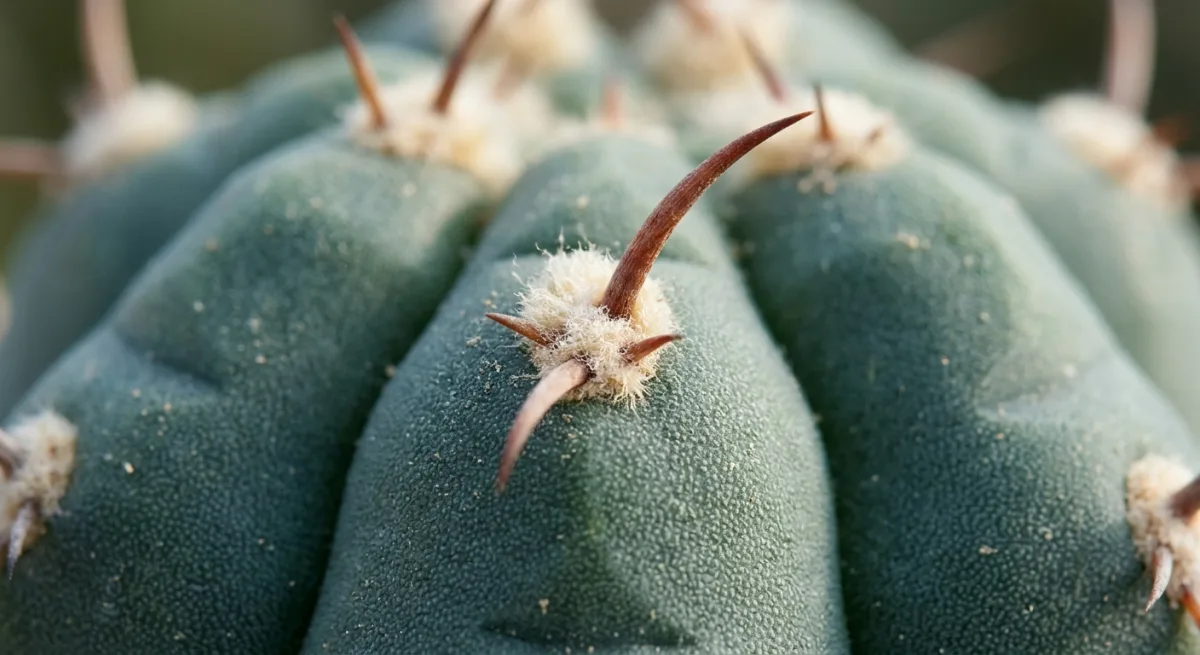
The most fascinating morphological hallmark of this species lies in its dynamic spine development. Young specimens emerge with 1 to 5 dark, curved, semi-flexible spines protruding from each woolly areole. However, as the stem expands into full maturity, these spines weaken structurally, become brittle, and naturally cast off. Consequently, mature collectors' specimens showcase an almost entirely 'naked' or sparsely spined surface of astonishing tactile beauty. The microscopic micro-papillate texture of its epidermis imparts a powdery, glaucous bluish-green to slate-grey hue—an evolutionary adaptation designed to reflect excess solar radiation while retaining cellular moisture.
Its floral biology represents the pinnacle of specialized co-evolution. Sprouting in midsummer from the areoles surrounding the apex, the flowers develop along an elongated floral tube measuring 8 to 10 cm in length. Crucially, these blossoms are not actinomorphic (radially symmetrical) like those of most traditional desert cacti; instead, they are conspicuously zygomorphic (bilaterally symmetrical), specifically tailored for bird pollination (ornithophily). These fiery scarlet to bright orange-red petals flare diagonally, offering an ergonomic landing and feeding runway engineered expressly for Andean hummingbirds.
2. Light Requirements and Optimal Indoor Placement
Emerging from vertical canyon clefts, Matucana madisoniorum cannot withstand relentless, scorching midday sun like open-desert species. In nature, it prospers in the partial shade cast by monolithic limestone boulders or sparse scrub vegetation, enjoying bright but diffused illumination. When brought indoors, managing its light exposure requires nuanced understanding.
The quintessential placement is an East or Southeast-facing windowsill, where it basks in 4 to 5 hours of gentle, direct morning sun followed by luminous indirect light throughout the afternoon. If placed near an intense South-facing window, you should diffuse direct rays between 11:00 AM and 4:00 PM during peak summer using a sheer linen curtain. Excessive direct heat will scorch its velvety, blue-grey epidermis, leaving irreversible yellowish-brown necrotic patches. Conversely, chronic low light triggers severe etiolation, causing the symmetrical globe to narrow awkwardly into a weak, tapered cone and lose its hallmark architectural geometry.
3. Watering Discipline: The 'Soak and Dry' Protocol
One of the most persistent fallacies in succulent care is that drought-tolerant plants should be sustained on meager, frequent dribbles of water, or alternatively, entirely neglected. Frequent surface misting or sporadic dribbling suffocates root hairs by maintaining constant moisture without ever deeply rehydrating cellular vacuoles. Because Matucana madisoniorum possesses delicate, fibrous root cortices with small air channels, sitting in damp substrate will swiftly collapse its root system.
The golden rule for this Andean native is the classic 'Soak and Dry' method:
- Active Vegetative Season (Spring to Summer): Only when the potting medium has dried out completely from top to bottom, saturate the pot thoroughly until water flows freely from the bottom drainage holes. Always empty the collection tray after 15 minutes; never permit the pot to sit in stagnant runoff. Validate soil dryness not merely by surface appearance, but by inserting a clean wooden skewer deep into the root ball.
- Dormant Rest Period (Late Autumn to Winter): When ambient temperatures fall to 12–15°C (54–59°F), the plant's metabolic activity slows down. Cease regular watering entirely. To prevent the ribs from collapsing or shriveling severely in dry indoor heating, provide only a modest hydration around the base on a bright, mild morning once a month.
4. Ideal Substrate Formulation and Pot Selection
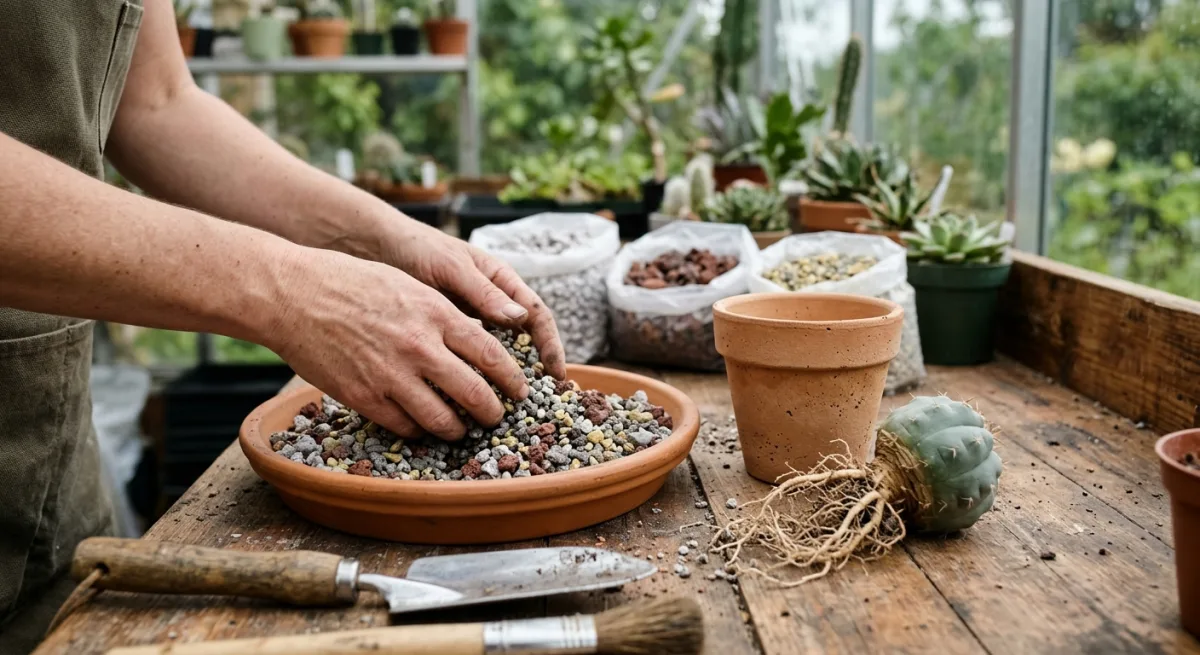
The fibrous roots of Matucana madisoniorum cannot survive in heavy, peat-rich commercial potting mixes. Recreating the porous, mineral-heavy, and rapidly aerating composition of its native Andean limestone crevices is non-negotiable. Excess water must drain within seconds, allowing fresh atmospheric oxygen to re-enter the root zone within hours of irrigation.
Regarding container choice, unglazed terracotta pots are far superior to plastic, resin, or glazed ceramic containers. The microporous terracotta walls permit moisture evaporation from all sides, effectively preventing moisture pockets from forming around the core root ball. Select a pot that is only 2 to 3 cm wider than the diameter of the cactus body. Overly deep or oversized pots harbor an unseen reservoir of wet soil at the bottom, which rapidly triggers basal stem rot and collar rot.
| Substrate Component | Ratio (%) | Grain Size | Botanical Function |
|---|---|---|---|
| Pumice | 40% | 3–6 mm | Maximizes internal macropores and guarantees continuous root aeration. |
| Crushed Lava Rock (Scoria) | 25% | 2–5 mm | Supplies trace minerals, structural stability, and ideal drainage pathways. |
| Zeolite (Clinoptilolite) | 15% | 2–4 mm | Increases Cation Exchange Capacity (CEC) and slowly buffers nutrient release. |
| Sieved Fibrous Peat / Coarse Cactus Soil | 15% | Fine fibrous | Retains minimal structural moisture and anchors microscopic root hairs. |
| Coarse River Sand / Horticultural Quartz | 5% | 1–2 mm | Prevents compaction of micropores and smooths hydraulic flow. |
When potting or repotting, top-dressing the crown and collar zone with pure coarse pumice or scoria ensures that the delicate lower epidermis never rests in direct contact with damp soil particles, reducing rot risks to near zero.
5. Step-by-Step Propagation Techniques
Matucana madisoniorum grows primarily as a solitary individual; only on rare occasions will an aging specimen produce basal offsets. Consequently, propagation by seed is the primary, most reliable route for horticulturists, though offset division remains an excellent method when offsets do appear.
Method A: Propagation from Seed (The Golden Standard)
- Seedbed Preparation: Blend an equal-part mixture of sieved pumice, coarse perlite, and fine cactus soil. Sterilize this medium thoroughly using steam or a microwave to eliminate opportunistic 'damping-off' fungal spores.
- Sowing: In mid-spring, scatter the minute seeds evenly across the pre-moistened surface. Do not cover them with soil; the seeds are photoblastic and require light to trigger germination.
- Humidity and Warmth: Seal the germination tray with a clear dome or transparent plastic wrap to maintain relative humidity between 80% and 90%. Keep ambient temperatures consistent between 22°C and 26°C (72–79°F).
- Germination and Acclimation: Tiny green spheres will emerge within 10 to 20 days. Once sprouted, gradually vent the cover to introduce airflow and prevent fungal stagnant humidity, keeping the delicate seedlings away from harsh, direct sunlight.
Method B: Basal Offset Division
When basal pups achieve a minimum diameter of 2 to 3 cm, carefully sever them from the parent plant using a sharp, flame- or alcohol-sterilized scalpel. Dust the cut surfaces with sulfur powder or cinnamon to stave off microbial pathogens, and place the offsets in a dry, ventilated, shaded area for 7 to 10 full days until a firm, woody callus forms. Plant the callused pup into dry, mineral-based pumice mix, delaying initial watering for at least 10 days to encourage proactive root seeking.
6. Common Pests, Pathologies, and Curative Protocols
Because of its velvety, soft epidermis, the Madison Cactus is more susceptible to insect infestations and chemical phytotoxicity than heavy-armored, thick-cuticle desert species.
- Mealybugs (Pseudococcidae): These cottony pests hide deep within woolly areoles and around the apical crown. Treat minor sightings immediately with a cotton swab dipped in 70% isopropyl alcohol. For widespread outbreaks, apply a targeted systemic insecticide (such as Acetamiprid) or dilute cold-pressed neem oil during dusk hours to prevent foliage burn.
- Root Mealybugs (Rhizoecus): These insidious pests colonize subterranean root networks, coating root hairs in powdery white wax and stunting vitality. If top growth freezes and the epidermis looks lackluster, unpot the plant, thoroughly wash away the soil substrate, submerge the roots in a diluted insecticidal bath, and replant in fresh, sterile medium.
- Basal and Stem Rot (Phytophthora & Fusarium): Typically caused by cold, saturated substrates. If the stem base turns discolored and spongy, act quickly: cleanly excise the damaged tissue with a sterile blade until only crisp, healthy green vascular tissue remains. Allow the healthy top portion to thoroughly callus over before attempting to re-root it in dry pumice.
7. Seasonal Maintenance Calendar and Expert Schedule
To preserve your specimen's structural health and enjoy a cascade of striking scarlet blooms each summer, synchronize your care with its seasonal biological clock:
- Spring (March – May): Waking from winter dormancy. As indoor ambient temperatures consistently rise above 16°C (61°F), incrementally resume watering. In mid-spring, incorporate a low-nitrogen, high-potassium liquid cactus fertilizer diluted to 1/4 strength into every second watering.
- Summer (June – August): Peak growth and floral display. Water thoroughly whenever the pot substrate dries completely. Provide morning sunlight, but shield the plant from harsh midday sun. Keep the plant in a fixed orientation once floral buds appear.
- Autumn (September – November): Gradual slowdown. Cease all fertilization by October. Taper watering intervals down to once every 2 to 3 weeks, prompting the plant to concentrate its cellular sap and harden its tissues ahead of chilly winter drafts.
- Winter (December – February): Deep physiological dormancy. Relocate your plant to a cool, luminous location hovering between 10°C and 14°C (50–57°F). Protect strictly against frost (never allow temperatures to dip below 5°C / 41°F). Water sparingly—just enough once a month to prevent ribs from deflating irreversibly.


Reader Reviews & Comments 4 Reviews
Marcus Sterling
Clara Higgins
Julian Vance
Sophia Bennett
Leave a Review & Rating
Share your plant care tips, experiences, or questions with our succulent community.