






Tucked into misty mountain slopes and anchored within limestone crevices across South Africa, Senecio oxyriifolius is celebrated by collectors worldwide as the 'False Rose' succulent or 'Shield-Leaf Senecio'. The juvenile leaves budding at the apical meristem of its shoots overlap tightly to mimic the delicate petals of an unfurling rosebud, earning this fascinating botanical wonder its poetic common name. Operating in nature as both a creeping groundcover and a scandent, semi-climbing geophyte, it brings a sense of living, architectural sculpture to any bright indoor collection.
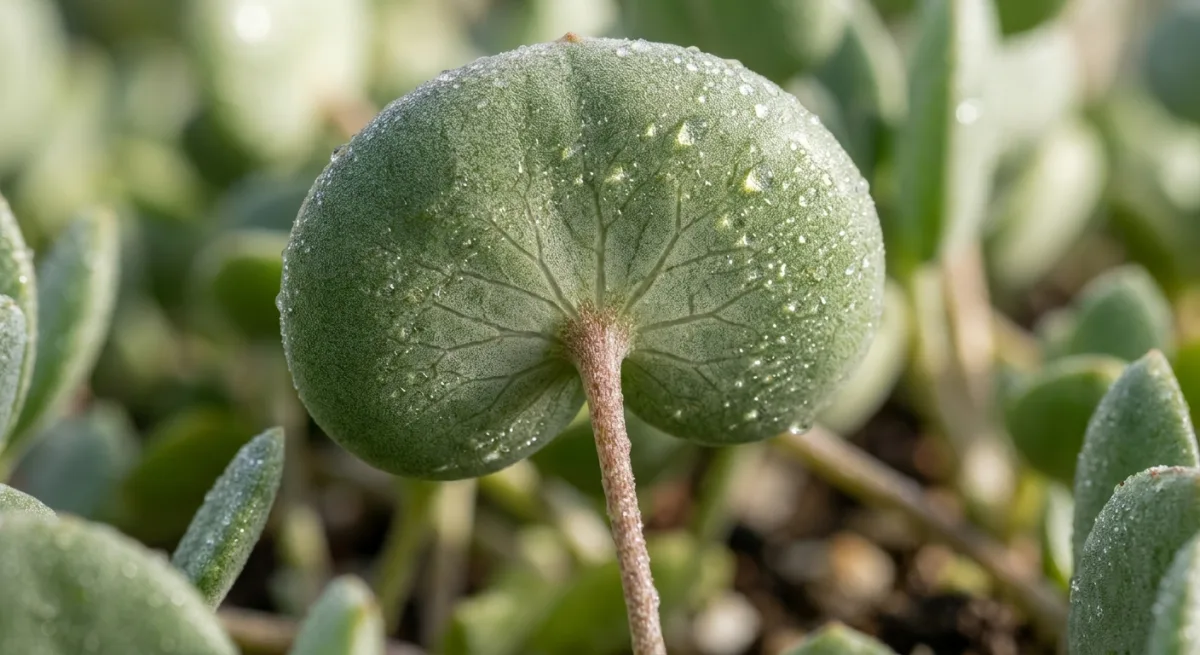
Horticulturists and casual enthusiasts alike are often captivated by the plant's succulent foliage and its distinctive 'peltate' morphology—a botanical trait where the petiole attaches near the center of the leaf's underside rather than its margin. As a distinctive gem within the Asteraceae (daisy) family, this underappreciated succulent provides a welcome, cascading alternative to standard symmetrical rosettes. Let us take an in-depth, scientifically grounded journey into its natural physiology, unlocking the exact care protocol required to keep it thriving for decades.
1. Botanical Identity and Morphological Characteristics
Classified in modern taxonomic revisions by many botanists as Curio oxyriifolius, Senecio oxyriifolius is an evergreen, tuberous perennial succulent adapted to prolonged seasons of drought. The plant's defining morphological hallmark is its peltate foliage: smooth, shield-shaped, succulent leaves whose supporting petioles fuse directly into the lower central blade. These blades are packed with specialized water-storing parenchyma tissue, wrapped in a protective, translucent epicuticular wax layer (farina) that minimizes transpirational moisture loss.
During its vegetative growth phase, young shoots clasp together tightly at the tips, creating an optical illusion that perfectly mimics a garden rose. As stems mature, they elongate into trailing or climbing vines that drape gracefully over pot rims or cascading rockeries. In late winter and early spring, slender pedunculated inflorescences rise above the foliage, culminating in delicate, composite discoid flowers of pale yellow or cream that punctuate its wild botanical charm.
2. Light Requirements and Indoor Positioning
In its native habitat, Senecio oxyriifolius flourishes in bright, dappled sunlight cast through rocky ledges and companion scrub. Direct, scorching midday sun can blister its fleshy tissues; therefore, gentle yet potent illumination is the goal. Providing at least 4 to 6 hours of bright, filtered morning or late-afternoon sunlight maintains dense internodes, robust leaf plumpness, and a compact 'rose' formation. In dark or poorly lit settings, the plant rapidly undergoes etiolation—stretching out into weak, leggy stems with wide nodal spacing and losing its floral aesthetic entirely.
Indoors, position your specimen directly beside east- or southeast-facing windows sheltered by sheer curtains. If placed near an intense south- or west-facing exposure during the height of summer, pull the container back 3 to 5 feet (1 to 1.5 meters) from the glass to prevent photo-oxidative stress and chlorotic burn lesions.
3. Watering Discipline: The 'Soak and Dry' Method
Frequent, shallow sips of water are an invitation to root suffocation. The golden standard for Senecio oxyriifolius is the disciplined 'Soak and Dry' protocol. Before reaching for your watering can, insert a wooden moisture probe or your finger deep into the substrate all the way to the bottom third of the container. If you detect any residual coolness or dampness, withhold water entirely.
When moisture reserves are completely depleted, saturate the substrate thoroughly until water streams freely from the base drainage holes. Always empty any runoff collected in the saucer within 15 minutes. As temperatures drop and daylight wanes during late autumn and winter, the plant's metabolic activity slows; hydration intervals should be spaced out dramatically, providing moisture only when the mature leaves show subtle cellular turgor loss and faint superficial wrinkling.
4. Ideal Soil Mix and Pot Selection
The root system of this species demands rapid gravitational drainage and substantial macroporosity. Standard peat-based potting soils are lethal over time because they retain excessive moisture and compact around delicate root hairs, inviting fungal pathogens such as Pythium and Phytophthora. A gritty, mineral-dominant substrate is non-negotiable.
| Substrate Component | Ratio (%) | Horticultural Function & Botanical Benefit |
|---|---|---|
| Horticultural Pumice (3–5 mm) | 35% | Creates stable macro-pores, ensuring immediate drainage and constant oxygenation. |
| Lava Rock (Scoria) / Zeolite | 25% | Provides mineral ion-buffering, structural porosity, and suppresses fungal stagnation. |
| Coarse Quartz Sand or Perlite | 15% | Maximizes internal flow velocity and halts soil compaction. |
| Fine Horticultural Coco Coir | 15% | Forms an airy, fibrous organic base that provides gentle mechanical anchorage for roots. |
| Worm Castings or Aged Compost | 10% | Supplies gentle, slow-release bio-available micronutrients and beneficial microbes. |
When selecting a planter, opt exclusively for unglazed terracotta or porous ceramic pots with large drainage holes. The micro-porous clay walls facilitate continuous lateral evaporation of water vapor, drastically cutting dry-down intervals and insulating fragile root tips from moisture pockets.
5. Step-by-Step Propagation Techniques
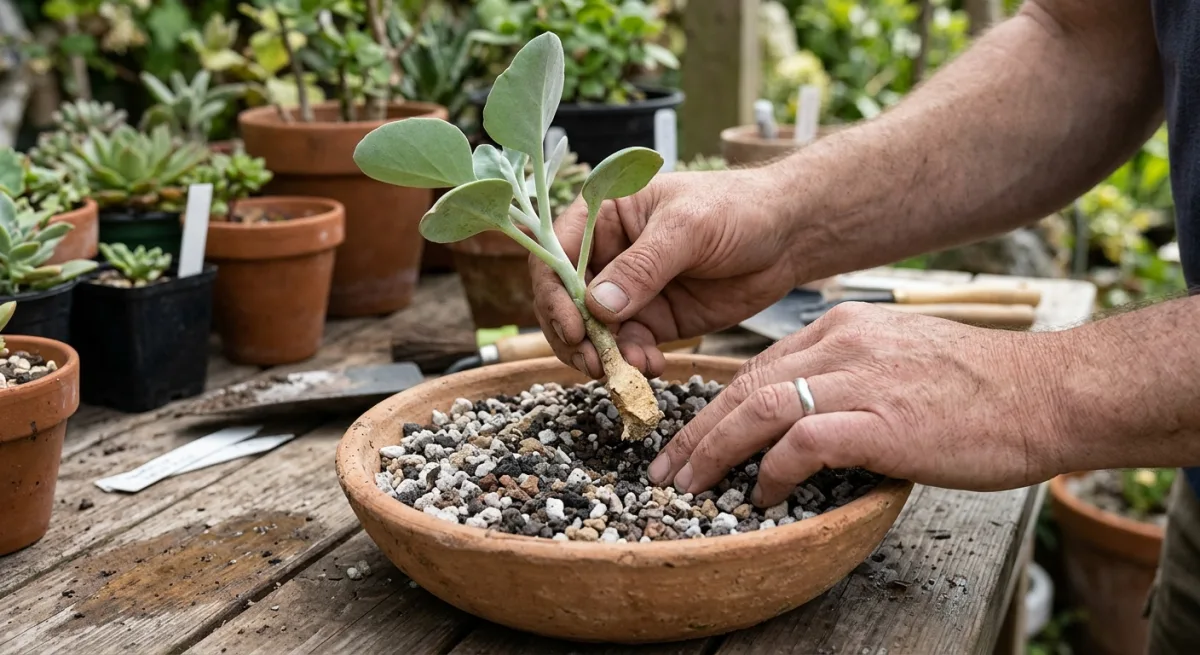
Propagating Senecio oxyriifolius is an immensely rewarding process with a remarkably high success rate when utilizing stem cuttings:
- Select a Healthy Stem: Using a sterilized, razor-sharp scalpel or micro-snips, excise a vigorous shoot containing at least 3 to 4 well-developed nodes and plump foliage, cutting just beneath a node.
- Allow the Callus to Form: Resist the urge to pot the cutting immediately. Place it on a clean, dry paper towel in a warm, shaded room for 48 to 72 hours. This drying period allows the severed vascular bundles to seal and form a protective suberin callus, thwarting bacterial ingress.
- Plant into Dry Mineral Mix: Insert the callused stem roughly 1 inch (2–3 cm) deep into completely dry, gritty mineral substrate.
- Initiate Hydration: Wait 5 to 7 days before introducing the very first light hydration, giving newly initiated root primordia time to emerge. Keep the container in a warm, sheltered location with bright, indirect light; vigorous structural roots will anchor within 3 to 4 weeks.
6. Common Pests, Diseases, and Troubleshooting
Your succulent communicates its physiological condition through distinct foliar signals:
- Mealybugs (Pseudococcidae): These sap-sucking pests congregate in the sheltered axils where petioles join the main stems, forming tiny, cotton-like masses. Treat immediately by spot-eradicating individuals using a cotton swab dipped in 70% isopropyl alcohol, followed by a targeted application of cold-pressed horticultural neem oil at dusk.
- Translucent, Dropping Leaves: A clear indicator of systemic overwatering and subterranean root rot. Unpot the plant immediately, excise all blackened or mushy root matter with sterile shears, dust the remaining healthy root zone with activated charcoal powder, and repot into entirely fresh, bone-dry mineral grit.
- Deflated, Shriveled Foliage: The plant has consumed its cellular moisture vacuoles. If the roots are firm and pale, the plant simply needs a thorough soak. If the substrate is wet yet the leaves are shriveled, the root system has failed, preventing water uptake.
7. Seasonal Care Calendar and Horticultural Guidelines
Spring (Active Growth Phase): As ambient temperatures stabilize above 60°F (15°C), growth surges. Administer a balanced, urea-free cactus and succulent liquid fertilizer diluted to quarter-strength once monthly. Spring is the premier window for repotting and crown divisions.
Summer (Heat Regulation & Estivation): During heatwaves exceeding 90°F (32°C), growth often pauses as the plant enters a protective semi-dormant state. Cease all fertilization during this period and restrict watering strictly to cool twilight hours.
Autumn (Hardening Off): Gradually taper watering intervals as photoperiods shorten. For plants grown outdoors on patios, transition them indoors well before ambient night temperatures drop below 50°F (10°C).
Winter (Rest & Vernalization): House your specimen in a cool, bright space maintained between 50°F and 59°F (10°C–15°C). This gentle chill is essential to stimulate the vernalization process that triggers spring floral development. Water sparingly—often no more than once a month.


Reader Reviews & Comments 3 Reviews
Eleanor Vance
Marcus Sterling
Claire Redman
Leave a Review & Rating
Share your plant care tips, experiences, or questions with our succulent community.