






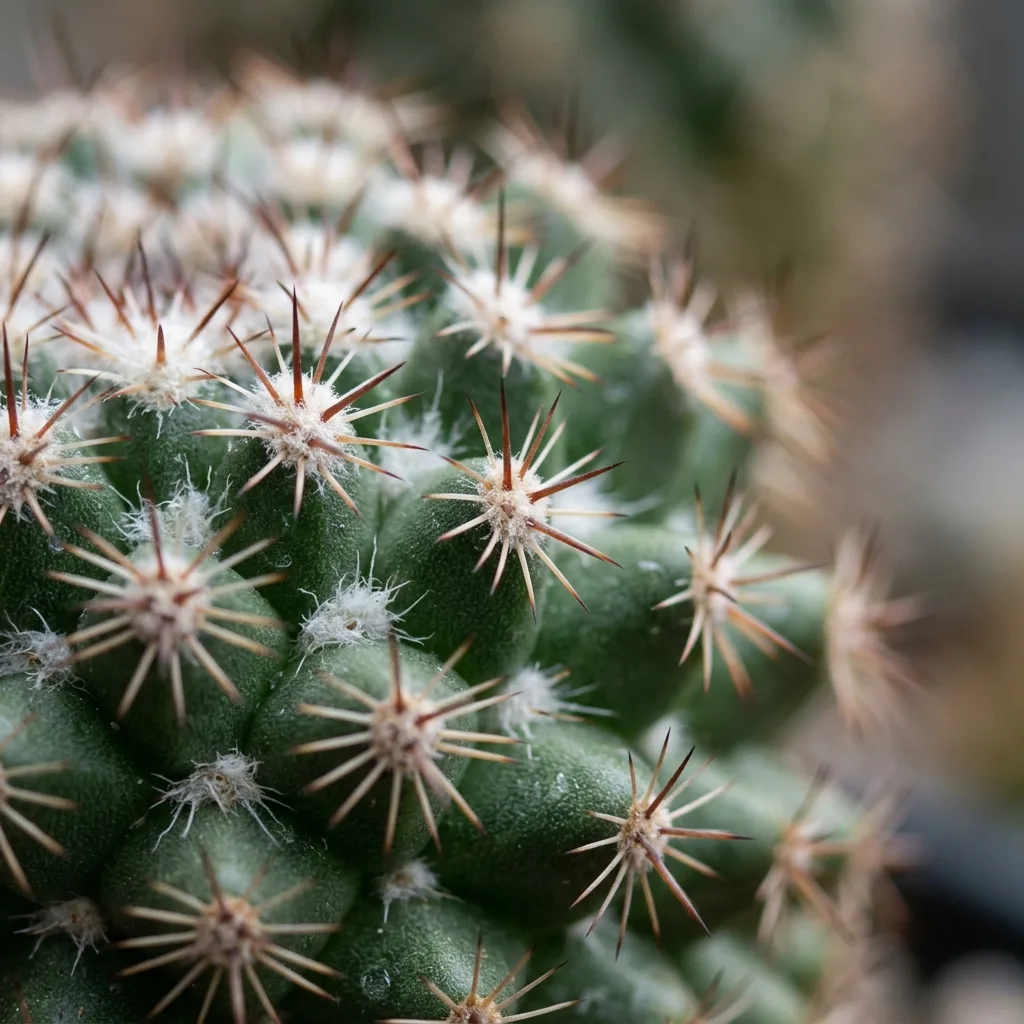
Across the unforgiving expanses stretching from the sun-bleached Chihuahuan Desert to the frost-sculpted plains of southern Canada, a miniature marvel thrives tucked inside rock fissures: Escobaria. While its dense web of interlaced radial spines and compact globular stem initially appear distinct from soft, fleshy succulents, its specialized parenchyma water-storage architecture and nocturnal Crassulacean Acid Metabolism (CAM) make it one of the most treasured collector gems in the succulent and cactus world. Welcoming this survivor into your indoor or outdoor sanctuary means inviting the untamed spirit of the North American steppes directly to your windowsill.
Taxonomic Identity & Morphological Wonders
Named in honor of the 19th-century Mexican botanists Rómulo and Numa Escobar, the genus Escobaria occupies a fascinating phylogenetic bridge within the family Cactaceae, closely related to Coryphantha and Mammillaria. Unlike Mammillaria, where flowers typically emerge from axils between tubercles, Escobaria produces blooms from distinct grooves or adjacent zones along mature tubercles. In natural habitats, species such as Escobaria vivipara (the beehive cactus) and Escobaria missouriensis face punishing environments where thermal swings can drop well below -15°C (5°F) in winter and soar past 40°C (104°F) in peak summer.
To withstand such intense ecological pressure, the plant relies on several critical evolutionary adaptations:
- Dense Interlaced Spination: The tightly clustered radial spines serve as an organic shade net, reducing solar radiation and leaf-surface heat while deflecting freezing winds and retaining a micro-layer of boundary humidity.
- Deep Tubercles with Apical Wool: Instead of continuous ribs, the stem is divided into distinct tubercles (podaria) that can contract inward like an accordion during extreme drought, shrinking the plant's surface area.
- Cellular Dehydration Strategy: In autumn, as daylight drops and temperatures chill, Escobaria evacuates a significant percentage of water from its cellular vacuoles, superconcentrating internal sugars and mucilage to act as natural cryoprotectants against intracellular freezing.
Substrate Physics: The Non-Negotiable Mineral Blend
If you take away just one core rule from our greenhouse mentors at Sukulentler.com, let it be this: organic peat is the natural enemy of Escobaria. In habitat, these plants root into disintegrated limestone gravel, decomposed granite, and gypsum crevices with almost zero decomposing organic matter. A soil mix that holds dampness around the root collar for more than 48 hours will inevitably trigger basal rot.
Always incorporate a top dressing of pure crushed quartz, granite, or limestone chips. This layer keeps the delicate stem neck dry, anchors the globular plant body, and prevents splashing soil from staining the pristine spination.
Light Architecture & Photoperiod Requirements
Escobaria craves intense, unfiltered light. Inadequate illumination causes rapid, irreversible etiolation, stretching the perfectly spherical or low-clustering stems into weak, elongated cones with sparse spination.
| Setting | Light Level | Seasonal Management |
|---|---|---|
| Outdoor Rock Garden / Balcony | Direct full sunlight (6–8+ hours) | Gradual spring acclimation prevents thermal shock and epidermal scorch. |
| South-Facing Window | Maximum unobstructed sunlight | Rotate every two weeks to maintain symmetrical, radial growth. |
| Indoor Grow Lights | PPFD of 350–500 µmol/m²/s | Run full-spectrum LEDs for 14 hours during active summer growth; reduce to 9 hours in winter. |
Hydration Cycles: The 'Soak & Dry' Method with a Cold Twist
Watering an Escobaria requires synchronizing with the plant's seasonal biological clock. Because it operates on CAM photosynthesis, opening stomata exclusively under the cover of night to absorb CO₂, watering in the late afternoon or early evening during warm months matches its natural metabolic cycle best.
- Active Spring & Summer: Water deeply until liquid streams from the bottom drainage holes, then wait until the entire root zone has turned bone dry before drenching again. Depending on ambient heat and airflow, this typically translates to once every 10 to 14 days.
- Midsummer Latency: In scorching climates exceeding 38°C (100°F), some Escobaria species enter a semi-dormant heat pause. Taper watering slightly during extreme heat waves to avoid boiling wet roots.
- Autumn Shrinking Phase: Gradually reduce watering frequency starting in late September. Allow the stems to wrinkle and draw closer to the soil surface.
- Absolute Winter Dryness: From November until early March, withhold water completely if keeping the plant in a cool or cold environment. A dry Escobaria can easily survive deep freezing temperatures; a wet Escobaria will perish at the first light frost.

Repotting and Propagation
Escobaria possesses a fragile, taproot-like or fibrous subterranean system that resents excessive mechanical disturbance. Repot only every 3 to 4 years in early spring as new spine clusters begin emerging from the crown.
Select unglazed terracotta or breathable stoneware pots with ample drainage holes. Terracotta accelerates substrate evaporation through its porous walls, providing an essential safety margin against overwatering. Always wait 7 to 10 days post-repotting before introducing the first drop of water, allowing any microscopic root abrasions to callus over completely.
Propagation can be achieved through offsets (pups) produced by clumping species like Escobaria sneedii or through seed. Sow seeds on sterilized mineral grit at 21–24°C (70–75°F) under sealed humidity domes, gradually airing them out once germination occurs.


Reader Reviews & Comments 3 Reviews
Julian Vance
Marcus Sterling
Clara Hensley
Leave a Review & Rating
Share your plant care tips, experiences, or questions with our succulent community.